Malaysia Swine Feed Market Size, Share & Growth Rate
The Malaysia Swine Feed Market was estimated at USD 483 Million in 2025 and is projected to reach USD 633 Million by 2032, growing at a CAGR of 3.9% from 2026 to 2032. This growth trajectory is underpinned by rising pork consumption, driven by population increases and evolving dietary preferences. Additionally, advancements in feed efficiency and a focus on animal health are pivotal in enhancing the market's performance.
Malaysia Swine Feed Market Year-wise Growth Rate and Key Drivers
This graph highlights how the Malaysia Swine Feed Market has steadily grown over the years, supported by major growth factors.
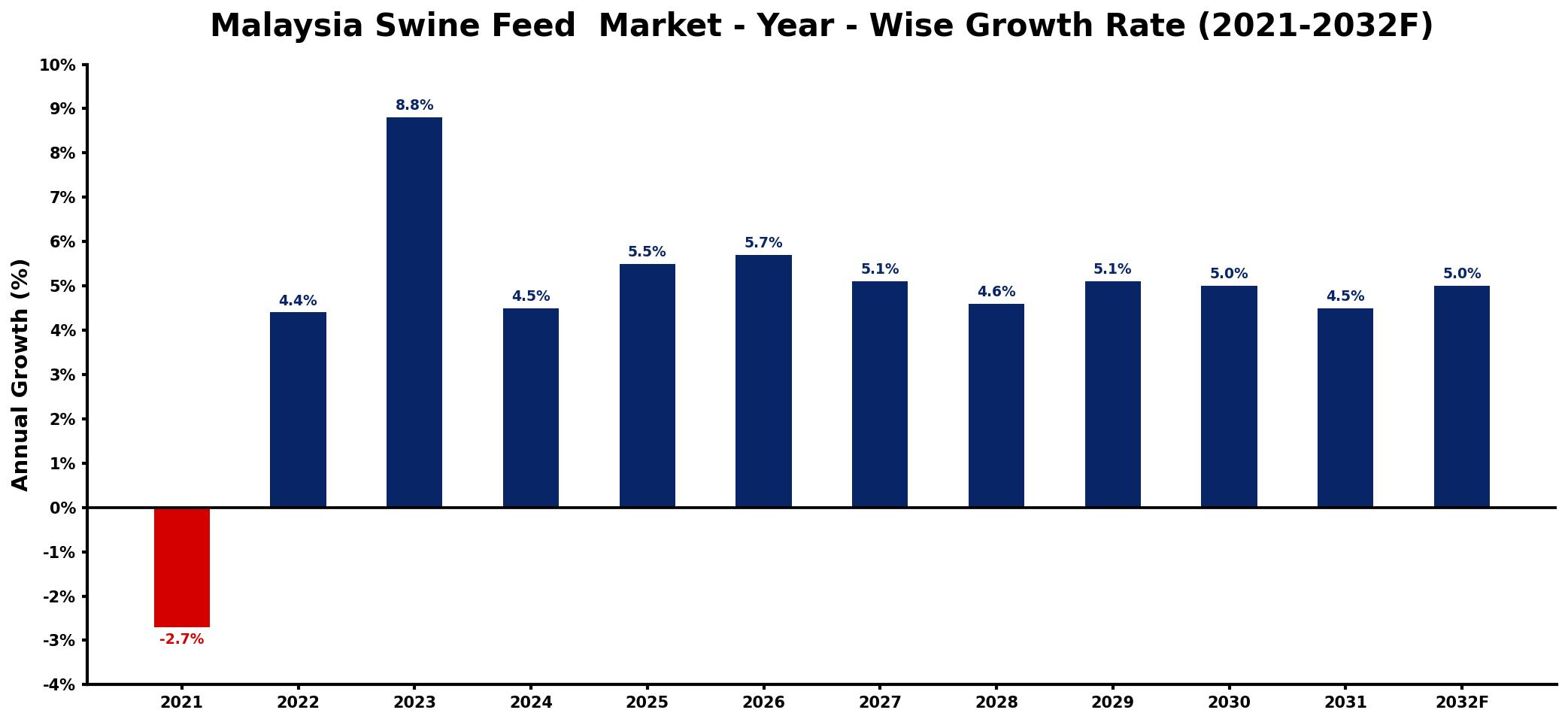
The table below presents the year‑wise growth rates along with the key drivers influencing the market
| Year | Growth Rate | Major Drivers |
| 2021 | -2.7% | decrease in livestock production |
| 2022 | 4.4% | rising consumer protein demand |
| 2023 | 8.8% | expansion of farming technologies |
| 2024 | 4.5% | increased livestock health awareness |
| 2025 | 5.5% | growing export market opportunities |
| 2026 | 5.7% | advancements in animal nutrition |
| 2027 | 5.1% | increased investment in agriculture |
| 2028 | 4.6% | rising popularity of sustainable practices |
| 2029 | 5.1% | enhanced supply chain efficiencies |
| 2030 | 5.0% | growing urban population demands |
| 2031 | 4.5% | rising procurement volume requirements |
| 2032 | 5.0% | increased focus on animal welfare |
Note: Market size estimations and growth projections presented in this report are based on 6Wresearch's proprietary forecasting methodology, utilizing the latest available industry data, government publications, and primary research inputs.
Malaysia Swine Feed Market Synopsis
The swine feed sector in Malaysia is a critical component of the countrys agriculture, significantly supporting the local pork production industry. With pork being a dietary staple, the demand for high-quality swine feed is essential to ensure livestock health and optimal production yields.
As the market continues to evolve, innovative feed formulations tailored to improve feed efficiency and manage diseases are being developed. Despite challenges such as fluctuating prices of raw materials, the sector's adaptability and focus on sustainability are driving growth.
Malaysia Swine Feed Market Key Takeaways
- The market is poised for steady growth due to increasing pork consumption and population dynamics.
- Innovations in feed formulations are enhancing efficiency and supporting animal health.
- Sustainability initiatives are becoming increasingly vital in feed production strategies.
- Government support and initiatives are fostering a more resilient agricultural sector.
- The recovery from COVID-19 disruptions is expected to accelerate growth in the coming years.
Evaluation of Restraints in Malaysia Swine Feed Market
Despite the positive outlook, the Malaysia Swine Feed Market encounters significant restraints that may limit its potential. Volatility in the prices of key feed ingredients creates uncertainty for producers, affecting profit margins and operational sustainability. Additionally, regulatory changes aimed at promoting food safety and animal health may impose additional compliance costs on manufacturers. Balancing these challenges with demand growth will require strategic adaptation by market players.
Malaysia Swine Feed Market Trends
Current trends in the Malaysia Swine Feed Market include a growing emphasis on sustainable sourcing of feed ingredients. This trend is driven by rising consumer awareness regarding food safety and animal welfare. Moreover, digital innovations in feed formulation and supply chain management are emerging, facilitating better monitoring of livestock health and enhancing overall operational efficiency. The integration of alternative protein sources is also gaining traction, presenting new avenues for feed production.
Malaysia Swine Feed Market Opportunities
Opportunities for growth within the Malaysia Swine Feed Market are abundant. The increasing demand for premium pork products opens doors for manufacturers to invest in high-value feed formulations. Additionally, collaboration with research institutions to develop nutritionally balanced feed can further enhance market offerings. Expanding into export markets presents a viable growth strategy, especially as regional pork consumption rises.
Government Initiatives in the Malaysia Swine Feed Market
The Malaysian government has initiated various programs aimed at bolstering the agricultural sector, including the swine feed market. These initiatives focus on enhancing productivity, ensuring food security, and promoting sustainable practices within the livestock industry. Investment in research and development, alongside policy support for farmers, is expected to create a more robust market environment conducive to growth.
Future Insights of the Malaysia Swine Feed Market
Looking ahead to the period from 2026 to 2032, the Malaysia Swine Feed Market is expected to witness significant changes. The continued adaptation of innovative feeding strategies, coupled with governmental support, will drive profitability in the sector. Furthermore, as consumers increasingly demand higher quality pork, feed manufacturers will likely focus on developing specialized products that address health and wellness trends, thereby reshaping the market landscape.
Malaysia Swine Feed Market Latest Developments (2025 - 2026)
Recent developments in the Malaysia Swine Feed Market indicate a shift towards greater sustainability in production practices. Companies are increasingly incorporating alternative ingredients to reduce reliance on traditional feed sources. Additionally, the market is seeing a rise in strategic partnerships aimed at enhancing research and development for innovative feed solutions. These collaborations are expected to accelerate advancements in feed efficiency and animal health management.
Malaysia Swine Feed Market - Key Attractiveness of the Report
- 10 Years of Market Numbers
- Historical Data Starting from 2022 to 2025
- Base Year: 2025
- Forecast Data until 2032
- Key Performance Indicators Impacting the Market
- Major Upcoming Developments and Projects
Key Highlights of the Report:
- Malaysia Swine Feed Market Outlook
- Market Size of Malaysia Swine Feed Market, 2025
- Forecast of Malaysia Swine Feed Market, 2032
- Historical Data and Forecast of Malaysia Swine Feed Revenues & Volume for the Period 2022-2032F
- Malaysia Swine Feed Market Trend Evolution
- Malaysia Swine Feed Market Drivers and Challenges
- Malaysia Swine Feed Price Trends
- Malaysia Swine Feed Porter's Five Forces
- Malaysia Swine Feed Industry Life Cycle
- Historical Data and Forecast of Malaysia Swine Feed Market Revenues & Volume By Product Type for the Period 2022-2032F
- Historical Data and Forecast of Malaysia Swine Feed Market Revenues & Volume By Grower for the Period 2022-2032F
- Historical Data and Forecast of Malaysia Swine Feed Market Revenues & Volume By Starter for the Period 2022-2032F
- Historical Data and Forecast of Malaysia Swine Feed Market Revenues & Volume By Sow for the Period 2022-2032F
- Historical Data and Forecast of Malaysia Swine Feed Market Revenues & Volume By Others for the Period 2022-2032F
- Historical Data and Forecast of Malaysia Swine Feed Market Revenues & Volume By Feed Essence for the Period 2022-2032F
- Historical Data and Forecast of Malaysia Swine Feed Market Revenues & Volume By Vitamins for the Period 2022-2032F
- Historical Data and Forecast of Malaysia Swine Feed Market Revenues & Volume By Antioxidants for the Period 2022-2032F
- Historical Data and Forecast of Malaysia Swine Feed Market Revenues & Volume By Feed Acidifiers for the Period 2022-2032F
- Historical Data and Forecast of Malaysia Swine Feed Market Revenues & Volume By Feed Enzymes for the Period 2022-2032F
- Historical Data and Forecast of Malaysia Swine Feed Market Revenues & Volume By Amino Acids for the Period 2022-2032F
- Historical Data and Forecast of Malaysia Swine Feed Market Revenues & Volume By Others for the Period 2022-2032F
- Historical Data and Forecast of Malaysia Swine Feed Market Revenues & Volume By Feed Additive Type for the Period 2022-2032F
- Historical Data and Forecast of Malaysia Swine Feed Market Revenues & Volume By Zootechnical Feed Additives for the Period 2022-2032F
- Historical Data and Forecast of Malaysia Swine Feed Market Revenues & Volume By Sensory Feed Additives for the Period 2022-2032F
- Historical Data and Forecast of Malaysia Swine Feed Market Revenues & Volume By Nutritional Feed Additives for the Period 2022-2032F
- Malaysia Swine Feed Import Export Trade Statistics
- Market Opportunity Assessment By Product Type
- Market Opportunity Assessment By Feed Essence
- Market Opportunity Assessment By Feed Additive Type
- Malaysia Swine Feed Top Companies Market Share
- Malaysia Swine Feed Competitive Benchmarking By Technical and Operational Parameters
- Malaysia Swine Feed Company Profiles
- Malaysia Swine Feed Key Strategic Recommendations






































