Malaysia Switchboards Market Summary
The malaysia switchboards market was estimated at USD 397 Million in 2025 and is projected to reach USD 519 Million by 2032, growing at a CAGR of 5.4% from 2026 to 2032.
Malaysia Switchboards Market Year-wise Growth Rate and Key Drivers
This graph highlights how the Malaysia Switchboards Market has steadily grown over the past five years, supported by major growth factors.
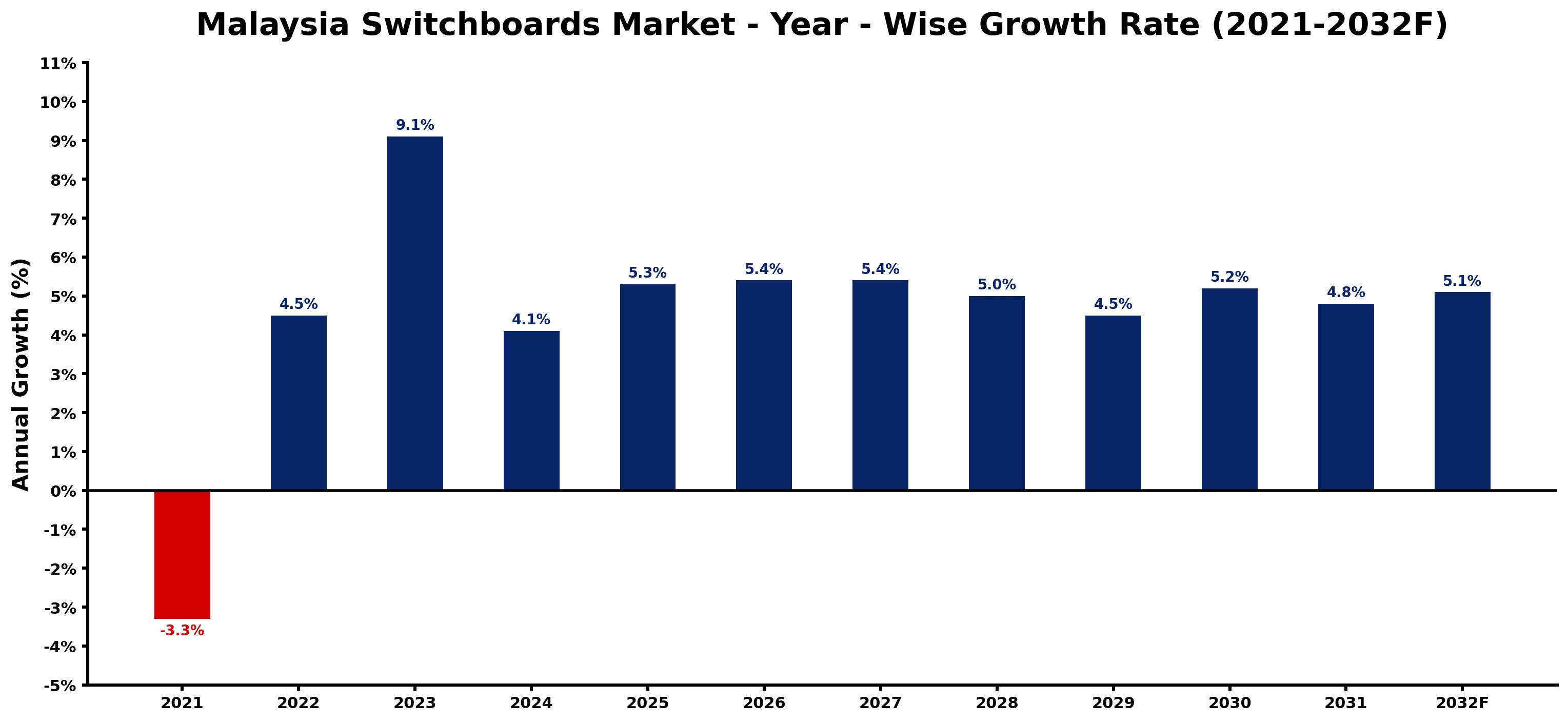
The table below presents the year wise growth rates along with the key drivers influencing the market
| Year | Growth Rate | Major Drivers |
| 2021 | -3.3% | Supply chain disruptions hindered timely project completions, leading to decreased demand for switchboard installations. |
| 2022 | 4.5% | Rural electrification initiatives create new opportunities for switchboard deployment. |
| 2023 | 9.1% | Shifts towards renewable energy sources lead to increased demand for advanced switchboards. |
| 2024 | 4.1% | Technological integration in smart homes necessitates modern switchboard systems. |
| 2025 | 5.3% | Local manufacturers enhance production capabilities to meet rising domestic needs. |
| 2026 | 5.4% | Urbanization trends increase the complexity of power distribution networks nationwide. |
| 2027 | 5.4% | Growing focus on energy efficiency drives innovation in switchboard design and functionality. |
| 2028 | 5.0% | Public-private partnerships facilitate investment in infrastructure upgrades across regions. |
| 2029 | 4.5% | Technological advancements propel the adoption of automated switchboard solutions. |
| 2030 | 5.2% | Increased urban density demands more robust energy management systems across cities. |
| 2031 | 4.8% | Sustainability mandates influence switchboard manufacturers to prioritize eco-friendly materials. |
| 2032 | 5.1% | Digital transformation in utilities requires seamless integration of switchboard technology. |
Note - Market size estimations and growth projections presented in this report are based on 6Wresearch's advanced forecasting approach, validated with industry datasets as of June 2026.
Malaysia Switchboards Market Synopsis
The Malaysia Switchboards Market is projected to reach 5.4% and witness significant growth during the forecast period (2026-2032). The anticipated growth trajectory is supported by an increasing demand for energy-efficient and resilient electrical switchboard systems across various industrial and commercial platforms in Malaysia. This demand is further accentuated by the country's rising power consumption, catalyzed by rapid population growth and urbanization, necessitating innovative electrical solutions in sectors such as automotive, IT/telecommunication, and healthcare. Furthermore, initiatives put forth by the government aimed at developing smart cities will likely spur further investments into energy-efficient switchboard systems, thus amplifying market growth over the coming years.
Malaysia Switchboards Market Growth Drivers
The growth of the Malaysia switchboards market is influenced by several key drivers:
- Increasing Energy Efficiency Demand: There is a marked shift towards adopting energy-efficient switchboard systems to comply with modern energy regulations and reduce operational costs.
- Urbanization Effects: Accelerated urban growth demands robust electrical infrastructure, with switchboards being integral to managing increased energy loads in urban settings.
- Industrial Expansion: As industries continue to grow, there is a heightened need for reliable switchboard solutions that can support complex electrical systems.
- Technological Advancements: The constant evolution in electrical technology promotes the integration of smarter switchboard systems, enhancing functionality and operational reliability.
- Government Commitments to Sustainable Development: Policies aimed at creating sustainable energy solutions incentivize businesses to adopt advanced switchboard technologies, thereby expanding market opportunities.
Malaysia Switchboards Market Challenges and Restraints
Despite the market's promising outlook, several challenges may hinder accelerated growth:
- High Installation Costs: The initial investment required for advanced switchboard systems can be prohibitive for smaller enterprises, leading to slower market penetration in certain segments.
- Lack of Skilled Workforce: A shortage of qualified technicians capable of installing and maintaining sophisticated switchboard systems can limit adoption.
- Market Fragmentation: The presence of various local and regional players may lead to inconsistent quality and standards, impacting overall market credibility.
- Regulatory Hurdles: Complex regulations surrounding the electrical sector can create barriers to entry for new companies and slow down project timelines.
- Preference for Conventional Systems: Some businesses may opt for traditional switchboard solutions due to familiarity, which can challenge the adoption of newer, energy-efficient alternatives.
Malaysia Switchboards Market Investment Opportunities
The Malaysia switchboards market presents various investment opportunities:
- Smart City Developments: Investments in smart city initiatives will likely lead to increased demand for advanced electrical infrastructure, including state-of-the-art switchboards.
- Renewable Energy Projects: As Malaysia transitions towards renewable energy sources, there will be a growing need for sophisticated switchboard systems capable of integrating with these technologies.
- Commercial Infrastructure Projects: The rise in construction of commercial buildings provides a significant market opportunity for switchboard manufacturers and suppliers.
- Upgrades to Existing Infrastructure: Many aging electrical systems are in need of upgrades, presenting an opportunity for switchboard providers to offer modern solutions.
- Export Potential: With growing demand across Southeast Asia, Malaysian switchboard manufacturers can explore export opportunities to neighboring countries.
Malaysia Switchboards Market Government Investment and Initiatives
The Malaysian government has undertaken several initiatives to bolster the switchboards market:
- Smart City Framework: The implementation of smart city frameworks encourages investments in advanced electrical systems, including switchboards, to create efficient urban spaces.
- National Energy Policy: Policies focusing on energy conservation and efficiency stimulate demand for modern switchboard applications that facilitate these objectives.
- Incentives for Renewable Integration: Government incentives for renewable energy projects create a favorable environment for the installation of switchboards that support these initiatives.
- Public Infrastructure Spending: Increased public spending on infrastructure projects provides a substantial market for electrical solutions, including switchboards, to improve public facilities.
- Training Programs: Government-supported training initiatives aim to build a skilled workforce capable of managing advanced electrical systems, directly benefitting the switchboards market.
Malaysia Switchboards Market Latest Developments (May 2025 - June 2026)
Recent developments in the Malaysia switchboards market indicate a shift towards more intelligent and integrated electrical solutions. Companies are increasingly focusing on research and development to create switchboards that offer enhanced performance and connectivity. The government has also announced several public projects emphasizing electrical infrastructure enhancements, further driving the demand for modern switchboard systems. Additionally, collaborations between technology firms and utilities have emerged, focusing on integrating smart technology into switchboard systems, which is expected to augment their functionality and user experience.
Malaysia Switchboards Market - Key Attractiveness of the Report
- 10 Years of Market Numbers
- Historical Data Starting from 2022 to 2025
- Base Year: 2025
- Forecast Data until 2032
- Key Performance Indicators Impacting the Market
- Major Upcoming Developments and Projects
Key Highlights of the Report:
- Malaysia Switchboards Market Outlook
- Market Size of Malaysia Switchboards Market, 2025
- Forecast of Malaysia Switchboards Market, 2032F
- Historical Data and Forecast of Malaysia Switchboards Revenues & Volume for the Period 2022-2032F
- Malaysia Switchboards Market Trend Evolution
- Malaysia Switchboards Market Drivers and Challenges
- Malaysia Switchboards Price Trends
- Malaysia Switchboards Porter's Five Forces
- Malaysia Switchboards Industry Life Cycle
- Historical Data and Forecast of Malaysia Switchboards Market Revenues & Volume By Type for the Period 2022-2032F
- Historical Data and Forecast of Malaysia Switchboards Market Revenues & Volume By Low-Voltage for the Period 2022-2032F
- Historical Data and Forecast of Malaysia Switchboards Market Revenues & Volume By Middle-Voltage for the Period 2022-2032F
- Historical Data and Forecast of Malaysia Switchboards Market Revenues & Volume By High-Voltage for the Period 2022-2032F
- Historical Data and Forecast of Malaysia Switchboards Market Revenues & Volume By End-users for the Period 2022-2032F
- Historical Data and Forecast of Malaysia Switchboards Market Revenues & Volume By Industrial for the Period 2022-2032F
- Historical Data and Forecast of Malaysia Switchboards Market Revenues & Volume By Residential for the Period 2022-2032F
- Historical Data and Forecast of Malaysia Switchboards Market Revenues & Volume By Commercial for the Period 2022-2032F
- Historical Data and Forecast of Malaysia Switchboards Market Revenues & Volume By Other for the Period 2022-2032F
- Malaysia Switchboards Import Export Trade Statistics
- Market Opportunity Assessment By Type
- Market Opportunity Assessment By End-users
- Malaysia Switchboards Top Companies Market Share
- Malaysia Switchboards Competitive Benchmarking By Technical and Operational Parameters
- Malaysia Switchboards Company Profiles
- Malaysia Switchboards Key Strategic Recommendations






































