Malaysia Tailors Scissor Market Size, Share & Growth Rate
The Malaysia Tailors Scissor Market was estimated at USD 835 Million in 2025 and is projected to reach USD 1261 Million by 2032, growing at a CAGR of 6.1% from 2026 to 2032. This positive trajectory is primarily driven by the robust expansion of the fashion and textile industries, which rely heavily on high-quality cutting tools for garment production. Furthermore, the growing interest in DIY projects among Malaysians has spurred additional demand for reliable and ergonomic tailors scissors, reinforcing the market's upward momentum.
Malaysia Tailors Scissor Market Year-wise Growth Rate and Key Drivers
This graph highlights how the Malaysia Tailors Scissor Market has steadily grown over the years, supported by major growth factors.
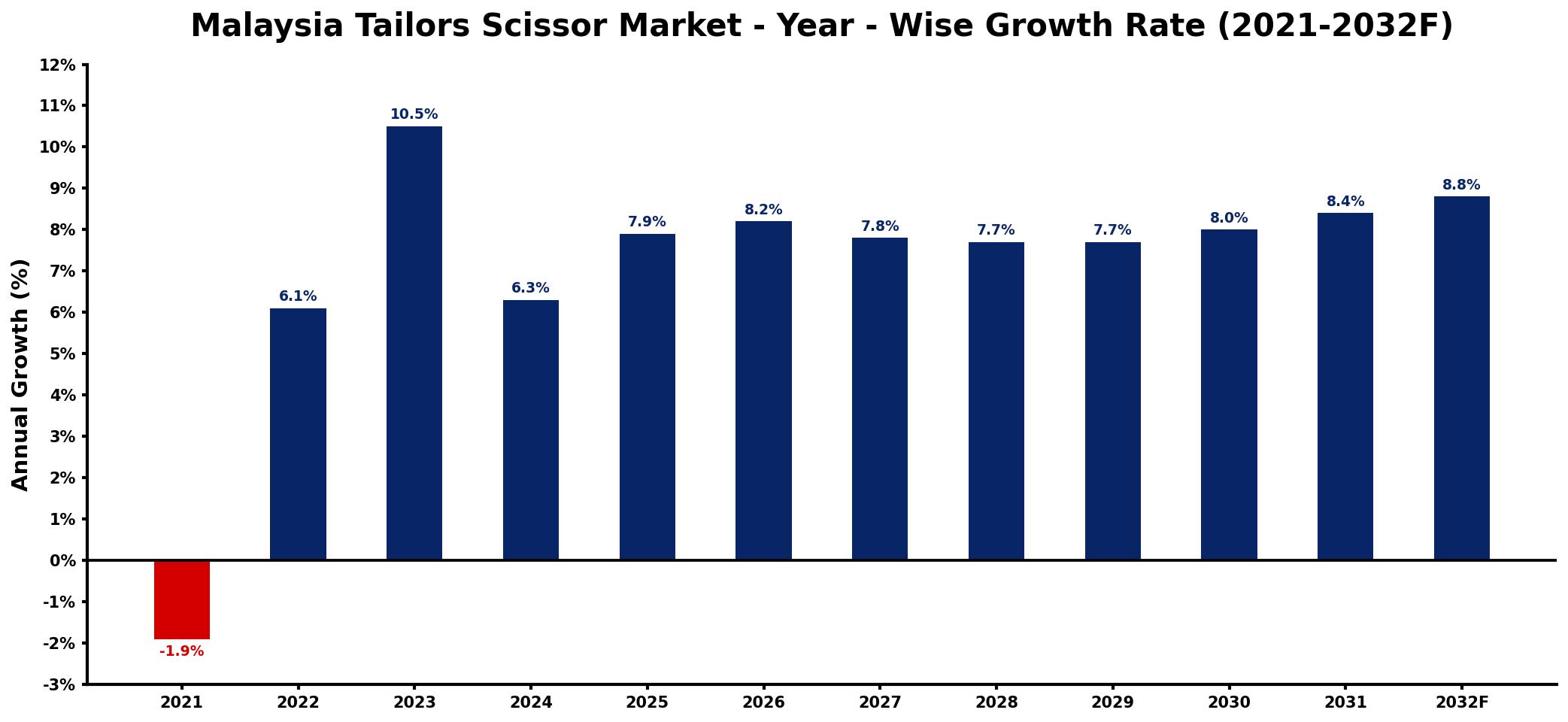
The table below presents the year‑wise growth rates along with the key drivers influencing the market
| Year | Growth Rate | Major Drivers |
| 2021 | -1.9% | decreased consumer spending on accessories |
| 2022 | 6.1% | rise in fashion industry activities |
| 2023 | 10.5% | increased demand for bespoke services |
| 2024 | 6.3% | growth in online retail platforms |
| 2025 | 7.9% | expansion of local manufacturing capabilities |
| 2026 | 8.2% | surge in DIY home projects |
| 2027 | 7.8% | greater investment in artisan workshops |
| 2028 | 7.7% | enhanced educational programs for craftsmanship |
| 2029 | 7.7% | increased collaborations with designers |
| 2030 | 8.0% | expanding manufacturing base activity |
| 2031 | 8.4% | rising popularity of crafting hobbies |
| 2032 | 8.8% | rising export shipment volumes |
Note: Market size estimations and growth projections presented in this report are based on 6Wresearch's proprietary forecasting methodology, utilizing the latest available industry data, government publications, and primary research inputs.
Malaysia Tailors Scissor Market Synopsis
The demand for precision cutting tools is critical in Malaysia's burgeoning fashion landscape. Tailors and designers require high-performance scissors to navigate the intricacies of fabric cutting, ensuring quality and precision in their creations. As the community of DIY enthusiasts continues to grow, the importance of reliable tailors scissors in home crafting and sewing projects cannot be understated.
With the Malaysian fashion sector becoming increasingly fashion-conscious, the need for customizable clothing options drives the demand for tailors scissors. Innovations in material and design are paving the way for scissors that not only offer better performance but also enhance user comfort and reduce fatigue during extended use, meeting the evolving needs of tailors and hobbyists alike.
Malaysia Tailors Scissor Market Key Takeaways
- Continued growth driven by the expanding textile and fashion industries.
- Rising popularity of DIY sewing and crafting activities among consumers.
- Increased focus on ergonomic designs and innovative materials in scissor manufacturing.
- Sustained demand for precision tools among tailors and garment producers.
- Key market players are evolving to meet the unique needs of the tailoring community.
Evaluation of Restraints in Malaysia Tailors Scissor Market
Despite the promising growth trajectory, the market is not without its challenges. Price sensitivity within the textile sector often limits the purchasing power of smaller tailors and independent designers. Additionally, the need for efficient distribution channels remains a hurdle, as some regions may experience delays in acquiring high-quality scissors. These factors can impede overall market growth, particularly in areas where access to premium tools is limited.
Malaysia Tailors Scissor Market Trends
The current trends shaping the Malaysia Tailors Scissor Market include a strong shift towards sustainability and eco-friendly materials in scissor production. Manufacturers are increasingly prioritizing the use of recyclable materials to appeal to environmentally conscious consumers. Moreover, advancements in technology are leading to the development of precision tools with enhanced performance capabilities, such as specialized blades that can handle diverse fabric types more effectively.
Malaysia Tailors Scissor Market Opportunities
The Malaysian market presents several genuine growth opportunities, particularly in enhancing e-commerce platforms for scissors. As more consumers turn to online shopping, establishing robust digital sales channels can significantly expand market reach. Additionally, partnerships with local educational institutions could nurture a new generation of tailors and designers, creating long-term demand for high-quality scissors tailored to emerging industry trends.
Government Initiatives in the Malaysia Tailors Scissor Market
The Malaysian government has initiated several policies aimed at promoting the local textile and fashion industries, which indirectly supports the tailors scissor market. Various programs focus on enhancing skills training for tailors and designers, facilitating their access to quality tools. Public spending on local fashion events and competitions further emphasizes the importance of quality craftsmanship, thereby boosting the demand for precision cutting tools.
Future Insights of the Malaysia Tailors Scissor Market
Looking ahead to 2026-2032, the Malaysia Tailors Scissor Market is poised for significant growth as the fashion and textile sectors continue to evolve. The increasing integration of technology in tailoring practices, coupled with a surge in interest for custom-made garments, will likely drive demand for innovative scissors. Moreover, the focus on ergonomic designs will resonate well with a demographic increasingly aware of the importance of user comfort in their crafting tools.
Malaysia Tailors Scissor Market Latest Developments (2025 - 2026)
Recent developments in the Malaysia Tailors Scissor Market indicate a shift towards collaborative initiatives between manufacturers and educational institutions. Workshops aimed at training upcoming tailors in modern sewing techniques are becoming more prevalent. Additionally, there is a noticeable increase in the introduction of eco-friendly scissors, reflecting a growing consumer preference for sustainable products.
Malaysia Tailors Scissor Market - Key Attractiveness of the Report
- 10 Years of Market Numbers
- Historical Data Starting from 2022 to 2025
- Base Year: 2025
- Forecast Data until 2032
- Key Performance Indicators Impacting the Market
- Major Upcoming Developments and Projects
Key Highlights of the Report:
- Malaysia Tailors Scissor Market Outlook
- Market Size of Malaysia Tailors Scissor Market, 2025
- Forecast of Malaysia Tailors Scissor Market, 2032
- Historical Data and Forecast of Malaysia Tailors Scissor Revenues & Volume for the Period 2022-2032F
- Malaysia Tailors Scissor Market Trend Evolution
- Malaysia Tailors Scissor Market Drivers and Challenges
- Malaysia Tailors Scissor Price Trends
- Malaysia Tailors Scissor Porter's Five Forces
- Malaysia Tailors Scissor Industry Life Cycle
- Historical Data and Forecast of Malaysia Tailors Scissor Market Revenues & Volume By Product for the Period 2022-2032F
- Historical Data and Forecast of Malaysia Tailors Scissor Market Revenues & Volume By Standard Scissors for the Period 2022-2032F
- Historical Data and Forecast of Malaysia Tailors Scissor Market Revenues & Volume By Customized Scissors for the Period 2022-2032F
- Historical Data and Forecast of Malaysia Tailors Scissor Market Revenues & Volume By Applications for the Period 2022-2032F
- Historical Data and Forecast of Malaysia Tailors Scissor Market Revenues & Volume By Household for the Period 2022-2032F
- Historical Data and Forecast of Malaysia Tailors Scissor Market Revenues & Volume By Commercial for the Period 2022-2032F
- Malaysia Tailors Scissor Import Export Trade Statistics
- Market Opportunity Assessment By Product
- Market Opportunity Assessment By Applications
- Malaysia Tailors Scissor Top Companies Market Share
- Malaysia Tailors Scissor Competitive Benchmarking By Technical and Operational Parameters
- Malaysia Tailors Scissor Company Profiles
- Malaysia Tailors Scissor Key Strategic Recommendations






































