Malaysia Textiles Fibre Market Size, Share & Growth Rate
The Malaysia Textiles Fibre Market was estimated at USD 486 Million in 2025 and is projected to reach USD 637 Million by 2032, growing at a CAGR of 3.9% from 2026 to 2032. This positive trajectory is largely driven by an increasing consumer preference for sustainable textile options, alongside government initiatives aimed at bolstering the textile and apparel sector. As manufacturers respond to these dynamics by investing in eco-friendly production methods and materials, the market is positioned for steady growth.
Malaysia Textiles Fibre Market Year-wise Growth Rate and Key Drivers
This graph highlights how the Malaysia Textiles Fibre Market has steadily grown over the years, supported by major growth factors.
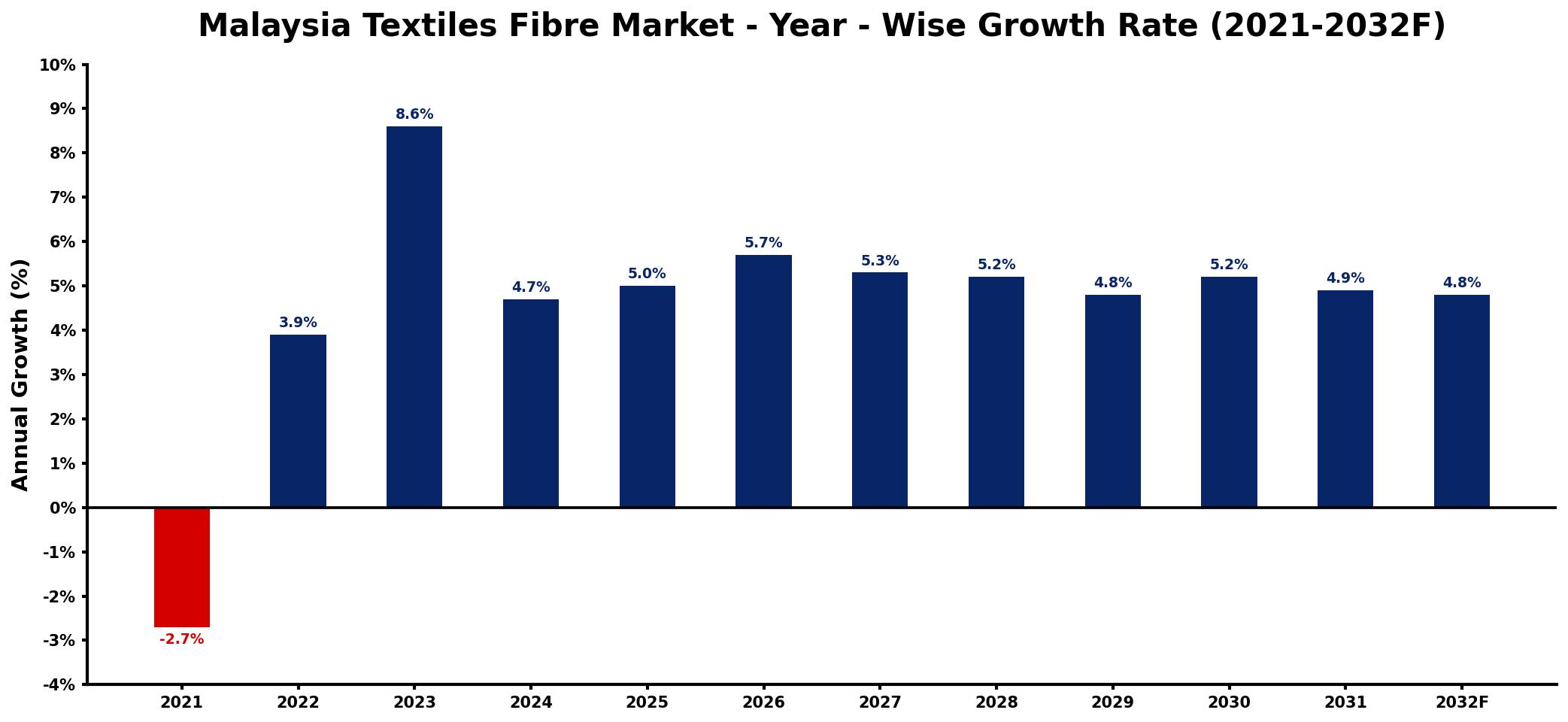
The table below presents the year‑wise growth rates along with the key drivers influencing the market
| Year | Growth Rate | Major Drivers |
| 2021 | -2.7% | decreased consumer spending habits |
| 2022 | 3.9% | rising demand from fashion industry |
| 2023 | 8.6% | increased export opportunities abroad |
| 2024 | 4.7% | growing eco-friendly materials trend |
| 2025 | 5.0% | higher investments in technology |
| 2026 | 5.7% | expansion of local manufacturing capacity |
| 2027 | 5.3% | emerging markets driving growth |
| 2028 | 5.2% | increased online retail platforms |
| 2029 | 4.8% | strengthened supply chain networks |
| 2030 | 5.2% | growing interest in sustainable practices |
| 2031 | 4.9% | enhanced collaboration with designers |
| 2032 | 4.8% | rising consumer awareness on quality |
Note: Market size estimations and growth projections presented in this report are based on 6Wresearch's proprietary forecasting methodology, utilizing the latest available industry data, government publications, and primary research inputs.
Malaysia Textiles Fibre Market Synopsis
In recent years, the Malaysia Textiles Fibre Market has seen a marked increase in the demand for natural fibers, including organic cotton and bamboo. This rising consumer consciousness regarding environmental sustainability is propelling manufacturers to innovate and adopt greener production techniques.
As manufacturers navigate the changing landscape, the market is also witnessing a significant push towards synthetic fibers that meet eco-friendly standards. The simultaneous rise in sustainable product options offers new avenues for growth while catering to the shifting demands of consumers.
Malaysia Textiles Fibre Market Key Takeaways
- The shift towards sustainable and natural fibers is reshaping production strategies.
- Government policies are increasingly focused on boosting the textile sector's growth.
- Competitive pricing remains a challenge amid global market pressures.
- Innovation in synthetic and sustainable fibers presents new growth opportunities.
- COVID-19 has catalyzed changes in market dynamics, enhancing digital adoption.
Evaluation of Restraints in Malaysia Textiles Fibre Market
Despite the promising outlook, the Malaysia Textiles Fibre Market contends with significant challenges. The pressure of global competition, particularly from regions with lower labor costs, hampers local competitiveness. Additionally, the urgency of adopting sustainable practices adds to operational costs, which can be a barrier for smaller manufacturers. Coupled with fluctuations in raw material pricing and the need for continuous innovation to align with consumer preferences, these factors necessitate a strategic approach for stakeholders aiming to navigate the complexities of the market.
Malaysia Textiles Fibre Market Trends
Several key trends are currently shaping the Malaysia Textiles Fibre Market. Firstly, there is a marked shift towards the use of sustainable materials as consumers increasingly prioritize eco-friendly products. Secondly, technological advancements are enhancing production processes, leading to more efficient operations. Additionally, the pandemic has accelerated digital transformation in the industry, paving the way for improved supply chain management and customer engagement. Finally, regulatory pressures are compelling manufacturers to adopt environmentally responsible practices, further driving the sustainability trend.
Malaysia Textiles Fibre Market Opportunities
Opportunities within the Malaysia Textiles Fibre Market are ripe for exploitation, particularly in the realm of sustainable and recycled fibers. The growing consumer base seeking eco-friendly textile options opens doors for innovation and product development. Additionally, partnerships with tech companies can enhance manufacturing efficiencies and reduce costs. The governments push for a robust textile sector offers further support for investments aimed at developing greener technologies and processes, positioning businesses favorably in a competitive landscape.
Government Initiatives in the Malaysia Textiles Fibre Market
The Malaysian government has rolled out several initiatives to strengthen the textiles sector, focusing on innovation, sustainability, and export growth. Programs are aimed at enhancing the global competitiveness of local manufacturers, including incentives for adopting environmentally friendly practices. Moreover, public investments are being directed toward research and development in sustainable textile technologies, promoting the overall growth and modernization of the industry.
Future Insights of the Malaysia Textiles Fibre Market
Looking ahead to 2026-2032, the Malaysia Textiles Fibre Market is set to embrace a green revolution characterized by innovation and consumer-centric production. The anticipated growth in demand for sustainable textiles will likely spur increased investments in research and sustainable production techniques. Additionally, as global trends continue to shift towards environmental stewardship, the Malaysian market is expected to adapt, ultimately enhancing its competitive positioning in the global textiles landscape.
Malaysia Textiles Fibre Market Latest Developments (2025 - 2026)
Recent developments in the Malaysia Textiles Fibre Market highlight a surge in investments directed towards sustainable manufacturing processes. Industry leaders are increasingly implementing digital solutions to enhance operational efficiency and reduce costs. Additionally, collaborations between textile manufacturers and technology firms are emerging, aimed at advancing sustainable production methods. These trends signal a robust alignment of market strategies with evolving consumer expectations.
Malaysia Textiles Fibre Market - Key Attractiveness of the Report
- 10 Years of Market Numbers
- Historical Data Starting from 2022 to 2025
- Base Year: 2025
- Forecast Data until 2032
- Key Performance Indicators Impacting the Market
- Major Upcoming Developments and Projects
Key Highlights of the Report:
- Malaysia Textiles Fibre Market Outlook
- Market Size of Malaysia Textiles Fibre Market, 2025
- Forecast of Malaysia Textiles Fibre Market, 2032
- Historical Data and Forecast of Malaysia Textiles Fibre Revenues & Volume for the Period 2022-2032F
- Malaysia Textiles Fibre Market Trend Evolution
- Malaysia Textiles Fibre Market Drivers and Challenges
- Malaysia Textiles Fibre Price Trends
- Malaysia Textiles Fibre Porter's Five Forces
- Malaysia Textiles Fibre Industry Life Cycle
- Historical Data and Forecast of Malaysia Textiles Fibre Market Revenues & Volume By Type for the Period 2022-2032F
- Historical Data and Forecast of Malaysia Textiles Fibre Market Revenues & Volume By Natural Fiber for the Period 2022-2032F
- Historical Data and Forecast of Malaysia Textiles Fibre Market Revenues & Volume By Synthetic Fiber for the Period 2022-2032F
- Historical Data and Forecast of Malaysia Textiles Fibre Market Revenues & Volume By Application for the Period 2022-2032F
- Historical Data and Forecast of Malaysia Textiles Fibre Market Revenues & Volume By Industrial for the Period 2022-2032F
- Historical Data and Forecast of Malaysia Textiles Fibre Market Revenues & Volume By Filters for the Period 2022-2032F
- Historical Data and Forecast of Malaysia Textiles Fibre Market Revenues & Volume By Tire Cords for the Period 2022-2032F
- Historical Data and Forecast of Malaysia Textiles Fibre Market Revenues & Volume By Feminine & Baby Care Products for the Period 2022-2032F
- Historical Data and Forecast of Malaysia Textiles Fibre Market Revenues & Volume By Surgical Gloves for the Period 2022-2032F
- Historical Data and Forecast of Malaysia Textiles Fibre Market Revenues & Volume By Apparels for the Period 2022-2032F
- Historical Data and Forecast of Malaysia Textiles Fibre Market Revenues & Volume By Bedding & Blankets for the Period 2022-2032F
- Historical Data and Forecast of Malaysia Textiles Fibre Market Revenues & Volume By Others for the Period 2022-2032F
- Historical Data and Forecast of Malaysia Textiles Fibre Market Revenues & Volume By End-Use Industry for the Period 2022-2032F
- Historical Data and Forecast of Malaysia Textiles Fibre Market Revenues & Volume By Automotive for the Period 2022-2032F
- Historical Data and Forecast of Malaysia Textiles Fibre Market Revenues & Volume By Building & Construction for the Period 2022-2032F
- Historical Data and Forecast of Malaysia Textiles Fibre Market Revenues & Volume By Healthcare for the Period 2022-2032F
- Historical Data and Forecast of Malaysia Textiles Fibre Market Revenues & Volume By Aerospace and Defense for the Period 2022-2032F
- Historical Data and Forecast of Malaysia Textiles Fibre Market Revenues & Volume By Textile for the Period 2022-2032F
- Historical Data and Forecast of Malaysia Textiles Fibre Market Revenues & Volume By Oil & Gas for the Period 2022-2032F
- Historical Data and Forecast of Malaysia Textiles Fibre Market Revenues & Volume By Energy and Power for the Period 2022-2032F
- Historical Data and Forecast of Malaysia Textiles Fibre Market Revenues & Volume By Others for the Period 2022-2032F
- Malaysia Textiles Fibre Import Export Trade Statistics
- Market Opportunity Assessment By Type
- Market Opportunity Assessment By Application
- Market Opportunity Assessment By End-Use Industry
- Malaysia Textiles Fibre Top Companies Market Share
- Malaysia Textiles Fibre Competitive Benchmarking By Technical and Operational Parameters
- Malaysia Textiles Fibre Company Profiles
- Malaysia Textiles Fibre Key Strategic Recommendations






































