Malaysia Thermoformed Plastic Products Market Size, Share & Growth Rate
The Malaysia Thermoformed Plastic Products Market was estimated at USD 157 Million in 2025 and is projected to reach USD 205 Million by 2032, growing at a CAGR of 3.9% from 2026 to 2032. This growth trajectory is primarily driven by the rising demand from food packaging, automotive, and electronics sectors. As industries increasingly prioritize lightweight and cost-effective materials, the appeal of thermoformed plastics continues to grow in Malaysia.
Malaysia Thermoformed Plastic Products Market Year-wise Growth Rate and Key Drivers
This graph highlights how the Malaysia Thermoformed Plastic Products Market has steadily grown over the years, supported by major growth factors.
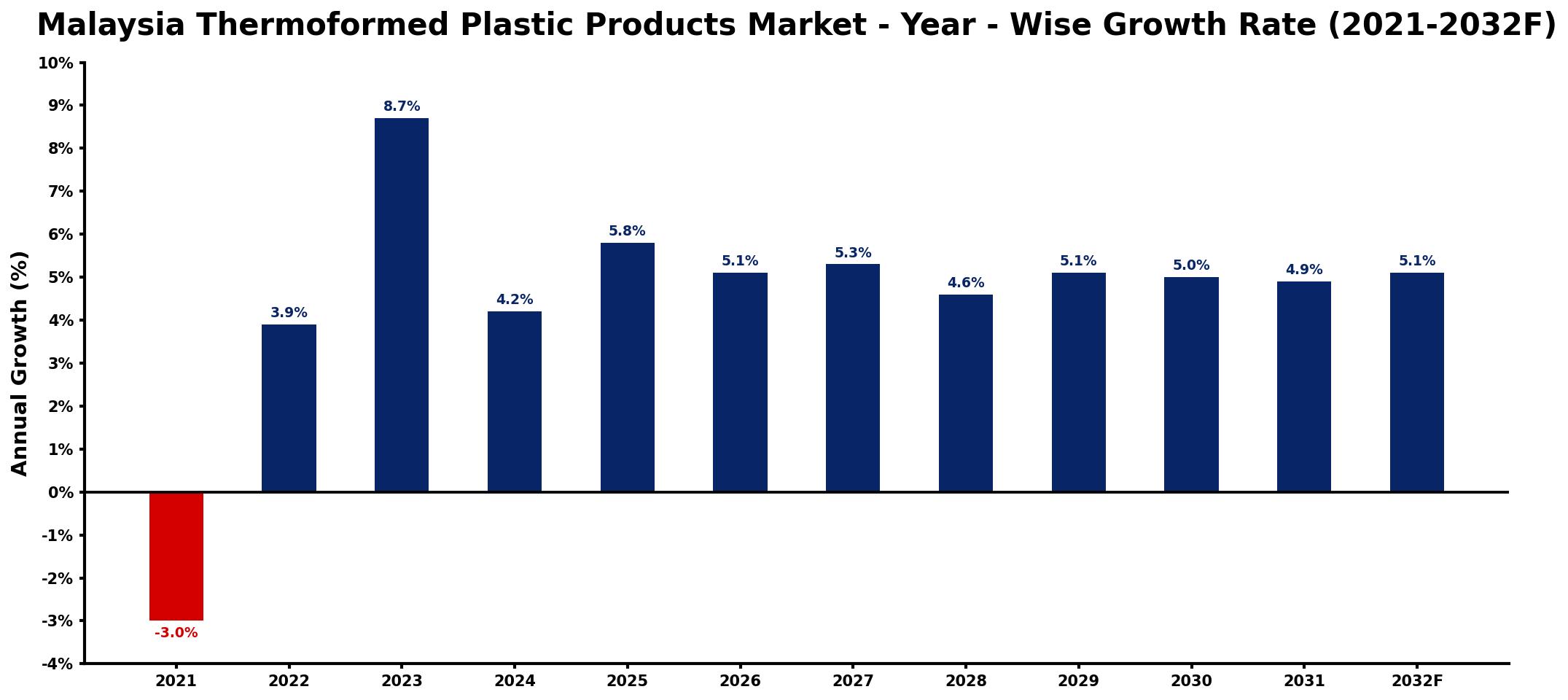
The table below presents the year‑wise growth rates along with the key drivers influencing the market
| Year | Growth Rate | Major Drivers |
| 2021 | -3.0% | decreased consumer spending on goods |
| 2022 | 3.9% | rising demand in packaging sector |
| 2023 | 8.7% | increased investment in automation |
| 2024 | 4.2% | growing e-commerce fulfillment needs |
| 2025 | 5.8% | expansion of food delivery services |
| 2026 | 5.1% | increased focus on sustainability practices |
| 2027 | 5.3% | growth in healthcare packaging solutions |
| 2028 | 4.6% | expanding industrial usage applications |
| 2029 | 5.1% | improved processing technologies adoption |
| 2030 | 5.0% | increased innovation in design capabilities |
| 2031 | 4.9% | growing adoption of lightweight materials |
| 2032 | 5.1% | increased overall sector activity |
Note: Market size estimations and growth projections presented in this report are based on 6Wresearch's proprietary forecasting methodology, utilizing the latest available industry data, government publications, and primary research inputs.
Malaysia Thermoformed Plastic Products Market Synopsis
In Malaysia, the thermoformed plastic products market is currently flourishing, fueled by significant shifts in consumer preferences towards sustainable packaging solutions. The versatility and lightweight nature of thermoformed plastics position them as a favored option for a multitude of applications, particularly in the burgeoning food packaging sector.
Moreover, the automotive industry is increasingly adopting thermoformed plastics due to their cost-effectiveness and ability to meet stringent regulations on sustainability. This growing inclination towards eco-friendly solutions reinforces the market's robust outlook, making it an area ripe for investment and innovation.
Malaysia Thermoformed Plastic Products Market Key Takeaways
- The market is driven by increasing applications in food packaging, automotive, and electronics.
- Sustainability and eco-friendliness are key factors influencing material selection.
- Innovation in biodegradable materials is shaping future product offerings.
- Manufacturers face pressures from regulations aimed at reducing plastic waste.
- Consumer preference is shifting towards environmentally responsible packaging options.
Evaluation of Restraints in Malaysia Thermoformed Plastic Products Market
While the Malaysian thermoformed plastic products market is on a growth path, it faces notable constraints related to environmental sustainability. The growing scrutiny of plastic waste, alongside evolving regulations aimed at reducing plastic use, pushes manufacturers to innovate continuously. Compliance with these regulations may require significant investment in research and development, thereby impacting profitability. Furthermore, the transition to alternative materials could disrupt existing supply chains and increase costs in the short term.
Malaysia Thermoformed Plastic Products Market Trends
Emerging trends within the Malaysia thermoformed plastic products market indicate a strong shift towards innovation in sustainable materials. Companies are increasingly exploring biodegradable options and recyclable formats in response to consumer demands for eco-friendliness. Additionally, advancements in manufacturing technology are improving production efficiency, enabling the creation of more complex shapes and designs. The integration of digital technologies into the manufacturing process, such as automation and AI, is also enhancing operational efficiency and product customization.
Malaysia Thermoformed Plastic Products Market Opportunities
The market presents a myriad of growth opportunities, particularly for firms that embrace sustainability in their product offerings. As regulations become more stringent, manufacturers innovating with green materials are well-positioned to capture a larger share of the market. Furthermore, the increasing demand from the e-commerce sector for safe and lightweight packaging solutions presents additional avenues for growth. Partnerships with tech firms focusing on automation and smart manufacturing may also lead to enhanced production capabilities and market differentiation.
Government Initiatives in the Malaysia Thermoformed Plastic Products Market
The Malaysian government is taking proactive steps to promote sustainability within the thermoformed plastic products market. Initiatives aimed at reducing plastic waste and encouraging the use of biodegradable materials are gaining traction. Programs designed to provide funding and resources for research into alternative materials are also being implemented. Furthermore, policies encouraging recycling and responsible waste management are being established to create a more sustainable packaging ecosystem.
Future Insights of the Malaysia Thermoformed Plastic Products Market
Looking ahead to the period from 2026 to 2032, the Malaysia thermoformed plastic products market is expected to evolve significantly. The ongoing push for sustainability will likely continue to shape product development, with manufacturers innovating to meet new consumer expectations and regulatory standards. The increasing penetration of technology within the industry will enhance production capabilities, allowing for greater customization and efficiency. As global trends shift towards eco-friendly solutions, the market is well-placed to adapt and thrive in this dynamic landscape.
Malaysia Thermoformed Plastic Products Market Latest Developments (2025 - 2026)
Recent developments in the Malaysian thermoformed plastic products market indicate a strong focus on sustainability and innovation. Companies are increasingly adopting cutting-edge technologies to improve production efficiency and reduce their carbon footprints. There is a noticeable rise in collaborations among industry players and research institutions aimed at developing biodegradable and recyclable materials. Furthermore, public awareness campaigns are intensifying, encouraging consumers to opt for sustainable packaging alternatives.
Malaysia Thermoformed Plastic Products Market - Key Attractiveness of the Report
- 10 Years of Market Numbers
- Historical Data Starting from 2022 to 2025
- Base Year: 2025
- Forecast Data until 2032
- Key Performance Indicators Impacting the Market
- Major Upcoming Developments and Projects
Key Highlights of the Report:
- Malaysia Thermoformed Plastic Products Market Outlook
- Market Size of Malaysia Thermoformed Plastic Products Market, 2025
- Forecast of Malaysia Thermoformed Plastic Products Market, 2032
- Historical Data and Forecast of Malaysia Thermoformed Plastic Products Revenues & Volume for the Period 2022-2032F
- Malaysia Thermoformed Plastic Products Market Trend Evolution
- Malaysia Thermoformed Plastic Products Market Drivers and Challenges
- Malaysia Thermoformed Plastic Products Price Trends
- Malaysia Thermoformed Plastic Products Porter's Five Forces
- Malaysia Thermoformed Plastic Products Industry Life Cycle
- Historical Data and Forecast of Malaysia Thermoformed Plastic Products Market Revenues & Volume By Product for the Period 2022-2032F
- Historical Data and Forecast of Malaysia Thermoformed Plastic Products Market Revenues & Volume By Polymethyl Methacrylate (PMMA) for the Period 2022-2032F
- Historical Data and Forecast of Malaysia Thermoformed Plastic Products Market Revenues & Volume By Bio-degradable polymers for the Period 2022-2032F
- Historical Data and Forecast of Malaysia Thermoformed Plastic Products Market Revenues & Volume By Polyethylene (PE) for the Period 2022-2032F
- Historical Data and Forecast of Malaysia Thermoformed Plastic Products Market Revenues & Volume By Acrylonitrile Butadiene Styrene (ABS) for the Period 2022-2032F
- Historical Data and Forecast of Malaysia Thermoformed Plastic Products Market Revenues & Volume By Poly Vinyl Chloride (PVC) for the Period 2022-2032F
- Historical Data and Forecast of Malaysia Thermoformed Plastic Products Market Revenues & Volume By High Impact Polystyrene (HIPS) for the Period 2022-2032F
- Historical Data and Forecast of Malaysia Thermoformed Plastic Products Market Revenues & Volume By Polystyrene (PS) for the Period 2022-2032F
- Historical Data and Forecast of Malaysia Polymethyl Methacrylate (PMMA) Thermoformed Plastic Products Market Revenues & Volume By Polypropylene (PP) for the Period 2022-2032F
- Historical Data and Forecast of Malaysia Thermoformed Plastic Products Market Revenues & Volume By Process for the Period 2022-2032F
- Historical Data and Forecast of Malaysia Thermoformed Plastic Products Market Revenues & Volume By Plug Assist Forming for the Period 2022-2032F
- Historical Data and Forecast of Malaysia Thermoformed Plastic Products Market Revenues & Volume By Thick Gauge Thermoforming for the Period 2022-2032F
- Historical Data and Forecast of Malaysia Thermoformed Plastic Products Market Revenues & Volume By Thin Gauge Thermoforming for the Period 2022-2032F
- Historical Data and Forecast of Malaysia Thermoformed Plastic Products Market Revenues & Volume By Vacuum Snapback for the Period 2022-2032F
- Historical Data and Forecast of Malaysia Thermoformed Plastic Products Market Revenues & Volume By Application for the Period 2022-2032F
- Historical Data and Forecast of Malaysia Thermoformed Plastic Products Market Revenues & Volume By Healthcare & Medical for the Period 2022-2032F
- Historical Data and Forecast of Malaysia Thermoformed Plastic Products Market Revenues & Volume By Food Packaging for the Period 2022-2032F
- Historical Data and Forecast of Malaysia Thermoformed Plastic Products Market Revenues & Volume By Electrical & Electronics for the Period 2022-2032F
- Historical Data and Forecast of Malaysia Thermoformed Plastic Products Market Revenues & Volume By Automotive for the Period 2022-2032F
- Historical Data and Forecast of Malaysia Thermoformed Plastic Products Market Revenues & Volume By Construction for the Period 2022-2032F
- Historical Data and Forecast of Malaysia Thermoformed Plastic Products Market Revenues & Volume By Consumer Goods & Appliances for the Period 2022-2032F
- Malaysia Thermoformed Plastic Products Import Export Trade Statistics
- Market Opportunity Assessment By Product
- Market Opportunity Assessment By Process
- Market Opportunity Assessment By Application
- Malaysia Thermoformed Plastic Products Top Companies Market Share
- Malaysia Thermoformed Plastic Products Competitive Benchmarking By Technical and Operational Parameters
- Malaysia Thermoformed Plastic Products Company Profiles
- Malaysia Thermoformed Plastic Products Key Strategic Recommendations






































