Malaysia Three Wheeler Market Size, Share & Growth Rate
The Malaysia Three Wheeler Market was estimated at USD 261 Million in 2025 and is projected to reach USD 341 Million by 2032, growing at a CAGR of 3.9% from 2026 to 2032. This growth is primarily fueled by the rapid urbanization trends in Malaysia, which are increasing the need for efficient, compact transportation options for both passengers and goods. As e-commerce continues to rise, particularly in urban centers, the demand for versatile three-wheelers capable of navigating congested streets is becoming essential for last-mile delivery solutions.
Malaysia Three Wheeler Market Year-wise Growth Rate and Key Drivers
This graph highlights how the Malaysia Three Wheeler Market has steadily grown over the years, supported by major growth factors.
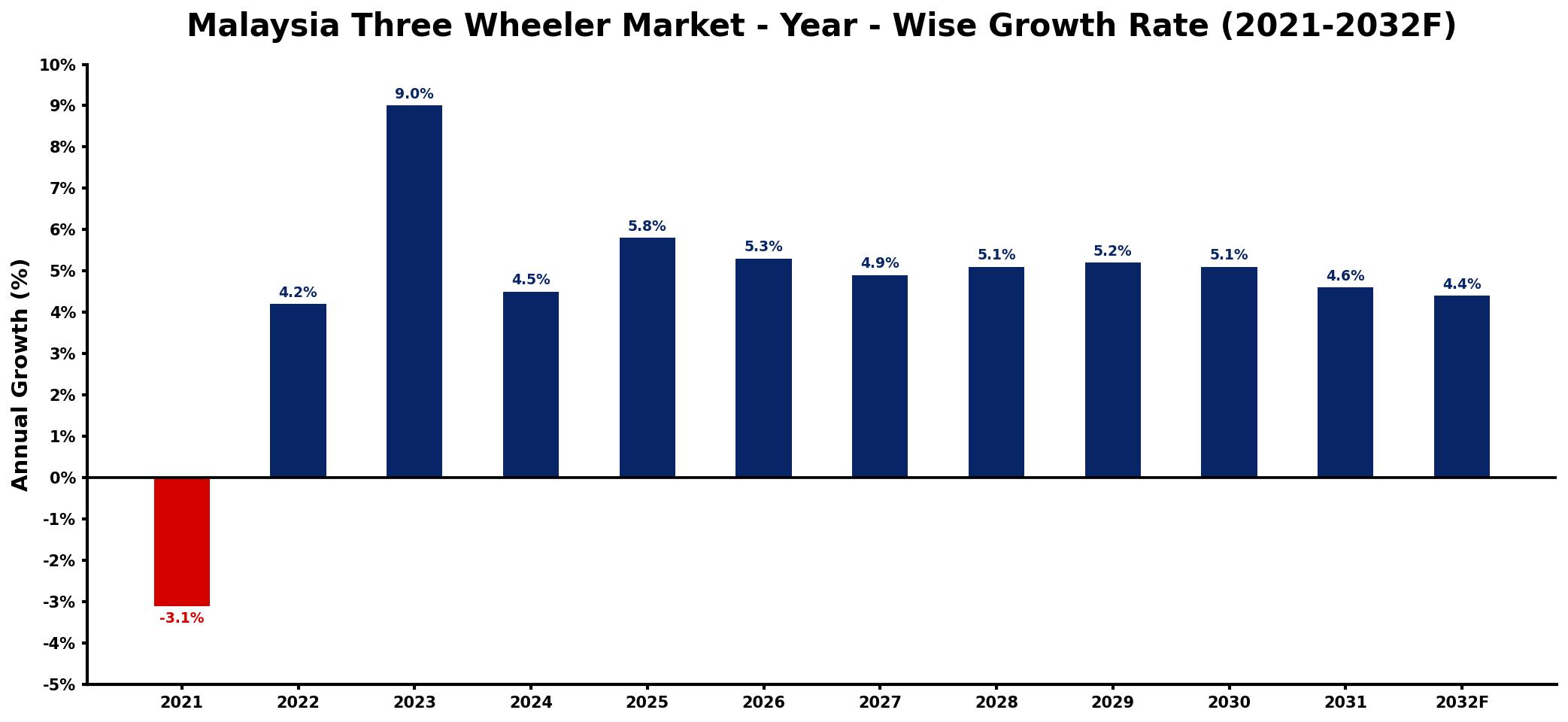
The table below presents the year‑wise growth rates along with the key drivers influencing the market
| Year | Growth Rate | Major Drivers |
| 2021 | -3.1% | decreased consumer transportation demand |
| 2022 | 4.2% | rise in urban mobility solutions |
| 2023 | 9.0% | increased investments in logistics |
| 2024 | 4.5% | growing demand for last mile |
| 2025 | 5.8% | expansion of ride-sharing platforms |
| 2026 | 5.3% | enhanced infrastructure development projects |
| 2027 | 4.9% | boost in tourism and travel |
| 2028 | 5.1% | growing focus on eco-friendly transport |
| 2029 | 5.2% | increase in small business logistics |
| 2030 | 5.1% | development of electric vehicle initiatives |
| 2031 | 4.6% | growing popularity of alternative transport |
| 2032 | 4.4% | rising demand for affordable mobility |
Note: Market size estimations and growth projections presented in this report are based on 6Wresearch's proprietary forecasting methodology, utilizing the latest available industry data, government publications, and primary research inputs.
Malaysia Three Wheeler Market Synopsis
The most significant force shaping the Malaysia Three Wheeler Market today is the dual push for cost-effective transportation and growing environmental awareness. Three-wheelers, particularly auto-rickshaws, are becoming increasingly popular due to their lower operating costs and ability to adapt to urban mobility needs, fostering growth in both passenger and goods transport.
Moreover, the rising emphasis on sustainability and government initiatives promoting electric vehicles are steering manufacturers toward eco-friendly alternatives. This transition not only aligns with global trends but also positions three-wheelers as a critical component of Malaysia's future urban transport landscape.
Malaysia Three Wheeler Market Key Takeaways
- Urbanization is driving the increased demand for compact, efficient transportation solutions.
- The market is witnessing a shift towards electric three-wheelers as sustainability gains traction.
- Three-wheelers remain a cost-effective option for small businesses, especially in last-mile delivery.
- Regulatory challenges, particularly around safety and emissions, may affect market accessibility.
- The COVID-19 pandemic highlighted the resilience of the commercial three-wheeler segment.
Evaluation of Restraints in Malaysia Three Wheeler Market
While the Malaysia Three Wheeler Market presents numerous growth opportunities, it is not without its constraints. One of the primary challenges lies in navigating complex regulatory frameworks that govern safety and emissions standards. These regulations can pose significant barriers to market entry, especially for new manufacturers looking to introduce innovative electric models. Moreover, varying levels of road infrastructure across urban and rural areas can limit the effectiveness and adoption of three-wheelers, potentially hindering their overall market growth.
Malaysia Three Wheeler Market Trends
Current trends in the Malaysia Three Wheeler Market indicate a strong inclination towards electrification. Manufacturers are increasingly investing in research and development to create electric three-wheelers that meet both consumer demands and regulatory requirements. Additionally, ride-hailing and logistics services are expanding their fleets to include three-wheelers, capitalizing on their maneuverability and operational cost benefits. Consumer preferences are also shifting, with a noticeable demand for vehicles that offer not just utility but also modern aesthetics and comfort.
Malaysia Three Wheeler Market Opportunities
Investment opportunities abound in the Malaysia Three Wheeler Market, particularly in the electric vehicle segment. Companies that innovate to produce affordable electric models could capture a growing niche market as more consumers and businesses seek sustainable transport options. Furthermore, there is potential for partnerships with logistics companies that are looking to diversify their delivery methods, positioning three-wheelers as a solution for last-mile delivery challenges.
Government Initiatives in the Malaysia Three Wheeler Market
The Malaysian government has been proactive in encouraging the adoption of electric vehicles, including three-wheelers, through various policies and incentives. These initiatives are focused on reducing carbon emissions and promoting a greener transport sector. Programs aimed at enhancing charging infrastructure and offering financial incentives for electric vehicle purchases are pivotal in stimulating market growth, creating a conducive environment for both consumers and manufacturers in the three-wheeler space.
Future Insights of the Malaysia Three Wheeler Market
Looking ahead to the 2026-2032 period, the Malaysia Three Wheeler Market is set to evolve significantly. The focus on sustainability will likely drive the proliferation of electric three-wheelers, influenced by both regulatory frameworks and consumer preferences. Additionally, as urban areas continue to grow, the demand for agile and cost-effective transportation solutions will further entrench three-wheelers in the fabric of Malaysian mobility. Innovations in technology and design are anticipated to reshape the market, making these vehicles more appealing to a broader consumer base.
Malaysia Three Wheeler Market Latest Developments (2025 - 2026)
Recent developments in the Malaysia Three Wheeler Market have centered around increasing electrification efforts, with several manufacturers unveiling their latest electric models aimed at both the passenger and goods transport segments. Additionally, partnerships between automotive companies and technology firms are emerging, focused on enhancing vehicle connectivity and operational efficiency. Regulatory updates are also being discussed that could further streamline the process for manufacturers looking to introduce electric three-wheelers.
Malaysia Three Wheeler Market - Key Attractiveness of the Report
- 10 Years of Market Numbers
- Historical Data Starting from 2022 to 2025
- Base Year: 2025
- Forecast Data until 2032
- Key Performance Indicators Impacting the Market
- Major Upcoming Developments and Projects
Key Highlights of the Report:
- Malaysia Three Wheeler Market Outlook
- Market Size of Malaysia Three Wheeler Market, 2025
- Forecast of Malaysia Three Wheeler Market, 2032
- Historical Data and Forecast of Malaysia Three Wheeler Revenues & Volume for the Period 2022-2032F
- Malaysia Three Wheeler Market Trend Evolution
- Malaysia Three Wheeler Market Drivers and Challenges
- Malaysia Three Wheeler Price Trends
- Malaysia Three Wheeler Porter's Five Forces
- Malaysia Three Wheeler Industry Life Cycle
- Historical Data and Forecast of Malaysia Three Wheeler Market Revenues & Volume By Fuel Type for the Period 2022-2032F
- Historical Data and Forecast of Malaysia Three Wheeler Market Revenues & Volume By Petrol/CNG for the Period 2022-2032F
- Historical Data and Forecast of Malaysia Three Wheeler Market Revenues & Volume By Diesel for the Period 2022-2032F
- Historical Data and Forecast of Malaysia Three Wheeler Market Revenues & Volume By Electric for the Period 2022-2032F
- Historical Data and Forecast of Malaysia Three Wheeler Market Revenues & Volume By Vehicle Type for the Period 2022-2032F
- Historical Data and Forecast of Malaysia Three Wheeler Market Revenues & Volume By Passenger Carrier for the Period 2022-2032F
- Historical Data and Forecast of Malaysia Three Wheeler Market Revenues & Volume By Load Carrier for the Period 2022-2032F
- Malaysia Three Wheeler Import Export Trade Statistics
- Market Opportunity Assessment By Fuel Type
- Market Opportunity Assessment By Vehicle Type
- Malaysia Three Wheeler Top Companies Market Share
- Malaysia Three Wheeler Competitive Benchmarking By Technical and Operational Parameters
- Malaysia Three Wheeler Company Profiles
- Malaysia Three Wheeler Key Strategic Recommendations






































