Malaysia Tire Machinery Market Size, Share & Growth Rate
The Malaysia Tire Machinery Market was estimated at USD 328 Million in 2025 and is projected to reach USD 425 Million by 2032, growing at a CAGR of 3.8% from 2026 to 2032. This growth trajectory is primarily driven by the burgeoning automotive sector within Malaysia, which remains a significant hub for regional automotive manufacturing. Increasing demands for advanced tire manufacturing equipment, especially in light of the rising trend towards electric vehicles, are further propelling the need for modern machinery solutions.
Malaysia Tire Machinery Market Year-wise Growth Rate and Key Drivers
This graph highlights how the Malaysia Tire Machinery Market has steadily grown over the years, supported by major growth factors.
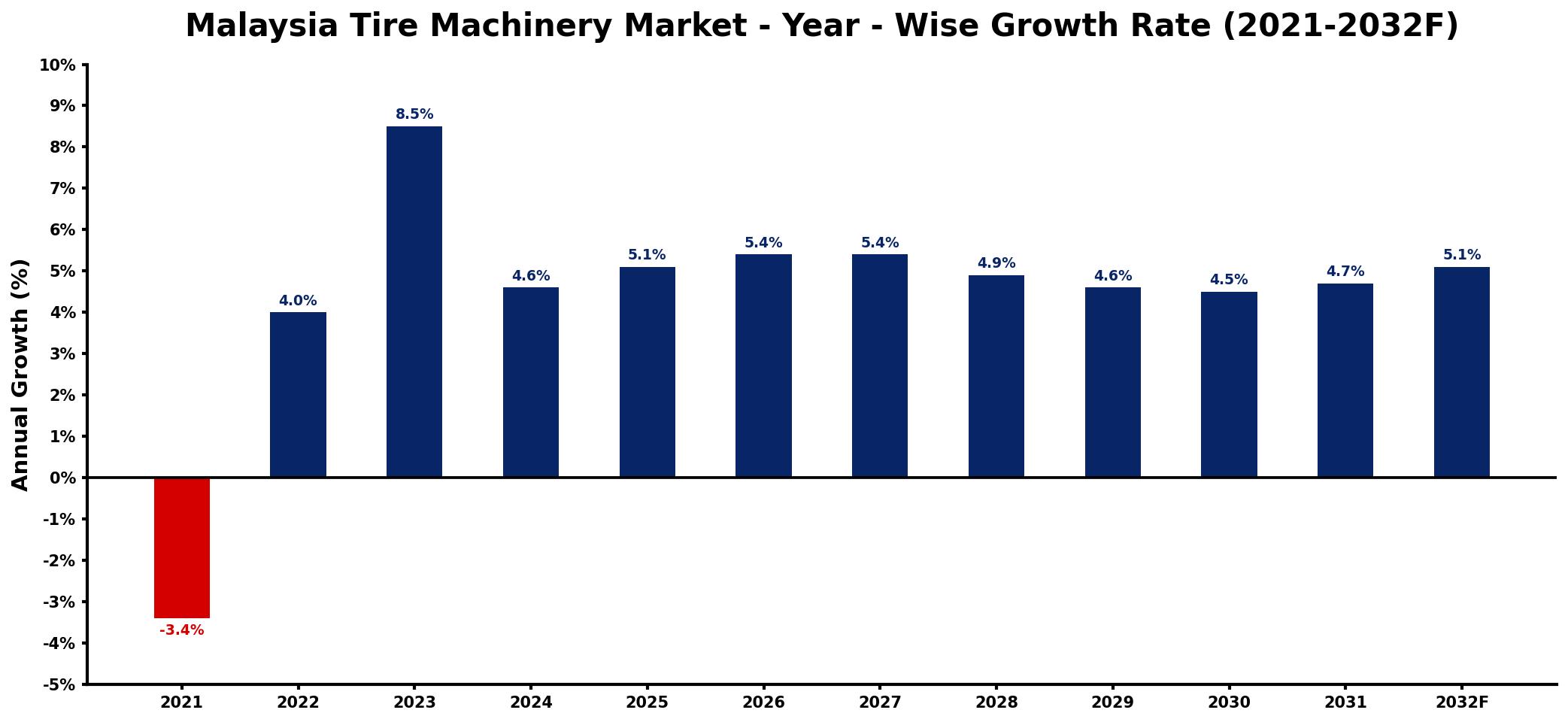
The table below presents the year‑wise growth rates along with the key drivers influencing the market
| Year | Growth Rate | Major Drivers |
| 2021 | -3.4% | decrease in automotive production levels |
| 2022 | 4.0% | rise in electric vehicle adoption |
| 2023 | 8.5% | expansion of manufacturing capabilities |
| 2024 | 4.6% | increased infrastructure development projects |
| 2025 | 5.1% | growth in domestic automotive sales |
| 2026 | 5.4% | enhanced supply chain efficiencies |
| 2027 | 5.4% | development of sustainable materials |
| 2028 | 4.9% | boost in regional export activities |
| 2029 | 4.6% | increased investment in R&D |
| 2030 | 4.5% | strengthening international trade flows |
| 2031 | 4.7% | growing emerging market penetration |
| 2032 | 5.1% | increased production capacity utilization |
Note: Market size estimations and growth projections presented in this report are based on 6Wresearch's proprietary forecasting methodology, utilizing the latest available industry data, government publications, and primary research inputs.
Malaysia Tire Machinery Market Synopsis
The current landscape of the Malaysia Tire Machinery Market showcases a steady demand influenced by both local automotive production and tire manufacturing capacities. With advancements in technology reshaping production processes, manufacturers are increasingly focusing on automation and smart manufacturing systems to enhance efficiency and reduce operational costs.
As Malaysia continues to embrace eco-friendly practices, the tire manufacturing industry is gradually pivoting towards sustainable production methods. This trend is expected to play a critical role in shaping the future of tire machinery, as manufacturers adapt to new regulatory landscapes and consumer preferences.
Malaysia Tire Machinery Market Key Takeaways
- The market is heavily influenced by the growth of the automotive sector, particularly in electric vehicle technology.
- Government initiatives are fostering an environment that supports tire production through infrastructure development.
- Technological advancements in automation are key to improving production efficiency.
- Challenges arise from global competition and fluctuations in raw material prices.
- Sustainability is becoming a critical focus, driving innovations in eco-friendly tire manufacturing processes.
Evaluation of Restraints in Malaysia Tire Machinery Market
Despite the promising growth potential, the Malaysia Tire Machinery Market faces several constraints. The dependency on raw materials such as rubber and steel poses significant challenges as price volatility can lead to fluctuating production costs. Moreover, the need for skilled technicians to operate and maintain advanced machinery can create workforce shortages. The increasing competitive pressure from lower-cost manufacturing regions further complicates the market dynamics, necessitating continuous investments in technology and innovation to remain relevant.
Malaysia Tire Machinery Market Trends
The shift towards automation and smart manufacturing processes is a prominent trend in the Malaysian tire machinery market. Manufacturers are increasingly integrating IoT and AI technologies to streamline operations and enhance product quality. Additionally, the demand for eco-friendly tires is pushing manufacturers to innovate and invest in sustainable production technologies, transforming the traditional manufacturing landscape.
Malaysia Tire Machinery Market Opportunities
Emerging opportunities in the Malaysia Tire Machinery Market largely stem from the automotive industry's ongoing evolution, particularly with the increasing emphasis on electric vehicle manufacturing. Companies that can adapt their machinery to produce specialized tires for electric vehicles will likely capture significant market share. Moreover, investments in R&D for more sustainable manufacturing processes present avenues for growth, aligning with global trends towards environmental responsibility.
Government Initiatives in the Malaysia Tire Machinery Market
The Malaysian government has been proactive in supporting the automotive sector through various initiatives, including tax incentives and infrastructure improvements. These programs aim to bolster tire production capabilities and encourage investments in modern machinery. Furthermore, the government's commitment to enhancing the manufacturing landscape is expected to create a conducive environment for the tire machinery market to thrive.
Future Insights of the Malaysia Tire Machinery Market
Looking ahead to 2026-2032, the Malaysia Tire Machinery Market is poised for continued evolution driven by technological advancements and sustainability initiatives. As manufacturers invest in automation and eco-friendly production processes, the market will likely see enhanced efficiency and reduced environmental impact. The demand for high-quality, specialized tires for electric vehicles will shape new opportunities, compelling machinery manufacturers to innovate continuously and adapt to the changing specifications in the automotive landscape.
Malaysia Tire Machinery Market Latest Developments (2025 - 2026)
Recent developments in the Malaysia Tire Machinery Market indicate a shift towards increased investments in automation technologies. Manufacturers are focusing on enhancing their production capabilities to meet the rising demands for electric vehicle tires. Additionally, many companies are prioritizing sustainability, aligning their practices with environmental regulations. The market is witnessing a trend where collaboration between machinery suppliers and tire manufacturers is becoming more common, aiming to foster innovation and address specific manufacturing challenges.
Malaysia Tire Machinery Market - Key Attractiveness of the Report
- 10 Years of Market Numbers
- Historical Data Starting from 2022 to 2025
- Base Year: 2025
- Forecast Data until 2032
- Key Performance Indicators Impacting the Market
- Major Upcoming Developments and Projects
Key Highlights of the Report:
- Malaysia Tire Machinery Market Outlook
- Market Size of Malaysia Tire Machinery Market, 2025
- Forecast of Malaysia Tire Machinery Market, 2032
- Historical Data and Forecast of Malaysia Tire Machinery Revenues & Volume for the Period 2022-2032F
- Malaysia Tire Machinery Market Trend Evolution
- Malaysia Tire Machinery Market Drivers and Challenges
- Malaysia Tire Machinery Price Trends
- Malaysia Tire Machinery Porter's Five Forces
- Malaysia Tire Machinery Industry Life Cycle
- Historical Data and Forecast of Malaysia Tire Machinery Market Revenues & Volume By Type for the Period 2022-2032F
- Historical Data and Forecast of Malaysia Tire Machinery Market Revenues & Volume By Mixing Machine/ Rubber Mixers for the Period 2022-2032F
- Historical Data and Forecast of Malaysia Tire Machinery Market Revenues & Volume By Calendaring Machine for the Period 2022-2032F
- Historical Data and Forecast of Malaysia Tire Machinery Market Revenues & Volume By Extrusion Machines for the Period 2022-2032F
- Historical Data and Forecast of Malaysia Tire Machinery Market Revenues & Volume By Multi Extrusion Lines for the Period 2022-2032F
- Historical Data and Forecast of Malaysia Tire Machinery Market Revenues & Volume By Inner Liner Lines for the Period 2022-2032F
- Historical Data and Forecast of Malaysia Tire Machinery Market Revenues & Volume By Extruders for the Period 2022-2032F
- Historical Data and Forecast of Malaysia Tire Machinery Market Revenues & Volume By Cooling Units for the Period 2022-2032F
- Historical Data and Forecast of Malaysia Mixing Machine/ Rubber Mixers Tire Machinery Market Revenues & Volume By Cutting Machines for the Period 2022-2032F
- Historical Data and Forecast of Malaysia Tire Machinery Market Revenues & Volume By Tire Type for the Period 2022-2032F
- Historical Data and Forecast of Malaysia Tire Machinery Market Revenues & Volume By Radial Tire for the Period 2022-2032F
- Historical Data and Forecast of Malaysia Tire Machinery Market Revenues & Volume By Bias Tire for the Period 2022-2032F
- Historical Data and Forecast of Malaysia Tire Machinery Market Revenues & Volume By Application for the Period 2022-2032F
- Historical Data and Forecast of Malaysia Tire Machinery Market Revenues & Volume By Two-wheeler tires for the Period 2022-2032F
- Historical Data and Forecast of Malaysia Tire Machinery Market Revenues & Volume By Passenger Vehicle Tires for the Period 2022-2032F
- Historical Data and Forecast of Malaysia Tire Machinery Market Revenues & Volume By Hatchback for the Period 2022-2032F
- Historical Data and Forecast of Malaysia Tire Machinery Market Revenues & Volume By Sedan for the Period 2022-2032F
- Historical Data and Forecast of Malaysia Tire Machinery Market Revenues & Volume By Utility Vehicles for the Period 2022-2032F
- Historical Data and Forecast of Malaysia Tire Machinery Market Revenues & Volume By Light Commercial Vehicle Tires for the Period 2022-2032F
- Historical Data and Forecast of Malaysia Tire Machinery Market Revenues & Volume By Medium & Heavy Commercial Vehicle Tires for the Period 2022-2032F
- Historical Data and Forecast of Malaysia Tire Machinery Market Revenues & Volume By Off-road Vehicle Tires for the Period 2022-2032F
- Malaysia Tire Machinery Import Export Trade Statistics
- Market Opportunity Assessment By Type
- Market Opportunity Assessment By Tire Type
- Market Opportunity Assessment By Application
- Malaysia Tire Machinery Top Companies Market Share
- Malaysia Tire Machinery Competitive Benchmarking By Technical and Operational Parameters
- Malaysia Tire Machinery Company Profiles
- Malaysia Tire Machinery Key Strategic Recommendations






































