Malaysia Toys and Games Market Size, Share & Growth Rate
The Malaysia Toys and Games Market was estimated at USD 432 Million in 2025 and is projected to reach USD 560 Million by 2032, growing at a CAGR of 3.8% from 2026 to 2032. This growth trajectory is fueled by rising disposable incomes and urbanization, as families invest more in quality entertainment for their children. Additionally, the increasing preference for educational and electronic toys reflects a broader shift in consumer demand towards products that combine fun and learning.
Malaysia Toys and Games Market Year-wise Growth Rate and Key Drivers
This graph highlights how the Malaysia Toys and Games Market has steadily grown over the years, supported by major growth factors.
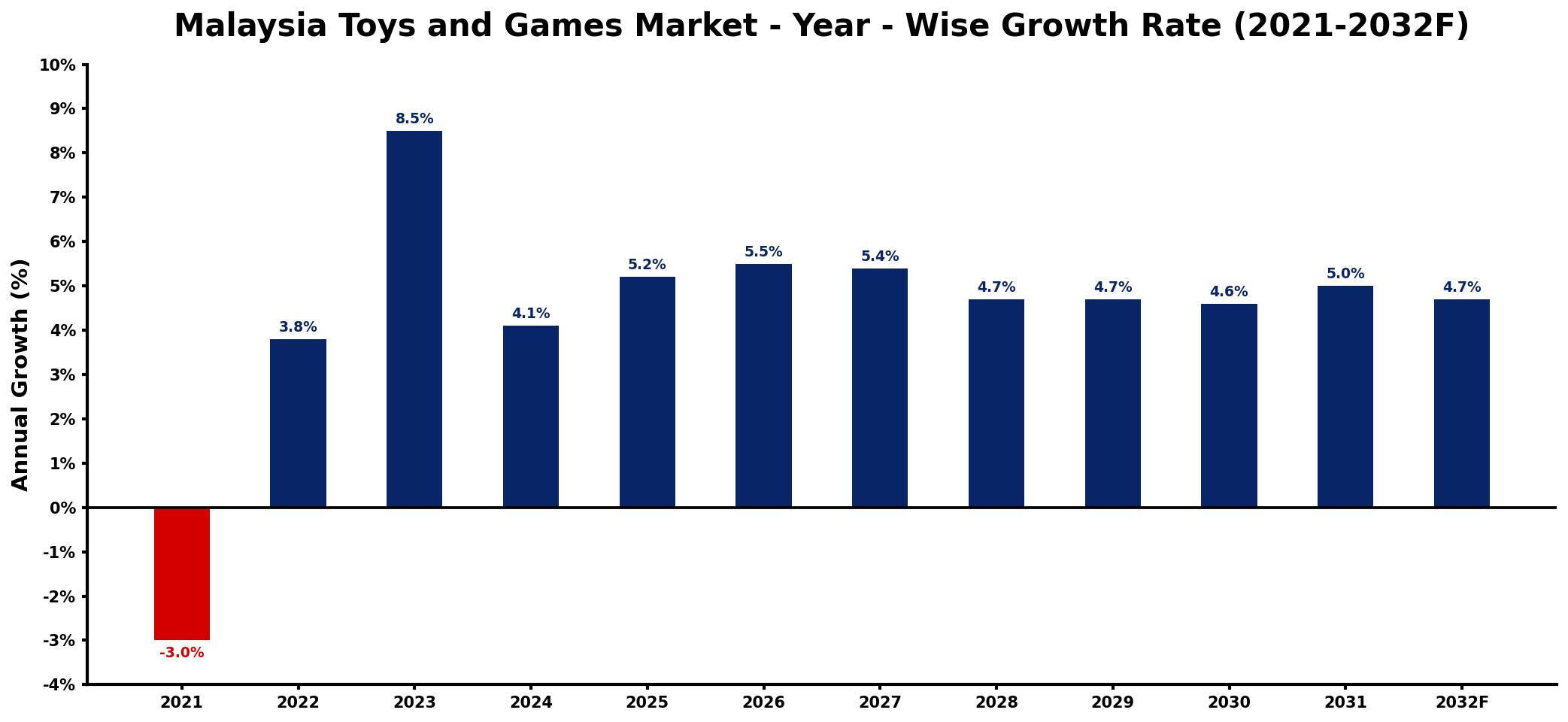
The table below presents the year‑wise growth rates along with the key drivers influencing the market
| Year | Growth Rate | Major Drivers |
| 2021 | -3.0% | Decreased consumer spending patterns |
| 2022 | 3.8% | Rise in online retail platforms |
| 2023 | 8.5% | Increased disposable income levels |
| 2024 | 4.1% | Expansion of e-commerce marketplace |
| 2025 | 5.2% | Growth in family entertainment options |
| 2026 | 5.5% | Emergence of innovative product designs |
| 2027 | 5.4% | Strengthened marketing strategies implemented |
| 2028 | 4.7% | Growing interest in educational products |
| 2029 | 4.7% | Increased participation in family activities |
| 2030 | 4.6% | growing commercial sector adoption |
| 2031 | 5.0% | Improved distribution network efficiency |
| 2032 | 4.7% | rising export shipment volumes |
Note: Market size estimations and growth projections presented in this report are based on 6Wresearch's proprietary forecasting methodology, utilizing the latest available industry data, government publications, and primary research inputs.
Malaysia Toys and Games Market Synopsis
A notable demand driver in the Malaysia Toys and Games Market is the surge in e-commerce sales, which has transformed how consumers access toys and games. With more parents shopping online, manufacturers are expanding their digital footprints to cater to this growing trend. As a result, the market is witnessing increased competition, compelling brands to innovate and diversify their product offerings.
Additionally, the trend towards interactive and educational toys is gaining momentum. Parents are increasingly concerned about the developmental benefits of play, leading to a rise in products that blend entertainment with educational value. As a response, market players must prioritize safety, quality, and compliance to meet the evolving expectations of consumers.
Malaysia Toys and Games Market Key Takeaways
- Growth in e-commerce is reshaping how consumers purchase toys and games in Malaysia.
- There is an increasing consumer preference for educational and interactive toys.
- Safety regulations are becoming more stringent, impacting product development and compliance costs.
- Urbanization and rising disposable incomes are driving market expansion.
- The shift towards digital gaming is becoming a significant factor in the market landscape.
Evaluation of Restraints in Malaysia Toys and Games Market
Despite the positive growth indicators, the Malaysia Toys and Games Market faces several restraints that may impede its progress. The rapid changes in consumer preferences require companies to be agile and responsive, which can strain resources. Additionally, safety regulations present a significant challenge; as they evolve, manufacturers must continually invest in compliance measures to ensure their products meet the latest standards. Furthermore, the presence of counterfeit and low-quality toys in the market poses a risk to established brands, making consumer trust increasingly crucial. Price sensitivity remains a concern, especially during economic downturns, impacting sales across various segments.
Malaysia Toys and Games Market Trends
Several key trends are shaping the Malaysia Toys and Games Market. The integration of technology into toys is gaining popularity, with digital and interactive games capturing the attention of tech-savvy children and parents alike. Meanwhile, sustainability is becoming a growing concern; consumers are increasingly seeking eco-friendly toys, encouraging manufacturers to adopt greener practices. The resurgence of traditional games and board games during the pandemic has highlighted a desire for offline, family-oriented play experiences, balancing screen time with physical interaction.
Malaysia Toys and Games Market Opportunities
The Malaysia Toys and Games Market presents numerous opportunities for growth, particularly in the realm of e-commerce and digital gaming. As online shopping becomes the norm, businesses that enhance their digital strategies stand to benefit significantly. Additionally, investing in the development of innovative educational toys that align with the national curriculum can attract parents seeking value and quality. There is also potential for expansion into emerging markets within Malaysia, as urbanization continues to provide new demographics eager for engaging products.
Government Initiatives in the Malaysia Toys and Games Market
The Malaysian government has initiated various programs to promote safe and quality products in the Toys and Games Market. These initiatives include stricter enforcement of safety regulations to protect consumers, particularly children. Moreover, public spending aimed at educational reforms encourages the incorporation of educational toys in learning environments. Government incentives for local manufacturers can also stimulate production and innovation within the industry, fostering a healthier market ecosystem.
Future Insights of the Malaysia Toys and Games Market
Looking ahead to 2026-2032, the Malaysia Toys and Games Market is expected to continue evolving rapidly. As disposable incomes rise and urbanization expands, the demand for high-quality toys will likely grow. Additionally, the trend toward digital gaming will create new avenues for interactive entertainment, while educational products are anticipated to gain further traction. Overall, adaptability and innovation will be essential for market players striving to meet the changing demands of Malaysian consumers.
Malaysia Toys and Games Market Latest Developments (2025 - 2026)
Recent developments in the Malaysia Toys and Games Market indicate a strong focus on integrating technology into new product lines. Companies are launching initiatives to enhance online customer experiences, aiming to capture the growing market for e-commerce. Additionally, brands are increasingly incorporating sustainability into their production processes, responding to the rising consumer demand for eco-friendly options. As the digital gaming sector continues to expand, strategic partnerships and collaborations are also on the rise, reflecting the competitive landscape of the market.
Malaysia Toys and Games Market - Key Attractiveness of the Report
- 10 Years of Market Numbers
- Historical Data Starting from 2022 to 2025
- Base Year: 2025
- Forecast Data until 2032
- Key Performance Indicators Impacting the Market
- Major Upcoming Developments and Projects
Key Highlights of the Report:
- Malaysia ToysandGames Market Outlook
- Market Size of Malaysia ToysandGames Market, 2025
- Forecast of Malaysia ToysandGames Market, 2032
- Historical Data and Forecast of Malaysia ToysandGames Revenues & Volume for the Period 2022-2032F
- Malaysia ToysandGames Market Trend Evolution
- Malaysia ToysandGames Market Drivers and Challenges
- Malaysia ToysandGames Price Trends
- Malaysia ToysandGames Porter's Five Forces
- Malaysia ToysandGames Industry Life Cycle
- Historical Data and Forecast of Malaysia ToysandGames Market Revenues & Volume By Product Type for the Period 2022-2032F
- Historical Data and Forecast of Malaysia ToysandGames Market Revenues & Volume By Games and Puzzles for the Period 2022-2032F
- Historical Data and Forecast of Malaysia ToysandGames Market Revenues & Volume By Video Games for the Period 2022-2032F
- Historical Data and Forecast of Malaysia ToysandGames Market Revenues & Volume By Construction Toys for the Period 2022-2032F
- Historical Data and Forecast of Malaysia ToysandGames Market Revenues & Volume By Dolls and Accessories for the Period 2022-2032F
- Historical Data and Forecast of Malaysia ToysandGames Market Revenues & Volume By Outdoor and Sports Toys for the Period 2022-2032F
- Historical Data and Forecast of Malaysia ToysandGames Market Revenues & Volume By Other for the Period 2022-2032F
- Historical Data and Forecast of Malaysia ToysandGames Market Revenues & Volume By Distribution Channel for the Period 2022-2032F
- Historical Data and Forecast of Malaysia ToysandGames Market Revenues & Volume By Online Channel for the Period 2022-2032F
- Historical Data and Forecast of Malaysia ToysandGames Market Revenues & Volume By Offline Channel for the Period 2022-2032F
- Malaysia ToysandGames Import Export Trade Statistics
- Market Opportunity Assessment By Product Type
- Market Opportunity Assessment By Distribution Channel
- Malaysia ToysandGames Top Companies Market Share
- Malaysia ToysandGames Competitive Benchmarking By Technical and Operational Parameters
- Malaysia ToysandGames Company Profiles
- Malaysia ToysandGames Key Strategic Recommendations






































