Malaysia Tractor Market Size, Share & Growth Rate
The Malaysia Tractor Market was estimated at USD 185 Million in 2025 and is projected to reach USD 239 Million by 2032, growing at a CAGR of 3.7% from 2026 to 2032. This upward trajectory is largely propelled by the ongoing modernization of the agriculture sector, with farmers increasingly turning to mechanization as a means of enhancing productivity. Government support for agricultural development and rural infrastructure is also pivotal in fostering a robust market environment for tractors.
Malaysia Tractor Market Year-wise Growth Rate and Key Drivers
This graph highlights how the Malaysia Tractor Market has steadily grown over the years, supported by major growth factors.
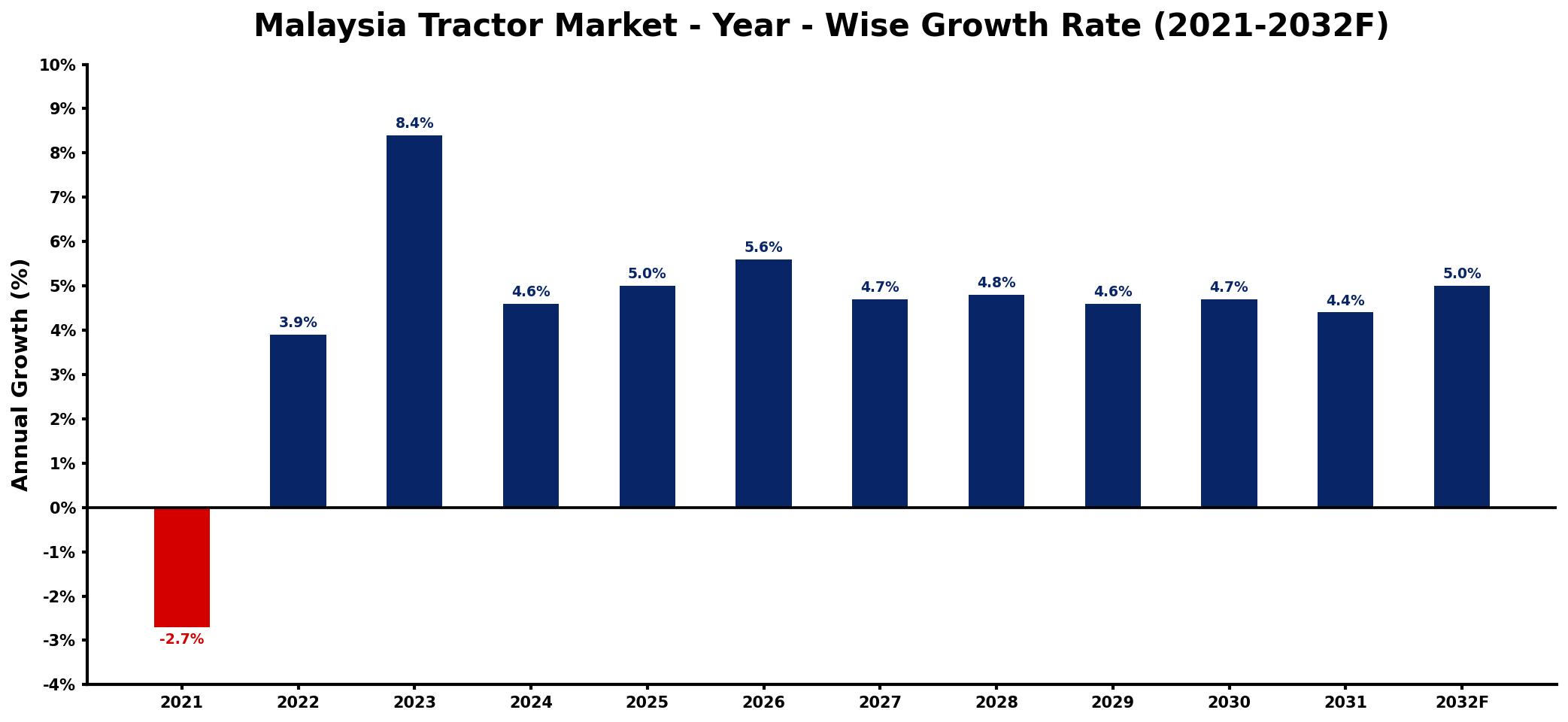
The table below presents the year‑wise growth rates along with the key drivers influencing the market
| Year | Growth Rate | Major Drivers |
| 2021 | -2.7% | decreased agricultural investment activity |
| 2022 | 3.9% | increased mechanization in agriculture |
| 2023 | 8.4% | growing demand for automation solutions |
| 2024 | 4.6% | expansion of rural infrastructure projects |
| 2025 | 5.0% | rising crop production requirements |
| 2026 | 5.6% | enhanced financing options availability |
| 2027 | 4.7% | sustainable farming practices adoption |
| 2028 | 4.8% | government support for modernization |
| 2029 | 4.6% | increased exports of agricultural products |
| 2030 | 4.7% | development of smart farming technologies |
| 2031 | 4.4% | growing popularity of precision farming |
| 2032 | 5.0% | rising environmental sustainability initiatives |
Note: Market size estimations and growth projections presented in this report are based on 6Wresearch's proprietary forecasting methodology, utilizing the latest available industry data, government publications, and primary research inputs.
Malaysia Tractor Market Synopsis
In Malaysia, the tractor market is significantly influenced by the agricultural sector's modernization efforts. Farmers are adopting more sophisticated equipment to improve efficiency, which in turn drives the demand for advanced tractor models. As the country prioritizes agricultural productivity, the need for reliable and efficient tractors becomes ever more critical.
Recent trends indicate a shift towards versatile and technologically advanced tractors that cater to varied farming practices. Additionally, the expansion of the construction and landscaping sectors is further diversifying the application of tractors, thus contributing to market growth.
Malaysia Tractor Market Key Takeaways
- The Malaysian tractor market is experiencing significant growth due to the rise in mechanized farming practices.
- Government initiatives play a crucial role in supporting agricultural expansion and rural infrastructure improvement.
- Technological advancements are driving demand for efficient and versatile tractor models among farmers.
- The industrial tractor segment is expanding, fueled by growth in construction and landscaping activities.
- Resilience in the agriculture sector during the pandemic has solidified the importance of tractors in farming operations.
Evaluation of Restraints in Malaysia Tractor Market
Despite the promising growth trajectory, the Malaysia tractor market faces significant restraints. A pressing challenge is the need for improved infrastructure, which hampers accessibility for many farmers. Additionally, access to financing options remains limited, making it difficult for small-scale farmers to invest in modern machinery. Adapting to shifting climate patterns poses another hurdle, as agricultural practices must evolve to remain viable, affecting tractor demand. These factors collectively underscore the need for strategic solutions to unlock the market's full potential.
Malaysia Tractor Market Trends
Several key trends are shaping the Malaysia tractor market landscape. A notable trend is the integration of smart technologies in tractors, such as GPS tracking and automation, which enhances operational efficiency. Additionally, there is a growing emphasis on fuel-efficient models that minimize operational costs. Farmers are also increasingly seeking multipurpose tractors that can perform a variety of tasks, reflecting a desire for versatility in agricultural machinery. As these trends continue to evolve, manufacturers are likely to adapt their offerings to meet the changing demands of the market.
Malaysia Tractor Market Opportunities
The Malaysia tractor market presents several genuine growth opportunities. As agricultural practices shift towards sustainability, there is an increasing demand for eco-friendly tractors that align with environmentally conscious farming methods. Furthermore, investment in rural infrastructure development offers a favorable environment for tractor sales. Expansion into the export market is another area of potential growth, particularly for manufacturers looking to capitalize on the rising demand in neighboring countries. By focusing on innovation and sustainability, businesses can position themselves favorably in this dynamic market.
Government Initiatives in the Malaysia Tractor Market
The Malaysian government has implemented several initiatives aimed at bolstering the agricultural sector, which directly impacts the tractor market. Support programs designed to enhance agricultural productivity and improve rural infrastructure are essential in fostering a favorable climate for tractor adoption. These initiatives include funding for modern farming practices, training programs for farmers, and incentives for purchasing new machinery. By creating a supportive ecosystem, the government plays a vital role in stimulating demand for tractors across the country.
Future Insights of the Malaysia Tractor Market
Looking ahead to 2026-2032, the Malaysia tractor market is poised for substantial transformation driven by ongoing technological advancements and shifting consumer preferences. As farmers become more adept at leveraging technology, the demand for high-tech and efficient tractors is expected to grow significantly. Moreover, continued government support and investments in rural infrastructure will further catalyze market expansion. The focus on sustainability will likely influence product development, steering manufacturers towards eco-friendly solutions that meet the evolving needs of the agricultural sector.
Malaysia Tractor Market Latest Developments (2025 - 2026)
In recent months, the Malaysia tractor market has seen a notable uptick in interest surrounding smart farming technologies. Companies are increasingly adopting innovative approaches to develop tractors equipped with advanced features like precision agriculture capabilities and automated systems. Additionally, there has been heightened collaboration between industry stakeholders and government agencies to enhance rural infrastructure, which is expected to boost tractor sales further. This evolving landscape indicates a proactive approach to meeting the demands of a modern agricultural economy.
Malaysia Tractor Market - Key Attractiveness of the Report
- 10 Years of Market Numbers
- Historical Data Starting from 2022 to 2025
- Base Year: 2025
- Forecast Data until 2032
- Key Performance Indicators Impacting the Market
- Major Upcoming Developments and Projects
Key Highlights of the Report:
- Malaysia Tractor Market Outlook
- Market Size of Malaysia Tractor Market, 2025
- Forecast of Malaysia Tractor Market, 2032
- Historical Data and Forecast of Malaysia Tractor Revenues & Volume for the Period 2022-2032F
- Malaysia Tractor Market Trend Evolution
- Malaysia Tractor Market Drivers and Challenges
- Malaysia Tractor Price Trends
- Malaysia Tractor Porter's Five Forces
- Malaysia Tractor Industry Life Cycle
- Historical Data and Forecast of Malaysia Tractor Market Revenues & Volume By Power Output for the Period 2022-2032F
- Historical Data and Forecast of Malaysia Tractor Market Revenues & Volume By Less Than 30 HP for the Period 2022-2032F
- Historical Data and Forecast of Malaysia Tractor Market Revenues & Volume By 30-50 HP for the Period 2022-2032F
- Historical Data and Forecast of Malaysia Tractor Market Revenues & Volume By 51-100 HP for the Period 2022-2032F
- Historical Data and Forecast of Malaysia Tractor Market Revenues & Volume By More Than 100 HP for the Period 2022-2032F
- Historical Data and Forecast of Malaysia Tractor Market Revenues & Volume By Drive Type for the Period 2022-2032F
- Historical Data and Forecast of Malaysia Tractor Market Revenues & Volume By 2 Wheel Drive for the Period 2022-2032F
- Historical Data and Forecast of Malaysia Tractor Market Revenues & Volume By 4 Wheel Drive for the Period 2022-2032F
- Historical Data and Forecast of Malaysia Tractor Market Revenues & Volume By Application for the Period 2022-2032F
- Historical Data and Forecast of Malaysia Tractor Market Revenues & Volume By Agriculture for the Period 2022-2032F
- Malaysia Tractor Import Export Trade Statistics
- Market Opportunity Assessment By Power Output
- Market Opportunity Assessment By Drive Type
- Market Opportunity Assessment By Application
- Malaysia Tractor Top Companies Market Share
- Malaysia Tractor Competitive Benchmarking By Technical and Operational Parameters
- Malaysia Tractor Company Profiles
- Malaysia Tractor Key Strategic Recommendations






































