Malaysia Trolley Market Size, Share & Growth Rate
The Malaysia Trolley Market was estimated at USD 276 Million in 2025 and is projected to reach USD 358 Million by 2032, growing at a CAGR of 3.8% from 2026 to 2032. This growth trajectory is strongly influenced by the expanding logistics and retail sectors, which rely increasingly on efficient material handling solutions. As e-commerce continues to flourish, the demand for specialized trolleys equipped with advanced features is expected to further bolster market dynamics.
Malaysia Trolley Market Year-wise Growth Rate and Key Drivers
This graph highlights how the Malaysia Trolley Market has steadily grown over the years, supported by major growth factors.
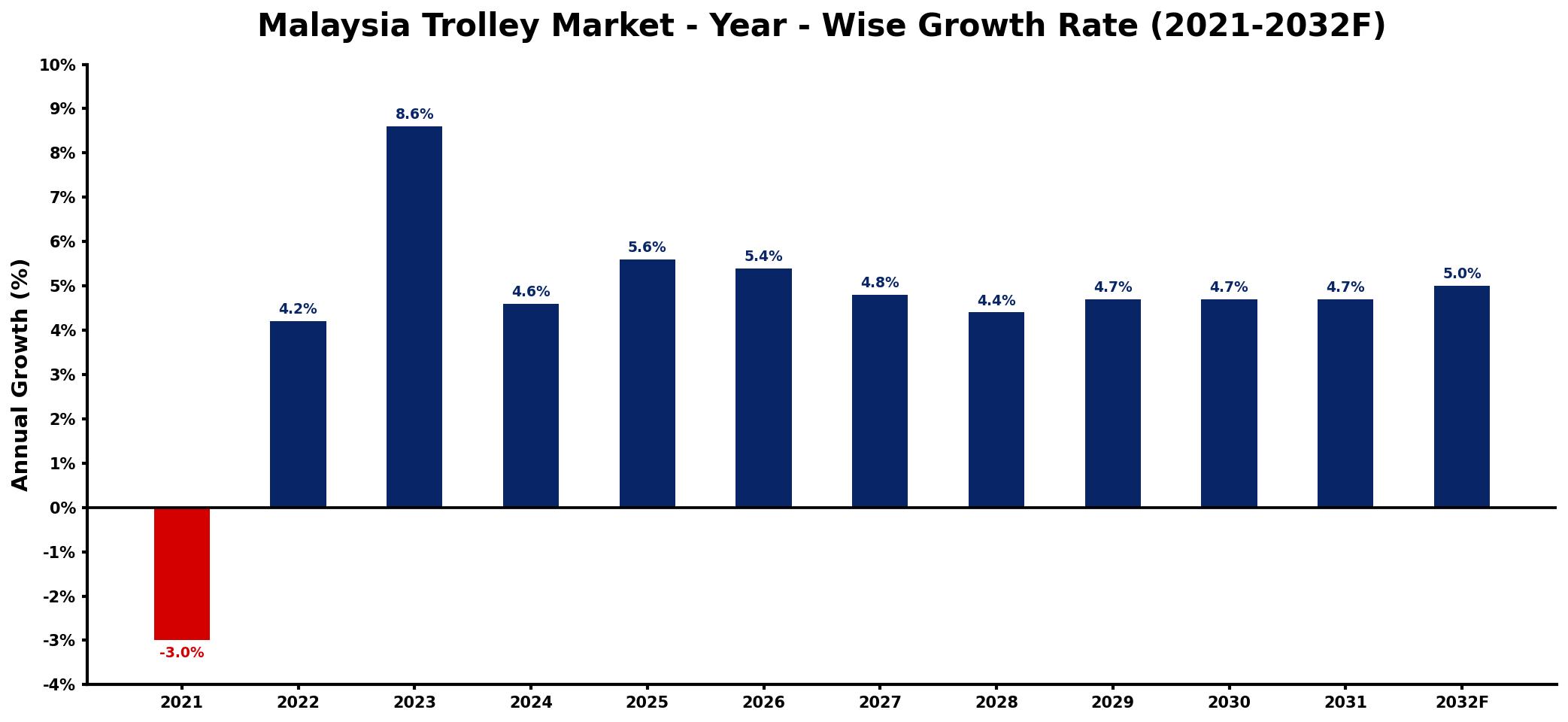
The table below presents the year‑wise growth rates along with the key drivers influencing the market
| Year | Growth Rate | Major Drivers |
| 2021 | -3.0% | decreased consumer spending on essentials |
| 2022 | 4.2% | growth in e-commerce logistics sector |
| 2023 | 8.6% | increased urbanization driving demand |
| 2024 | 4.6% | expansion of retail infrastructure projects |
| 2025 | 5.6% | rising disposable income among consumers |
| 2026 | 5.4% | rising procurement volume requirements |
| 2027 | 4.8% | increased focus on sustainability practices |
| 2028 | 4.4% | technological advancements in supply chain |
| 2029 | 4.7% | strong investments in logistics automation |
| 2030 | 4.7% | growing trend of convenience shopping |
| 2031 | 4.7% | improved raw material availability |
| 2032 | 5.0% | increased demand for smart solutions |
Note: Market size estimations and growth projections presented in this report are based on 6Wresearch's proprietary forecasting methodology, utilizing the latest available industry data, government publications, and primary research inputs.
Malaysia Trolley Market Synopsis
In Malaysia, trolleys serve as essential tools across various industries, facilitating seamless material handling and transportation. The growing emphasis on operational efficiency has led businesses to invest in ergonomic and automated trolley solutions, reflecting a shift towards modernization in logistics and retail.
Moreover, the heightened awareness of sustainability is steering consumer preferences towards eco-friendly trolley options. As industries strive to implement greener practices, manufacturers are tasked with innovating their offerings to meet these evolving demands, ensuring product durability while minimizing environmental impact.
Malaysia Trolley Market Key Takeaways
- The market is expected to grow at a steady pace, driven by the retail and logistics sectors.
- Increased adoption of e-commerce is boosting the demand for effective material handling solutions.
- Businesses are seeking specialized trolleys with innovative features to streamline operations.
- Sustainability is becoming a significant factor in consumer decision-making regarding trolley purchases.
- Market players face challenges related to differentiation and innovation in a saturated environment.
Evaluation of Restraints in Malaysia Trolley Market
The Malaysia trolley market is currently experiencing challenges related to product differentiation and market saturation. With a plethora of options available, manufacturers often struggle to highlight unique features that can captivate potential buyers. This saturation necessitates a clear strategy to innovate and enhance product offerings. Additionally, ensuring robust trolley durability and optimal load-bearing capabilities remains a challenge, as frequent replacements can deter customers. Furthermore, the market must adapt to growing environmental concerns, as consumers increasingly prefer sustainable and recyclable options.
Malaysia Trolley Market Trends
Current trends in the Malaysia trolley market reveal a significant shift toward the integration of technology in design and functionality. Automated trolleys equipped with load sensors are becoming increasingly popular, enhancing efficiency and reducing manual labor. In tandem with this, the rise of e-commerce has catalyzed a demand for versatile trolleys tailored for last-mile delivery operations, further shaping industry standards. Ergonomics also play a crucial role, as businesses prioritize worker safety and comfort through the adoption of user-friendly trolley designs.
Malaysia Trolley Market Opportunities
Genuine growth opportunities in the Malaysia trolley market lie in the continuous evolution of consumer demands and technological advancements. As companies increasingly look to optimize their supply chains, investment in trolleys that enhance operational efficiency and reduce labor costs will be paramount. Moreover, the push towards eco-friendly products opens avenues for manufacturers willing to innovate sustainable materials and designs. Establishing partnerships with e-commerce platforms can also drive demand, as online retailers seek integrated solutions for logistics.
Government Initiatives in the Malaysia Trolley Market
The Malaysian government is actively promoting initiatives aimed at enhancing the logistics and supply chain sectors, which indirectly benefits the trolley market. Public spending on infrastructure improvements, coupled with policies supporting the growth of e-commerce, creates a favorable environment for trolley manufacturers. Additionally, incentives for adopting sustainable practices are prompting companies to invest in eco-friendly trolley solutions, aligning with national sustainability goals.
Future Insights of the Malaysia Trolley Market
Looking ahead to the period between 2026 and 2032, the Malaysia trolley market is poised for significant evolution. As technological innovations continue to emerge, the incorporation of automation and smart technologies in trolley designs will likely redefine operational standards. The focus on sustainability will persist, pushing manufacturers to prioritize eco-friendly materials and processes. Additionally, the ongoing expansion of e-commerce will further entrench the necessity for efficient and versatile trolley solutions tailored for modern logistics challenges.
Malaysia Trolley Market Latest Developments (2025 - 2026)
Recent developments in the Malaysia trolley market indicate a continued focus on innovation and sustainability. Companies are launching new trolley models featuring enhanced durability and ergonomic designs tailored for specific industrial applications. Furthermore, collaborations between manufacturers and tech firms are emerging, aiming to integrate automation features into trolleys to improve operational efficiency. As a result, the market is witnessing a gradual shift towards more technologically advanced and environmentally friendly solutions.
Malaysia Trolley Market - Key Attractiveness of the Report
- 10 Years of Market Numbers
- Historical Data Starting from 2022 to 2025
- Base Year: 2025
- Forecast Data until 2032
- Key Performance Indicators Impacting the Market
- Major Upcoming Developments and Projects
Key Highlights of the Report:
- Malaysia Trolley Market Outlook
- Market Size of Malaysia Trolley Market, 2025
- Forecast of Malaysia Trolley Market, 2032
- Historical Data and Forecast of Malaysia Trolley Revenues & Volume for the Period 2022-2032F
- Malaysia Trolley Market Trend Evolution
- Malaysia Trolley Market Drivers and Challenges
- Malaysia Trolley Price Trends
- Malaysia Trolley Porter's Five Forces
- Malaysia Trolley Industry Life Cycle
- Historical Data and Forecast of Malaysia Trolley Market Revenues & Volume By Product for the Period 2022-2032F
- Historical Data and Forecast of Malaysia Trolley Market Revenues & Volume By Manual for the Period 2022-2032F
- Historical Data and Forecast of Malaysia Trolley Market Revenues & Volume By Electric for the Period 2022-2032F
- Historical Data and Forecast of Malaysia Trolley Market Revenues & Volume By Application for the Period 2022-2032F
- Historical Data and Forecast of Malaysia Trolley Market Revenues & Volume By Commercial for the Period 2022-2032F
- Historical Data and Forecast of Malaysia Trolley Market Revenues & Volume By Non-commercial for the Period 2022-2032F
- Historical Data and Forecast of Malaysia Trolley Market Revenues & Volume By Distribution for the Period 2022-2032F
- Historical Data and Forecast of Malaysia Trolley Market Revenues & Volume By Offline for the Period 2022-2032F
- Historical Data and Forecast of Malaysia Trolley Market Revenues & Volume By Online for the Period 2022-2032F
- Malaysia Trolley Import Export Trade Statistics
- Market Opportunity Assessment By Product
- Market Opportunity Assessment By Application
- Market Opportunity Assessment By Distribution
- Malaysia Trolley Top Companies Market Share
- Malaysia Trolley Competitive Benchmarking By Technical and Operational Parameters
- Malaysia Trolley Company Profiles
- Malaysia Trolley Key Strategic Recommendations






































