Malaysia Truck / Lorry Trailers Market Summary
The malaysia truck / lorry trailers market was estimated at USD 361 Million in 2025 and is projected to reach USD 545 Million by 2032, growing at a CAGR of 8.2% from 2026 to 2032.
Malaysia Truck / Lorry Trailers Market Year-wise Growth Rate and Key Drivers
This graph highlights how the Malaysia Truck / Lorry Trailers Market has steadily grown over the past five years, supported by major growth factors.
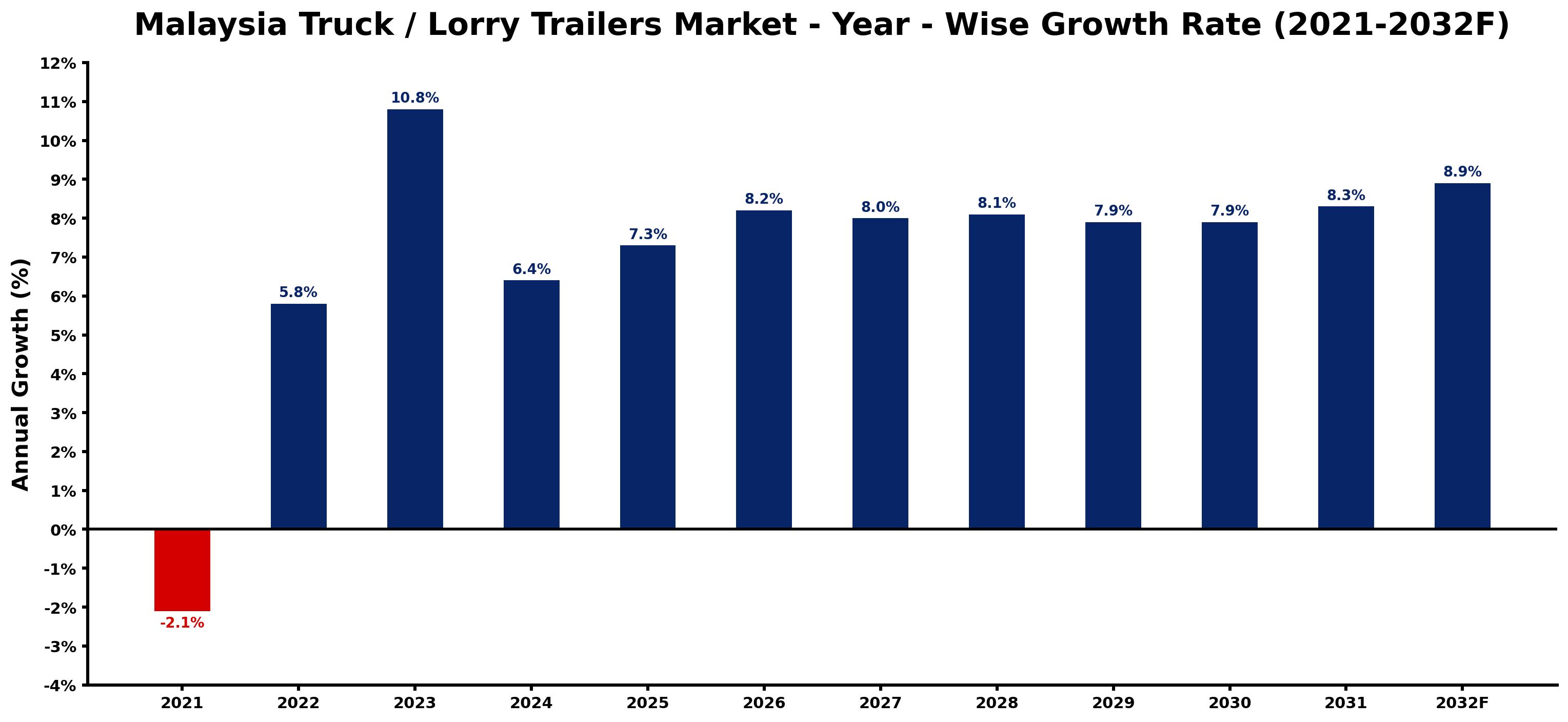
The table below presents the year wise growth rates along with the key drivers influencing the market
| Year | Growth Rate | Major Drivers |
| 2021 | -2.1% | Supply chain disruptions impeded production capacities, leading to a notable decline in trailer availability. |
| 2022 | 5.8% | Local manufacturers expanded production capabilities, enhancing trailer availability in the market. |
| 2023 | 10.8% | Construction sector improvements bolstered demand for specialized trailers tailored for heavy loads. |
| 2024 | 6.4% | Urbanization trends prompted logistics firms to upgrade their fleets with newer models. |
| 2025 | 7.3% | Increased e-commerce activities required more efficient transportation solutions, boosting trailer sales. |
| 2026 | 8.2% | Local government infrastructure projects stimulated large-scale demand for durable lorry trailers. |
| 2027 | 8.0% | Partnerships between manufacturers and logistics companies ensured innovation in trailer technology. |
| 2028 | 8.1% | Rural development programs necessitated improved logistics, expanding trailer usage across diverse regions. |
| 2029 | 7.9% | International trade agreements facilitated easier access to advanced trailer models and technologies. |
| 2030 | 7.9% | Consumer preferences shifted toward environmentally friendly trailers, influencing market trends significantly. |
| 2031 | 8.3% | The rise of digital freight platforms encouraged smart trailer systems and related services. |
| 2032 | 8.9% | Investment in alternative energy sources inspired hybrid trailer designs, reshaping market dynamics. |
Note - Market size estimations and growth projections presented in this report are based on 6Wresearch's advanced forecasting approach, validated with industry datasets as of June 2026.
Malaysia Truck / Lorry Trailers Market Synopsis
The Malaysia Truck / Lorry Trailers Market is projected to reach 8.2% and witness significant growth during the forecast period (2026-2032). The market is anticipated to expand at a compound annual growth rate (CAGR) of 4.1%, driven primarily by escalating demand from the transport and logistics sectors. This growth is further propelled by factors such as a burgeoning population, rapid urbanization, industrial advancements, and targeted government initiatives aimed at enhancing infrastructure throughout the nation. Additionally, soaring e-commerce activities have increased the need for trucks and lorries, consequently boosting the sales of truck/lorry trailers across Malaysia. Technological innovations, particularly in telematics systems, are also being embraced by commercial operators to enhance trailer tracking capabilities, improving overall operational efficiency and safety while simultaneously lowering long-haul operational costs.
Malaysia Truck / Lorry Trailers Market Growth Drivers
Several factors are influencing the growth trajectory of the Malaysia Truck / Lorry Trailers Market. Primarily, the increase in population and urbanisation is generating higher demand for logistics and transport services. As urban areas expand, the need for reliable and efficient transport solutions becomes more pressing, thereby increasing the demand for trailers. Moreover, government policies promoting infrastructure development are inviting investments and enhancing logistics capacities. The rise of e-commerce has also transformed consumer behaviour, necessitating more robust transport solutions to meet delivery timelines. Lastly, the adoption of advanced telematics technologies by operators is proving to be a game-changer, as it not only allows for better tracking of cargo but also ensures that trailers are maintained in optimal condition, contributing to safety and efficiency.
Malaysia Truck / Lorry Trailers Market Challenges and Restraints
Despite the promising growth outlook, the Malaysia Truck / Lorry Trailers Market faces several challenges. One significant barrier is the lack of standardization in trailer designs, which can complicate adoption for some users. This inconsistency can lead to confusion regarding compatibility and regulatory compliance, ultimately hindering market penetration. Additionally, the rising costs associated with raw materials and manufacturing can place pressure on profit margins for operators and manufacturers alike. Economic fluctuations and uncertainties may also impact investment in fleet expansion, making long-term planning more difficult for businesses in the sector. Furthermore, the need for continuous technological upgrades necessitates significant capital investment, which may not be feasible for all players in the market.
Malaysia Truck / Lorry Trailers Market Government Investment and Initiatives
The Malaysian government has initiated multiple programs aimed at enhancing the infrastructure necessary for a robust Truck / Lorry Trailers Market. Investment in road networks, bridges, and transport hubs underpins the broader goal of facilitating efficient logistics operations across the country. The government is actively promoting public spending on infrastructure projects, creating new opportunities for logistics companies. Additionally, incentives for adopting advanced transport technologies are being offered to encourage operators to enhance fleet efficiency. Policies aimed at reducing emissions and promoting sustainable transport solutions are also becoming a focal point for future investments, aligning with global trends towards greener logistics. Long-term development plans highlight the importance of supporting the transport sector as a critical driver of economic growth within Malaysia.
Malaysia Truck / Lorry Trailers Market Latest Developments (May 2025 - June 2026)
Between May 2025 and June 2026, the Malaysia Truck / Lorry Trailers Market has witnessed notable developments that signal evolving market dynamics. A marked increase in e-commerce activities has prompted logistics firms to optimize their fleet operations, leading to an uptick in trailer purchases. The implementation of smart telematics solutions has gained traction, allowing operators to monitor vehicle health and optimize routing, thereby reducing costs and improving service delivery. Efforts towards sustainable practices have also been observed, with companies increasingly focusing on eco-friendly solutions, such as lightweight materials and energy-efficient designs. Additionally, ongoing dialogues between the government and industry players indicate a collaborative approach towards addressing regulatory challenges, with efforts to streamline standards and improve overall sector competitiveness.
Malaysia Truck / Lorry Trailers Market - Key Attractiveness of the Report
- 10 Years of Market Numbers
- Historical Data Starting from 2022 to 2025
- Base Year: 2025
- Forecast Data until 2032
- Key Performance Indicators Impacting the Market
- Major Upcoming Developments and Projects
Key Highlights of the Report:
- Malaysia Truck / Lorry Trailers Market Outlook
- Market Size of Malaysia Truck / Lorry Trailers Market, 2025
- Forecast of Malaysia Truck / Lorry Trailers Market, 2032F
- Historical Data and Forecast of Malaysia Truck / Lorry Trailers Revenues & Volume for the Period 2022-2032F
- Malaysia Truck / Lorry Trailers Market Trend Evolution
- Malaysia Truck / Lorry Trailers Market Drivers and Challenges
- Malaysia Truck / Lorry Trailers Price Trends
- Malaysia Truck / Lorry Trailers Porter's Five Forces
- Malaysia Truck / Lorry Trailers Industry Life Cycle
- Historical Data and Forecast of Malaysia Truck / Lorry Trailers Market Revenues & Volume By Types for the Period 2022-2032F
- Historical Data and Forecast of Malaysia Truck / Lorry Trailers Market Revenues & Volume By Articulated Dump Trucks for the Period 2022-2032F
- Historical Data and Forecast of Malaysia Truck / Lorry Trailers Market Revenues & Volume By Electric Dump Trucks for the Period 2022-2032F
- Historical Data and Forecast of Malaysia Truck / Lorry Trailers Market Revenues & Volume By Mechanical Dump Trucks for the Period 2022-2032F
- Historical Data and Forecast of Malaysia Truck / Lorry Trailers Market Revenues & Volume By Applications for the Period 2022-2032F
- Historical Data and Forecast of Malaysia Truck / Lorry Trailers Market Revenues & Volume By Mining Industry for the Period 2022-2032F
- Historical Data and Forecast of Malaysia Truck / Lorry Trailers Market Revenues & Volume By Achitechive for the Period 2022-2032F
- Historical Data and Forecast of Malaysia Truck / Lorry Trailers Market Revenues & Volume By Municipal Services for the Period 2022-2032F
- Historical Data and Forecast of Malaysia Truck / Lorry Trailers Market Revenues & Volume By Other for the Period 2022-2032F
- Malaysia Truck / Lorry Trailers Import Export Trade Statistics
- Market Opportunity Assessment By Types
- Market Opportunity Assessment By Applications
- Malaysia Truck / Lorry Trailers Top Companies Market Share
- Malaysia Truck / Lorry Trailers Competitive Benchmarking By Technical and Operational Parameters
- Malaysia Truck / Lorry Trailers Company Profiles
- Malaysia Truck / Lorry Trailers Key Strategic Recommendations






































