Malaysia Tung Oil Market Size, Share & Growth Rate
The Malaysia Tung Oil Market was estimated at USD 346 Million in 2025 and is projected to reach USD 454 Million by 2032, growing at a CAGR of 4.0% from 2026 to 2032. This growth trajectory is primarily driven by the rising demand for sustainable and eco-friendly products across multiple industries, particularly in woodworking, paints, and industrial lubricants. Malaysia's commitment to enhancing its production capabilities and promoting sustainable cultivation practices further supports this optimistic outlook.
Malaysia Tung Oil Market Year-wise Growth Rate and Key Drivers
This graph highlights how the Malaysia Tung Oil Market has steadily grown over the years, supported by major growth factors.
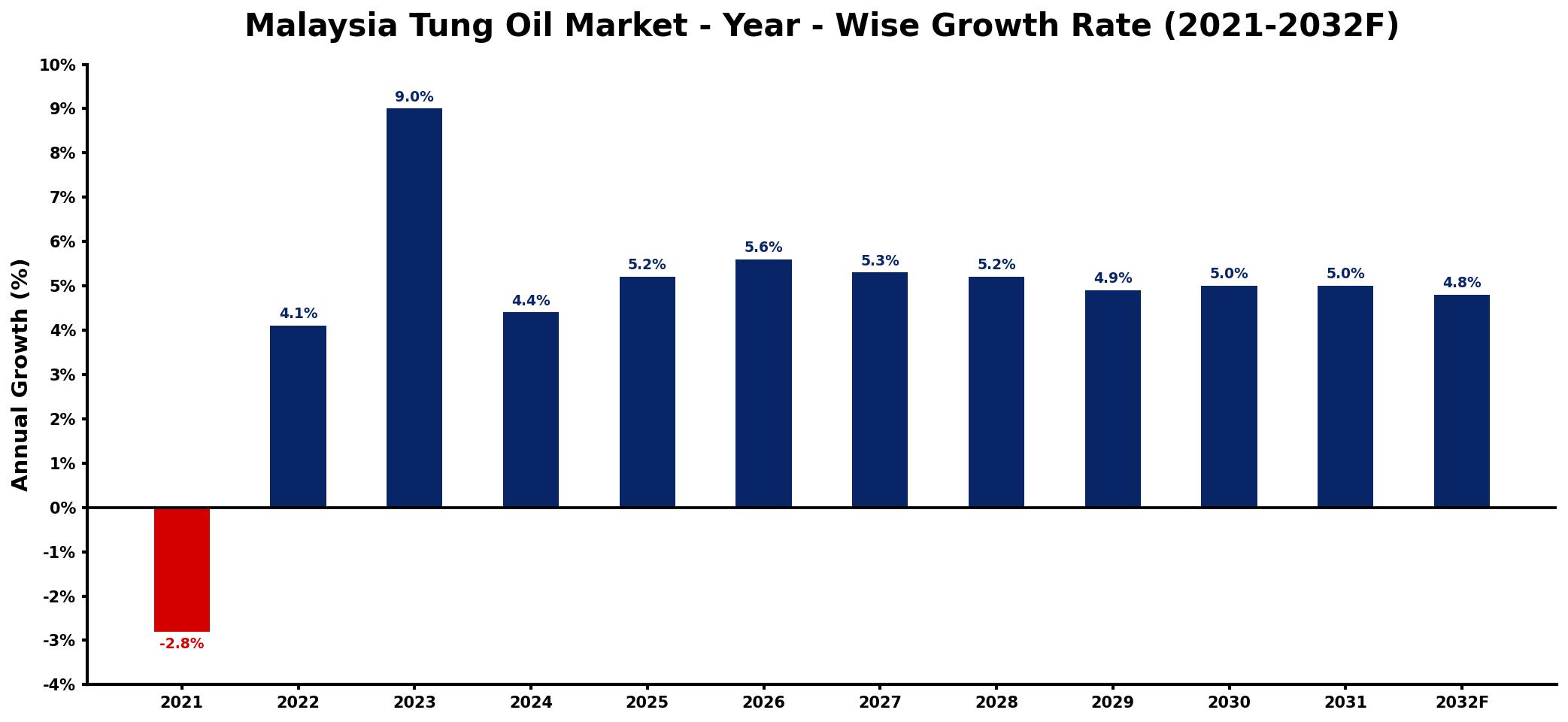
The table below presents the year‑wise growth rates along with the key drivers influencing the market
| Year | Growth Rate | Major Drivers |
| 2021 | -2.8% | decreased demand in construction sector |
| 2022 | 4.1% | increased focus on renewable materials |
| 2023 | 9.0% | growing interest in eco-friendly products |
| 2024 | 4.4% | rising investments in sustainable practices |
| 2025 | 5.2% | expansion of export markets opportunities |
| 2026 | 5.6% | surge in consumer health awareness |
| 2027 | 5.3% | development of innovative product applications |
| 2028 | 5.2% | increased collaboration with manufacturers |
| 2029 | 4.9% | enhanced regulatory support for sustainability |
| 2030 | 5.0% | growth in domestic production capacity |
| 2031 | 5.0% | emergence of new market segments |
| 2032 | 4.8% | strengthened distribution network efficiency |
Note: Market size estimations and growth projections presented in this report are based on 6Wresearch's proprietary forecasting methodology, utilizing the latest available industry data, government publications, and primary research inputs.
Malaysia Tung Oil Market Synopsis
The strongest force shaping the Malaysia tung oil market is the accelerating shift towards environmentally friendly alternatives in various industrial applications. As manufacturers seek sustainable solutions, the versatility of tung oil in paints, varnishes, and industrial lubricants becomes increasingly valuable.
Moreover, the countrys ongoing investments in expanding production capacity and refining the sustainability of its supply chain reinforce its position as a key player in the global oleochemical landscape. As industries adapt to evolving regulations and consumer preferences, Malaysias tung oil market is poised for continued expansion.
Malaysia Tung Oil Market Key Takeaways
- The Malaysia tung oil market is set for significant growth, driven by sustainable product demand.
- Investments in production capacity and supply chain improvements are enhancing market stability.
- The versatility of tung oil in multiple applications fuels its adoption across sectors.
- Climate sensitivity remains a critical factor affecting production consistency.
- Economic recovery post-COVID-19 is likely to boost market demand further.
Evaluation of Restraints in Malaysia Tung Oil Market
While the Malaysia tung oil market is experiencing growth, it faces notable restraints, particularly stemming from climate sensitivity. Tung oil trees are highly susceptible to weather fluctuations, which can significantly impact oil yields. Additionally, the need for sustainable cultivation practices is paramount; addressing diseases and pests is crucial to maintaining a consistent supply of high-quality tung oil. These factors create challenges that stakeholders must navigate to ensure long-term stability in the market.
Malaysia Tung Oil Market Trends
Several emerging trends are shaping the Malaysia tung oil market. First, there is a noticeable shift towards bio-based coatings and finishes, as industries increasingly prioritize eco-friendly options. Furthermore, advancements in cultivation techniques and oil extraction processes are improving efficiency and yield. As manufacturers seek to innovate and meet environmental regulations, the demand for high-performance, sustainable solutions will likely rise, driving the market forward.
Malaysia Tung Oil Market Opportunities
The Malaysia tung oil market presents genuine growth and investment opportunities, particularly in R&D for new applications and product development. As consumer preferences continue to shift towards sustainable options, there is a significant opportunity for manufacturers to innovate. Partnerships focusing on enhancing the sustainability of supply chains and cultivation practices can also yield substantial benefits, positioning businesses favorably in an evolving market landscape.
Government Initiatives in the Malaysia Tung Oil Market
The Malaysian government has been active in supporting the oleochemical sector through policies aimed at promoting sustainable agricultural practices and enhancing production efficiency. Public spending initiatives focus on research and development, which are critical for advancing cultivation and production techniques. Moreover, incentives for environmentally sustainable practices encourage investment in the tung oil supply chain, reinforcing Malaysia's role in the global market.
Future Insights of the Malaysia Tung Oil Market
Looking ahead to the period from 2026 to 2032, the Malaysia tung oil market is expected to continue its upward trajectory. The increasing regulatory emphasis on sustainability and environmentally friendly products will drive demand across key sectors such as construction, automotive, and consumer goods. Moreover, as production capabilities expand and technology improves, Malaysia is well-positioned to capitalize on global market trends, enhancing its competitive edge in the oleochemical industry.
Malaysia Tung Oil Market Latest Developments (2025 - 2026)
Recent developments in the Malaysia tung oil market indicate a renewed focus on improving production techniques and expanding market reach. Initiatives to strengthen the supply chain through sustainable practices have gained momentum, with various stakeholders engaging in collaborative efforts. Additionally, as global demand stabilizes post-pandemic, interest in tung oil applications has surged, signaling a positive shift in market dynamics.
Malaysia Tung Oil Market - Key Attractiveness of the Report
- 10 Years of Market Numbers
- Historical Data Starting from 2022 to 2025
- Base Year: 2025
- Forecast Data until 2032
- Key Performance Indicators Impacting the Market
- Major Upcoming Developments and Projects
Key Highlights of the Report:
- Malaysia Tung Oil Market Outlook
- Market Size of Malaysia Tung Oil Market, 2025
- Forecast of Malaysia Tung Oil Market, 2032
- Historical Data and Forecast of Malaysia Tung Oil Revenues & Volume for the Period 2022-2032F
- Malaysia Tung Oil Market Trend Evolution
- Malaysia Tung Oil Market Drivers and Challenges
- Malaysia Tung Oil Price Trends
- Malaysia Tung Oil Porter's Five Forces
- Malaysia Tung Oil Industry Life Cycle
- Historical Data and Forecast of Malaysia Tung Oil Market Revenues & Volume By Product Type for the Period 2022-2032F
- Historical Data and Forecast of Malaysia Tung Oil Market Revenues & Volume By Raw Tung Oil for the Period 2022-2032F
- Historical Data and Forecast of Malaysia Tung Oil Market Revenues & Volume By Boiled Tung Oil for the Period 2022-2032F
- Historical Data and Forecast of Malaysia Tung Oil Market Revenues & Volume By Application for the Period 2022-2032F
- Historical Data and Forecast of Malaysia Tung Oil Market Revenues & Volume By Wood Finishing for the Period 2022-2032F
- Historical Data and Forecast of Malaysia Tung Oil Market Revenues & Volume By Food and Beverage for the Period 2022-2032F
- Historical Data and Forecast of Malaysia Tung Oil Market Revenues & Volume By Medicines for the Period 2022-2032F
- Historical Data and Forecast of Malaysia Tung Oil Market Revenues & Volume By Others for the Period 2022-2032F
- Malaysia Tung Oil Import Export Trade Statistics
- Market Opportunity Assessment By Product Type
- Market Opportunity Assessment By Application
- Malaysia Tung Oil Top Companies Market Share
- Malaysia Tung Oil Competitive Benchmarking By Technical and Operational Parameters
- Malaysia Tung Oil Company Profiles
- Malaysia Tung Oil Key Strategic Recommendations






































