Malaysia Ultrasonic Cleaning Equipment Market Size, Share & Growth Rate
The Malaysia Ultrasonic Cleaning Equipment Market was estimated at USD 409 Million in 2025 and is projected to reach USD 534 Million by 2032, growing at a CAGR of 3.9% from 2026 to 2032. This robust growth can be attributed to the burgeoning healthcare sector, where stringent infection control standards necessitate advanced cleaning technologies. Additionally, the electronics and automotive industries are increasingly incorporating ultrasonic cleaners to meet elevated cleanliness benchmarks, further propelling market dynamics.
Malaysia Ultrasonic Cleaning Equipment Market Year-wise Growth Rate and Key Drivers
This graph highlights how the Malaysia Ultrasonic Cleaning Equipment Market has steadily grown over the years, supported by major growth factors.
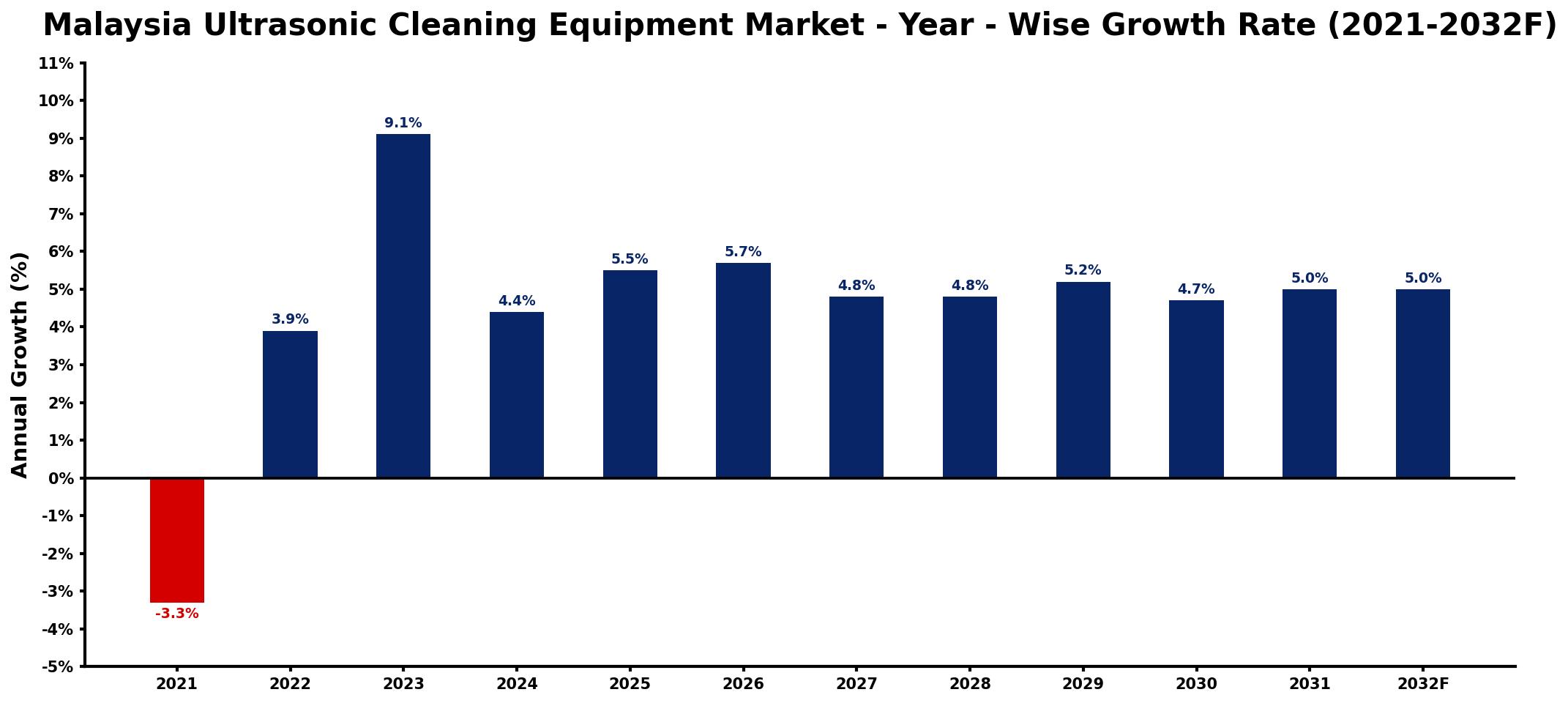
The table below presents the year‑wise growth rates along with the key drivers influencing the market
| Year | Growth Rate | Major Drivers |
| 2021 | -3.3% | decreased industrial production activities |
| 2022 | 3.9% | rising demand from healthcare sector |
| 2023 | 9.1% | increased focus on sustainability practices |
| 2024 | 4.4% | growing adoption in automotive industry |
| 2025 | 5.5% | expansion of electronic manufacturing sector |
| 2026 | 5.7% | increased investments in research initiatives |
| 2027 | 4.8% | growing regional consumption patterns |
| 2028 | 4.8% | growing popularity in jewelry sector |
| 2029 | 5.2% | increased utilization in aerospace applications |
| 2030 | 4.7% | expanding healthcare application demand |
| 2031 | 5.0% | growing interest in precision technology |
| 2032 | 5.0% | increased integration with automation systems |
Note: Market size estimations and growth projections presented in this report are based on 6Wresearch's proprietary forecasting methodology, utilizing the latest available industry data, government publications, and primary research inputs.
Malaysia Ultrasonic Cleaning Equipment Market Synopsis
Currently, the most significant force driving the Malaysia Ultrasonic Cleaning Equipment Market is the healthcare sector's unwavering commitment to infection prevention and control. Hospitals and clinics are prioritizing ultrasonic cleaning systems to ensure that surgical instruments and medical equipment are impeccably sanitized, underscoring the critical role of these technologies in patient safety.
Moreover, the increasing adoption of ultrasonic cleaners in the electronics and automotive sectors is reshaping market dynamics. As manufacturers seek to enhance product reliability and longevity, the demand for precision cleaning solutions that ultrasonic equipment provides is gaining traction. This trend not only reflects a need for higher cleaning standards but also aligns with the evolving production practices in Malaysia.
Malaysia Ultrasonic Cleaning Equipment Market Key Takeaways
- The market is witnessing substantial growth driven primarily by the healthcare sector.
- Increased focus on environmentally friendly cleaning solutions is shaping product offerings.
- Emerging trends include the integration of smart technologies and automation in cleaning processes.
- Training and workforce development will be critical as technologies evolve.
- COVID-19 has amplified the importance of cleanliness, boosting market demand for ultrasonic equipment.
Evaluation of Restraints in Malaysia Ultrasonic Cleaning Equipment Market
Despite the positive growth trajectory, the Malaysia Ultrasonic Cleaning Equipment Market faces several restraints. Regulatory scrutiny surrounding environmental sustainability is increasing, necessitating that manufacturers innovate and provide eco-friendly cleaning solutions. Additionally, competition from alternative cleaning technologies, such as laser cleaning, may challenge traditional ultrasonic methods. Companies will also need to focus on ensuring that staff are well-trained to operate sophisticated equipment, as this is essential for maximizing the benefits of ultrasonic cleaning.
Malaysia Ultrasonic Cleaning Equipment Market Trends
Current trends in the Malaysia Ultrasonic Cleaning Equipment Market indicate a strong shift towards automation and smart cleaning solutions. As industries embrace Industry 4.0 practices, there is an increasing integration of IoT technologies in ultrasonic systems, allowing for better monitoring and control of the cleaning process. This technological evolution not only enhances cleaning efficacy but also improves operational efficiency.
Furthermore, sustainability is becoming a focal point, with manufacturers exploring non-toxic cleaning agents that align with environmental regulations. This trend reflects a broader movement within the industrial sector to adopt greener practices, which are expected to resonate well with eco-conscious consumers and businesses alike.
Malaysia Ultrasonic Cleaning Equipment Market Opportunities
Investment opportunities in the Malaysia Ultrasonic Cleaning Equipment Market are abundant, particularly in healthcare and advanced manufacturing sectors. As hospitals expand and modernize their facilities, the demand for sophisticated cleaning equipment will rise correspondingly. Additionally, as the automotive industry progresses towards electric vehicle production, there will be increased needs for specialized cleaning solutions to maintain intricate components. This transition presents an opportune moment for companies that can innovate and deliver tailored cleaning technologies.
Government Initiatives in the Malaysia Ultrasonic Cleaning Equipment Market
The Malaysian government has been actively promoting initiatives aimed at enhancing the countrys manufacturing capabilities, which includes support for advanced cleaning technologies. Public spending on healthcare infrastructure is on the rise, translating into increased procurement of cleaning equipment that adheres to international standards. Furthermore, government programs encouraging eco-friendly practices are paving the way for innovation in the ultrasonic cleaning equipment segment.
Future Insights of the Malaysia Ultrasonic Cleaning Equipment Market
Looking ahead to 2026-2032, the Malaysia Ultrasonic Cleaning Equipment Market is poised for significant advancements. Driven by continuous innovations in cleaning technology and a steadfast commitment to hygiene across industries, the demand for ultrasonic cleaners is expected to remain robust. The intersection of sustainability and efficiency will also define future growth, as businesses increasingly seek solutions that meet both operational needs and environmental responsibilities.
Malaysia Ultrasonic Cleaning Equipment Market Latest Developments (2025 - 2026)
Recent developments in the ultrasonic cleaning sector indicate a heightened emphasis on research and development. Companies are prioritizing the creation of smart ultrasonic systems that incorporate real-time monitoring features, enhancing efficiency and effectiveness. Additionally, collaborations between industry players and academic institutions are fostering innovation, particularly in developing environmentally friendly cleaning solutions.
Malaysia Ultrasonic Cleaning Equipment Market - Key Attractiveness of the Report
- 10 Years of Market Numbers
- Historical Data Starting from 2022 to 2025
- Base Year: 2025
- Forecast Data until 2032
- Key Performance Indicators Impacting the Market
- Major Upcoming Developments and Projects
Key Highlights of the Report:
- Malaysia Ultrasonic Cleaning Equipment Market Outlook
- Market Size of Malaysia Ultrasonic Cleaning Equipment Market, 2025
- Forecast of Malaysia Ultrasonic Cleaning Equipment Market, 2032
- Historical Data and Forecast of Malaysia Ultrasonic Cleaning Equipment Revenues & Volume for the Period 2022-2032F
- Malaysia Ultrasonic Cleaning Equipment Market Trend Evolution
- Malaysia Ultrasonic Cleaning Equipment Market Drivers and Challenges
- Malaysia Ultrasonic Cleaning Equipment Price Trends
- Malaysia Ultrasonic Cleaning Equipment Porter's Five Forces
- Malaysia Ultrasonic Cleaning Equipment Industry Life Cycle
- Historical Data and Forecast of Malaysia Ultrasonic Cleaning Equipment Market Revenues & Volume By Type for the Period 2022-2032F
- Historical Data and Forecast of Malaysia Ultrasonic Cleaning Equipment Market Revenues & Volume By Standalone for the Period 2022-2032F
- Historical Data and Forecast of Malaysia Ultrasonic Cleaning Equipment Market Revenues & Volume By Benchtop for the Period 2022-2032F
- Historical Data and Forecast of Malaysia Ultrasonic Cleaning Equipment Market Revenues & Volume By Multistage for the Period 2022-2032F
- Historical Data and Forecast of Malaysia Ultrasonic Cleaning Equipment Market Revenues & Volume By Application for the Period 2022-2032F
- Historical Data and Forecast of Malaysia Ultrasonic Cleaning Equipment Market Revenues & Volume By Automotive for the Period 2022-2032F
- Historical Data and Forecast of Malaysia Ultrasonic Cleaning Equipment Market Revenues & Volume By Healthcare for the Period 2022-2032F
- Historical Data and Forecast of Malaysia Ultrasonic Cleaning Equipment Market Revenues & Volume By Electrical & Electronics for the Period 2022-2032F
- Historical Data and Forecast of Malaysia Ultrasonic Cleaning Equipment Market Revenues & Volume By Aerospace & Defense for the Period 2022-2032F
- Historical Data and Forecast of Malaysia Ultrasonic Cleaning Equipment Market Revenues & Volume By Others for the Period 2022-2032F
- Malaysia Ultrasonic Cleaning Equipment Import Export Trade Statistics
- Market Opportunity Assessment By Type
- Market Opportunity Assessment By Application
- Malaysia Ultrasonic Cleaning Equipment Top Companies Market Share
- Malaysia Ultrasonic Cleaning Equipment Competitive Benchmarking By Technical and Operational Parameters
- Malaysia Ultrasonic Cleaning Equipment Company Profiles
- Malaysia Ultrasonic Cleaning Equipment Key Strategic Recommendations






































