Malaysia Vegetable oils Market Summary
The malaysia vegetable oils market was estimated at USD 275 Million in 2025 and is projected to reach USD 359 Million by 2032, growing at a CAGR of 5.5% from 2026 to 2032.
Malaysia Vegetable oils Market Year-wise Growth Rate and Key Drivers
This graph highlights how the Malaysia Vegetable oils Market has steadily grown over the past five years, supported by major growth factors.
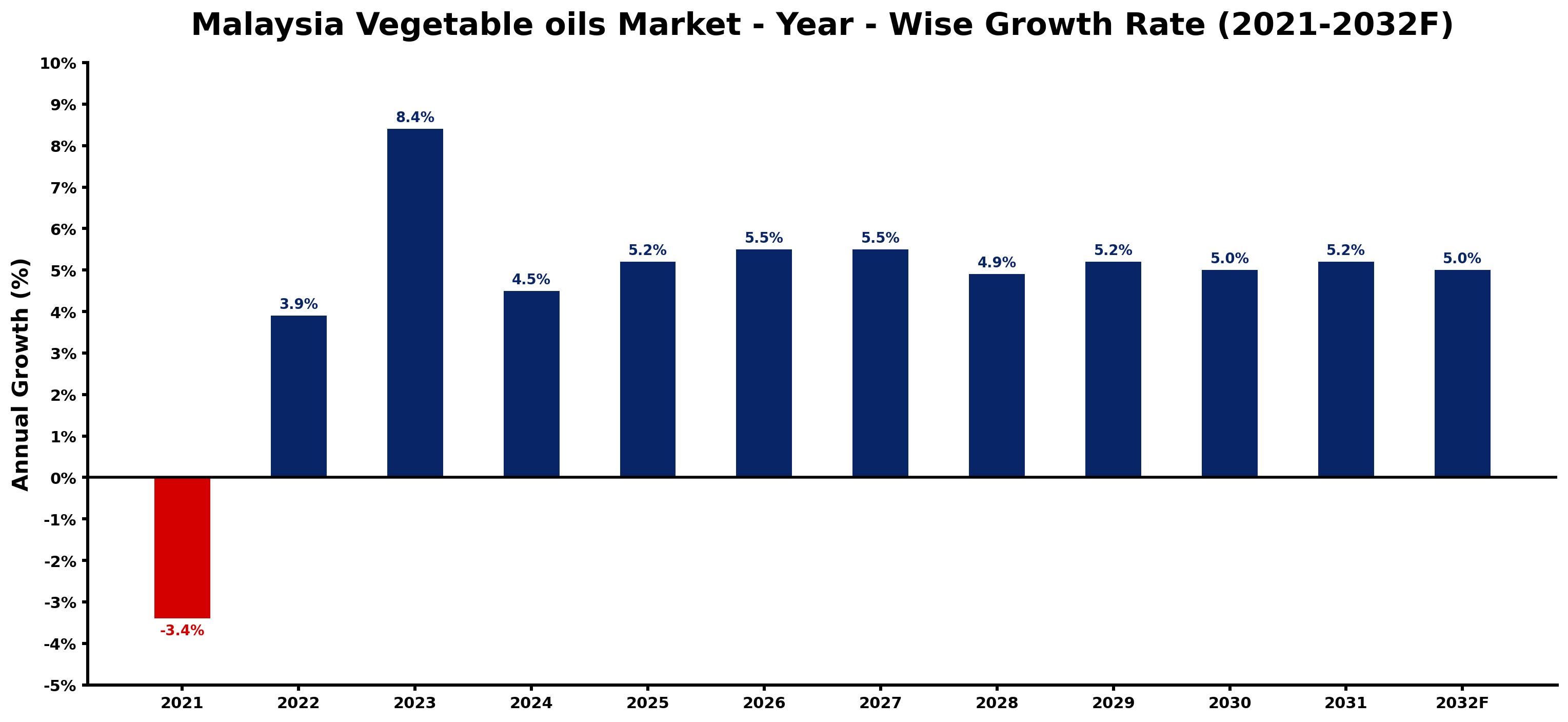
The table below presents the year wise growth rates along with the key drivers influencing the market
| Year | Growth Rate | Major Drivers |
| 2021 | -3.4% | Unfavorable weather conditions significantly decreased palm oil yields, impacting supply and driving prices up. |
| 2022 | 3.9% | A surge in health-conscious eating habits drove organic oil preferences among consumers. |
| 2023 | 8.4% | Increased local production capabilities led to a reduction in import reliance for oils. |
| 2024 | 4.5% | Adoption of innovative extraction methods improved oil yield and product quality. |
| 2025 | 5.2% | Rising awareness regarding sustainable sourcing enhanced demand for certified oils. |
| 2026 | 5.5% | Expansion of foodservice sectors directly influenced bulk purchasing of vegetable oils. |
| 2027 | 5.5% | Investment in logistics infrastructure streamlined supply chains for oil distribution. |
| 2028 | 4.9% | Emerging culinary trends highlighted the versatility of vegetable oils in various cuisines. |
| 2029 | 5.2% | Shifts in dietary patterns emphasized the role of vegetable oils in plant-based diets. |
| 2030 | 5.0% | Technological improvements in processing enhanced shelf life and consumer appeal. |
| 2031 | 5.2% | Increased export capabilities opened new markets for Malaysian vegetable oil producers. |
| 2032 | 5.0% | Growing urbanization trends led to heightened consumption of convenient cooking options. |
Note - Market size estimations and growth projections presented in this report are based on 6Wresearch's advanced forecasting approach, validated with industry datasets as of June 2026.
Malaysia Vegetable oils Market Synopsis
The Malaysia Vegetable oils Market is projected to reach 5.5% and witness significant growth during the forecast period (2026-2032). This anticipated expansion can be attributed to the rising demand for vegetable oils across diverse end-user industries, notably food processing, pharmaceuticals, and cosmetics. Enhanced consumer health consciousness and an increasing preference for natural ingredients are pivotal factors driving this growth. As consumers become more aware of the health benefits associated with vegetable oils, the market is expected to see a steady surge. Furthermore, advancements in refining processes and an increase in the variety of oil brands showcasing a broad spectrum of products will also contribute to the market's positive trajectory. Additionally, government initiatives promoting biofuel production in Malaysia are forecasted to play a crucial role in shaping the industry in the coming years.
Malaysia Vegetable oils Market Growth Drivers
Several key growth drivers are underpinning the Malaysia Vegetable oils Market. Firstly, the significant demand for vegetable oils in the food sector is fueled by a growing population, which necessitates a stable and reliable supply of cooking oils. Secondly, the pharmaceutical industry is increasingly incorporating natural oils in product formulations, enhancing the market's appeal. Thirdly, the cosmetic sector's shift towards organic and natural products is propelling the demand for vegetable oils, which are perceived as healthier alternatives. Moreover, technological advancements are resulting in improved production efficiency and oil quality, which are essential in meeting consumer expectations. Lastly, the government's role in enhancing biofuel production aligns with global sustainability trends, promoting the use of vegetable oils.
Malaysia Vegetable oils Market Trends and Opportunities
In the evolving landscape of the Malaysia Vegetable oils Market, several trends are emerging. A pronounced trend is the increasing preference for sustainably sourced and organic oils, reflecting a broader global shift towards environmentally friendly practices. Another notable trend is the diversification of product offerings by manufacturers, catering to niche markets such as specialty oils, which include cold-pressed and health-focused variants. Additionally, the rise of e-commerce platforms is transforming distribution channels, allowing for broader consumer access to a range of vegetable oil products. Opportunities also lie in the growing trend of personalized nutrition, where consumers seek oils tailored to specific dietary needs or health benefits. Lastly, increasing collaborations between agricultural sectors and technology providers present opportunities for innovation in production processes, enhancing overall market efficiency.
Malaysia Vegetable oils Market Challenges and Restraints
Despite the positive outlook, the Malaysia Vegetable oils Market faces several challenges. A primary concern is the volatility of raw material prices, which can lead to fluctuating production costs and subsequently affect pricing strategies. Additionally, competition from alternative oils, such as palm oil and sunflower oil, poses a challenge as consumers might gravitate towards more affordable options. Environmental regulations regarding agricultural practices can also increase compliance costs for producers. Furthermore, changing consumer preferences, especially among younger demographics, who are increasingly seeking innovative food products, might require rapid adaptation from industry players. Lastly, supply chain disruptions, exacerbated by global events, can affect the consistency of product availability in the market.
Malaysia Vegetable oils Market Government Investment and Initiatives
The Malaysian government is actively fostering growth within the Vegetable oils Market through various investments and initiatives. These efforts encompass policies aimed at enhancing agricultural productivity, ensuring a stable supply of raw materials for the vegetable oils sector. The government has introduced incentives for farmers to adopt sustainable agricultural practices, promoting responsible cultivation of oilseed crops. Furthermore, initiatives targeting research and development within the biofuel sector are being prioritized, aimed at increasing the utilization of vegetable oils in renewable energy solutions. Programs promoting public-private partnerships are also being encouraged to bolster technological advancements in oil processing. By focusing on sustainable practices and technological innovation, the government's initiatives are expected to significantly impact the market's growth trajectory.
Malaysia Vegetable oils Market Latest Developments (May 2025 - June 2026)
Recent developments in the Malaysia Vegetable oils Market reflect a proactive evolution within the industry. Over the past year, there has been an increasing emphasis on the integration of technology in oil refining processes, leading to enhanced yield and quality. Additionally, industry stakeholders have been working on developing new product lines to cater to the rising trend of health-conscious consumers seeking oils fortified with essential nutrients. Further, the market has observed a significant uptick in collaborations between producers and research institutions aimed at developing sustainable cultivation practices. Public awareness campaigns promoting the benefits of vegetable oils over synthetic alternatives have also gained momentum, aimed at increasing consumer education. These developments are critical in positioning the Malaysian vegetable oils sector favorably in a competitive global market.
Malaysia Vegetable oils Market - Key Attractiveness of the Report
- 10 Years of Market Numbers
- Historical Data Starting from 2022 to 2025
- Base Year: 2025
- Forecast Data until 2032
- Key Performance Indicators Impacting the Market
- Major Upcoming Developments and Projects
Key Highlights of the Report:
- Malaysia Vegetable oils Market Outlook
- Market Size of Malaysia Vegetable oils Market, 2025
- Forecast of Malaysia Vegetable oils Market, 2032F
- Historical Data and Forecast of Malaysia Vegetable oils Revenues & Volume for the Period 2022-2032F
- Malaysia Vegetable oils Market Trend Evolution
- Malaysia Vegetable oils Market Drivers and Challenges
- Malaysia Vegetable oils Price Trends
- Malaysia Vegetable oils Porter's Five Forces
- Malaysia Vegetable oils Industry Life Cycle
- Historical Data and Forecast of Malaysia Vegetable oils Market Revenues & Volume By Types for the Period 2022-2032F
- Historical Data and Forecast of Malaysia Vegetable oils Market Revenues & Volume By Palm Oil for the Period 2022-2032F
- Historical Data and Forecast of Malaysia Vegetable oils Market Revenues & Volume By Soybean Oil for the Period 2022-2032F
- Historical Data and Forecast of Malaysia Vegetable oils Market Revenues & Volume By Rapeseed Oil for the Period 2022-2032F
- Historical Data and Forecast of Malaysia Vegetable oils Market Revenues & Volume By Sunflower Oil for the Period 2022-2032F
- Historical Data and Forecast of Malaysia Vegetable oils Market Revenues & Volume By Olive Oil for the Period 2022-2032F
- Historical Data and Forecast of Malaysia Vegetable oils Market Revenues & Volume By Others for the Period 2022-2032F
- Historical Data and Forecast of Malaysia Vegetable oils Market Revenues & Volume By Applications for the Period 2022-2032F
- Historical Data and Forecast of Malaysia Vegetable oils Market Revenues & Volume By Food for the Period 2022-2032F
- Historical Data and Forecast of Malaysia Vegetable oils Market Revenues & Volume By Feed for the Period 2022-2032F
- Historical Data and Forecast of Malaysia Vegetable oils Market Revenues & Volume By Industrial for the Period 2022-2032F
- Malaysia Vegetable oils Import Export Trade Statistics
- Market Opportunity Assessment By Types
- Market Opportunity Assessment By Applications
- Malaysia Vegetable oils Top Companies Market Share
- Malaysia Vegetable oils Competitive Benchmarking By Technical and Operational Parameters
- Malaysia Vegetable oils Company Profiles
- Malaysia Vegetable oils Key Strategic Recommendations






































