Malaysia Vetiver Oil Market Size, Share & Growth Rate
The Malaysia Vetiver Oil Market was estimated at USD 161 Million in 2025 and is projected to reach USD 210 Million by 2032, growing at a CAGR of 3.9% from 2026 to 2032. This upward trajectory is propelled by the increasing consumer preference for natural fragrances and the booming wellness sector, particularly aromatherapy, where vetiver oil is highly sought after for its calming properties. Additionally, the rising demand for organic personal care products is further driving the growth of this market.
Malaysia Vetiver Oil Market Year-wise Growth Rate and Key Drivers
This graph highlights how the Malaysia Vetiver Oil Market has steadily grown over the years, supported by major growth factors.
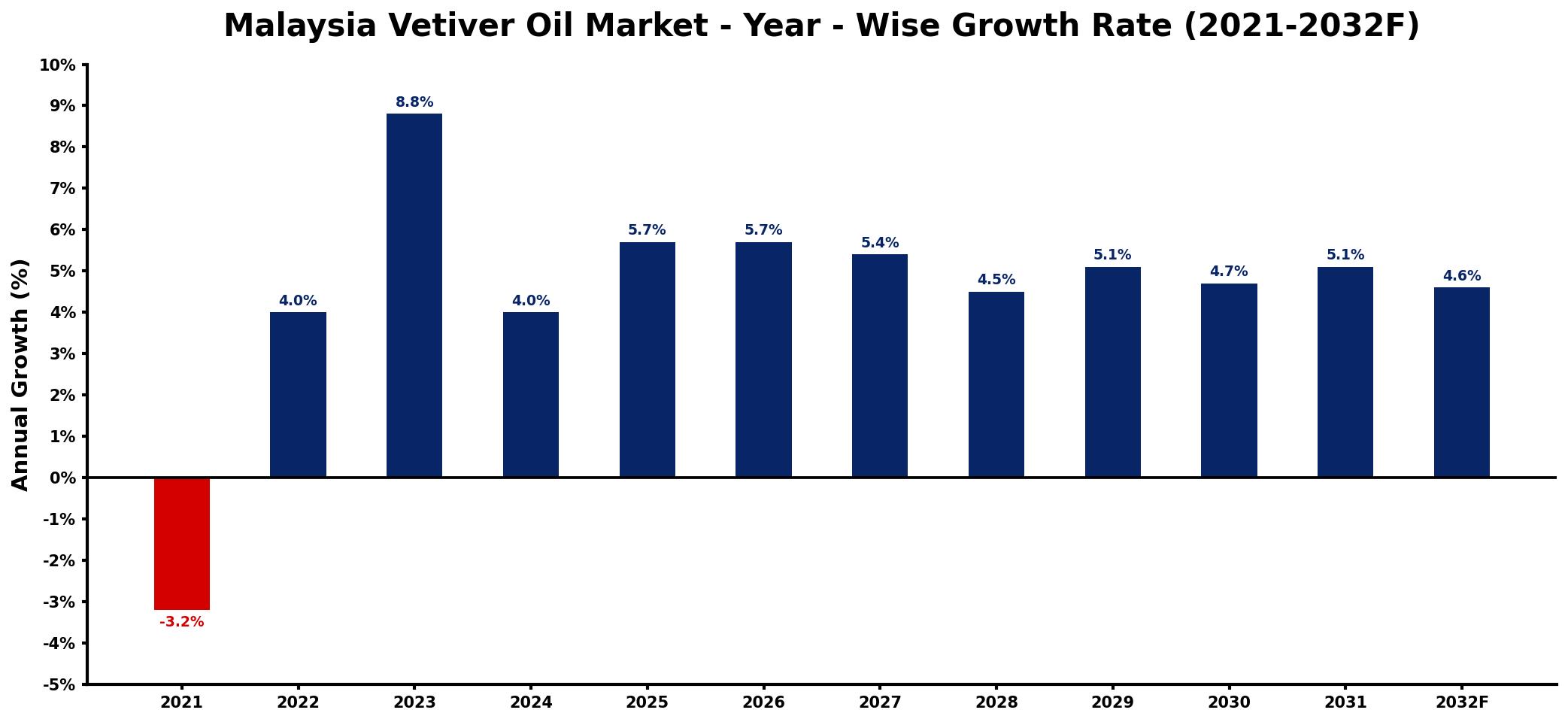
The table below presents the year‑wise growth rates along with the key drivers influencing the market
| Year | Growth Rate | Major Drivers |
| 2021 | -3.2% | decreased demand from fragrance industry |
| 2022 | 4.0% | rising interest in natural ingredients |
| 2023 | 8.8% | expansion of aromatherapy applications |
| 2024 | 4.0% | growing popularity in cosmetics |
| 2025 | 5.7% | increased investment in sustainable sourcing |
| 2026 | 5.7% | enhanced awareness of wellness benefits |
| 2027 | 5.4% | broader adoption in personal care |
| 2028 | 4.5% | surge in eco-friendly product demand |
| 2029 | 5.1% | strengthened export opportunities in Asia |
| 2030 | 4.7% | growing market for organic products |
| 2031 | 5.1% | increased utilization in home fragrances |
| 2032 | 4.6% | rising consumer preference for sustainability |
Note: Market size estimations and growth projections presented in this report are based on 6Wresearch's proprietary forecasting methodology, utilizing the latest available industry data, government publications, and primary research inputs.
Malaysia Vetiver Oil Market Synopsis
In recent years, the Malaysia vetiver oil market has gained momentum thanks to a shift towards eco-friendly and sustainable products in both the fragrance and cosmetic industries. This demand surge reflects a broader consumer trend that favors natural ingredients, offering a promising outlook for the market. Moving forward, the emphasis on quality sourcing and sustainable practices will be essential in maintaining this growth trajectory.
As consumers become more discerning regarding product origins and the ethical implications of their purchases, companies are presented with both challenges and opportunities. The focus on quality vetiver oil, alongside responsible farming practices, will define the competitive landscape, ensuring that Malaysia remains a key player in the global vetiver oil market.
Malaysia Vetiver Oil Market Key Takeaways
- The market is experiencing significant growth driven by a surge in demand for natural and organic products.
- Increased awareness of vetiver oils therapeutic properties boosts its application in wellness and aromatherapy.
- Consumer preferences are shifting towards sustainable and responsibly sourced ingredients.
- There is a growing interest from the cosmetic industry in incorporating natural oils, creating new market opportunities.
- Key players need to focus on enhancing extraction technologies for better yield and environmental sustainability.
Evaluation of Restraints in Malaysia Vetiver Oil Market
Despite the positive outlook, the Malaysia vetiver oil market grapples with significant restraints. The challenge of ensuring sustainable sourcing and extraction methods is prominent, as the global demand for responsibly sourced vetiver oil grows. Companies must navigate complex supply chains to guarantee fair compensation to local farmers, which often complicates operations. Furthermore, the investment in advanced extraction technologies that balance oil yield with minimal environmental impact is paramount for long-term success. Addressing these issues will be critical for market players aiming to solidify their positions in this dynamic market.
Malaysia Vetiver Oil Market Trends
The current trends in the Malaysia vetiver oil market reveal a heightened interest in organic and natural ingredients across consumer sectors. Aromatherapy continues to flourish, with vetiver oil being favored for its relaxation benefits. Moreover, the beauty and personal care industry is increasingly integrating natural oils, driven by consumer demands for transparency and sustainability in formulations. The trend towards minimalism in beauty products also paves the way for concentrated, effective natural oils like vetiver to take center stage.
Malaysia Vetiver Oil Market Opportunities
Significant growth opportunities lie in expanding the applications of vetiver oil beyond traditional uses. Innovative formulations in cosmetics and skincare that leverage vetivers aromatic and therapeutic properties can attract new consumer segments. Additionally, exploring export opportunities in regions with growing demand for natural oils presents a viable path for market expansion. Companies can also invest in education and marketing strategies that highlight the benefits of vetiver oil, effectively differentiating their offerings in a crowded marketplace.
Government Initiatives in the Malaysia Vetiver Oil Market
The Malaysian government has shown a commitment to supporting the natural products sector, including vetiver oil cultivation. Policies promoting sustainable agricultural practices and providing training for local farmers aim to enhance the quality and yield of vetiver crops. Additionally, initiatives focusing on eco-tourism and the marketing of natural products are expected to bolster local economies and promote the unique qualities of Malaysian vetiver oil on the global stage.
Future Insights of the Malaysia Vetiver Oil Market
Looking ahead to 2026-2032, the Malaysia vetiver oil market is poised for robust growth as consumer preferences evolve towards natural and organic products. The intersection of wellness and beauty will likely dominate market trends, with vetiver oil's calming properties making it a staple in aromatherapy and personal care items. Strategic collaborations between producers and cosmetic companies will further enhance product innovation and market penetration, ensuring that Malaysia remains a significant player in the global vetiver oil landscape.
Malaysia Vetiver Oil Market Latest Developments (2025 - 2026)
In the latest developments, the Malaysia vetiver oil market has witnessed a surge in interest from international brands seeking to incorporate high-quality natural ingredients into their products. Companies are increasingly focusing on sustainability, with several introducing transparent sourcing initiatives and eco-friendly packaging solutions. This shift aligns with global trends toward environmental consciousness and responsible consumerism. As the market adapts, research and development efforts aimed at enhancing extraction processes are anticipated, setting the stage for innovation in product offerings.
Malaysia Vetiver Oil Market - Key Attractiveness of the Report
- 10 Years of Market Numbers
- Historical Data Starting from 2022 to 2025
- Base Year: 2025
- Forecast Data until 2032
- Key Performance Indicators Impacting the Market
- Major Upcoming Developments and Projects
Key Highlights of the Report:
- Malaysia Vetiver Oil Market Outlook
- Market Size of Malaysia Vetiver Oil Market, 2025
- Forecast of Malaysia Vetiver Oil Market, 2032
- Historical Data and Forecast of Malaysia Vetiver Oil Revenues & Volume for the Period 2022-2032F
- Malaysia Vetiver Oil Market Trend Evolution
- Malaysia Vetiver Oil Market Drivers and Challenges
- Malaysia Vetiver Oil Price Trends
- Malaysia Vetiver Oil Porter's Five Forces
- Malaysia Vetiver Oil Industry Life Cycle
- Historical Data and Forecast of Malaysia Vetiver Oil Market Revenues & Volume By Application for the Period 2022-2032F
- Historical Data and Forecast of Malaysia Vetiver Oil Market Revenues & Volume By Medical for the Period 2022-2032F
- Historical Data and Forecast of Malaysia Vetiver Oil Market Revenues & Volume By Food & Beverage for the Period 2022-2032F
- Historical Data and Forecast of Malaysia Vetiver Oil Market Revenues & Volume By Spa & Relaxation for the Period 2022-2032F
- Malaysia Vetiver Oil Import Export Trade Statistics
- Market Opportunity Assessment By Application
- Malaysia Vetiver Oil Top Companies Market Share
- Malaysia Vetiver Oil Competitive Benchmarking By Technical and Operational Parameters
- Malaysia Vetiver Oil Company Profiles
- Malaysia Vetiver Oil Key Strategic Recommendations






































