Malaysia Wash Basins Market Size, Share & Growth Rate
The Malaysia Wash Basins Market was estimated at USD 430 Million in 2025 and is projected to reach USD 561 Million by 2032, growing at a CAGR of 3.9% from 2026 to 2032. This growth is primarily fueled by the vibrant construction and real estate sectors, which are witnessing a surge in both residential and commercial projects. As more homeowners and businesses seek modern, aesthetically pleasing bathroom fixtures, demand for innovative wash basins continues to rise.
Malaysia Wash Basins Market Year-wise Growth Rate and Key Drivers
This graph highlights how the Malaysia Wash Basins Market has steadily grown over the years, supported by major growth factors.
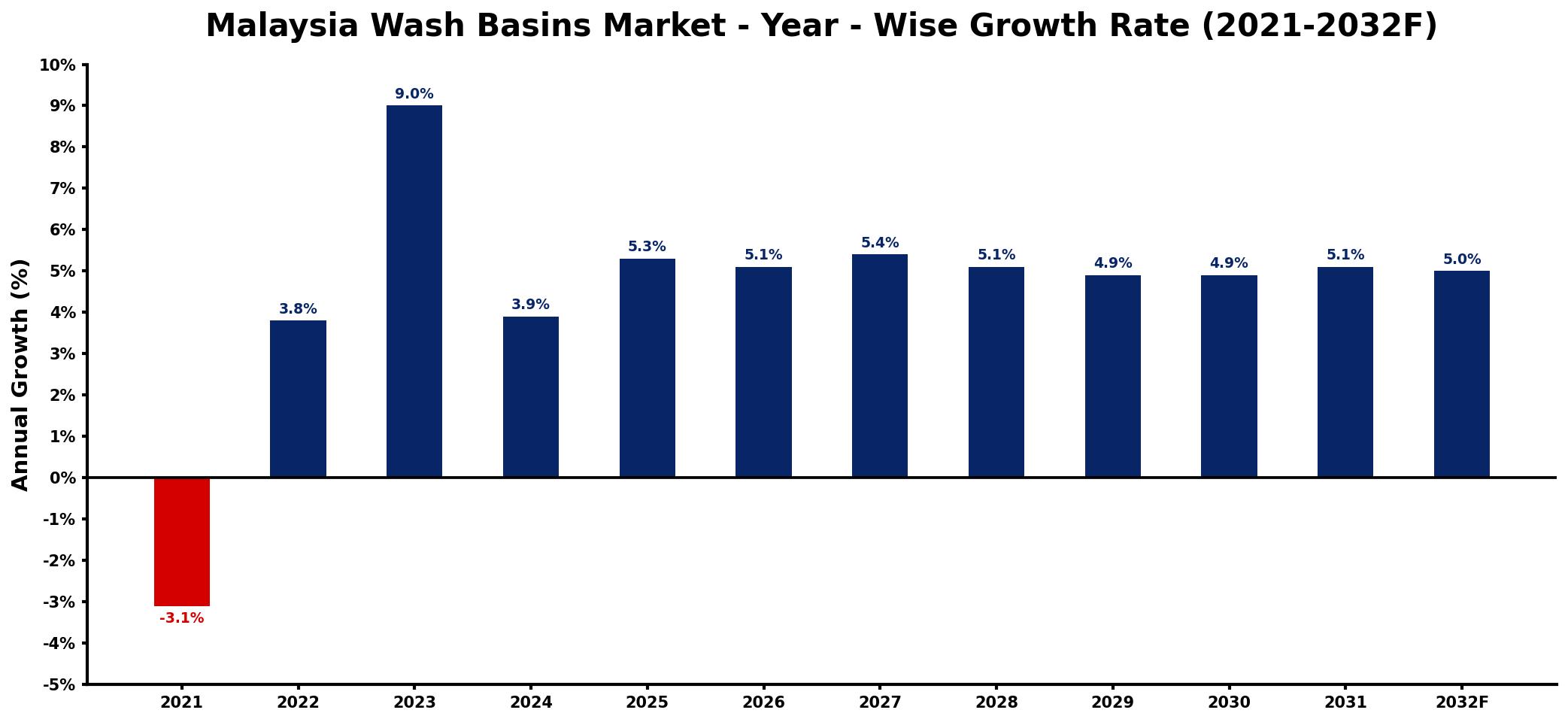
The table below presents the year‑wise growth rates along with the key drivers influencing the market
| Year | Growth Rate | Major Drivers |
| 2021 | -3.1% | decreased consumer renovation projects |
| 2022 | 3.8% | increased residential construction activities |
| 2023 | 9.0% | growing trend in eco-friendly designs |
| 2024 | 3.9% | rising disposable income levels |
| 2025 | 5.3% | expansion of online retail platforms |
| 2026 | 5.1% | increased focus on interior aesthetics |
| 2027 | 5.4% | growth in hospitality sector investments |
| 2028 | 5.1% | increased urbanization and population density |
| 2029 | 4.9% | rising demand for luxury fixtures |
| 2030 | 4.9% | enhanced awareness of sustainable materials |
| 2031 | 5.1% | increase in building regulations compliance |
| 2032 | 5.0% | improved raw material availability |
Note: Market size estimations and growth projections presented in this report are based on 6Wresearch's proprietary forecasting methodology, utilizing the latest available industry data, government publications, and primary research inputs.
Malaysia Wash Basins Market Synopsis
In Malaysia, the increasing urban population is leading to a heightened demand for stylish and functional wash basins. This has resulted in manufacturers innovating with new designs and sustainable materials to cater to evolving consumer preferences. Furthermore, a focus on modernizing bathrooms enhances the appeal of wash basins in contemporary architecture.
Post-COVID-19, there has been a notable shift towards products that prioritize hygiene and sanitation. As consumers become more aware of the importance of cleanliness in their personal spaces, the demand for advanced wash basins equipped with enhanced functionalities is also on the rise.
Malaysia Wash Basins Market Key Takeaways
- Growth driven by booming construction and real estate sectors.
- Urbanization is increasing the demand for modern bathroom fixtures.
- Sustainability initiatives are shaping the design and technology of wash basins.
- Consumer preferences are shifting towards hygienic and functional designs.
- Major players are responding with innovative materials and aesthetics.
Evaluation of Restraints in Malaysia Wash Basins Market
Despite the positive growth trajectory, the Malaysia Wash Basins Market faces certain restraints that could limit its potential. Intense price competition among manufacturers often leads to reduced profit margins, making it challenging for companies to invest in innovation. Additionally, the rapid evolution of consumer preferences necessitates ongoing advancements in design and materials, which can strain resources. Finally, increasing scrutiny around sustainability practices raises concerns about water usage and waste disposal, compelling manufacturers to adapt quickly to remain compliant and competitive.
Malaysia Wash Basins Market Trends
A prominent trend in the Malaysia Wash Basins Market is the integration of smart technology into bathroom fixtures. Consumers are increasingly attracted to features that enhance convenience and efficiency, such as touchless controls and built-in water-saving mechanisms. Additionally, there is a rising interest in minimalist designs that emphasize clean lines and simplicity, reflecting broader lifestyle trends towards decluttering. Moreover, the preference for eco-friendly materials is gaining traction, influencing manufacturers to seek sustainable options in their product lines.
Malaysia Wash Basins Market Opportunities
The Malaysia Wash Basins Market presents significant opportunities for growth, particularly in the renovation sector. As homeowners look to enhance the aesthetics and functionality of their bathrooms, there is an increasing demand for customized solutions tailored to individual tastes. Additionally, as urban development continues to accelerate, both residential and commercial projects will require modern wash basin installations, providing ample opportunities for manufacturers and suppliers. Furthermore, leveraging technological advancements to create innovative products can open new market segments and attract discerning consumers.
Government Initiatives in the Malaysia Wash Basins Market
The Malaysian government has taken steps to boost the construction sector, which in turn benefits the wash basins market. Initiatives promoting sustainable building practices are increasingly shaping industry standards, encouraging manufacturers to adopt environmentally friendly designs. Public spending on infrastructure development and housing projects is also contributing positively, as it creates a more extensive market for bathroom fixtures. Policies aimed at improving sanitation facilities are likely to further enhance demand for modern wash basins.
Future Insights of the Malaysia Wash Basins Market
Looking ahead to 2026-2032, the Malaysia Wash Basins Market is set to evolve in alignment with technological innovations and changing consumer expectations. As the market expands, manufacturers will likely focus more on integrating smart technologies into their products, prioritizing user-friendly features and eco-friendliness. The ongoing trend towards urbanization will sustain demand for high-quality bathroom fixtures, while the emphasis on sustainability will propel the adoption of environmentally conscious materials and designs. Overall, the future holds promising potential for growth and diversification in this dynamic market.
Malaysia Wash Basins Market Latest Developments (2025 - 2026)
Recent developments in the Malaysia Wash Basins Market have highlighted a significant push towards innovative product offerings. Companies are increasingly showcasing advanced designs that not only focus on aesthetics but also incorporate functionality and sustainability. Market players are actively engaging in partnerships to enhance their product lines with smart technology, aiming to meet the growing consumer demand for modern solutions. Additionally, industry events and trade shows have become platforms for unveiling new trends and establishing networks that will shape the future of the market.
Malaysia Wash Basins Market - Key Attractiveness of the Report
- 10 Years of Market Numbers
- Historical Data Starting from 2022 to 2025
- Base Year: 2025
- Forecast Data until 2032
- Key Performance Indicators Impacting the Market
- Major Upcoming Developments and Projects
Key Highlights of the Report:
- Malaysia Wash Basins Market Outlook
- Market Size of Malaysia Wash Basins Market, 2025
- Forecast of Malaysia Wash Basins Market, 2032
- Historical Data and Forecast of Malaysia Wash Basins Revenues & Volume for the Period 2022-2032F
- Malaysia Wash Basins Market Trend Evolution
- Malaysia Wash Basins Market Drivers and Challenges
- Malaysia Wash Basins Price Trends
- Malaysia Wash Basins Porter's Five Forces
- Malaysia Wash Basins Industry Life Cycle
- Historical Data and Forecast of Malaysia Wash Basins Market Revenues & Volume By Product for the Period 2022-2032F
- Historical Data and Forecast of Malaysia Wash Basins Market Revenues & Volume By Wash Basins with Integrated Half Pedestal for the Period 2022-2032F
- Historical Data and Forecast of Malaysia Wash Basins Market Revenues & Volume By Counter Wash Basins With/ With Out Utility Counter for the Period 2022-2032F
- Historical Data and Forecast of Malaysia Wash Basins Market Revenues & Volume By Tabletop Wash Basins for the Period 2022-2032F
- Historical Data and Forecast of Malaysia Wash Basins Market Revenues & Volume By Tabletop Wall Hung Wash Basins for the Period 2022-2032F
- Historical Data and Forecast of Malaysia Wash Basins Market Revenues & Volume By Wall Hung Wash Basins for the Period 2022-2032F
- Historical Data and Forecast of Malaysia Wash Basins Market Revenues & Volume By Application for the Period 2022-2032F
- Historical Data and Forecast of Malaysia Wash Basins Market Revenues & Volume By Domestic for the Period 2022-2032F
- Historical Data and Forecast of Malaysia Wash Basins Market Revenues & Volume By Commercial for the Period 2022-2032F
- Malaysia Wash Basins Import Export Trade Statistics
- Market Opportunity Assessment By Product
- Market Opportunity Assessment By Application
- Malaysia Wash Basins Top Companies Market Share
- Malaysia Wash Basins Competitive Benchmarking By Technical and Operational Parameters
- Malaysia Wash Basins Company Profiles
- Malaysia Wash Basins Key Strategic Recommendations






































