Malaysia Wheat Starch Market Size, Share & Growth Rate
The Malaysia Wheat Starch Market was estimated at USD 177 Million in 2025 and is projected to reach USD 229 Million by 2032, growing at a CAGR of 3.7% from 2026 to 2032. This growth trajectory is underpinned by the rising demand for functional food ingredients that provide texture and stability in processed foods. The versatility of wheat starch in various applications, alongside the increasing processed food sector, reinforces its expanding role in Malaysia's dynamic food industry.
Malaysia Wheat Starch Market Growth Rate Analysis (2021-2032)
The Malaysian wheat starch market has experienced significant fluctuations in growth over the past few years. After a decline of 3.2% in 2021, the sector rebounded with 3.9% growth in 2022, driven largely by increasing consumer demand in the food sector. This upward trend accelerated in 2023, achieving an impressive 8.6% increase, supported by strategic investments in processing technologies and infrastructure improvements. Looking ahead, growth is projected to stabilize around 4.1% in 2024, with ongoing expansion in food applications and the adoption of digitalization enhancing production efficiency. By 2033, average growth is expected to settle at approximately 4.9%, fueled by evolving consumer preferences and a more robust industrial framework in Malaysia.
Malaysia Wheat Starch Market Year-wise Growth Rate and Key Drivers
This graph highlights how the Malaysia Wheat Starch Market has steadily grown over the past five years, supported by major growth factors.
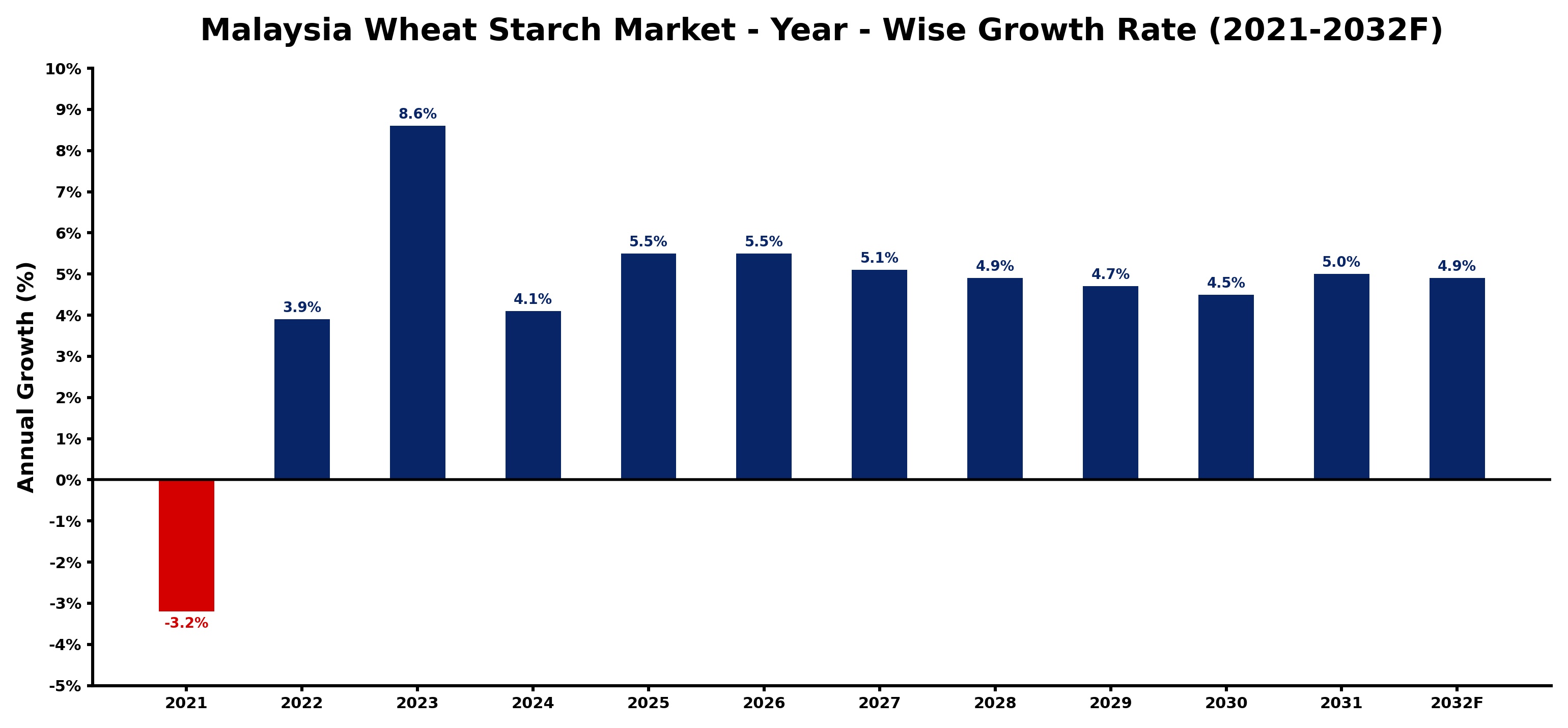
The table below presents the year‑wise growth rates along with the key drivers influencing the market
| Year | Growth Rate | Major Drivers |
| 2021 | -3.2% | Supply chain disruptions limited availability |
| 2022 | 3.9% | Foodservice expansion drove growth |
| 2023 | 8.6% | Retail expansion increased availability |
| 2024 | 4.1% | Supermarket penetration improved access |
| 2025 | 5.5% | Premium pasta adoption gained traction |
| 2026 | 5.5% | Durum wheat imports stabilized supply |
| 2027 | 5.1% | Western cuisine adoption increased |
| 2028 | 4.9% | Health food interest surged upward |
| 2029 | 4.7% | Product diversification attracted consumers |
| 2030 | 4.5% | Grocery availability enhanced distribution |
| 2031 | 5.0% | Pasta brand expansion grew significantly |
| 2032 | 4.9% | Online grocery channels boosted sales |
Note - Market size estimations and growth projections presented in this report are based on 6Wresearch's advanced forecasting approach, validated with industry datasets as of June 2026.
Malaysia Wheat Starch Market Synopsis
In Malaysia, the domestic consumption of wheat starch reached approximately 60 thousand metric tons in 2017/18, reflecting a consistent year-on-year growth rate of 4-5%. The market largely relies on imports, predominantly from China and India, due to their competitive pricing and broader product range, outpacing the limited local offerings.
As the processed food sector expands, the demand for wheat starch is propelled by its multifunctionality. It's increasingly favored for its ability to impart desirable thickening and gelling properties, making it essential in a variety of food applications such as soups, sauces, and baked goods.
Malaysia Wheat Starch Market Key Takeaways
- Robust growth expected from a projected market size of USD 177 Million in 2025 to USD 229 Million by 2032.
- Key drivers include the functional properties of wheat starch and the expansion of the processed food industry.
- Market heavily reliant on imports due to limited local production capabilities.
- Shifting consumer preferences towards clean-label products favoring natural ingredients support market growth.
- Innovative applications in both food and industrial sectors are emerging, diversifying the usage of wheat starch.
Evaluation of Restraints in Malaysia Wheat Starch Market
While the market shows promising growth, several restraints hold it back. Chief among these are supply chain disruptions, particularly those stemming from international trade restrictions that impact the availability of imported wheat starch. Additionally, competition from alternative starch sources, including native and plant-based starches, poses challenges to market players. These dynamics underscore the importance of developing local sourcing capabilities and educating stakeholders on the unique advantages of wheat starch in various applications.
Malaysia Wheat Starch Market Trends
A significant trend is the increasing consumer preference for clean-label products, as health-conscious consumers gravitate towards natural ingredients in their food. This trend aligns well with the familiar profile of wheat starch, which is viewed as a wholesome ingredient. Furthermore, as manufacturers seek to innovate their product offerings, the exploration of value-added wheat starch solutions is gaining traction. The food processing industry is particularly interested in adapting traditional recipes to accommodate evolving consumer tastes.
Malaysia Wheat Starch Market Opportunities
Genuine growth opportunities exist in the diversification of applications for wheat starch, particularly in emerging sectors such as plant-based foods and clean-label products. Investment in local wheat cultivation could bolster supply chains and reduce dependency on imports. Additionally, educational initiatives aimed at demonstrating the unique benefits of wheat starch in food formulation can open doors for wider acceptance and utilization across various food industry segments.
Government Initiatives in the Malaysia Wheat Starch Market
The Malaysian government has been focusing on boosting the agricultural sector, which includes initiatives to promote local wheat production. There are ongoing programs aimed at enhancing agricultural productivity and sustainability. Public spending in research and development for crop improvement and the establishment of better supply chain frameworks may also contribute to bolstering the wheat starch market in the region.
Future Insights of the Malaysia Wheat Starch Market
Looking ahead to 2026-2032, the Malaysia wheat starch market is poised for a transformative phase characterized by innovation and increased local sourcing. As the processed food industry continues to evolve, manufacturers will likely emphasize the need for versatile ingredients that provide texture and stability. The potential recovery post-pandemic will also stimulate renewed demand, leading to further exploration of wheat starch applications in both food and non-food sectors.
Malaysia Wheat Starch Market Latest Developments (May 2025 - June 2026)
Recent industry developments have focused on optimizing supply chains and enhancing local production capacities. There has been an uptick in research initiatives aimed at improving the quality and variety of wheat starch products available in Malaysia. Additionally, efforts to forge partnerships between local farmers and manufacturers are gaining momentum, aimed at stabilizing supply and supporting local agriculture.
Malaysia Wheat Starch Market - Key Attractiveness of the Report
- 10 Years of Market Numbers
- Historical Data Starting from 2022 to 2025
- Base Year: 2025
- Forecast Data until 2032
- Key Performance Indicators Impacting the Market
- Major Upcoming Developments and Projects
Key Highlights of the Report:
- Malaysia Wheat Starch Market Outlook
- Market Size of Malaysia Wheat Starch Market, 2025
- Forecast of Malaysia Wheat Starch Market, 2032F
- Historical Data and Forecast of Malaysia Wheat Starch Revenues & Volume for the Period 2022-2032F
- Malaysia Wheat Starch Market Trend Evolution
- Malaysia Wheat Starch Market Drivers and Challenges
- Malaysia Wheat Starch Price Trends
- Malaysia Wheat Starch Porter's Five Forces
- Malaysia Wheat Starch Industry Life Cycle
- Historical Data and Forecast of Malaysia Wheat Starch Market Revenues & Volume By Type for the Period 2022-2032F
- Historical Data and Forecast of Malaysia Wheat Starch Market Revenues & Volume By Native Wheat Starch for the Period 2022-2032F
- Historical Data and Forecast of Malaysia Wheat Starch Market Revenues & Volume By Modified Wheat Starch for the Period 2022-2032F
- Historical Data and Forecast of Malaysia Wheat Starch Market Revenues & Volume By Grade for the Period 2022-2032F
- Historical Data and Forecast of Malaysia Wheat Starch Market Revenues & Volume By Food Grade for the Period 2022-2032F
- Historical Data and Forecast of Malaysia Wheat Starch Market Revenues & Volume By Industrial Grade for the Period 2022-2032F
- Historical Data and Forecast of Malaysia Wheat Starch Market Revenues & Volume By End-Users Industry for the Period 2022-2032F
- Historical Data and Forecast of Malaysia Wheat Starch Market Revenues & Volume By Food and Beverages for the Period 2022-2032F
- Historical Data and Forecast of Malaysia Wheat Starch Market Revenues & Volume By Cosmetics for the Period 2022-2032F
- Historical Data and Forecast of Malaysia Wheat Starch Market Revenues & Volume By Others for the Period 2022-2032F
- Malaysia Wheat Starch Import Export Trade Statistics
- Market Opportunity Assessment By Type
- Market Opportunity Assessment By Grade
- Market Opportunity Assessment By End-Users Industry
- Malaysia Wheat Starch Top Companies Market Share
- Malaysia Wheat Starch Competitive Benchmarking By Technical and Operational Parameters
- Malaysia Wheat Starch Company Profiles
- Malaysia Wheat Starch Key Strategic Recommendations






































