Malaysia Whipping Cream Market Size, Share & Growth Rate
The Malaysia Whipping Cream Market was estimated at USD 393 Million in 2025 and is projected to reach USD 512 Million by 2032, growing at a CAGR of 3.9% from 2026 to 2032. This upward trajectory is fueled by an increasing consumer shift towards premium desserts and convenient, ready-to-use ingredients that simplify home baking and culinary endeavors. The strong growth in the foodservice industry, coupled with evolving consumer tastes, further underscores the market's potential.
Malaysia Whipping Cream Market Year-wise Growth Rate and Key Drivers
This graph highlights how the Malaysia Whipping Cream Market has steadily grown over the years, supported by major growth factors.
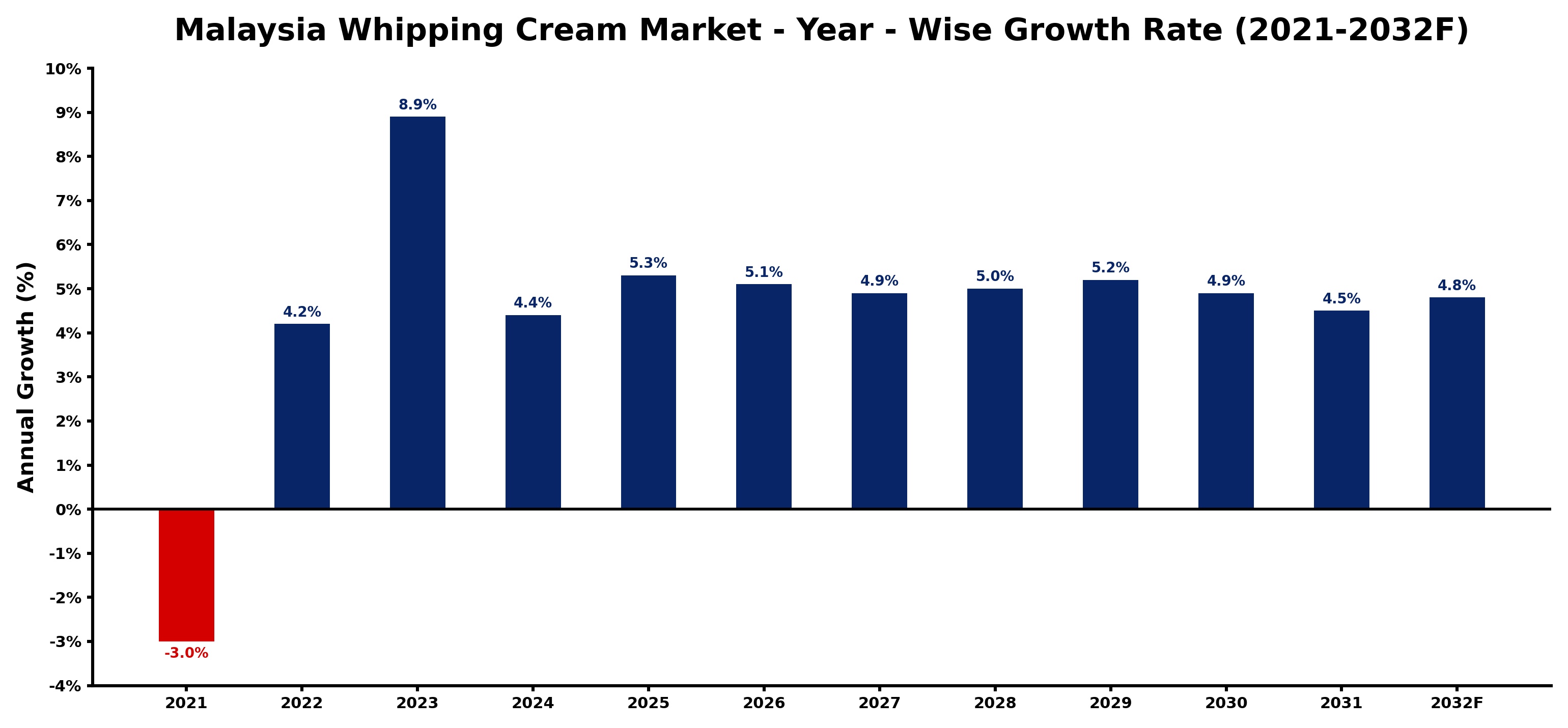
The table below presents the year‑wise growth rates along with the key drivers influencing the market
| Year | Growth Rate | Major Drivers |
| 2021 | -3.0% | Consumer preferences shifted downward |
| 2022 | 4.2% | Foodservice sector recovery accelerated |
| 2023 | 8.9% | Home baking trends gained momentum |
| 2024 | 4.4% | Dairy alternatives market expanded rapidly |
| 2025 | 5.3% | Culinary innovation attracted new customers |
| 2026 | 5.1% | Seasonal desserts popularity increased significantly |
| 2027 | 4.9% | Social media influence drove sales |
| 2028 | 5.0% | Health-conscious products gained traction |
| 2029 | 5.2% | Sustainable sourcing practices enhanced appeal |
| 2030 | 4.9% | E-commerce growth improved accessibility |
| 2031 | 4.5% | Catering services expanded market reach |
| 2032 | 4.8% | Collaborations with chefs increased visibility |
Note - Market size estimations and growth projections presented in this report are based on 6Wresearch’s advanced forecasting approach, validated with industry datasets as of June 2026.
Malaysia Whipping Cream Market Synopsis
The Malaysia whipping cream market reflects a dynamic and evolving landscape characterized by a growing appreciation for diverse dessert options among consumers. The demand for whipped cream is escalating, largely driven by its versatility in both sweet and savory applications, making it a staple in kitchens across the nation.
Recent trends indicate that convenience is a significant factor, with many households opting for ready-made desserts over traditional preparation methods. Retail outlets now showcase a variety of whipping cream options, appealing to a broad range of consumer preferences and enhancing the overall market appeal.
Malaysia Whipping Cream Market Key Takeaways
- The Malaysian whipping cream market is experiencing steady growth, underpinned by rising disposable incomes and changing lifestyles.
- Consumer demand for premium desserts and high-quality culinary experiences continues to drive the market's expansion.
- The hospitality sector's growth positively influences the uptake of whipping cream in various food applications.
- Convenience and ready-to-use products are shaping consumer purchasing decisions, further increasing market penetration.
- Innovations in product offerings and flavors are anticipated to create additional growth avenues moving forward.
Evaluation of Restraints in Malaysia Whipping Cream Market
Despite the positive outlook, the Malaysia whipping cream market faces some challenges that could hinder its growth. Consumer preferences are continually evolving, which necessitates ongoing education regarding the versatility of whipping cream in diverse culinary applications. Additionally, maintaining consistent product quality remains crucial, as fluctuations in supply chain dynamics could impact availability and pricing. As such, addressing these limitations is vital for ensuring sustained market growth in the future.
Malaysia Whipping Cream Market Trends
Current trends in the Malaysia whipping cream market reveal a strong inclination towards plant-based and healthier alternatives. As health-conscious consumers seek to indulge without compromising on nutrition, brands are responding by diversifying their product lines to include low-fat, organic, and dairy-free options. Moreover, social media's influence on food aesthetics encourages the creative use of whipping cream in elaborate desserts, driving demand even higher.
Malaysia Whipping Cream Market Opportunities
The market presents substantial opportunities for growth, particularly as the trend toward home baking and cooking continues to surge. Brands that invest in innovative marketing strategies and product development can capture the attention of younger consumers keen on experimenting with whipping cream. Additionally, partnerships with the foodservice sector can enhance market reach, opening new channels for premium product offerings.
Government Initiatives in the Malaysia Whipping Cream Market
The Malaysian government has introduced various initiatives aimed at enhancing the food and beverage industry, including regulatory frameworks that support the dairy sector. Public spending on agriculture and food security ensures a stable supply chain, encouraging the production of high-quality dairy products such as whipping cream. Furthermore, programs focusing on food safety and quality assurance contribute to consumer confidence in local products.
Future Insights of the Malaysia Whipping Cream Market
Looking ahead to 2026-2032, the Malaysia whipping cream market is poised for significant growth, driven by an increasing consumer base and a broader acceptance of whipping cream in various culinary contexts. Innovations in product formulations, particularly those that align with health trends, will be essential in capturing consumer interest. Additionally, as the foodservice sector continues to expand, the demand for high-quality whipping cream in cafes and restaurants will further bolster market dynamics.
Malaysia Whipping Cream Market Latest Developments (May 2025 - June 2026)
Recent developments in the Malaysian whipping cream market have highlighted a shift towards sustainable practices, with several manufacturers implementing eco-friendly packaging solutions. Additionally, product launches focusing on low-calorie and organic whipping creams are gaining traction, catering to a health-conscious demographic. The market is witnessing a growing emphasis on artisanal and locally sourced products, which are becoming increasingly popular among discerning consumers.
Malaysia Whipping Cream Market - Key Attractiveness of the Report
- 10 Years of Market Numbers
- Historical Data Starting from 2022 to 2025
- Base Year: 2025
- Forecast Data until 2032
- Key Performance Indicators Impacting the Market
- Major Upcoming Developments and Projects
Key Highlights of the Report:
- Malaysia Whipping Cream Market Outlook
- Market Size of Malaysia Whipping Cream Market, 2025
- Forecast of Malaysia Whipping Cream Market, 2032
- Historical Data and Forecast of Malaysia Whipping Cream Revenues & Volume for the Period 2022-2032F
- Malaysia Whipping Cream Market Trend Evolution
- Malaysia Whipping Cream Market Drivers and Challenges
- Malaysia Whipping Cream Price Trends
- Malaysia Whipping Cream Porter's Five Forces
- Malaysia Whipping Cream Industry Life Cycle
- Historical Data and Forecast of Malaysia Whipping Cream Market Revenues & Volume By Product for the Period 2022-2032F
- Historical Data and Forecast of Malaysia Whipping Cream Market Revenues & Volume By Dairy for the Period 2022-2032F
- Historical Data and Forecast of Malaysia Whipping Cream Market Revenues & Volume By Non-Dairy for the Period 2022-2032F
- Historical Data and Forecast of Malaysia Whipping Cream Market Revenues & Volume By Application for the Period 2022-2032F
- Historical Data and Forecast of Malaysia Whipping Cream Market Revenues & Volume By B2B for the Period 2022-2032F
- Historical Data and Forecast of Malaysia Whipping Cream Market Revenues & Volume By B2C for the Period 2022-2032F
- Historical Data and Forecast of Malaysia Whipping Cream Market Revenues & Volume By Distribution Channel for the Period 2022-2032F
- Historical Data and Forecast of Malaysia Whipping Cream Market Revenues & Volume By Warehouse Clubs for the Period 2022-2032F
- Historical Data and Forecast of Malaysia Whipping Cream Market Revenues & Volume By Variety Stores for the Period 2022-2032F
- Historical Data and Forecast of Malaysia Whipping Cream Market Revenues & Volume By Department Stores for the Period 2022-2032F
- Historical Data and Forecast of Malaysia Whipping Cream Market Revenues & Volume By Online Retail for the Period 2022-2032F
- Historical Data and Forecast of Malaysia Whipping Cream Market Revenues & Volume By Convenience Stores for the Period 2022-2032F
- Historical Data and Forecast of Malaysia Whipping Cream Market Revenues & Volume By Supermarkets and Hypermarket for the Period 2022-2032F
- Historical Data and Forecast of Malaysia Whipping Cream Market Revenues & Volume By Specialist Retailers for the Period 2022-2032F
- Historical Data and Forecast of Malaysia Whipping Cream Market Revenues & Volume By Others for the Period 2022-2032F
- Malaysia Whipping Cream Import Export Trade Statistics
- Market Opportunity Assessment By Product
- Market Opportunity Assessment By Application
- Market Opportunity Assessment By Distribution Channel
- Malaysia Whipping Cream Top Companies Market Share
- Malaysia Whipping Cream Competitive Benchmarking By Technical and Operational Parameters
- Malaysia Whipping Cream Company Profiles
- Malaysia Whipping Cream Key Strategic Recommendations






































