Malaysia Winding Wire Market Size, Share & Growth Rate
The Malaysia Winding Wire Market was estimated at USD 195 Million in 2025 and is projected to reach USD 254 Million by 2032, growing at a CAGR of 3.8% from 2026 to 2032. This anticipated growth trajectory is fueled by the increasing demand from the electrical and electronics sectors, particularly in the manufacturing of motors, transformers, and generators. As Malaysia invests in infrastructure and enhances its electronics capabilities, the market's potential is further bolstered by advancements in wire insulation and production technology, positioning it well for future opportunities.
Malaysia Winding Wire Market Year-wise Growth Rate and Key Drivers
This graph highlights how the Malaysia Winding Wire Market has steadily grown over the years, supported by major growth factors.
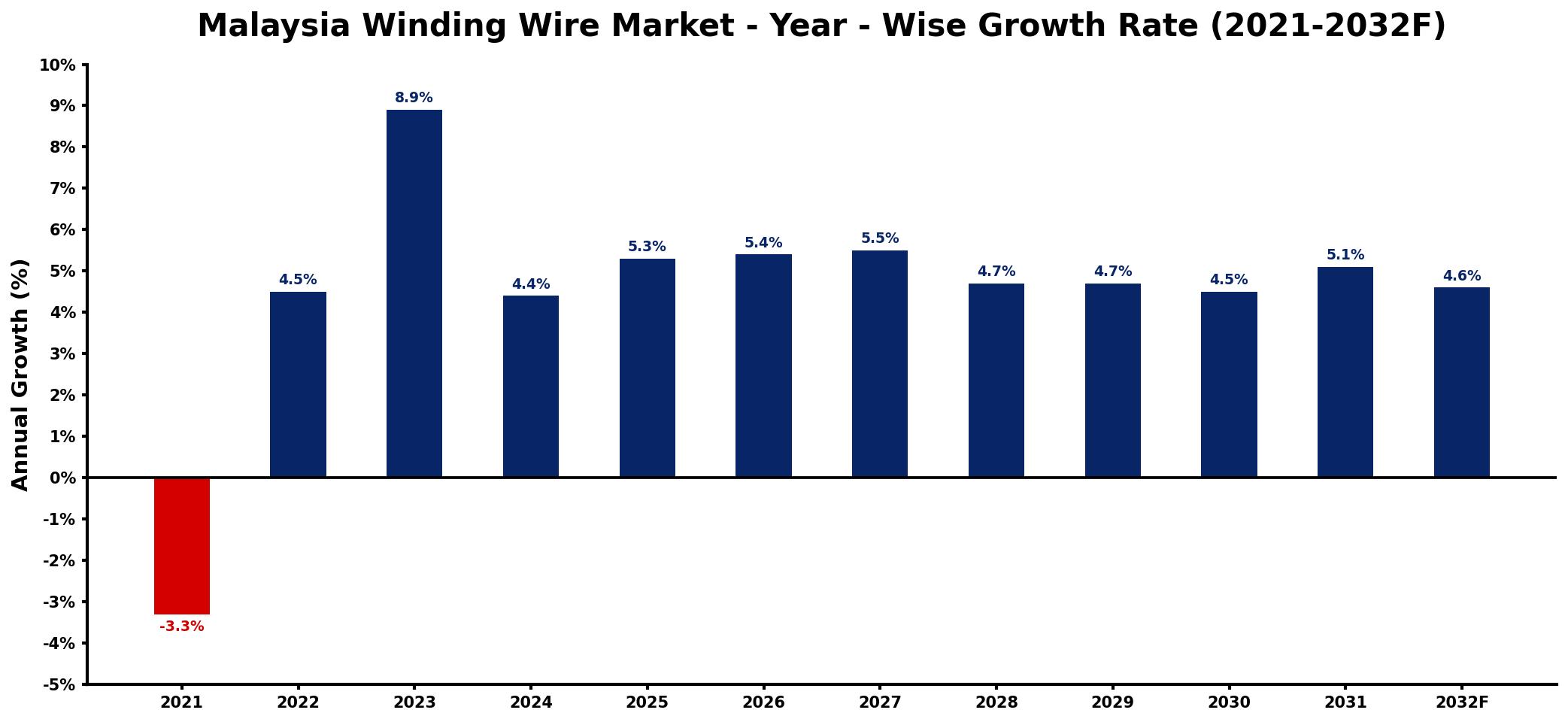
The table below presents the year‑wise growth rates along with the key drivers influencing the market
| Year | Growth Rate | Major Drivers |
| 2021 | -3.3% | slowdown in industrial investments |
| 2022 | 4.5% | renewable energy sector expansion |
| 2023 | 8.9% | improved processing technologies adoption |
| 2024 | 4.4% | increased construction activity growth |
| 2025 | 5.3% | rising demand for electronics |
| 2026 | 5.4% | enhanced manufacturing capabilities development |
| 2027 | 5.5% | growth in telecommunications infrastructure |
| 2028 | 4.7% | surge in electric vehicle adoption |
| 2029 | 4.7% | expansion of smart grid projects |
| 2030 | 4.5% | increased focus on sustainability |
| 2031 | 5.1% | growing demand for automation |
| 2032 | 4.6% | investment in green technologies |
Note: Market size estimations and growth projections presented in this report are based on 6Wresearch's proprietary forecasting methodology, utilizing the latest available industry data, government publications, and primary research inputs.
Malaysia Winding Wire Market Synopsis
Despite the recent disruptions caused by the pandemic, the Malaysia winding wire market is on a path toward steady recovery and growth. The expanding electronics and electrical manufacturing industries are driving this resurgence, highlighting the critical role of winding wires in various applications.
Looking forward, the market is expected to capitalize on advancements in manufacturing processes and insulation materials. These improvements not only enhance the performance of winding wires but also align with sustainability initiatives that are increasingly important to manufacturers and consumers alike.
Malaysia Winding Wire Market Key Takeaways
- The market is projected to grow from USD 195 Million in 2025 to USD 254 Million by 2032.
- Increased domestic and export demand for electronic goods is driving winding wire consumption.
- Advancements in wire insulation technology are enhancing the performance of winding wires.
- Investments in infrastructure and manufacturing capabilities are creating new opportunities for market players.
- Sustainability efforts are pushing manufacturers to explore eco-friendly materials in winding wire production.
Evaluation of Restraints in Malaysia Winding Wire Market
The Malaysia winding wire market faces several constraints that could hinder its growth. A significant challenge is the price competitiveness posed by low-cost imports, which can undermine local manufacturers market share. Furthermore, maintaining consistent quality standards is crucial, as winding wires are integral components of critical electrical applications. The need for continual innovation in response to evolving technologies also adds pressure on companies, necessitating ongoing investments in research and development. Together, these factors create a complex landscape that businesses must navigate to remain competitive.
Malaysia Winding Wire Market Trends
A notable trend in the Malaysia winding wire market is the increasing emphasis on eco-friendly production processes. Manufacturers are actively seeking sustainable materials and innovative techniques to reduce environmental impacts. Additionally, the integration of digital technologies within manufacturing processes is reshaping traditional production methods, enhancing efficiency and quality. Furthermore, the rise of smart technologies in electrical and electronic applications is expected to drive demand for high-performance winding wires capable of meeting the growing complexity of these systems.
Malaysia Winding Wire Market Opportunities
Growth opportunities in the Malaysia winding wire market are primarily driven by the ongoing expansion of the electronics manufacturing sector. As Malaysia positions itself as a regional hub for electronics, demand for high-quality winding wires will surge. Furthermore, investments in renewable energy and electric vehicles are likely to create new applications and markets for winding wires, offering manufacturers avenues for diversification and growth. Companies that prioritize innovation in materials and process efficiencies will be well-positioned to capitalize on these emerging opportunities.
Government Initiatives in the Malaysia Winding Wire Market
The Malaysian government has shown a strong commitment to boosting the electrical and electronics sector through various initiatives and policies. Public spending on infrastructure projects and support for technology upgrades in manufacturing are key components of its strategy. Additionally, programs aimed at encouraging research and development in sustainable manufacturing practices are pivotal in shaping the future of the winding wire market. These initiatives not only support the growth of local manufacturers but also align with broader economic goals.
Future Insights of the Malaysia Winding Wire Market
Looking ahead to 2026-2032, the Malaysia winding wire market is set for transformative growth driven by technological advancements and increased demand from the electrical sector. As industries continue to evolve towards automation and smart technologies, the need for high-quality and efficient winding wires will be paramount. Furthermore, the ongoing focus on sustainability will push manufacturers to innovate while meeting environmental standards. The combination of these factors positions the Malaysia winding wire market for a promising future, characterized by increased investments and enhanced competitiveness.
Malaysia Winding Wire Market Latest Developments (2025 - 2026)
Recent developments in the Malaysia winding wire market include a surge in investment aimed at upgrading production facilities to enhance efficiency and output quality. Companies are increasingly incorporating digital solutions to streamline operations and improve product traceability. Additionally, there is a heightened focus on collaborations between industry stakeholders and research institutions to foster innovation in materials and manufacturing processes, thereby supporting the shift towards more sustainable practices.
Malaysia Winding Wire Market - Key Attractiveness of the Report
- 10 Years of Market Numbers
- Historical Data Starting from 2022 to 2025
- Base Year: 2025
- Forecast Data until 2032
- Key Performance Indicators Impacting the Market
- Major Upcoming Developments and Projects
Key Highlights of the Report:
- Malaysia Winding Wire Market Outlook
- Market Size of Malaysia Winding Wire Market, 2025
- Forecast of Malaysia Winding Wire Market, 2032
- Historical Data and Forecast of Malaysia Winding Wire Revenues & Volume for the Period 2022-2032F
- Malaysia Winding Wire Market Trend Evolution
- Malaysia Winding Wire Market Drivers and Challenges
- Malaysia Winding Wire Price Trends
- Malaysia Winding Wire Porter's Five Forces
- Malaysia Winding Wire Industry Life Cycle
- Historical Data and Forecast of Malaysia Winding Wire Market Revenues & Volume By Product for the Period 2022-2032F
- Historical Data and Forecast of Malaysia Winding Wire Market Revenues & Volume By Copper Winding Wire for the Period 2022-2032F
- Historical Data and Forecast of Malaysia Winding Wire Market Revenues & Volume By Aluminum Winding Wire for the Period 2022-2032F
- Malaysia Winding Wire Import Export Trade Statistics
- Market Opportunity Assessment By Product
- Malaysia Winding Wire Top Companies Market Share
- Malaysia Winding Wire Competitive Benchmarking By Technical and Operational Parameters
- Malaysia Winding Wire Company Profiles
- Malaysia Winding Wire Key Strategic Recommendations






































