Malaysia Wood Flooring Market Summary
The malaysia wood flooring market was estimated at USD 203 Million in 2025 and is projected to reach USD 264 Million by 2032, growing at a CAGR of 5.8% from 2026 to 2032.
Malaysia Wood Flooring Market Year-wise Growth Rate and Key Drivers
This graph highlights how the Malaysia Wood Flooring Market has steadily grown over the past five years, supported by major growth factors.
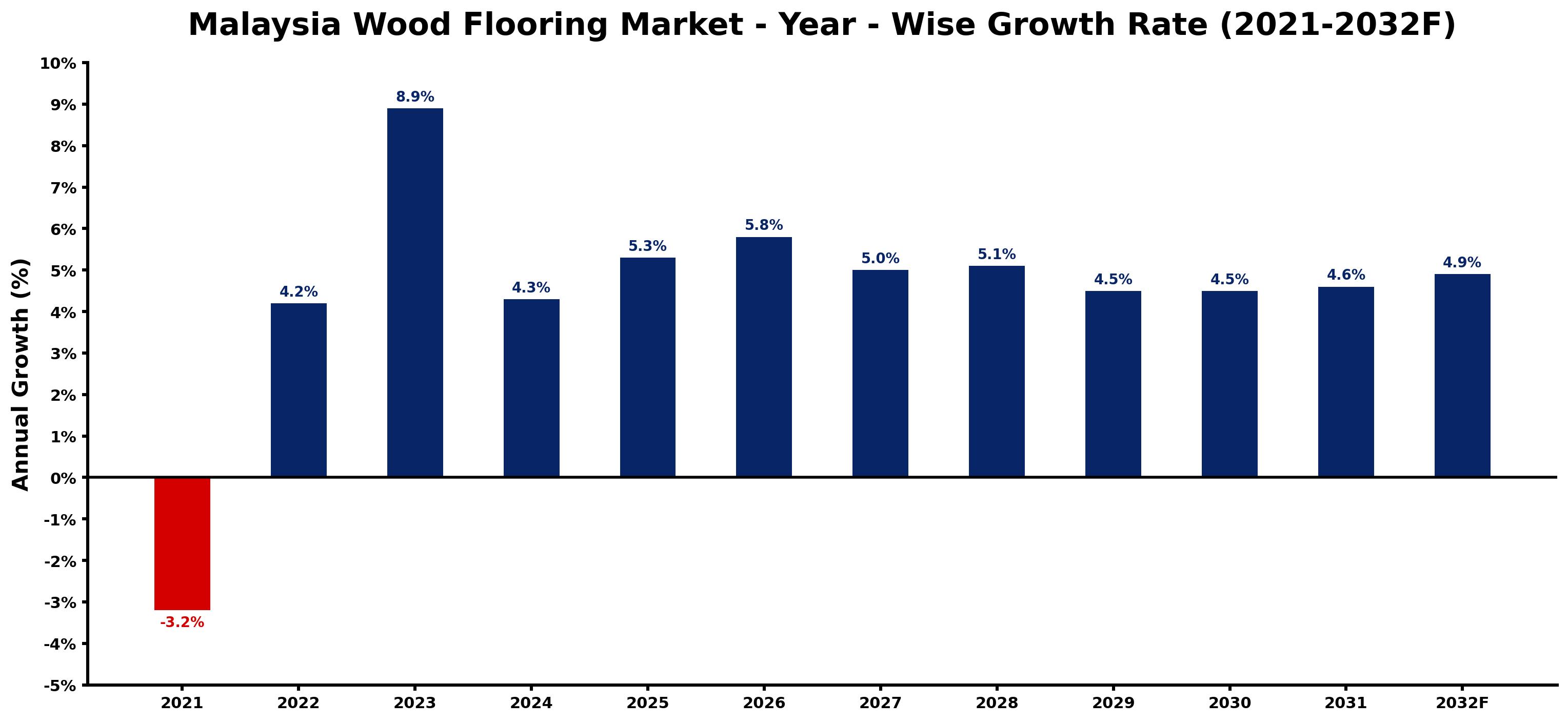
The table below presents the year wise growth rates along with the key drivers influencing the market
| Year | Growth Rate | Major Drivers |
| 2021 | -3.2% | Lingering supply chain disruptions from the pandemic hindered timely product availability, deterring consumer purchases. |
| 2022 | 4.2% | Sustainability trends prompted consumers to seek eco-friendly flooring alternatives. |
| 2023 | 8.9% | Urbanization pressures increased demand for aesthetically pleasing residential spaces. |
| 2024 | 4.3% | Technological advancements in flooring production enhanced durability and design options. |
| 2025 | 5.3% | Rising disposable incomes influenced consumer preferences towards premium wood products. |
| 2026 | 5.8% | The construction sector's expansion fueled demand for high-quality flooring solutions. |
| 2027 | 5.0% | Growing awareness of indoor air quality impacted choices for flooring materials. |
| 2028 | 5.1% | Cultural shifts towards modern design featured wood flooring as a popular choice. |
| 2029 | 4.5% | Increased real estate developments created a competitive landscape for flooring suppliers. |
| 2030 | 4.5% | Home automation trends influenced integrated flooring solutions with smart technologies. |
| 2031 | 4.6% | The tourism sector's rebound led to more investments in hospitality flooring upgrades. |
| 2032 | 4.9% | Emerging market players introduced innovative designs, diversifying the wood flooring landscape. |
Note - Market size estimations and growth projections presented in this report are based on 6Wresearch's advanced forecasting approach, validated with industry datasets as of June 2026.
Malaysia Wood Flooring Market Synopsis
The Malaysia Wood Flooring Market is projected to reach 5.8% and witness significant growth during the forecast period (2026-2032). This growth will be driven by a combination of factors, including increasing construction activities spurred by rapid urbanization, rising disposable income levels among consumers, and an escalating popularity of engineered wooden floors. The demand for wood flooring products in Malaysia is anticipated to remain robust in the coming years due to their durability and cost-effectiveness compared to alternative materials like tiles or stone. Additionally, the diverse range of options available, including laminates, solid hardwood floors, and bamboo flooring, has further fueled the market's growth.
Malaysia Wood Flooring Market Growth Drivers
Several key drivers are propelling the expansion of the Malaysia Wood Flooring Market. Firstly, the construction sector is experiencing a boom, attributed to both residential and commercial projects driven by urbanization trends. Secondly, as consumers' disposable income increases, there is a noticeable shift towards premium flooring options that offer aesthetic and functional value, such as hardwood and engineered flooring. Thirdly, the growing awareness of sustainable building practices is encouraging the adoption of environmentally friendly materials, which bolsters the appeal of wood flooring. Fourthly, the versatility of wood flooring products, which can complement various interior design styles, is attracting a broader customer base across different market segments. Lastly, ongoing government initiatives aimed at promoting forestry and sustainable practices indirectly support the wood flooring industry by ensuring the steady supply of quality raw materials.
Malaysia Wood Flooring Market Trends and Opportunities
The Malaysia Wood Flooring Market is witnessing several notable trends that present lucrative opportunities for stakeholders. One significant trend is the increasing demand for engineered wood flooring due to its enhanced stability and resistance to moisture compared to traditional solid wood options. Furthermore, technological advancements in manufacturing processes are leading to higher quality products with improved finishes and durability. Another trend is the rise of eco-conscious consumers influencing manufacturers to introduce sustainable and recycled wood flooring options. Additionally, urban dwellers are favoring innovative designs that maximize space while delivering aesthetic appeal, thereby fueling demand for customizable flooring solutions. Lastly, the integration of digital tools for enhanced customer experiences, such as augmented reality apps for visualizing flooring options, is gradually becoming more commonplace in the market.
Malaysia Wood Flooring Market Challenges and Restraints
Despite the positive growth outlook for the Malaysia Wood Flooring Market, several challenges could impede its progress. One primary concern is the fluctuation in timber prices, which can affect production costs and, subsequently, retail prices for consumers. Additionally, there is an ongoing challenge regarding the sustainability of forest resources, as over-exploitation can lead to supply shortages. The competition from alternative flooring materials, such as laminate and luxury vinyl tiles, which are often perceived as more affordable, poses a significant threat to market growth. Furthermore, the economic landscape and potential changes in consumer spending behavior could impact the demand for wood flooring. Lastly, the ongoing threat of environmental regulations related to deforestation and sustainable sourcing may also impose operational constraints on manufacturers.
Malaysia Wood Flooring Market Government Investment and Initiatives
The government of Malaysia has been actively investing in initiatives that support the wood flooring industry. Policies promoting sustainable forestry practices, such as the Mesyuarat Agung Perhutanan Negeri, are integral to ensuring a stable supply of wood resources while protecting biodiversity. Additionally, public spending on infrastructure and housing development is expected to have a positive ripple effect on the wood flooring market by increasing the demand for flooring solutions in new projects. The government also provides incentives for sustainable practices within the construction sector, encouraging the use of eco-friendly materials, including wood flooring. Furthermore, local and international exhibitions focusing on wood products often receive government backing, providing stakeholders in the wood flooring market opportunities to showcase innovations and connect with potential buyers.
Malaysia Wood Flooring Market Latest Developments (May 2025 - June 2026)
During the period from May 2025 to June 2026, the Malaysia Wood Flooring Market has seen various developments that indicate its dynamic nature. There has been an observable rise in consumer interest towards engineered wood products, with manufacturers introducing innovative features to meet changing preferences. Furthermore, the industry has begun to adopt more stringent environmental standards in response to both consumer demand and regulatory pressures, highlighting an alignment towards sustainability. Trade exhibitions and industry conferences have increased in frequency, emphasizing new technologies and trends, while fostering collaboration among stakeholders. Additionally, there is a growing trend towards digital marketing strategies, where companies leverage online platforms to enhance customer engagement and streamline sales processes. Overall, these developments underline a proactive approach within the industry to adapt to evolving market demands.
Malaysia Wood Flooring Market - Key Attractiveness of the Report
- 10 Years of Market Numbers
- Historical Data Starting from 2022 to 2025
- Base Year: 2025
- Forecast Data until 2032
- Key Performance Indicators Impacting the Market
- Major Upcoming Developments and Projects
Key Highlights of the Report:
- Malaysia Wood Flooring Market Outlook
- Market Size of Malaysia Wood Flooring Market, 2025
- Forecast of Malaysia Wood Flooring Market, 2032F
- Historical Data and Forecast of Malaysia Wood Flooring Revenues & Volume for the Period 2022-2032F
- Malaysia Wood Flooring Market Trend Evolution
- Malaysia Wood Flooring Market Drivers and Challenges
- Malaysia Wood Flooring Price Trends
- Malaysia Wood Flooring Porter's Five Forces
- Malaysia Wood Flooring Industry Life Cycle
- Historical Data and Forecast of Malaysia Wood Flooring Market Revenues & Volume By Product Type for the Period 2022-2032F
- Historical Data and Forecast of Malaysia Wood Flooring Market Revenues & Volume By Solid Wood for the Period 2022-2032F
- Historical Data and Forecast of Malaysia Wood Flooring Market Revenues & Volume By Engineered Wood for the Period 2022-2032F
- Historical Data and Forecast of Malaysia Wood Flooring Market Revenues & Volume By Distribution Channel for the Period 2022-2032F
- Historical Data and Forecast of Malaysia Wood Flooring Market Revenues & Volume By Home Centers for the Period 2022-2032F
- Historical Data and Forecast of Malaysia Wood Flooring Market Revenues & Volume By Flagship Stores for the Period 2022-2032F
- Historical Data and Forecast of Malaysia Wood Flooring Market Revenues & Volume By Specialty Stores for the Period 2022-2032F
- Historical Data and Forecast of Malaysia Wood Flooring Market Revenues & Volume By Online for the Period 2022-2032F
- Historical Data and Forecast of Malaysia Wood Flooring Market Revenues & Volume By Other for the Period 2022-2032F
- Historical Data and Forecast of Malaysia Wood Flooring Market Revenues & Volume By End-User for the Period 2022-2032F
- Historical Data and Forecast of Malaysia Wood Flooring Market Revenues & Volume By Residential for the Period 2022-2032F
- Historical Data and Forecast of Malaysia Wood Flooring Market Revenues & Volume By Commercial for the Period 2022-2032F
- Malaysia Wood Flooring Import Export Trade Statistics
- Market Opportunity Assessment By Product Type
- Market Opportunity Assessment By Distribution Channel
- Market Opportunity Assessment By End-User
- Malaysia Wood Flooring Top Companies Market Share
- Malaysia Wood Flooring Competitive Benchmarking By Technical and Operational Parameters
- Malaysia Wood Flooring Company Profiles
- Malaysia Wood Flooring Key Strategic Recommendations






































