Malaysia Wood Pellets Market Summary
The malaysia wood pellets market was estimated at USD 435 Million in 2025 and is projected to reach USD 560 Million by 2032, growing at a CAGR of 5.2% from 2026 to 2032.
Malaysia Wood Pellets Market Year-wise Growth Rate and Key Drivers
This graph highlights how the Malaysia Wood Pellets Market has steadily grown over the past five years, supported by major growth factors.
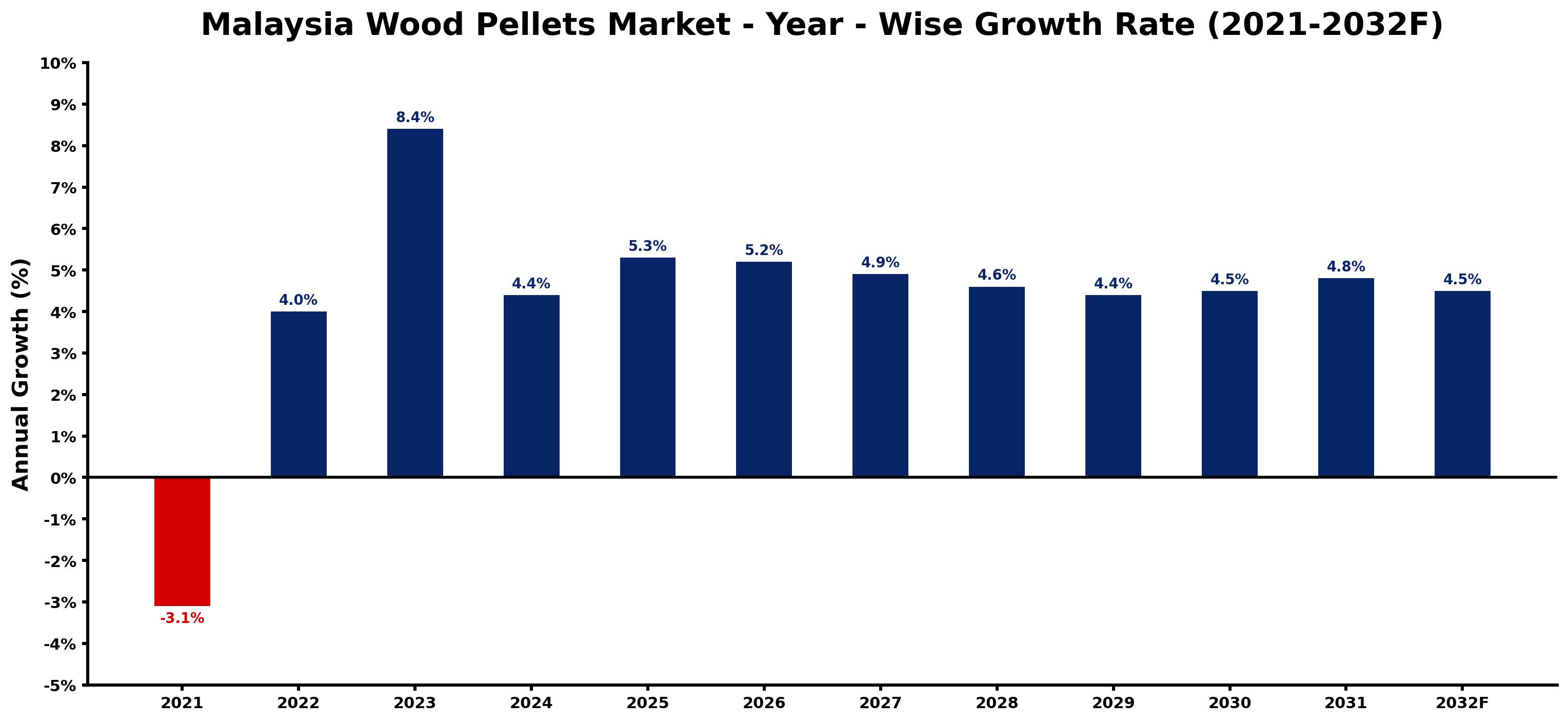
The table below presents the year wise growth rates along with the key drivers influencing the market
| Year | Growth Rate | Major Drivers |
| 2021 | -3.1% | Supply chain disruptions restricted access to essential raw materials, hindering production capabilities in the wood pellets market. |
| 2022 | 4.0% | Local manufacturers recognized opportunities in producing wood pellets for export. |
| 2023 | 8.4% | Investments in biomass technology improved production efficiency and reduced operational costs. |
| 2024 | 4.4% | Corporate sustainability goals prompted increased interest in renewable energy sources. |
| 2025 | 5.3% | Growing awareness of climate change encouraged consumers to shift towards greener alternatives. |
| 2026 | 5.2% | Infrastructure developments in rural areas created new markets for wood pellet distribution. |
| 2027 | 4.9% | Collaboration between businesses and research institutions spurred innovation in pellet production. |
| 2028 | 4.6% | Export opportunities to neighboring countries expanded the local wood pellet market significantly. |
| 2029 | 4.4% | Consumer preferences increasingly favored wood pellets for heating over traditional fuels. |
| 2030 | 4.5% | Technological advancements in pelletization processes enhanced product quality and consistency. |
| 2031 | 4.8% | Growing urbanization led to higher energy demands, boosting biomass energy solutions. |
| 2032 | 4.5% | Regional partnerships strengthened supply chains, ensuring steady wood pellet availability. |
Note - Market size estimations and growth projections presented in this report are based on 6Wresearch's advanced forecasting approach, validated with industry datasets as of June 2026.
Malaysia Wood Pellets Market Synopsis
The Malaysia Wood Pellets Market is projected to reach 5.2% and witness significant growth during the forecast period (2026-2032). This market is primarily driven by the increasing demand for renewable energy sources and government initiatives aimed at promoting sustainable resource usage. With rising awareness about environmental sustainability and a strategic pivot towards reducing dependency on fossil fuels, the Malaysia wood pellets market is expected to expand considerably throughout the forecast period.
Malaysia Wood Pellets Market Growth Drivers
Several key factors are propelling the growth of the Malaysia wood pellets market. Firstly, the government has made concerted efforts to utilize renewable sources of energy to lower greenhouse gas emissions. The introduction of the Renewable Energy Act 2011 (REA) is pivotal, as it promotes biomass as a viable alternative fuel alongside solar and wind energy. This legislative framework has stimulated investments in biomass technologies, enhancing production avenues such as biogas facilities and pelletization plants. Secondly, the increasing calorific value of wood pellets appeals to both industrial users and households, driving their demand as an energy source. Furthermore, the shift towards cleaner energy solutions, coupled with heightened regulatory measures to control air quality, augments the appeal of wood pellets. The growing global trend towards environmental consciousness also acts as a catalyst for market expansion.
Malaysia Wood Pellets Market Trends and Opportunities
The trends shaping the Malaysia wood pellets market reflect a robust move toward sustainability. The increasing integration of wood pellets in various industries signifies a broader acceptance of biomass energy. For instance, sectors such as heating, power generation, and industrial processes are increasingly adopting wood pellets due to their lower emission profiles compared to fossil fuels. Additionally, opportunities for exports to international markets are expanding as global demand for renewable energy sources burgeons. The formulation of strategic partnerships within the biomass sector can enhance logistics and distribution networks, further solidifying market growth. Moreover, the potential for technological innovations in biomass production and processing offers avenues for increased efficiency and cost-effectiveness in wood pellet manufacturing.
Malaysia Wood Pellets Market Challenges and Restraints
Despite the positive outlook, the Malaysia wood pellets market faces several challenges. One primary concern is the sourcing of raw materials, as sustainable forestry practices are crucial for long-term viability. Market participants must navigate regulatory and competitive pressures to ensure a consistent supply of biomass feedstock. Additionally, fluctuations in the global energy market can impact pricing strategies, creating volatility that can deter potential investors. The initial capital investment required for setting up pelletization facilities can also act as a barrier to entry for smaller entities looking to enter the market. Finally, there exists a need for consumer awareness and education regarding the benefits of wood pellets, which remains an essential factor in driving adoption.
Malaysia Wood Pellets Market Government Investment and Initiatives
The Malaysian government has implemented several policies and initiatives to foster the growth of the wood pellets market. A key focus lies in aligning national energy policies with global sustainability goals, promoting biomass as an integral component of the energy mix. Investments in renewable energy infrastructure underline the government's commitment to reducing reliance on fossil fuels. Notably, incentives for biomass production and processing facilities have been introduced, including tax rebates and grants aimed at enhancing the economic viability of wood pellet operations. Collaborative programs with research institutions to develop innovative technologies in biomass are also underway. Such initiatives are designed to attract private sector involvement and elevate the country's standing in the global biomass market.
Malaysia Wood Pellets Market Latest Developments (May 2025 - June 2026)
During the period from May 2025 to June 2026, the Malaysia wood pellets market has observed notable trends. There has been an uptick in research and development activities aimed at enhancing the efficiency and environmental performance of wood pellet production. Additionally, various collaborations between governmental bodies and private sectors have been initiated to bolster biomass technology advancements. Regulatory frameworks have evolved, leading to more robust standards for pellet quality, ensuring that products meet both domestic and export requirements. Efforts have also been made to improve supply chain logistics, enhancing distribution routes for wood pellets. The collective aim is to fortify Malaysia's position as a competitive player in the growing global wood pellets market.
Malaysia Wood Pellets Market - Key Attractiveness of the Report
- 10 Years of Market Numbers
- Historical Data Starting from 2022 to 2025
- Base Year: 2025
- Forecast Data until 2032
- Key Performance Indicators Impacting the Market
- Major Upcoming Developments and Projects
Key Highlights of the Report:
- Malaysia Wood Pellets Market Outlook
- Market Size of Malaysia Wood Pellets Market, 2025
- Forecast of Malaysia Wood Pellets Market, 2032F
- Historical Data and Forecast of Malaysia Wood Pellets Revenues & Volume for the Period 2022-2032F
- Malaysia Wood Pellets Market Trend Evolution
- Malaysia Wood Pellets Market Drivers and Challenges
- Malaysia Wood Pellets Price Trends
- Malaysia Wood Pellets Porter's Five Forces
- Malaysia Wood Pellets Industry Life Cycle
- Historical Data and Forecast of Malaysia Wood Pellets Market Revenues & Volume By Types for the Period 2022-2032F
- Historical Data and Forecast of Malaysia Wood Pellets Market Revenues & Volume By Hardwood for the Period 2022-2032F
- Historical Data and Forecast of Malaysia Wood Pellets Market Revenues & Volume By Softwood for the Period 2022-2032F
- Historical Data and Forecast of Malaysia Wood Pellets Market Revenues & Volume By Applications for the Period 2022-2032F
- Historical Data and Forecast of Malaysia Wood Pellets Market Revenues & Volume By Power Plants for the Period 2022-2032F
- Historical Data and Forecast of Malaysia Wood Pellets Market Revenues & Volume By Residential Heating for the Period 2022-2032F
- Historical Data and Forecast of Malaysia Wood Pellets Market Revenues & Volume By Commercial Heating for the Period 2022-2032F
- Historical Data and Forecast of Malaysia Wood Pellets Market Revenues & Volume By Combined Heat and Power (CHP) for the Period 2022-2032F
- Malaysia Wood Pellets Import Export Trade Statistics
- Market Opportunity Assessment By Types
- Market Opportunity Assessment By Applications
- Malaysia Wood Pellets Top Companies Market Share
- Malaysia Wood Pellets Competitive Benchmarking By Technical and Operational Parameters
- Malaysia Wood Pellets Company Profiles
- Malaysia Wood Pellets Key Strategic Recommendations






































