Malaysia Wood Processing Market Size, Share & Growth Rate
The Malaysia Wood Processing Market was estimated at USD 200 Million in 2025 and is projected to reach USD 259 Million by 2032, growing at a CAGR of 3.8% from 2026 to 2032. This promising growth trajectory is primarily fueled by the booming construction and furniture industries, which increasingly rely on processed wood products. Furthermore, the surge in global demand for sustainable, eco-friendly materials has prompted local manufacturers to innovate and enhance their production capabilities.
Malaysia Wood Processing Market Year-wise Growth Rate and Key Drivers
This graph highlights how the Malaysia Wood Processing Market has steadily grown over the years, supported by major growth factors.
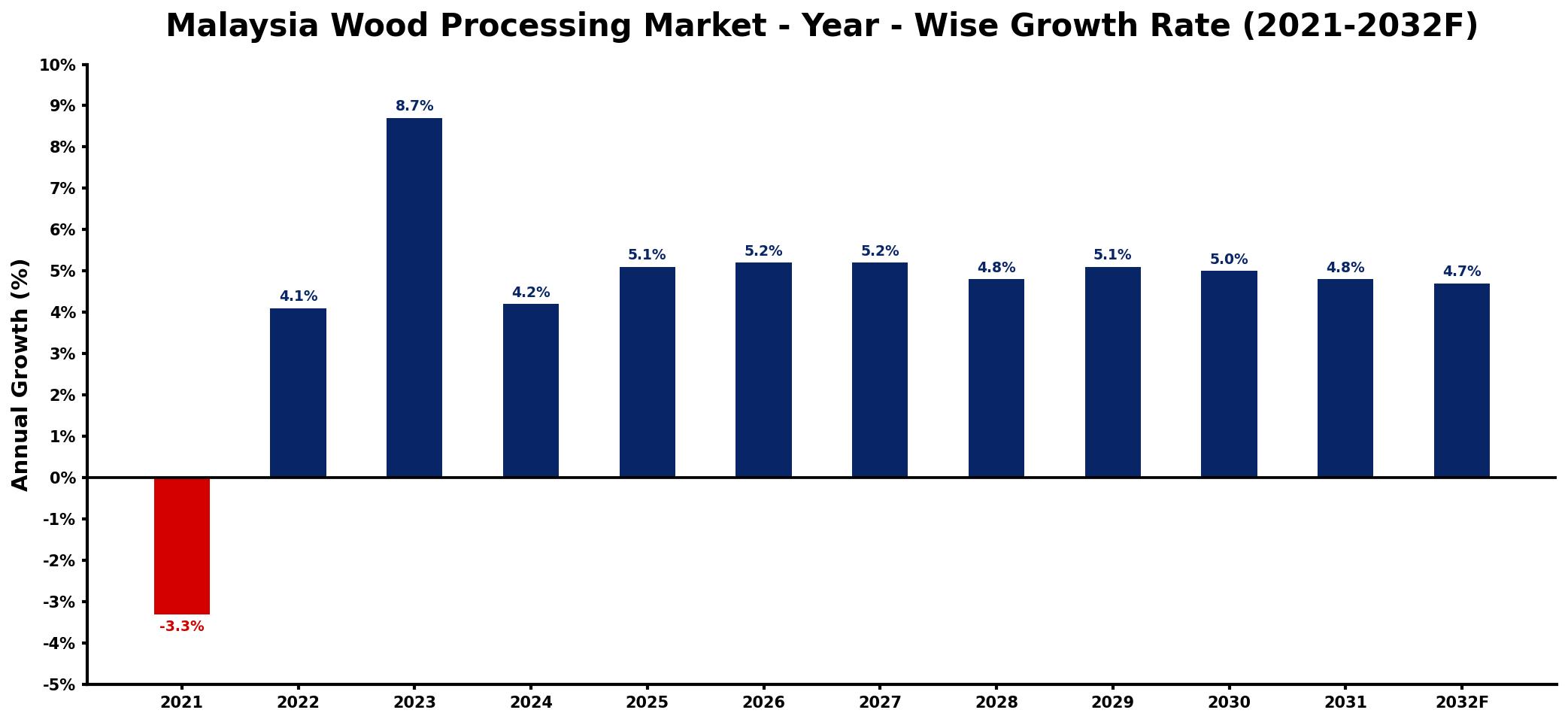
The table below presents the year‑wise growth rates along with the key drivers influencing the market
| Year | Growth Rate | Major Drivers |
| 2021 | -3.3% | decreased domestic construction activity |
| 2022 | 4.1% | growing export market opportunities |
| 2023 | 8.7% | increased furniture manufacturing demand |
| 2024 | 4.2% | rising renewable energy investments |
| 2025 | 5.1% | expansion of eco-friendly initiatives |
| 2026 | 5.2% | higher residential development projects |
| 2027 | 5.2% | increased government infrastructure spending |
| 2028 | 4.8% | growing tourism sector investments |
| 2029 | 5.1% | strengthened global trade partnerships |
| 2030 | 5.0% | increased demand for sustainable solutions |
| 2031 | 4.8% | rising urbanization driving consumption |
| 2032 | 4.7% | enhanced product quality standards |
Note: Market size estimations and growth projections presented in this report are based on 6Wresearch's proprietary forecasting methodology, utilizing the latest available industry data, government publications, and primary research inputs.
Malaysia Wood Processing Market Synopsis
With a rich tapestry of timber resources, Malaysia is strategically positioned as a leading player in the wood processing sector. The process encompasses various stages, including sawmilling and the production of value-added wood products, thereby enriching the supply chain.
The government's ongoing initiatives to promote sustainable forestry practices further bolster the market's growth potential. By fostering partnerships within the wood supply chain, local manufacturers can maximize resource utilization and enhance product quality, addressing both domestic and international demands effectively.
Malaysia Wood Processing Market Key Takeaways
- The market is driven by an abundant supply of timber and a burgeoning demand for wood products.
- Technological advancements and sustainable practices are crucial for optimizing production efficiency.
- The construction and furniture industries heavily influence market dynamics, with steady growth anticipated.
- Strategic partnerships within the supply chain are essential for enhancing competitiveness.
- Malaysia's reputation for high-quality wood products solidifies its position in the global market.
Evaluation of Restraints in Malaysia Wood Processing Market
Despite the positive growth outlook, the Malaysia Wood Processing Market faces constraints primarily related to sustainable forestry practices. As environmental concerns mount, the industry must navigate the challenges of balancing timber extraction with ecological preservation. Additionally, shifts in consumer preferences towards alternative materials can impact demand dynamics, requiring market participants to adapt swiftly. Maintaining compliance with increasingly stringent regulations also poses an ongoing challenge for manufacturers.
Malaysia Wood Processing Market Trends
Emerging trends in the Malaysia Wood Processing Market are increasingly centered around sustainability and innovation. The adoption of eco-friendly production techniques is gaining momentum, as manufacturers seek to meet global demand for responsibly sourced wood products. Additionally, advancements in technology, such as automation and smart manufacturing processes, are reshaping the industry landscape, enabling more efficient operations and enhanced product quality.
Malaysia Wood Processing Market Opportunities
Opportunities for growth and investment abound within the Malaysian wood processing sector. As the global market increasingly prioritizes sustainable materials, there is a significant opportunity for local companies to capitalize on eco-friendly wood products. Moreover, expanding into value-added manufacturing—such as engineered wood products—can open new revenue streams. Companies that embrace innovation and sustainable practices are well-positioned to capture market share both domestically and internationally.
Government Initiatives in the Malaysia Wood Processing Market
The Malaysian government is actively supporting the wood processing industry through various policies aimed at promoting sustainability and innovation. Initiatives include funding for research and development in eco-friendly wood technologies and incentivizing companies to adopt sustainable practices. Furthermore, the government has established frameworks to facilitate international trade, enhancing the competitiveness of Malaysian wood products in the global market.
Future Insights of the Malaysia Wood Processing Market
Looking ahead to the period from 2026 to 2032, the Malaysia Wood Processing Market is expected to continue its upward trajectory. As domestic construction and furniture sectors evolve, the demand for high-quality processed wood will persist. Furthermore, increasing investment in sustainable practices will not only enhance operational efficiencies but also align with global market trends. The focus on eco-friendly products will likely drive innovation, positioning Malaysia as a leading supplier of sustainable wood solutions.
Malaysia Wood Processing Market Latest Developments (2025 - 2026)
The wood processing industry in Malaysia has recently witnessed a surge in activities, as companies pivot towards enhancing production capabilities amid recovering market conditions post-COVID-19. Many manufacturers are investing in advanced machinery to improve operational efficiency and product quality. Additionally, there is a noticeable uptick in collaborations aimed at promoting sustainable practices, reflecting the industry's commitment to environmental responsibility.
Malaysia Wood Processing Market - Key Attractiveness of the Report
- 10 Years of Market Numbers
- Historical Data Starting from 2022 to 2025
- Base Year: 2025
- Forecast Data until 2032
- Key Performance Indicators Impacting the Market
- Major Upcoming Developments and Projects
Key Highlights of the Report:
- Malaysia Wood Processing Market Outlook
- Market Size of Malaysia Wood Processing Market, 2025
- Forecast of Malaysia Wood Processing Market, 2032
- Historical Data and Forecast of Malaysia Wood Processing Revenues & Volume for the Period 2022-2032F
- Malaysia Wood Processing Market Trend Evolution
- Malaysia Wood Processing Market Drivers and Challenges
- Malaysia Wood Processing Price Trends
- Malaysia Wood Processing Porter's Five Forces
- Malaysia Wood Processing Industry Life Cycle
- Historical Data and Forecast of Malaysia Wood Processing Market Revenues & Volume By Type for the Period 2022-2032F
- Historical Data and Forecast of Malaysia Wood Processing Market Revenues & Volume By Wood Chips for the Period 2022-2032F
- Historical Data and Forecast of Malaysia Wood Processing Market Revenues & Volume By Sawn Wood Lumber for the Period 2022-2032F
- Historical Data and Forecast of Malaysia Wood Processing Market Revenues & Volume By Others for the Period 2022-2032F
- Malaysia Wood Processing Import Export Trade Statistics
- Market Opportunity Assessment By Type
- Malaysia Wood Processing Top Companies Market Share
- Malaysia Wood Processing Competitive Benchmarking By Technical and Operational Parameters
- Malaysia Wood Processing Company Profiles
- Malaysia Wood Processing Key Strategic Recommendations






































