Malaysia Wood Wool Insulation Market Size, Share & Growth Rate
The Malaysia Wood Wool Insulation Market was estimated at USD 357 Million in 2025 and is projected to reach USD 465 Million by 2032, growing at a CAGR of 3.8% from 2026 to 2032. This growth trajectory is primarily driven by the rising demand for sustainable and energy-efficient construction materials amidst a growing awareness of environmental concerns. As the Malaysian construction sector shifts towards greener practices, wood wool insulations eco-friendly and versatile properties align perfectly with market needs, fueling its adoption across various building projects.
Malaysia Wood Wool Insulation Market Year-wise Growth Rate and Key Drivers
This graph highlights how the Malaysia Wood Wool Insulation Market has steadily grown over the years, supported by major growth factors.
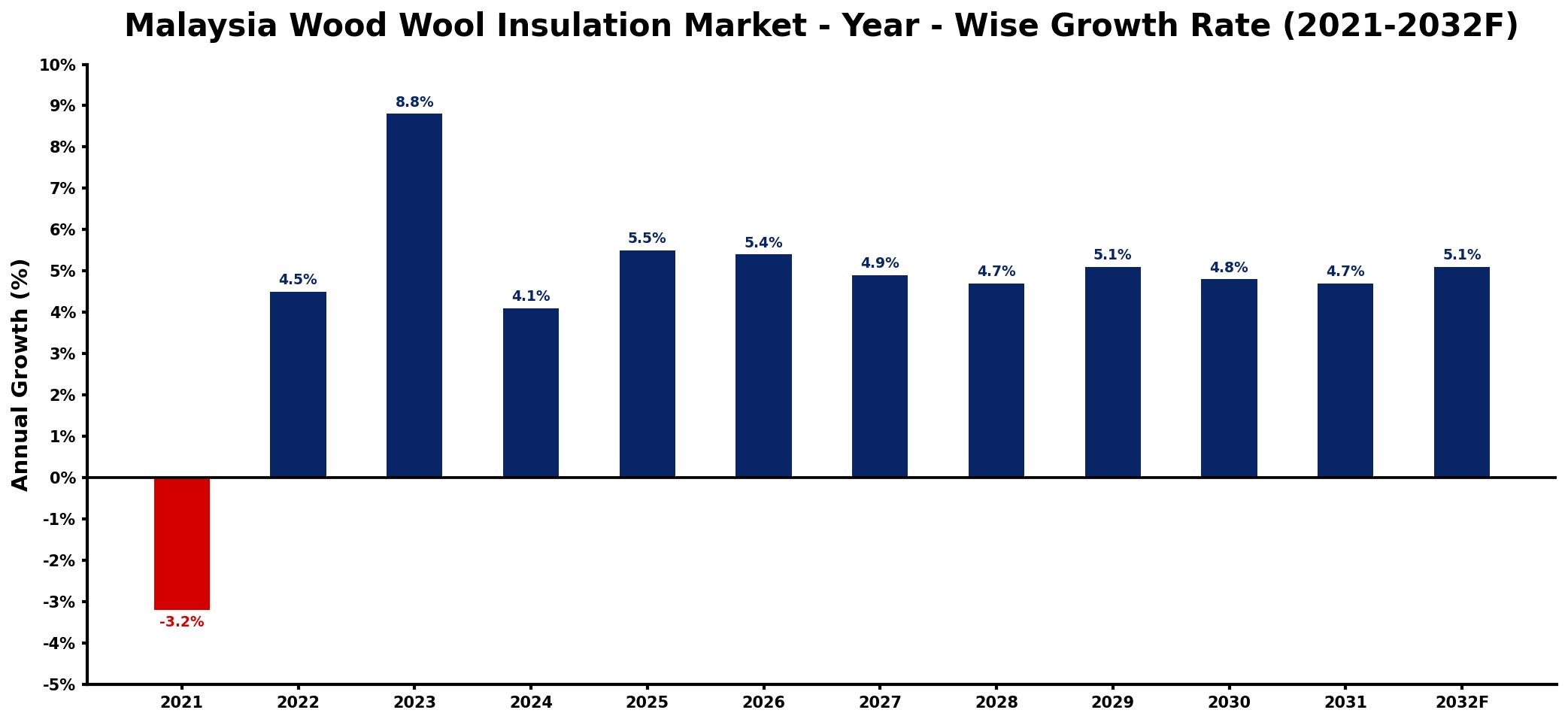
The table below presents the year‑wise growth rates along with the key drivers influencing the market
| Year | Growth Rate | Major Drivers |
| 2021 | -3.2% | decreased construction activity levels |
| 2022 | 4.5% | rising demand for eco-friendly materials |
| 2023 | 8.8% | increase in green building initiatives |
| 2024 | 4.1% | growing awareness of energy efficiency |
| 2025 | 5.5% | expansion of sustainable construction projects |
| 2026 | 5.4% | increased investment in renewable technologies |
| 2027 | 4.9% | surge in residential renovation projects |
| 2028 | 4.7% | higher consumer preference for sustainability |
| 2029 | 5.1% | growth in government incentives programs |
| 2030 | 4.8% | rising popularity of energy-efficient homes |
| 2031 | 4.7% | expanding manufacturing base activity |
| 2032 | 5.1% | increased focus on climate-friendly solutions |
Note: Market size estimations and growth projections presented in this report are based on 6Wresearch's proprietary forecasting methodology, utilizing the latest available industry data, government publications, and primary research inputs.
Malaysia Wood Wool Insulation Market Synopsis
The wood wool insulation market in Malaysia is emerging as a key player in sustainable construction practices. Its ability to provide excellent thermal and acoustic insulation while remaining eco-friendly places it at the forefront of modern building solutions. With the government's push towards green initiatives, the sector is set for significant growth.
In recent years, the construction industry in Malaysia has seen a shift towards incorporating sustainable materials that not only meet energy efficiency standards but also contribute positively to the environment. Wood wool insulation has gained traction due to its natural origins, fire-resistant properties, and versatility in application, making it an attractive option for builders and architects alike.
Malaysia Wood Wool Insulation Market Key Takeaways
- The market is driven by increasing government initiatives promoting energy-efficient building materials.
- Wood wool insulation is recognized for its thermal and acoustic benefits, enhancing its demand in various applications.
- Post-pandemic recovery in the construction sector is expected to spur further growth in wood wool insulation sales.
- The competitive landscape includes challenges from synthetic materials, necessitating a focus on quality production.
- Growing awareness of environmental sustainability is fueling consumer preference for eco-friendly insulation options.
Evaluation of Restraints in Malaysia Wood Wool Insulation Market
While the wood wool insulation market in Malaysia holds immense potential, it faces notable challenges. The competition from synthetic insulation materials presents a significant barrier, as these alternatives often come at a lower cost and with claims of superior performance. Additionally, maintaining consistent quality in wood wool production is crucial, as discrepancies can impact both performance and market acceptance. The industry's dependency on raw material availability, coupled with variations in production standards, creates a need for stringent quality control measures. Navigating these restraints will be vital for players aiming to establish a strong foothold in this growing market.
Malaysia Wood Wool Insulation Market Trends
The trend towards sustainable architecture is reshaping the Malaysian insulation landscape. Increasingly, architects and builders are seeking materials that not only provide energy efficiency but also reduce environmental impact. Wood wool insulation is being embraced for its natural composition and dual benefits of thermal insulation and sound absorption. Additionally, innovations in production methods are enhancing the performance characteristics of wood wool, making it an even more attractive choice for contemporary construction projects.
Malaysia Wood Wool Insulation Market Opportunities
The growth prospects for wood wool insulation in Malaysia are bolstered by various opportunities. With the ongoing urbanization and expansion of the construction industry, there is a substantial demand for innovative insulation solutions. Additionally, the increasing focus on energy conservation aligns perfectly with the benefits offered by wood wool insulation. Investment in research and development could yield new applications and improve material properties, further enhancing market appeal. Collaborations with government bodies to promote green building certifications could also create avenues for growth.
Government Initiatives in the Malaysia Wood Wool Insulation Market
The Malaysian government has been actively promoting sustainable building practices through various initiatives and policies. Efforts to enhance energy efficiency in construction include incentives for the adoption of eco-friendly materials, like wood wool insulation. Public spending on green infrastructure projects is expected to rise, further supporting the demand for environmentally conscious insulation solutions. Regulatory frameworks are also being refined to encourage the use of sustainable practices across the construction sector.
Future Insights of the Malaysia Wood Wool Insulation Market
As we look towards the future of the Malaysia wood wool insulation market from 2026 to 2032, several key developments are anticipated. The continued emphasis on energy-efficient and green building practices is expected to drive demand consistently. With a growing segment of environmentally conscious consumers, the focus will likely shift to products that enhance sustainability without compromising performance. As the market evolves, innovations in wood wool technology and increased awareness of its benefits will play a significant role in shaping its trajectory.
Malaysia Wood Wool Insulation Market Latest Developments (2025 - 2026)
In the latest developments, the Malaysia wood wool insulation market has witnessed a surge in interest due to rising construction activities fueled by government incentives for green buildings. Industry stakeholders have been focusing on enhancing the eco-friendliness of their products, leading to new partnerships aimed at promoting wood wool as a sustainable option. Additionally, ongoing research into advanced production techniques is expected to yield better quality and performance, positioning wood wool insulation more competitively against synthetic alternatives.
Malaysia Wood Wool Insulation Market - Key Attractiveness of the Report
- 10 Years of Market Numbers
- Historical Data Starting from 2022 to 2025
- Base Year: 2025
- Forecast Data until 2032
- Key Performance Indicators Impacting the Market
- Major Upcoming Developments and Projects
Key Highlights of the Report:
- Malaysia Wood Wool Insulation Market Outlook
- Market Size of Malaysia Wood Wool Insulation Market, 2025
- Forecast of Malaysia Wood Wool Insulation Market, 2032
- Historical Data and Forecast of Malaysia Wood Wool Insulation Revenues & Volume for the Period 2022-2032F
- Malaysia Wood Wool Insulation Market Trend Evolution
- Malaysia Wood Wool Insulation Market Drivers and Challenges
- Malaysia Wood Wool Insulation Price Trends
- Malaysia Wood Wool Insulation Porter's Five Forces
- Malaysia Wood Wool Insulation Industry Life Cycle
- Historical Data and Forecast of Malaysia Wood Wool Insulation Market Revenues & Volume By Product Type for the Period 2022-2032F
- Historical Data and Forecast of Malaysia Wood Wool Insulation Market Revenues & Volume By Stable for the Period 2022-2032F
- Historical Data and Forecast of Malaysia Wood Wool Insulation Market Revenues & Volume By Flexible for the Period 2022-2032F
- Historical Data and Forecast of Malaysia Wood Wool Insulation Market Revenues & Volume By Application for the Period 2022-2032F
- Historical Data and Forecast of Malaysia Wood Wool Insulation Market Revenues & Volume By Thermal Insulation for the Period 2022-2032F
- Historical Data and Forecast of Malaysia Wood Wool Insulation Market Revenues & Volume By Acoustic Insulation for the Period 2022-2032F
- Historical Data and Forecast of Malaysia Wood Wool Insulation Market Revenues & Volume By Electrical Insulation for the Period 2022-2032F
- Malaysia Wood Wool Insulation Import Export Trade Statistics
- Market Opportunity Assessment By Product Type
- Market Opportunity Assessment By Application
- Malaysia Wood Wool Insulation Top Companies Market Share
- Malaysia Wood Wool Insulation Competitive Benchmarking By Technical and Operational Parameters
- Malaysia Wood Wool Insulation Company Profiles
- Malaysia Wood Wool Insulation Key Strategic Recommendations






































