Malaysia Wooden Packaging Market Size, Share & Growth Rate
The Malaysia Wooden Packaging Market was estimated at USD 493 Million in 2025 and is projected to reach USD 646 Million by 2032, growing at a CAGR of 3.9% from 2026 to 2032. This anticipated growth reflects the increasing preference for sturdy and eco-friendly packaging options across key sectors, particularly logistics, agriculture, and food processing. As these industries flourish in Malaysia, driven by both local demand and export opportunities, the wooden packaging sector is set to expand significantly in tandem.
Malaysia Wooden Packaging Market Year-wise Growth Rate and Key Drivers
This graph highlights how the Malaysia Wooden Packaging Market has steadily grown over the years, supported by major growth factors.
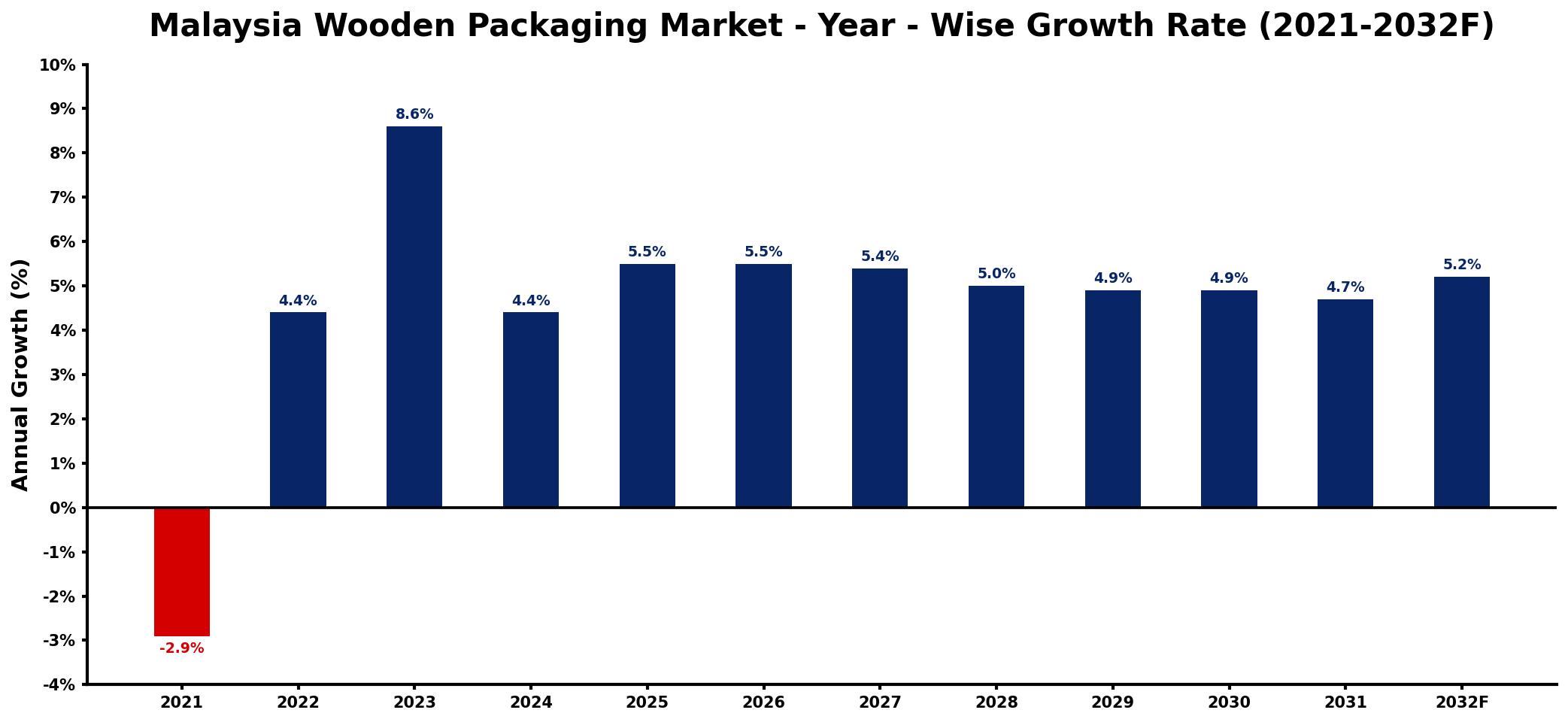
The table below presents the year‑wise growth rates along with the key drivers influencing the market
| Year | Growth Rate | Major Drivers |
| 2021 | -2.9% | decreased consumer spending on imports |
| 2022 | 4.4% | rising demand from e-commerce sector |
| 2023 | 8.6% | increased investments in logistics infrastructure |
| 2024 | 4.4% | rising export shipment volumes |
| 2025 | 5.5% | expansion of retail market presence |
| 2026 | 5.5% | surge in export activities globally |
| 2027 | 5.4% | increased focus on sustainability practices |
| 2028 | 5.0% | growth in online shopping trends |
| 2029 | 4.9% | strengthening underlying market demand |
| 2030 | 4.9% | expanding manufacturing base activity |
| 2031 | 4.7% | stronger distribution network expansion |
| 2032 | 5.2% | growing automotive sector requirements |
Note: Market size estimations and growth projections presented in this report are based on 6Wresearch's proprietary forecasting methodology, utilizing the latest available industry data, government publications, and primary research inputs.
Malaysia Wooden Packaging Market Synopsis
The demand for wooden packaging solutions in Malaysia is on an upward trajectory, propelled by their strength, durability, and environmental sustainability. As businesses increasingly prioritize eco-friendly packaging options, wooden materials are gaining traction across various sectors, including logistics and agriculture.
Recent advancements in wood treatment and innovative packaging designs are further enhancing the functionality of wooden packaging. The inherent reusability and recyclability of these materials position them favorably amidst the global shift towards sustainable practices.
Malaysia Wooden Packaging Market Key Takeaways
- The market is anticipated to grow steadily due to the rising demand for sustainable packaging solutions.
- Wooden packaging materials offer superior durability, making them ideal for logistics and food processing sectors.
- Advancements in treatment technologies are boosting the functionality and longevity of wooden packaging products.
- The market is influenced by increasing eco-conscious consumer preferences and industry regulations.
- Key players in the market are focusing on innovation to meet the evolving needs of end-users.
Evaluation of Restraints in Malaysia Wooden Packaging Market
Despite its positive outlook, the Malaysia wooden packaging market faces certain restraints that could inhibit its full potential. The market encounters robust competition from alternative packaging materials, such as plastics and cardboard, which may offer lower costs and greater flexibility. Furthermore, compliance with stringent international regulations regarding sustainable sourcing and production practices poses a challenge, particularly for exporters. Companies must navigate these complexities to maintain competitiveness while adhering to environmental standards.
Malaysia Wooden Packaging Market Trends
One of the most significant trends shaping the Malaysia wooden packaging market is the increasing emphasis on sustainability. As both consumers and companies become more environmentally conscious, the demand for eco-friendly packaging materials is surging. Additionally, technological advancements are enhancing the quality and design of wooden packaging, making them more appealing to a wider range of industries.
The rise of e-commerce has also influenced packaging needs, with businesses seeking solutions that provide protection during transit while being environmentally friendly. This shift is pushing companies to innovate and develop customized wooden packaging solutions that cater to the specific needs of online retailers.
Malaysia Wooden Packaging Market Opportunities
The potential for growth in the Malaysia wooden packaging market is substantial, particularly as businesses look to embrace sustainable practices. There is a genuine opportunity for investment in new technologies that improve the durability and design of wooden packaging, making it an even more attractive option for industries like logistics and food processing. Furthermore, developing partnerships with local businesses and export markets can enhance distribution channels, driving further demand for wooden packaging solutions.
Government Initiatives in the Malaysia Wooden Packaging Market
The Malaysian government has implemented various initiatives aimed at promoting sustainable practices within the packaging industry. This includes incentives for companies that adopt eco-friendly materials and technologies in their packaging solutions. Furthermore, public spending on infrastructure improvements within the logistics sector is likely to bolster the demand for efficient packaging solutions, including wooden options. These governmental strategies are designed to encourage sustainable growth and position Malaysia as a leader in environmentally responsible packaging.
Future Insights of the Malaysia Wooden Packaging Market
Looking ahead to the period from 2026 to 2032, the Malaysia wooden packaging market is projected to thrive, driven by ongoing demand in key sectors. The increasing consumer preference for sustainability and the expansion of the e-commerce sector are expected to further fuel market growth. Additionally, technological advancements in wood treatment and design are anticipated to play a crucial role in enhancing the performance and appeal of wooden packaging, solidifying its position as a vital solution in the packaging landscape.
Malaysia Wooden Packaging Market Latest Developments (2025 - 2026)
In recent months, the Malaysia wooden packaging market has seen a surge in innovation, with companies launching new product lines that emphasize sustainability and functionality. Additionally, there has been a noticeable increase in collaborative efforts among manufacturers to enhance supply chain efficiencies. Industry players are also adapting to evolving consumer preferences by introducing customized packaging solutions tailored to specific sectors, indicating a strong commitment to meeting market demands.
Malaysia Wooden Packaging Market - Key Attractiveness of the Report
- 10 Years of Market Numbers
- Historical Data Starting from 2022 to 2025
- Base Year: 2025
- Forecast Data until 2032
- Key Performance Indicators Impacting the Market
- Major Upcoming Developments and Projects
Key Highlights of the Report:
- Malaysia Wooden Packaging Market Outlook
- Market Size of Malaysia Wooden Packaging Market, 2025
- Forecast of Malaysia Wooden Packaging Market, 2032
- Historical Data and Forecast of Malaysia Wooden Packaging Revenues & Volume for the Period 2022-2032F
- Malaysia Wooden Packaging Market Trend Evolution
- Malaysia Wooden Packaging Market Drivers and Challenges
- Malaysia Wooden Packaging Price Trends
- Malaysia Wooden Packaging Porter's Five Forces
- Malaysia Wooden Packaging Industry Life Cycle
- Historical Data and Forecast of Malaysia Wooden Packaging Market Revenues & Volume By Type for the Period 2022-2032F
- Historical Data and Forecast of Malaysia Wooden Packaging Market Revenues & Volume By Pallets for the Period 2022-2032F
- Historical Data and Forecast of Malaysia Wooden Packaging Market Revenues & Volume By Boxes and Bins for the Period 2022-2032F
- Historical Data and Forecast of Malaysia Wooden Packaging Market Revenues & Volume By Crates and Cases for the Period 2022-2032F
- Historical Data and Forecast of Malaysia Wooden Packaging Market Revenues & Volume By Spools for the Period 2022-2032F
- Historical Data and Forecast of Malaysia Wooden Packaging Market Revenues & Volume By Dunnage for the Period 2022-2032F
- Historical Data and Forecast of Malaysia Wooden Packaging Market Revenues & Volume By Others for the Period 2022-2032F
- Historical Data and Forecast of Malaysia Wooden Packaging Market Revenues & Volume By Application for the Period 2022-2032F
- Historical Data and Forecast of Malaysia Wooden Packaging Market Revenues & Volume By Food & Beverages Storage for the Period 2022-2032F
- Historical Data and Forecast of Malaysia Wooden Packaging Market Revenues & Volume By Transportation for the Period 2022-2032F
- Historical Data and Forecast of Malaysia Wooden Packaging Market Revenues & Volume By Industrial for the Period 2022-2032F
- Historical Data and Forecast of Malaysia Wooden Packaging Market Revenues & Volume By Shipping for the Period 2022-2032F
- Historical Data and Forecast of Malaysia Wooden Packaging Market Revenues & Volume By Others for the Period 2022-2032F
- Malaysia Wooden Packaging Import Export Trade Statistics
- Market Opportunity Assessment By Type
- Market Opportunity Assessment By Application
- Malaysia Wooden Packaging Top Companies Market Share
- Malaysia Wooden Packaging Competitive Benchmarking By Technical and Operational Parameters
- Malaysia Wooden Packaging Company Profiles
- Malaysia Wooden Packaging Key Strategic Recommendations






































