Malaysia Wooden Toys Market Size, Share & Growth Rate
The Malaysia Wooden Toys Market was estimated at USD 347 Million in 2025 and is projected to reach USD 454 Million by 2032, growing at a CAGR of 3.9% from 2026 to 2032. This robust growth trajectory is driven by an increasing consumer preference for sustainable and eco-friendly products, particularly among parents keen on providing safe and educational play options for their children. Moreover, rising awareness of the environmental impact of toys, combined with a cultural appreciation for handmade craftsmanship, is expected to further fuel market expansion.
Malaysia Wooden Toys Market Year-wise Growth Rate and Key Drivers
This graph highlights how the Malaysia Wooden Toys Market has steadily grown over the years, supported by major growth factors.
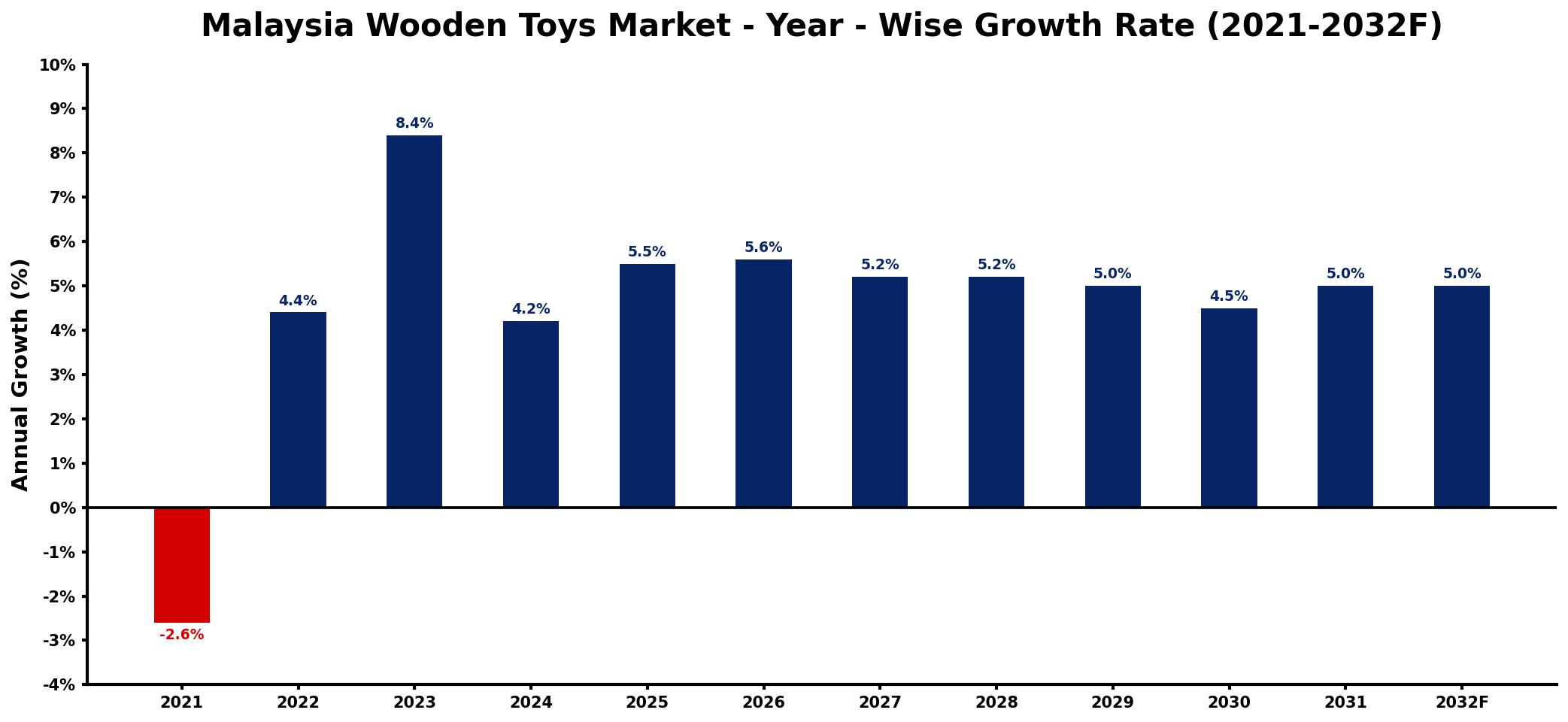
The table below presents the year‑wise growth rates along with the key drivers influencing the market
| Year | Growth Rate | Major Drivers |
| 2021 | -2.6% | Decline in consumer spending habits |
| 2022 | 4.4% | Rising interest in eco-friendly products |
| 2023 | 8.4% | Growth in online retail channels |
| 2024 | 4.2% | Increased investment in local manufacturing |
| 2025 | 5.5% | Expansion of educational play initiatives |
| 2026 | 5.6% | Higher demand for sustainable materials |
| 2027 | 5.2% | increased capital investment inflows |
| 2028 | 5.2% | Increase in disposable income levels |
| 2029 | 5.0% | strengthening underlying market demand |
| 2030 | 4.5% | stronger distribution network expansion |
| 2031 | 5.0% | Rise in collaborative community events |
| 2032 | 5.0% | Increased focus on developmental benefits |
Note: Market size estimations and growth projections presented in this report are based on 6Wresearch's proprietary forecasting methodology, utilizing the latest available industry data, government publications, and primary research inputs.
Malaysia Wooden Toys Market Synopsis
The strongest force shaping the Malaysia Wooden Toys Market is the growing emphasis on eco-friendliness and sustainability. As parents and caregivers gravitate towards products that are not only safe but also contribute positively to the environment, wooden toys are becoming the go-to choice. This shift aligns with a broader trend of conscious consumerism, where purchasing decisions reflect values of safety and environmental stewardship.
In addition to safety concerns, wooden toys are increasingly recognized for their developmental benefits. Items like puzzles and imaginative playsets are not just toys; they serve as tools for cognitive and motor skill development. The artisanal charm of locally crafted wooden toys adds another layer of appeal, making them attractive gifts that celebrate Malaysias cultural heritage.
Malaysia Wooden Toys Market Key Takeaways
- The market is expected to grow significantly due to rising demand for educational and eco-friendly toys.
- Parents are prioritizing safety and non-toxic materials in their toy choices, bolstering the wooden toys segment.
- Handcrafted wooden toys are gaining popularity due to their uniqueness and cultural relevance.
- Government support for sustainable products is enhancing market conditions.
- COVID-19 has influenced consumer habits, leading to an increased focus on home-based educational toys.
Evaluation of Restraints in Malaysia Wooden Toys Market
While the Malaysia Wooden Toys Market is poised for growth, several restraints need to be considered. Foremost is the stiff competition from more affordable plastic and electronic alternatives, which could deter budget-conscious consumers. Moreover, the cost of producing high-quality wooden toys can be a barrier, limiting accessibility for some families. Challenges in sourcing sustainable timber and ensuring compliance with safety regulations also pose significant operational hurdles for manufacturers aiming to maintain quality without compromising on price.
Malaysia Wooden Toys Market Trends
Current trends in the Malaysia Wooden Toys Market point towards a rising demand for educational toys that foster creativity and learning. Puzzles, building sets, and role-play toys are particularly favored for their developmental advantages. Additionally, there is a growing trend towards customization, with consumers increasingly seeking unique, handcrafted options that tell a story. Online shopping platforms are also becoming vital, enabling artisans to reach a wider audience and consumers to access a broader range of products.
Malaysia Wooden Toys Market Opportunities
The market presents numerous opportunities for growth, particularly for companies that emphasize sustainability and craftsmanship. The increasing popularity of eco-friendly products among Malaysian consumers creates a fertile ground for innovative wooden toy designs that can cater to educational and entertainment needs. Furthermore, collaborations with local artisans can enhance product offerings and appeal to buyers looking for authenticity. Expanding distribution channels, particularly online, can also unlock new customer bases.
Government Initiatives in the Malaysia Wooden Toys Market
Government initiatives promoting sustainability and eco-friendly products play a crucial role in shaping the Malaysia Wooden Toys Market. Programs aimed at increasing awareness of the benefits of sustainable materials are encouraging both manufacturers and consumers to prioritize eco-conscious options. Public spending on educational initiatives is also fostering an environment where educational toys are valued, benefiting the wooden toys segment significantly.
Future Insights of the Malaysia Wooden Toys Market
Looking ahead to 2026-2032, the Malaysia Wooden Toys Market is set to continue its upward trend, driven by an increasing population of environmentally conscious parents. As awareness of the benefits of educational toys expands, manufacturers will likely respond with innovative designs that integrate learning with play. Additionally, the market can expect to see more collaborations between local artisans and larger manufacturers, enhancing product diversity while celebrating local culture.
Malaysia Wooden Toys Market Latest Developments (2025 - 2026)
Recent developments in the Malaysia Wooden Toys Market indicate a surge in consumer interest towards eco-friendly options. Many companies are now adopting sustainable practices in their production processes, reflecting a significant shift in industry standards. Additionally, there has been an increasing focus on digital marketing strategies to connect with a tech-savvy audience, emphasizing the educational benefits of wooden toys in online campaigns.
Malaysia Wooden Toys Market - Key Attractiveness of the Report
- 10 Years of Market Numbers
- Historical Data Starting from 2022 to 2025
- Base Year: 2025
- Forecast Data until 2032
- Key Performance Indicators Impacting the Market
- Major Upcoming Developments and Projects
Key Highlights of the Report:
- Malaysia Wooden Toys Market Outlook
- Market Size of Malaysia Wooden Toys Market, 2025
- Forecast of Malaysia Wooden Toys Market, 2032
- Historical Data and Forecast of Malaysia Wooden Toys Revenues & Volume for the Period 2022-2032F
- Malaysia Wooden Toys Market Trend Evolution
- Malaysia Wooden Toys Market Drivers and Challenges
- Malaysia Wooden Toys Price Trends
- Malaysia Wooden Toys Porter's Five Forces
- Malaysia Wooden Toys Industry Life Cycle
- Historical Data and Forecast of Malaysia Wooden Toys Market Revenues & Volume By Product Type for the Period 2022-2032F
- Historical Data and Forecast of Malaysia Wooden Toys Market Revenues & Volume By Educational Toys for the Period 2022-2032F
- Historical Data and Forecast of Malaysia Wooden Toys Market Revenues & Volume By Construction Toys for the Period 2022-2032F
- Historical Data and Forecast of Malaysia Wooden Toys Market Revenues & Volume By Musical Toys for the Period 2022-2032F
- Historical Data and Forecast of Malaysia Wooden Toys Market Revenues & Volume By Game Toys for the Period 2022-2032F
- Historical Data and Forecast of Malaysia Wooden Toys Market Revenues & Volume By Dolls & Miniatures for the Period 2022-2032F
- Historical Data and Forecast of Malaysia Wooden Toys Market Revenues & Volume By Automotive Toys for the Period 2022-2032F
- Historical Data and Forecast of Malaysia Wooden Toys Market Revenues & Volume By Pretend Play Toys for the Period 2022-2032F
- Historical Data and Forecast of Malaysia Wooden Toys Market Revenues & Volume By Wood Type for the Period 2022-2032F
- Historical Data and Forecast of Malaysia Wooden Toys Market Revenues & Volume By Softwood for the Period 2022-2032F
- Historical Data and Forecast of Malaysia Wooden Toys Market Revenues & Volume By Hardwood for the Period 2022-2032F
- Historical Data and Forecast of Malaysia Wooden Toys Market Revenues & Volume By Age Group for the Period 2022-2032F
- Historical Data and Forecast of Malaysia Wooden Toys Market Revenues & Volume By Below 1 Year for the Period 2022-2032F
- Historical Data and Forecast of Malaysia Wooden Toys Market Revenues & Volume By Age 1-3 for the Period 2022-2032F
- Historical Data and Forecast of Malaysia Wooden Toys Market Revenues & Volume By Age 3-5 for the Period 2022-2032F
- Historical Data and Forecast of Malaysia Wooden Toys Market Revenues & Volume By Age 5-12 for the Period 2022-2032F
- Historical Data and Forecast of Malaysia Wooden Toys Market Revenues & Volume By Age 12+ for the Period 2022-2032F
- Historical Data and Forecast of Malaysia Wooden Toys Market Revenues & Volume By Distribution Channel for the Period 2022-2032F
- Historical Data and Forecast of Malaysia Wooden Toys Market Revenues & Volume By Online for the Period 2022-2032F
- Historical Data and Forecast of Malaysia Wooden Toys Market Revenues & Volume By Offline for the Period 2022-2032F
- Malaysia Wooden Toys Import Export Trade Statistics
- Market Opportunity Assessment By Product Type
- Market Opportunity Assessment By Wood Type
- Market Opportunity Assessment By Age Group
- Market Opportunity Assessment By Distribution Channel
- Malaysia Wooden Toys Top Companies Market Share
- Malaysia Wooden Toys Competitive Benchmarking By Technical and Operational Parameters
- Malaysia Wooden Toys Company Profiles
- Malaysia Wooden Toys Key Strategic Recommendations






































