Malaysia Woodworking CNC Tools Market Size, Share & Growth Rate
The Malaysia Woodworking CNC Tools Market was estimated at USD 451 Million in 2025 and is projected to reach USD 587 Million by 2032, growing at a CAGR of 3.8% from 2026 to 2032. This growth trajectory is largely fueled by the increasing demand for high-quality, customized wood products, alongside the adoption of automation in manufacturing processes. As local manufacturers embrace advanced CNC technology, the market is poised to capitalize on precision engineering and innovative design trends.
Malaysia Woodworking CNC Tools Market Year-wise Growth Rate and Key Drivers
This graph highlights how the Malaysia Woodworking CNC Tools Market has steadily grown over the years, supported by major growth factors.
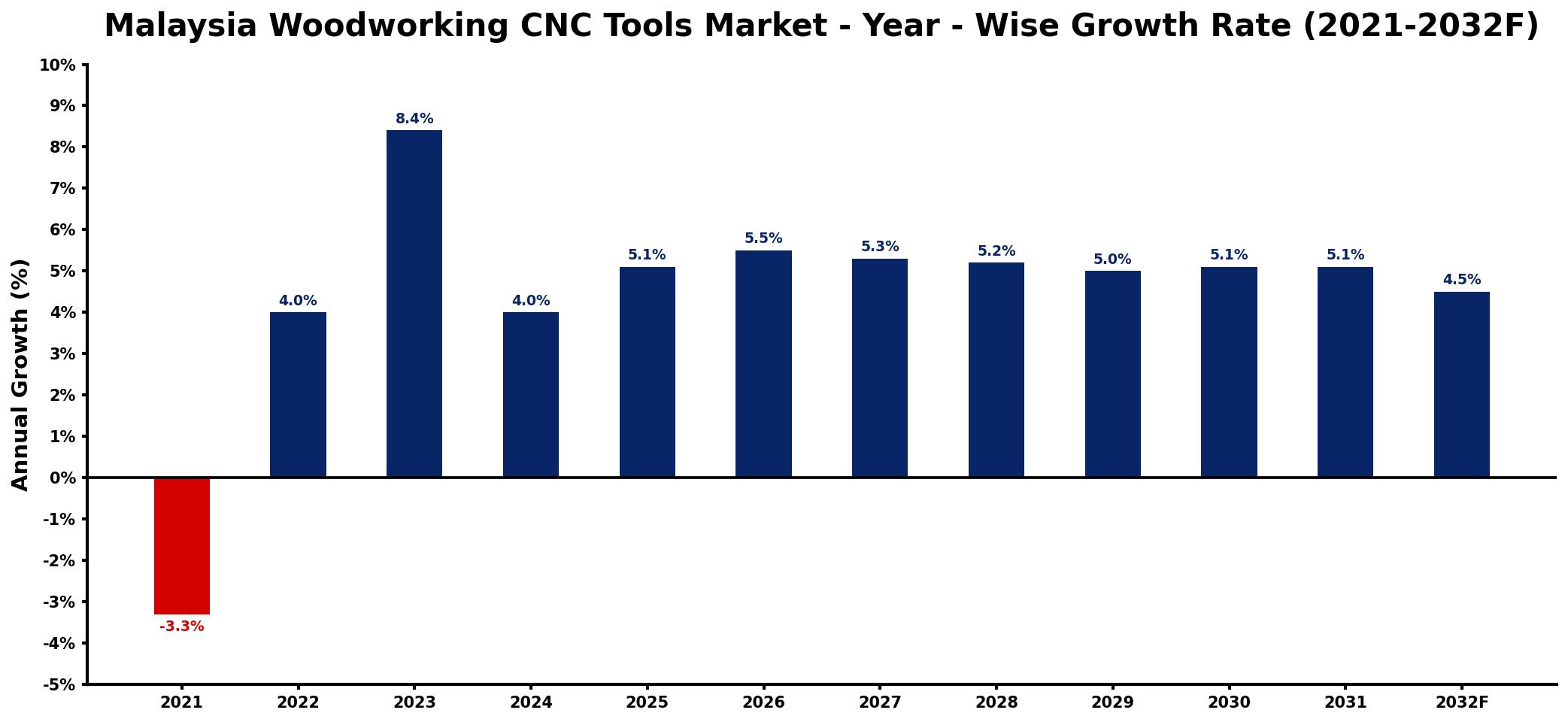
The table below presents the year‑wise growth rates along with the key drivers influencing the market
| Year | Growth Rate | Major Drivers |
| 2021 | -3.3% | decreased construction project investments |
| 2022 | 4.0% | rising demand for automated production |
| 2023 | 8.4% | expansion of furniture manufacturing sector |
| 2024 | 4.0% | increased adoption of smart technologies |
| 2025 | 5.1% | growing interest in sustainable practices |
| 2026 | 5.5% | enhanced consumer spending on renovations |
| 2027 | 5.3% | higher exports of finished goods |
| 2028 | 5.2% | influx of foreign direct investments |
| 2029 | 5.0% | diversification of manufacturing capabilities |
| 2030 | 5.1% | improvement in local supply chains |
| 2031 | 5.1% | strengthened partnerships with suppliers |
| 2032 | 4.5% | emerging trends in interior design |
Note: Market size estimations and growth projections presented in this report are based on 6Wresearch's proprietary forecasting methodology, utilizing the latest available industry data, government publications, and primary research inputs.
Malaysia Woodworking CNC Tools Market Synopsis
Despite the challenges posed by the COVID-19 pandemic, which temporarily disrupted manufacturing and supply chains, the Malaysia woodworking CNC tools market has demonstrated resilience. As the industry shifts towards a recovery phase, the emphasis on quality and customization is driving renewed interest and investment in CNC technologies.
Looking ahead, the market is on track for substantial growth, driven by evolving consumer preferences for personalized woodworking solutions. As businesses invest in automation and adopt advanced CNC machinery, there is significant potential for enhanced production capabilities and operational efficiency.
Malaysia Woodworking CNC Tools Market Key Takeaways
- The market is experiencing steady growth attributed to increasing demands for customized wood products.
- Automation and digitalization are critical factors enhancing efficiency in woodworking operations.
- Investments in R&D are essential for manufacturers to keep up with technological advancements.
- The COVID-19 pandemic has reshaped consumer preferences, driving demand for personalized woodworking solutions.
- Workforce training remains vital for maximizing the potential of CNC tools in the industry.
Evaluation of Restraints in Malaysia Woodworking CNC Tools Market
The growth of the Malaysia woodworking CNC tools market is tempered by several notable restraints. Chief among these is the ongoing need for technological upgrades to keep pace with the precision demands of modern woodworking processes. Manufacturers face substantial financial pressures when investing in advanced machinery and software, making return on investment a primary concern. Additionally, competition from imported CNC tools poses challenges for local manufacturers, particularly in maintaining market share. Furthermore, there exists a pressing need for skilled labor capable of operating these sophisticated tools, which necessitates ongoing workforce training and skills development.
Malaysia Woodworking CNC Tools Market Trends
Current trends in the Malaysia woodworking CNC tools market indicate a growing integration of advanced software solutions into CNC operations. This integration enhances capabilities, allowing for more intricate designs and improved efficiency. Additionally, the demand for eco-friendly and sustainable woodworking practices is shaping product development, with manufacturers focusing on tools that support these initiatives. The emphasis on quality craftsmanship coupled with consumer preference for bespoke items is driving the adoption of CNC technology, highlighting the transformative role these tools play in modern woodworking.
Malaysia Woodworking CNC Tools Market Opportunities
Significant growth opportunities exist within the Malaysia woodworking CNC tools market, particularly in niche segments that cater to bespoke product manufacturing. As consumer preferences shift towards personalized and unique woodworking solutions, manufacturers can leverage this trend by investing in innovative CNC technologies. Furthermore, partnerships with local artisans and furniture designers could lead to the development of specialized tools that enhance creativity and precision. Additionally, training programs aimed at upskilling the workforce present a dual opportunity for improving operational efficiency while also addressing the labor skills gap in the industry.
Government Initiatives in the Malaysia Woodworking CNC Tools Market
The Malaysian government has recognized the importance of the woodworking industry in driving economic growth and is taking steps to bolster the sector. Initiatives aimed at promoting technological advancement, such as funding for research and development, are being implemented. Additionally, public spending on infrastructure and digitalization is paving the way for enhanced capabilities in the woodworking sector. There is also a focus on training programs that seek to equip the workforce with the necessary skills to adapt to advanced CNC technologies, thereby fostering innovation and competitiveness within the market.
Future Insights of the Malaysia Woodworking CNC Tools Market
From 2026 to 2032, the Malaysia woodworking CNC tools market is projected to evolve considerably, driven by continuous advancements in technology and increasing consumer demands for high-quality, customized products. The focus on sustainability will likely lead to a greater emphasis on tools that support eco-friendly practices. Furthermore, the integration of artificial intelligence in CNC machining processes could transform production methodologies, enhancing efficiency and accuracy. This forward momentum indicates a promising horizon for manufacturers who are willing to invest in innovation and adapt to changing market dynamics.
Malaysia Woodworking CNC Tools Market Latest Developments (2025 - 2026)
Recent developments in the Malaysia woodworking CNC tools market have seen a notable increase in collaboration between technology providers and woodworking firms. These partnerships focus on customizing CNC machinery to meet specific industry needs, ensuring higher precision and flexibility. Additionally, manufacturers are increasingly adopting digital solutions that streamline production processes and enhance operational efficiency. As the market rebounds, a push towards adopting cutting-edge technologies and sustainable practices continues to shape industry dynamics.
Malaysia Woodworking CNC Tools Market - Key Attractiveness of the Report
- 10 Years of Market Numbers
- Historical Data Starting from 2022 to 2025
- Base Year: 2025
- Forecast Data until 2032
- Key Performance Indicators Impacting the Market
- Major Upcoming Developments and Projects
Key Highlights of the Report:
- Malaysia Woodworking CNC Tools Market Outlook
- Market Size of Malaysia Woodworking CNC Tools Market, 2025
- Forecast of Malaysia Woodworking CNC Tools Market, 2032
- Historical Data and Forecast of Malaysia Woodworking CNC Tools Revenues & Volume for the Period 2022-2032F
- Malaysia Woodworking CNC Tools Market Trend Evolution
- Malaysia Woodworking CNC Tools Market Drivers and Challenges
- Malaysia Woodworking CNC Tools Price Trends
- Malaysia Woodworking CNC Tools Porter's Five Forces
- Malaysia Woodworking CNC Tools Industry Life Cycle
- Historical Data and Forecast of Malaysia Woodworking CNC Tools Market Revenues & Volume By Tool Type for the Period 2022-2032F
- Historical Data and Forecast of Malaysia Woodworking CNC Tools Market Revenues & Volume By Router Bits for the Period 2022-2032F
- Historical Data and Forecast of Malaysia Woodworking CNC Tools Market Revenues & Volume By Insert Knives for the Period 2022-2032F
- Historical Data and Forecast of Malaysia Woodworking CNC Tools Market Revenues & Volume By Engraving Tools for the Period 2022-2032F
- Historical Data and Forecast of Malaysia Woodworking CNC Tools Market Revenues & Volume By Cutters for the Period 2022-2032F
- Historical Data and Forecast of Malaysia Woodworking CNC Tools Market Revenues & Volume By Wood Type for the Period 2022-2032F
- Historical Data and Forecast of Malaysia Woodworking CNC Tools Market Revenues & Volume By Plywood for the Period 2022-2032F
- Historical Data and Forecast of Malaysia Woodworking CNC Tools Market Revenues & Volume By Chipboard for the Period 2022-2032F
- Historical Data and Forecast of Malaysia Woodworking CNC Tools Market Revenues & Volume By MDF (Medium Density Fiberboard) for the Period 2022-2032F
- Historical Data and Forecast of Malaysia Woodworking CNC Tools Market Revenues & Volume By HDF (High Density Fiberboard) for the Period 2022-2032F
- Historical Data and Forecast of Malaysia Woodworking CNC Tools Market Revenues & Volume By Hardwood for the Period 2022-2032F
- Historical Data and Forecast of Malaysia Woodworking CNC Tools Market Revenues & Volume By Operation for the Period 2022-2032F
- Historical Data and Forecast of Malaysia Woodworking CNC Tools Market Revenues & Volume By Milling for the Period 2022-2032F
- Historical Data and Forecast of Malaysia Woodworking CNC Tools Market Revenues & Volume By Drilling for the Period 2022-2032F
- Historical Data and Forecast of Malaysia Woodworking CNC Tools Market Revenues & Volume By Cutting for the Period 2022-2032F
- Historical Data and Forecast of Malaysia Woodworking CNC Tools Market Revenues & Volume By Profiling for the Period 2022-2032F
- Malaysia Woodworking CNC Tools Import Export Trade Statistics
- Market Opportunity Assessment By Tool Type
- Market Opportunity Assessment By Wood Type
- Market Opportunity Assessment By Operation
- Malaysia Woodworking CNC Tools Top Companies Market Share
- Malaysia Woodworking CNC Tools Competitive Benchmarking By Technical and Operational Parameters
- Malaysia Woodworking CNC Tools Company Profiles
- Malaysia Woodworking CNC Tools Key Strategic Recommendations






































