Malaysia Workflow Management System Market Size & Growth Rate (2026-2032)
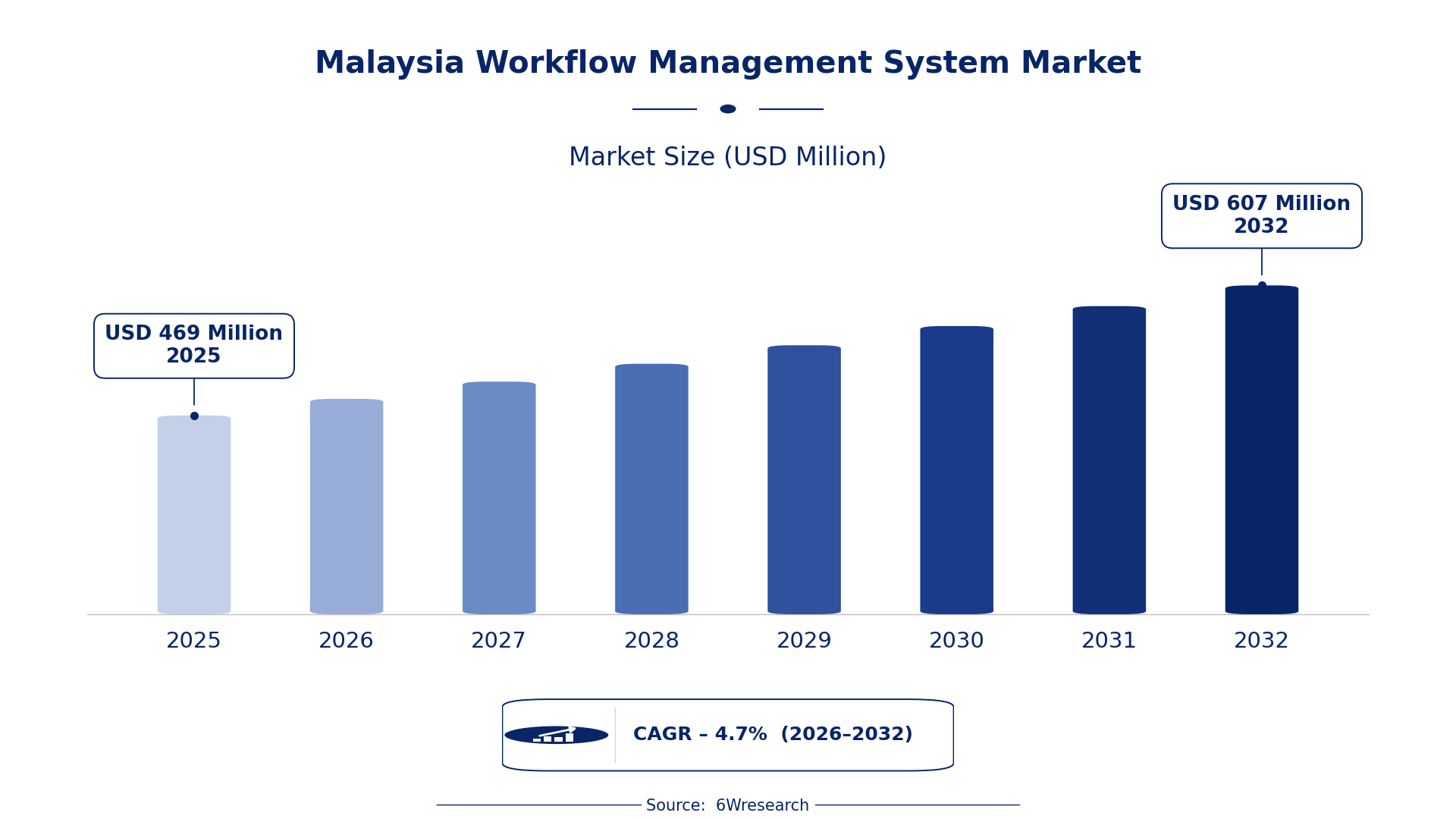
The Malaysia Workflow Management System Market was estimated at USD 469 Million in 2025 and is projected to reach USD 607 Million by 2032, growing at a CAGR of 4.7% from 2026 to 2032.
Malaysia Workflow Management System Market Synopsis
The demand for workflow management systems in Malaysia is increasingly driven by organizations seeking to automate their processes. As industries expand, the need for effective collaboration tools that ensure timely project delivery has become paramount. Customizable platforms that enhance operational efficiency are at the forefront of this shift.
With digital transformation initiatives gaining traction, businesses are prioritizing solutions that minimize manual errors and optimize workflows. The urgency for streamlined operations has led to a significant uptick in the adoption of user-friendly workflow solutions tailored to the unique requirements of Malaysian enterprises.
Malaysia Workflow Management System Market Year-wise Growth Rate and Key Drivers
This graph illustrates the annual growth rates of the Malaysia Workflow Management System Market from 2021 to 2032, highlighting a steady upward trajectory and projected expansion over the forecast period.
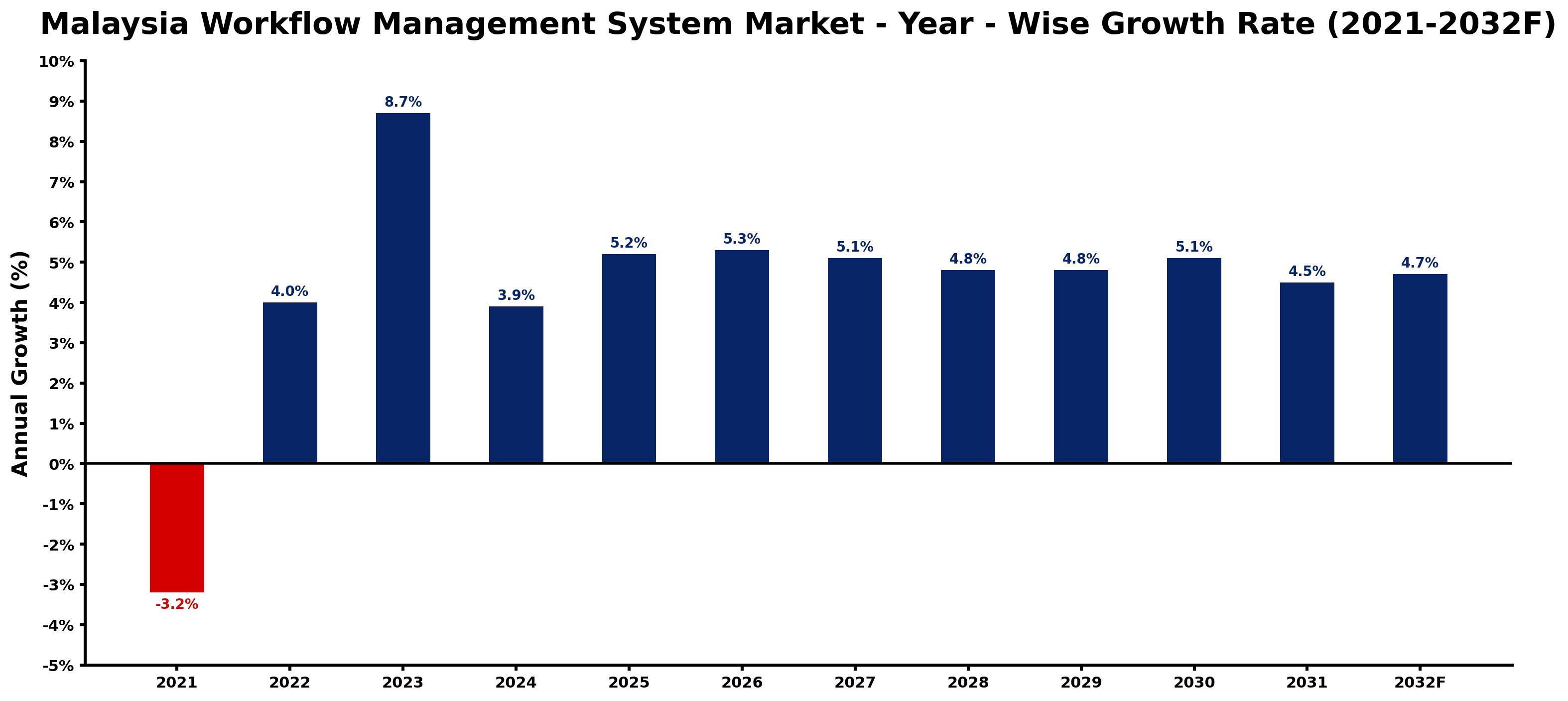
The table below presents the year‑wise growth rates along with the key drivers influencing the market
| Year | Growth Rate | Major Drivers |
| 2021 | -3.2% | Pandemic-related project delays stymied software adoption. |
| 2022 | 4.0% | Investment in Malaysia's National Fiberisation Plan boosts connectivity. |
| 2023 | 8.7% | Rise in e-commerce drives need for efficient workflows. |
| 2024 | 3.9% | Government support for digital economy enhances workflow adoption. |
| 2025 | 5.2% | Increased FDI in tech sector creates automation demand. |
| 2026 | 5.3% | Healthcare digitization initiatives promote process optimization software. |
| 2027 | 5.1% | Focus on education technology encourages workflow system usage. |
| 2028 | 4.8% | Regulatory updates streamline business processes necessitating system upgrades. |
| 2029 | 4.8% | Urbanization trends increase demand for responsive management solutions. |
| 2030 | 5.1% | Push for green technologies drives efficient resource management. |
| 2031 | 4.5% | Local startups embrace agile methodologies enhancing workflow efficiency. |
| 2032 | 4.7% | Corporate partnerships enhance integration of advanced management tools. |
Note: Market size estimations and growth projections presented in this report are based on 6Wresearch's proprietary forecasting methodology, utilizing the latest available industry data, government publications, and primary research inputs.
Malaysia Workflow Management System Market Key Takeaways
Below are some of the specific key takeaways from the market, including:
- The market is expected to grow substantially, driven by the push for increased automation and efficiency.
- Customization and user-friendliness are critical factors influencing the purchasing decisions of businesses.
- Digital transformation initiatives are a primary catalyst for market growth.
- Integration challenges among various software systems remain a barrier to widespread adoption.
- Compliance with data privacy regulations is increasingly important as organizations adopt new workflow solutions.
Evaluation of Restraints in Malaysia Workflow Management System Market
Despite the growth potential, the Malaysia Workflow Management System Market faces notable constraints. Standardization remains a significant challenge as companies often utilize a variety of software tools, leading to integration issues. This fragmentation can hinder the effectiveness of workflow solutions, as seamless communication between disparate systems is essential for maximizing efficiency. on top of that, as businesses implement these technologies, they must navigate the complexities of data privacy and compliance, particularly in sectors governed by stringent regulations. These hurdles could delay the adoption of comprehensive workflow management systems.
Malaysia Workflow Management System Market Trends
Several trends are shaping the future of the Malaysia Workflow Management System Market. A notable shift is the move towards cloud-based solutions, allowing for greater flexibility and accessibility. As remote work becomes more common, businesses are investing in platforms that facilitate seamless collaboration among distributed teams. Additionally, AI and machine learning technologies are being integrated into workflow systems, enabling predictive analytics and enhancing decision-making processes.
Another trend is the focus on user experience; organizations are prioritizing solutions that not only meet functional requirements but also provide an intuitive interface. This emphasis on usability is particularly relevant as companies seek to improve employee adoption rates of new technologies.
Malaysia Workflow Management System Market Opportunities
The market presents several opportunities for growth and investment. There is considerable potential in developing niche solutions tailored for specific industries such as healthcare, manufacturing, and finance, where unique workflows demand specialized features. Additionally, local players can capitalize on the increasing preference for customizable platforms that address regional business needs. As government initiatives promote digital transformation, companies can leverage support programs to enhance their offerings and reach broader market segments.
Government Initiatives in the Malaysia Workflow Management System Market
The Malaysian government is actively fostering a conducive environment for the growth of the Workflow Management System Market. With a strong focus on digital transformation, public policy initiatives aim to enhance operational efficiencies across various sectors. These efforts not only promote technological adoption but also address the regulatory frameworks necessary for compliance. The government’s commitment to improving digital infrastructure is crucial in shaping the future of this market.
- A national digital infrastructure upgrade programme now in its rollout phase aims to enhance connectivity across urban and rural areas.
- A regulatory framework introduced in 2025 mandates data protection measures, influencing how businesses implement workflow systems.
- Current initiatives are underway to support small and medium-sized enterprises (SMEs) in adopting digital solutions, including workflow management systems.
- Future plans include a public-private initiative expected to enhance cloud computing capabilities by 2028.
Future Insights of the Malaysia Workflow Management System Market
Looking ahead to 2026-2032, the Malaysia Workflow Management System Market is set for steady expansion. Businesses will increasingly recognize the importance of automation and collaboration tools in driving productivity. As digital transformation continues to evolve, there will be a surge in demand for innovative solutions that not only streamline operations but also adapt to changing business environments. Companies that focus on integrating advanced technologies, such as AI and machine learning, will likely gain a competitive edge in this dynamic market.
Malaysia Workflow Management System Market Latest Developments
In the past year, the Malaysia Workflow Management System Market has seen significant activity as companies adapt to new operational demands. The emphasis has shifted towards creating more integrated and user-friendly solutions that cater to diverse business requirements. Recent collaborations and technology enhancements have positioned several firms to capitalize on the growing need for efficient workflow management.
- A major technology vendor launched a new AI-powered workflow management solution in early 2025, aimed at improving process automation.
- A collaboration between two local software companies is currently ongoing, focusing on developing customized workflow solutions for the healthcare sector.
- A service upgrade enhancing user experience is planned for mid-2026, intended to incorporate feedback from existing clients.
- A pilot program aimed at SMEs to adopt workflow management systems began in Q1 2025 and remains underway.
Malaysia Workflow Management System Market - Key Attractiveness of the Report
- 10 Years of Market Numbers
- Historical Data Starting from 2022 to 2025
- Base Year: 2025
- Forecast Data until 2032
- Key Performance Indicators Impacting the Market
- Major Upcoming Developments and Projects
Key Highlights of the Report:
- Malaysia Workflow Management System Market Outlook
- Market Size of Malaysia Workflow Management System Market, 2025
- Forecast of Malaysia Workflow Management System Market, 2032
- Historical Data and Forecast of Malaysia Workflow Management System Revenues & Volume for the Period 2022-2032F
- Malaysia Workflow Management System Market Trend Evolution
- Malaysia Workflow Management System Market Drivers and Challenges
- Malaysia Workflow Management System Price Trends
- Malaysia Workflow Management System Porter's Five Forces
- Malaysia Workflow Management System Industry Life Cycle
- Historical Data and Forecast of Malaysia Workflow Management System Market Revenues & Volume By Component for the Period 2022-2032F
- Historical Data and Forecast of Malaysia Workflow Management System Market Revenues & Volume By Software for the Period 2022-2032F
- Historical Data and Forecast of Malaysia Workflow Management System Market Revenues & Volume By Services for the Period 2022-2032F
- Historical Data and Forecast of Malaysia Workflow Management System Market Revenues & Volume By Service for the Period 2022-2032F
- Historical Data and Forecast of Malaysia Workflow Management System Market Revenues & Volume By IT consulting for the Period 2022-2032F
- Historical Data and Forecast of Malaysia Workflow Management System Market Revenues & Volume By Integration and implementation for the Period 2022-2032F
- Historical Data and Forecast of Malaysia Workflow Management System Market Revenues & Volume By Training and development for the Period 2022-2032F
- Historical Data and Forecast of Malaysia Workflow Management System Market Revenues & Volume By Software for the Period 2022-2032F
- Historical Data and Forecast of Malaysia Workflow Management System Market Revenues & Volume By Production workflow systems for the Period 2022-2032F
- Historical Data and Forecast of Malaysia Workflow Management System Market Revenues & Volume By Messaging-based workflow systems for the Period 2022-2032F
- Historical Data and Forecast of Malaysia Workflow Management System Market Revenues & Volume By Web-based workflow systems for the Period 2022-2032F
- Historical Data and Forecast of Malaysia Workflow Management System Market Revenues & Volume By Suite-based workflow systems for the Period 2022-2032F
- Historical Data and Forecast of Malaysia Workflow Management System Market Revenues & Volume By Other workflow systems for the Period 2022-2032F
- Historical Data and Forecast of Malaysia Workflow Management System Market Revenues & Volume By Deployment Type for the Period 2022-2032F
- Historical Data and Forecast of Malaysia Workflow Management System Market Revenues & Volume By Cloud for the Period 2022-2032F
- Historical Data and Forecast of Malaysia Workflow Management System Market Revenues & Volume By On-premises for the Period 2022-2032F
- Historical Data and Forecast of Malaysia Workflow Management System Market Revenues & Volume By Industry Verticals for the Period 2022-2032F
- Historical Data and Forecast of Malaysia Workflow Management System Market Revenues & Volume By Banking, financial services, and insurance for the Period 2022-2032F
- Historical Data and Forecast of Malaysia Workflow Management System Market Revenues & Volume By Public sector for the Period 2022-2032F
- Historical Data and Forecast of Malaysia Workflow Management System Market Revenues & Volume By Healthcare for the Period 2022-2032F
- Historical Data and Forecast of Malaysia Workflow Management System Market Revenues & Volume By Energy and utilities for the Period 2022-2032F
- Historical Data and Forecast of Malaysia Workflow Management System Market Revenues & Volume By Retail for the Period 2022-2032F
- Historical Data and Forecast of Malaysia Workflow Management System Market Revenues & Volume By IT and telecom for the Period 2022-2032F
- Historical Data and Forecast of Malaysia Workflow Management System Market Revenues & Volume By Travel and hospitality for the Period 2022-2032F
- Historical Data and Forecast of Malaysia Workflow Management System Market Revenues & Volume By Transportation and logistics for the Period 2022-2032F
- Malaysia Workflow Management System Import Export Trade Statistics
- Market Opportunity Assessment By Component
- Market Opportunity Assessment By Service
- Market Opportunity Assessment By Software
- Market Opportunity Assessment By Deployment Type
- Market Opportunity Assessment By Industry Verticals
- Malaysia Workflow Management System Top Companies Market Share
- Malaysia Workflow Management System Competitive Benchmarking By Technical and Operational Parameters
- Malaysia Workflow Management System Company Profiles
- Malaysia Workflow Management System Key Strategic Recommendations






































