Malaysia Workplace Safety Market Size & Growth Rate (2026-2032)
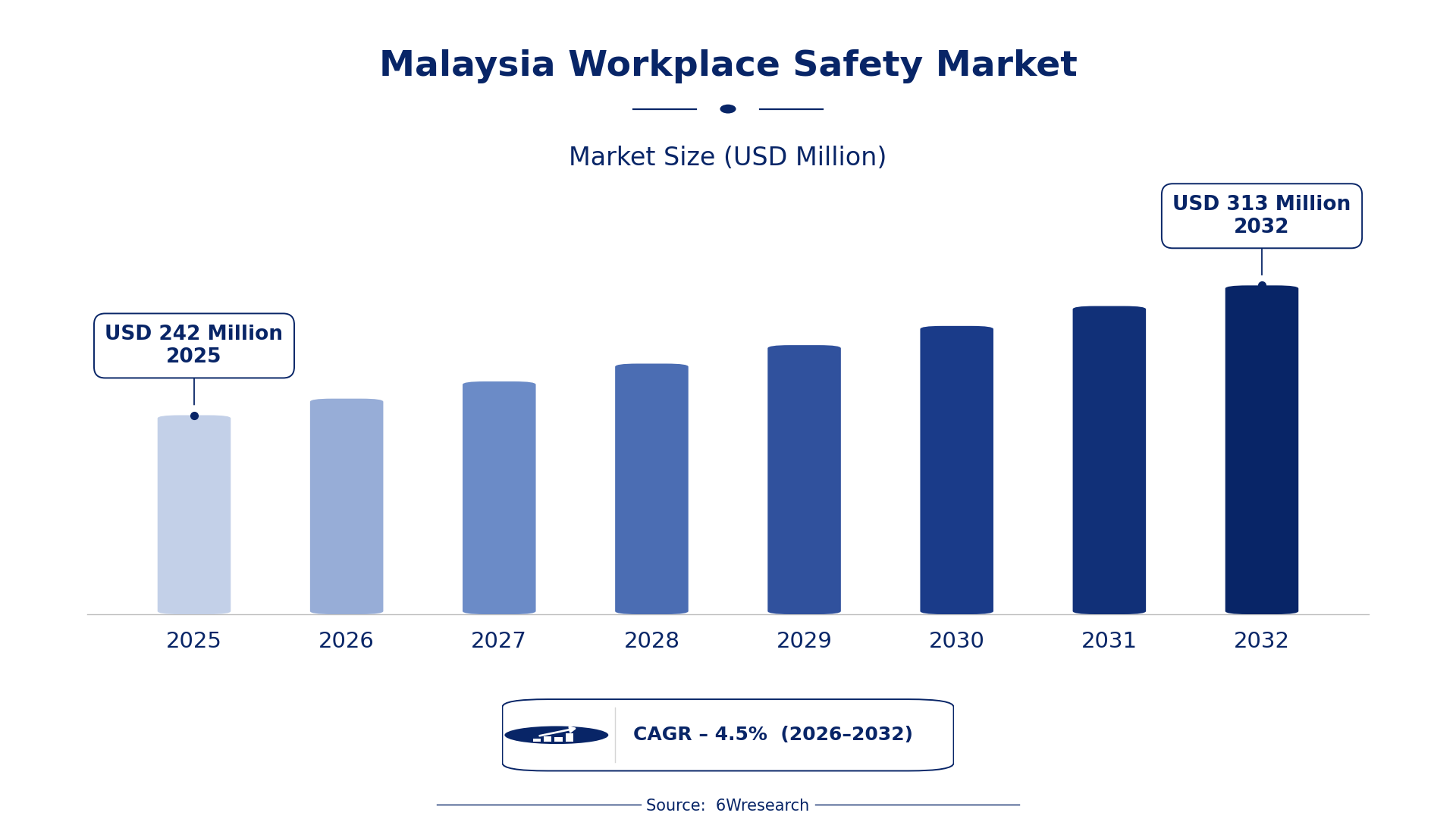
The Malaysia Workplace Safety Market was estimated at USD 242 Million in 2025 and is projected to reach USD 313 Million by 2032, growing at a CAGR of 4.5% from 2026 to 2032.
Malaysia Workplace Safety Market Synopsis
The recent uptick in Malaysia's workplace safety market reflects an urgent shift towards comprehensive safety measures. Growing awareness and regulatory pressure are prompting businesses to enhance their safety protocols, prioritizing employee health above all. As we look ahead, the market is set to evolve further, with increased investment in advanced safety technologies and training programs.
Despite the heightened focus on safety, challenges persist. Companies often grapple with compliance issues and budget constraints that hinder their safety investments. However, the clear trajectory towards improvement indicates that the market will likely expand as businesses recognize the long-term benefits of a safe working environment.
Malaysia Workplace Safety Market Year-wise Growth Rate and Key Drivers
This graph illustrates the annual growth rates of the Malaysia Workplace Safety Market from 2021 to 2032, highlighting a steady upward trajectory and projected expansion over the forecast period.
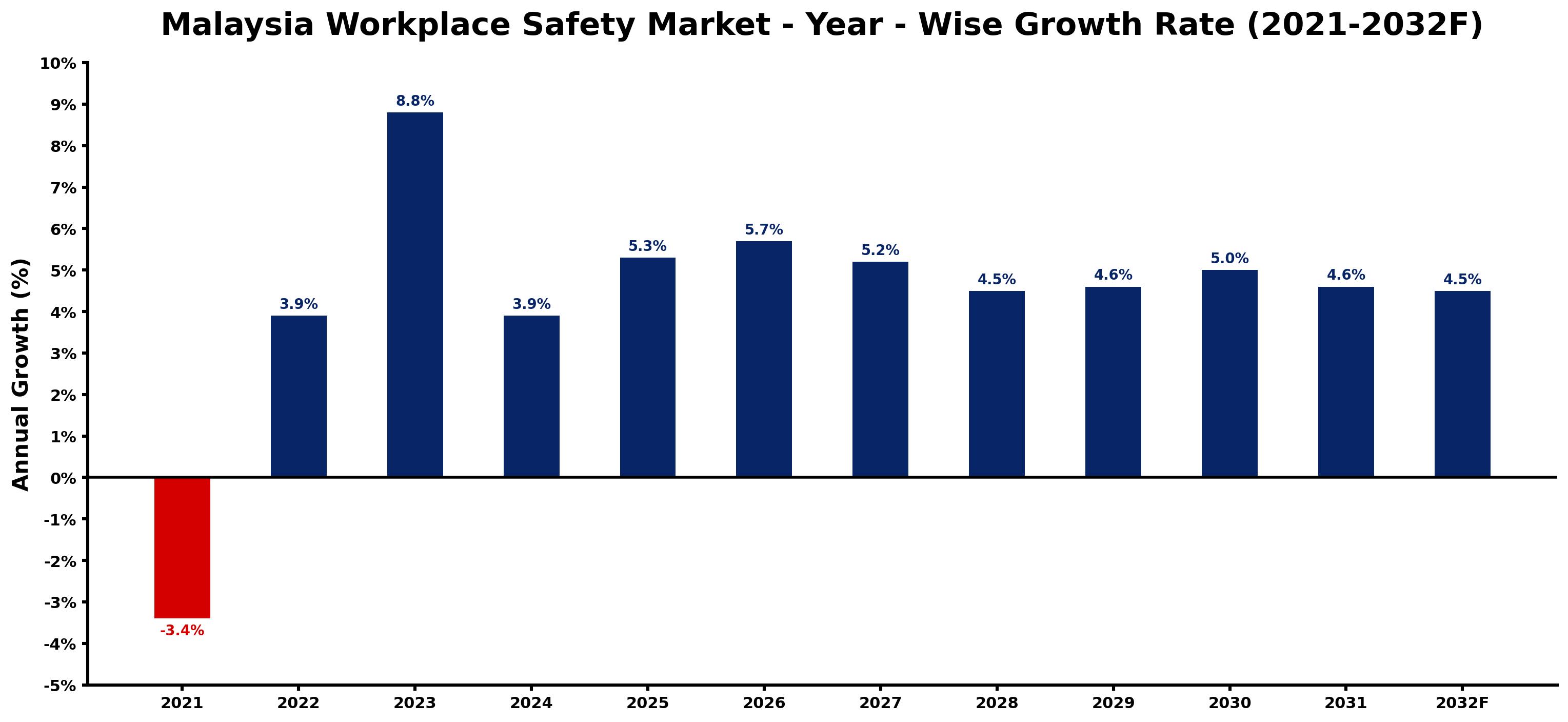
The table below presents the year‑wise growth rates along with the key drivers influencing the market
| Year | Growth Rate | Major Drivers |
| 2021 | -3.4% | Implementation of stricter OSHA compliance requirements deterred new investments. |
| 2022 | 3.9% | Implementation of OSHA safety regulations among manufacturers |
| 2023 | 8.8% | Increased foreign investment driving safety compliance standards |
| 2024 | 3.9% | Rise in workplace accidents prompting stricter safety policies |
| 2025 | 5.3% | Government training grants for hazardous material handling |
| 2026 | 5.7% | Corporate accountability measures enhancing safety infrastructure |
| 2027 | 5.2% | Local industry partnerships promoting safety best practices |
| 2028 | 4.5% | Adoption of smart safety technologies in factories |
| 2029 | 4.6% | Growing focus on mental health safety regulations |
| 2030 | 5.0% | Legislative reforms boosting health and safety inspections |
| 2031 | 4.6% | Demand for ergonomic workplace solutions rising among SMEs |
| 2032 | 4.5% | Public awareness campaigns elevating workplace safety concerns |
Note: Market size estimations and growth projections presented in this report are based on 6Wresearch's proprietary forecasting methodology, utilizing the latest available industry data, government publications, and primary research inputs.
Malaysia Workplace Safety Market Key Takeaways
Below are some of the specific key takeaways from the market, including:
- Stringent regulatory requirements are pushing businesses to adopt comprehensive workplace safety solutions.
- The COVID-19 pandemic significantly accelerated the adoption of health-focused safety measures.
- Investment in training and compliance management solutions is on the rise.
- Budget constraints and a lack of skilled professionals are primary challenges for employers.
- Leading companies are expanding their product offerings to meet growing safety demands.
Evaluation of Restraints in Malaysia Workplace Safety Market
Compliance issues represent a critical challenge for many organizations. As regulations evolve, companies frequently find themselves scrambling to adapt, often stretching their limited budgets even thinner. The shortage of skilled professionals adds another layer of difficulty, as many organizations are unable to hire or retain the necessary expertise to implement effective safety measures. Consequently, this hampers their ability to fully realize the benefits of workplace safety investments.
Malaysia Workplace Safety Market Trends
The emergence of new technologies is fundamentally transforming the way workplace safety is approached in Malaysia. Companies are increasingly turning to digital solutions, such as AI-driven safety management systems and IoT devices for real-time monitoring. Another notable trend is the integration of mental health initiatives into workplace safety programs, recognizing the need for a holistic approach to employee well-being. This dual focus on physical and mental health is becoming a standard expectation within many organizations.
Malaysia Workplace Safety Market Opportunities
The market is ripe with opportunities for growth and innovation. Companies that offer integrated safety solutions, including training and compliance management, are well-positioned to capture a significant share of the growing market. Furthermore, the rise of remote work has opened avenues for virtual training and safety assessments, creating a demand for technology-driven solutions. Public-private partnerships may also emerge, aimed at addressing the skills gap and developing educational programs to cultivate future workplace safety professionals.
Government Initiatives in the Malaysia Workplace Safety Market
The Malaysian government is actively reinforcing workplace safety standards through a variety of initiatives. Regulatory bodies are tightening compliance measures, ensuring that companies prioritize safety in their operations. This focus reflects a broader commitment to fostering a culture of safety that resonates across industries and sectors, making government policy a crucial factor in shaping the market's future.
- A regulatory framework introduced in 2023 mandating the implementation of safety audits for all businesses.
- Current efforts include a campaign that started in early 2024 to promote mental health awareness in workplaces.
- A planned public-private initiative focused on enhancing training facilities for safety professionals is expected to launch in 2025.
- Ongoing inspections by regulatory authorities aim to enforce compliance with updated safety standards introduced in 2023.
- A recently completed pilot program aimed at providing subsidies for small businesses to upgrade safety equipment.
Future Insights of the Malaysia Workplace Safety Market
Looking ahead, the Malaysia workplace safety market will likely see substantial growth driven by evolving regulations and heightened safety awareness. Organizations that proactively invest in innovative safety solutions will not only comply with regulations but also create a culture that values employee well-being. As businesses adapt to new technologies and practices, the market will evolve into a more sophisticated ecosystem, ultimately prioritizing long-term sustainability and employee health.
Malaysia Workplace Safety Market Latest Developments
In the past year, the Malaysia workplace safety market has witnessed significant activity as organizations ramp up their safety protocols. The focus on health and safety has intensified, particularly following the impacts of the COVID-19 pandemic. Companies are leveraging new technologies and solutions to enhance their safety measures, leading to a more proactive approach toward workplace safety.
- A major technology vendor launched a new AI-based safety compliance tool in Q2 2024, aimed at simplifying compliance management for businesses.
- A recent partnership between industry stakeholders initiated in early 2024 is focusing on developing a new training curriculum tailored to emerging workplace safety trends.
- An ongoing initiative started in mid-2024 to offer remote safety assessments has gained traction among businesses adjusting to flexible work environments.
- A rollout expected to begin in late 2024 involves a nationwide awareness campaign on workplace safety regulations for small to medium enterprises.
- By Q1 2025, several companies are set to introduce advanced personal protective equipment integrating smart technology for improved safety.
Malaysia Workplace Safety Market - Key Attractiveness of the Report
- 10 Years of Market Numbers
- Historical Data Starting from 2022 to 2025
- Base Year: 2025
- Forecast Data until 2032
- Key Performance Indicators Impacting the Market
- Major Upcoming Developments and Projects
Key Highlights of the Report:
- Malaysia Workplace Safety Market Outlook
- Market Size of Malaysia Workplace Safety Market, 2025
- Forecast of Malaysia Workplace Safety Market, 2032
- Historical Data and Forecast of Malaysia Workplace Safety Revenues & Volume for the Period 2022-2032F
- Malaysia Workplace Safety Market Trend Evolution
- Malaysia Workplace Safety Market Drivers and Challenges
- Malaysia Workplace Safety Price Trends
- Malaysia Workplace Safety Porter's Five Forces
- Malaysia Workplace Safety Industry Life Cycle
- Historical Data and Forecast of Malaysia Workplace Safety Market Revenues & Volume By Component for the Period 2022-2032F
- Historical Data and Forecast of Malaysia Workplace Safety Market Revenues & Volume By Hardware for the Period 2022-2032F
- Historical Data and Forecast of Malaysia Workplace Safety Market Revenues & Volume By Software for the Period 2022-2032F
- Historical Data and Forecast of Malaysia Workplace Safety Market Revenues & Volume By Services for the Period 2022-2032F
- Historical Data and Forecast of Malaysia Workplace Safety Market Revenues & Volume By Application for the Period 2022-2032F
- Historical Data and Forecast of Malaysia Workplace Safety Market Revenues & Volume By Incident for the Period 2022-2032F
- Historical Data and Forecast of Malaysia Workplace Safety Market Revenues & Volume By Emergency Management for the Period 2022-2032F
- Historical Data and Forecast of Malaysia Workplace Safety Market Revenues & Volume By Asset Tracking for the Period 2022-2032F
- Historical Data and Forecast of Malaysia Workplace Safety Market Revenues & Volume By PPE Detection for the Period 2022-2032F
- Historical Data and Forecast of Malaysia Workplace Safety Market Revenues & Volume By System for the Period 2022-2032F
- Historical Data and Forecast of Malaysia Workplace Safety Market Revenues & Volume By Environmental Health and Safety for the Period 2022-2032F
- Historical Data and Forecast of Malaysia Workplace Safety Market Revenues & Volume By Access Control and Surveillance System for the Period 2022-2032F
- Historical Data and Forecast of Malaysia Workplace Safety Market Revenues & Volume By Real Time Location Monitoring for the Period 2022-2032F
- Historical Data and Forecast of Malaysia Workplace Safety Market Revenues & Volume By Others for the Period 2022-2032F
- Historical Data and Forecast of Malaysia Workplace Safety Market Revenues & Volume By Deployment Mode for the Period 2022-2032F
- Historical Data and Forecast of Malaysia Workplace Safety Market Revenues & Volume By On-premise for the Period 2022-2032F
- Historical Data and Forecast of Malaysia Workplace Safety Market Revenues & Volume By Cloud for the Period 2022-2032F
- Historical Data and Forecast of Malaysia Workplace Safety Market Revenues & Volume By End User for the Period 2022-2032F
- Historical Data and Forecast of Malaysia Workplace Safety Market Revenues & Volume By Energy and Utilities for the Period 2022-2032F
- Historical Data and Forecast of Malaysia Workplace Safety Market Revenues & Volume By Construction and Engineering for the Period 2022-2032F
- Historical Data and Forecast of Malaysia Workplace Safety Market Revenues & Volume By Chemical and Materials for the Period 2022-2032F
- Historical Data and Forecast of Malaysia Workplace Safety Market Revenues & Volume By Government and Defense for the Period 2022-2032F
- Historical Data and Forecast of Malaysia Workplace Safety Market Revenues & Volume By Healthcare for the Period 2022-2032F
- Historical Data and Forecast of Malaysia Workplace Safety Market Revenues & Volume By Food and Beverages for the Period 2022-2032F
- Historical Data and Forecast of Malaysia Workplace Safety Market Revenues & Volume By Others for the Period 2022-2032F
- Malaysia Workplace Safety Import Export Trade Statistics
- Market Opportunity Assessment By Component
- Market Opportunity Assessment By Application
- Market Opportunity Assessment By System
- Market Opportunity Assessment By Deployment Mode
- Market Opportunity Assessment By End User
- Malaysia Workplace Safety Top Companies Market Share
- Malaysia Workplace Safety Competitive Benchmarking By Technical and Operational Parameters
- Malaysia Workplace Safety Company Profiles
- Malaysia Workplace Safety Key Strategic Recommendations






































