Malaysia Workspace as a Service Market Size & Growth Rate (2026-2032)
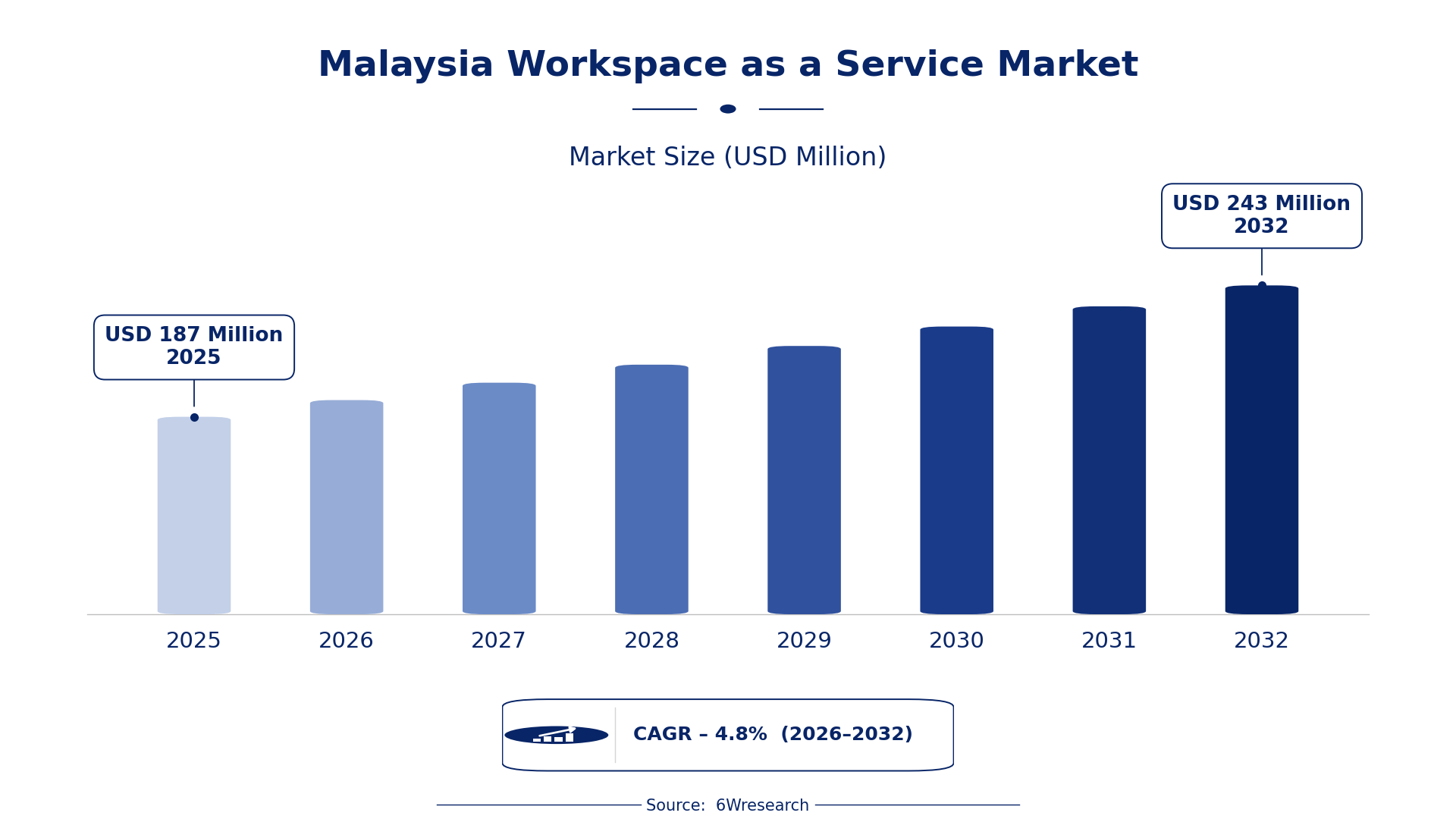
The Malaysia Workspace as a Service Market was estimated at USD 187 Million in 2025 and is projected to reach USD 243 Million by 2032, growing at a CAGR of 4.8% from 2026 to 2032.
Malaysia Workspace as a Service Market Synopsis
In recent years, the Malaysia Workspace as a Service market has gained notable momentum as businesses increasingly recognize the advantages of flexible work environments. Companies across diverse sectors are embracing WaaS solutions to empower their workforce with remote access and collaborative tools.
Looking ahead, the demand for Workspace as a Service solutions is set to escalate. Organizations are prioritizing agility and productivity, making WaaS an essential component of their operational strategies. As a result, the market is on an upward trajectory, aligning with global trends in workplace transformation.
Malaysia Workspace as a Service Market Year-wise Growth Rate and Key Drivers
This graph illustrates the annual growth rates of the Malaysia Workspace as a Service Market from 2021 to 2032, highlighting a steady upward trajectory and projected expansion over the forecast period.
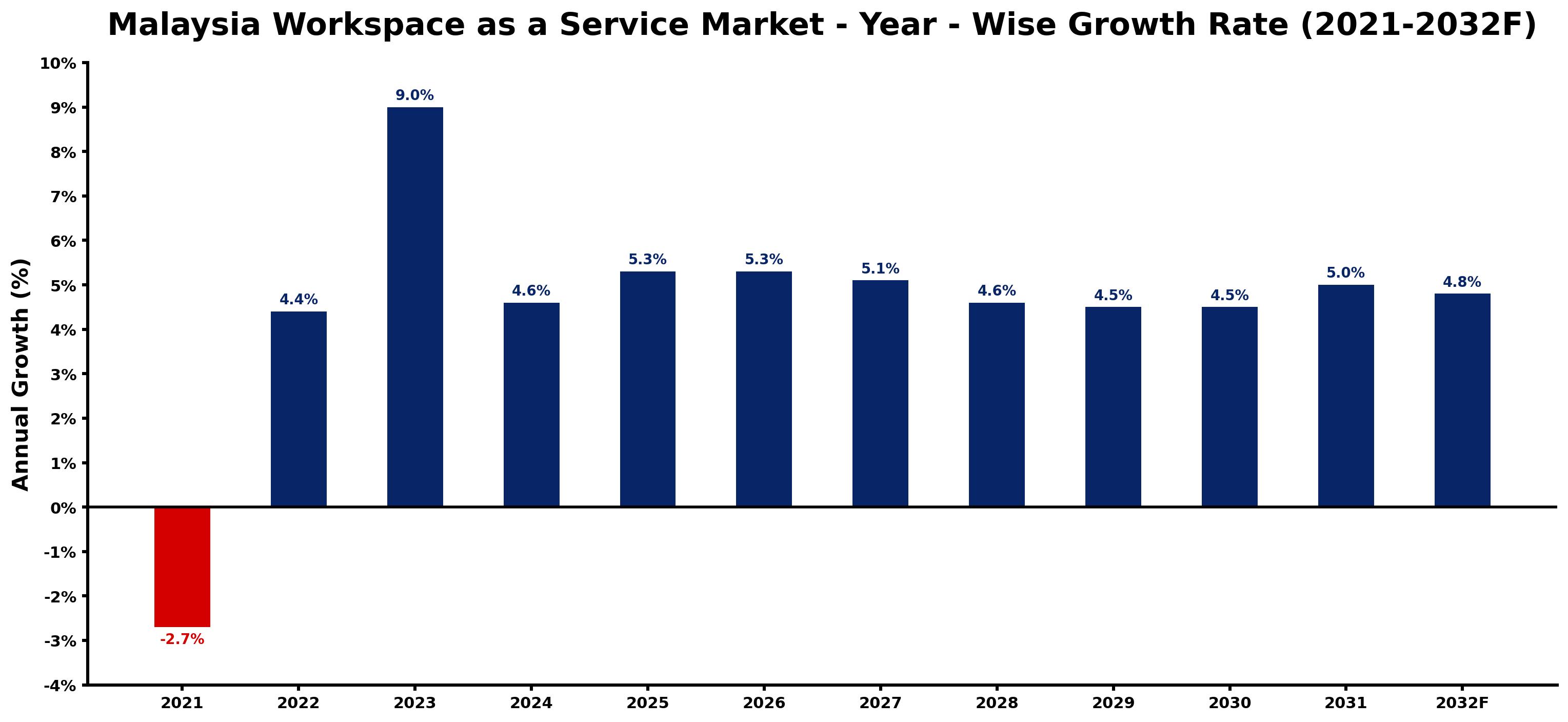
The table below presents the year‑wise growth rates along with the key drivers influencing the market
| Year | Growth Rate | Major Drivers |
| 2021 | -2.7% | MCO restrictions limited workspace adoption in Malaysia. |
| 2022 | 4.4% | Growing remote work adoption among Malaysian enterprises |
| 2023 | 9.0% | Introduction of Malaysia's Digital Economy Blueprint 2021-2025 |
| 2024 | 4.6% | Rise in startup incubators supporting workspace flexibility |
| 2025 | 5.3% | Supportive regulatory environment for co-working spaces |
| 2026 | 5.3% | Surge in tech startups seeking flexible office solutions |
| 2027 | 5.1% | Increased urbanization boosting demand for office services |
| 2028 | 4.6% | Government tax incentives for digital workspace providers |
| 2029 | 4.5% | Local enterprises prioritizing employee well-being and collaboration |
| 2030 | 4.5% | Enhanced connectivity from Malaysia's telecommunications upgrades |
| 2031 | 5.0% | Growing focus on hybrid work models in corporations |
| 2032 | 4.8% | Rising investments in technology for remote collaboration |
Note: Market size estimations and growth projections presented in this report are based on 6Wresearch's proprietary forecasting methodology, utilizing the latest available industry data, government publications, and primary research inputs.
Malaysia Workspace as a Service Market Key Takeaways
Below are some of the specific key takeaways from the market, including:
- The market is driven by the increasing shift toward remote and flexible work arrangements.
- Cloud-based solutions are essential for supporting collaboration among distributed teams.
- Businesses are actively seeking cost-effective solutions to reduce reliance on physical office space.
- Data security and compliance remain critical concerns for organizations adopting WaaS.
- Local providers are customizing WaaS offerings to better meet the needs of Malaysian enterprises.
Evaluation of Restraints in Malaysia Workspace as a Service Market
Despite the promising growth, the Malaysia Workspace as a Service market faces significant hurdles. A primary concern is data security, particularly for businesses operating in regulated industries where compliance with local regulations is non-negotiable. Organizations must navigate the complexities of managing sensitive data in a cloud environment, which raises concerns about potential breaches and vulnerabilities. Additionally, the integration of WaaS solutions with existing on-premises systems poses challenges, as businesses strive for operational continuity while ensuring performance consistency across devices and locations. The intricacies of subscription pricing models further complicate decision-making, as companies seek to ensure they derive tangible value from their investments in WaaS.
Malaysia Workspace as a Service Market Trends
The trends shaping the Malaysia Workspace as a Service market are predominantly driven by technological advancements and changing work paradigms. Organizations are increasingly adopting hybrid work models, blending remote and in-office strategies. As a result, there is a growing emphasis on user-friendly interfaces and enhanced collaboration features within WaaS solutions.
on top of that, businesses are leveraging artificial intelligence and machine learning to optimize workspace management, resulting in improved user experiences. The focus on employee well-being and productivity is prompting a surge in demand for customizable and scalable workspace solutions.
Malaysia Workspace as a Service Market Opportunities
The landscape for investment and growth in the Malaysia Workspace as a Service market is rich with opportunities. Companies looking to enhance operational efficiency can capitalize on the increasing adoption of WaaS solutions, particularly in sectors such as finance, healthcare, and IT. There is also a potential market for localized services tailored to meet the unique requirements of Malaysian enterprises, particularly in terms of compliance and user support.
on top of that, as more organizations embrace digital transformation, partnerships between local providers and global technology leaders are likely to thrive, facilitating the delivery of advanced WaaS offerings. This synergy presents a significant opportunity for businesses to differentiate themselves and capture market share.
Government Initiatives in the Malaysia Workspace as a Service Market
Government policies are playing an increasingly vital role in shaping the Malaysia Workspace as a Service market. The regulatory environment is focused on encouraging digital innovation and supporting businesses in their transition to cloud-based solutions. By prioritizing digital infrastructure and cybersecurity frameworks, the government is laying the groundwork for a more agile workforce.
- A national digital infrastructure upgrade programme was recently launched to enhance connectivity across urban and rural areas.
- A regulatory framework mandating data security measures for cloud services is currently under development.
- Ongoing efforts to promote public-private partnerships aim to stimulate investment in digital workspace solutions.
- Upcoming initiatives include a planned national awareness campaign to educate businesses on the benefits of WaaS.
Future Insights of the Malaysia Workspace as a Service Market
As we look towards 2026-2032, the Malaysia Workspace as a Service market is expected to witness substantial evolution. The growing demand for remote work capabilities and collaborative technologies will continue to drive market expansion. Companies will increasingly adopt WaaS solutions to enhance operational flexibility and maintain competitive advantage. Additionally, emerging technologies such as AI and machine learning will play a crucial role in shaping the future of workspace management, offering businesses innovative ways to optimize productivity and user experience.
Malaysia Workspace as a Service Market Latest Developments
In the last year, the Malaysia Workspace as a Service market has seen a flurry of activity as organizations adapt to new work norms and seek innovative solutions. This period has been marked by a surge in the development of tailored WaaS offerings and partnerships aimed at enhancing service delivery.
- A major technology vendor rolled out a new WaaS platform in early 2025, designed to improve user experience and integration capabilities.
- In mid-2025, a collaborative initiative between several local providers aimed at enhancing cybersecurity measures for WaaS solutions was launched.
- Plans for a comprehensive WaaS service upgrade are expected to be implemented by late 2026, focusing on improved scalability and performance.
- A new partnership between a leading regional operator and a global cloud service provider is currently underway, aimed at expanding WaaS offerings in the Malaysian market.
Malaysia Workspace as a Service Market - Key Attractiveness of the Report
- 10 Years of Market Numbers
- Historical Data Starting from 2022 to 2025
- Base Year: 2025
- Forecast Data until 2032
- Key Performance Indicators Impacting the Market
- Major Upcoming Developments and Projects
Key Highlights of the Report:
- Malaysia Workspace as a Service Market Outlook
- Market Size of Malaysia Workspace as a Service Market, 2025
- Forecast of Malaysia Workspace as a Service Market, 2032
- Historical Data and Forecast of Malaysia Workspace as a Service Revenues & Volume for the Period 2022-2032F
- Malaysia Workspace as a Service Market Trend Evolution
- Malaysia Workspace as a Service Market Drivers and Challenges
- Malaysia Workspace as a Service Price Trends
- Malaysia Workspace as a Service Porter's Five Forces
- Malaysia Workspace as a Service Industry Life Cycle
- Historical Data and Forecast of Malaysia Workspace as a Service Market Revenues & Volume By Solutions for the Period 2022-2032F
- Historical Data and Forecast of Malaysia Workspace as a Service Market Revenues & Volume By VDI and Applications for the Period 2022-2032F
- Historical Data and Forecast of Malaysia Workspace as a Service Market Revenues & Volume By Desktop as a Service for the Period 2022-2032F
- Historical Data and Forecast of Malaysia Workspace as a Service Market Revenues & Volume By Hosted Applications (Unified Communication Applications) for the Period 2022-2032F
- Historical Data and Forecast of Malaysia Workspace as a Service Market Revenues & Volume By Security Solutions for the Period 2022-2032F
- Historical Data and Forecast of Malaysia Workspace as a Service Market Revenues & Volume By Others (Browser-based WaaS solutions) for the Period 2022-2032F
- Historical Data and Forecast of Malaysia Workspace as a Service Market Revenues & Volume By Services for the Period 2022-2032F
- Historical Data and Forecast of Malaysia Workspace as a Service Market Revenues & Volume By System Integration for the Period 2022-2032F
- Historical Data and Forecast of Malaysia Workspace as a Service Market Revenues & Volume By Consulting services for the Period 2022-2032F
- Historical Data and Forecast of Malaysia Workspace as a Service Market Revenues & Volume By Managed services for the Period 2022-2032F
- Historical Data and Forecast of Malaysia Workspace as a Service Market Revenues & Volume By Deployment Type for the Period 2022-2032F
- Historical Data and Forecast of Malaysia Workspace as a Service Market Revenues & Volume By Public for the Period 2022-2032F
- Historical Data and Forecast of Malaysia Workspace as a Service Market Revenues & Volume By Private for the Period 2022-2032F
- Historical Data and Forecast of Malaysia Workspace as a Service Market Revenues & Volume By Hybrid for the Period 2022-2032F
- Historical Data and Forecast of Malaysia Workspace as a Service Market Revenues & Volume By End-Users for the Period 2022-2032F
- Historical Data and Forecast of Malaysia Workspace as a Service Market Revenues & Volume By Enterprises for the Period 2022-2032F
- Historical Data and Forecast of Malaysia Workspace as a Service Market Revenues & Volume By Small and medium businesses(SMB) for the Period 2022-2032F
- Historical Data and Forecast of Malaysia Workspace as a Service Market Revenues & Volume By Verticals for the Period 2022-2032F
- Historical Data and Forecast of Malaysia Workspace as a Service Market Revenues & Volume By Banking, Financial Services and Insurance (BFSI) for the Period 2022-2032F
- Historical Data and Forecast of Malaysia Workspace as a Service Market Revenues & Volume By Retail for the Period 2022-2032F
- Historical Data and Forecast of Malaysia Workspace as a Service Market Revenues & Volume By Government for the Period 2022-2032F
- Historical Data and Forecast of Malaysia Workspace as a Service Market Revenues & Volume By Healthcare for the Period 2022-2032F
- Historical Data and Forecast of Malaysia Workspace as a Service Market Revenues & Volume By Manufacturing for the Period 2022-2032F
- Historical Data and Forecast of Malaysia Workspace as a Service Market Revenues & Volume By Telecom and IT for the Period 2022-2032F
- Historical Data and Forecast of Malaysia Workspace as a Service Market Revenues & Volume By Utilities for the Period 2022-2032F
- Historical Data and Forecast of Malaysia Workspace as a Service Market Revenues & Volume By Travel and Hospitality for the Period 2022-2032F
- Malaysia Workspace as a Service Import Export Trade Statistics
- Market Opportunity Assessment By Solutions
- Market Opportunity Assessment By Services
- Market Opportunity Assessment By Deployment Type
- Market Opportunity Assessment By End-Users
- Market Opportunity Assessment By Verticals
- Malaysia Workspace as a Service Top Companies Market Share
- Malaysia Workspace as a Service Competitive Benchmarking By Technical and Operational Parameters
- Malaysia Workspace as a Service Company Profiles
- Malaysia Workspace as a Service Key Strategic Recommendations






































