Malaysia Yarn, Fiber and Thread Market Summary
The malaysia yarn, fiber and thread market was estimated at USD 229 Million in 2025 and is projected to reach USD 300 Million by 2032, growing at a CAGR of 5.7% from 2026 to 2032.
Malaysia Yarn, Fiber and Thread Market Year-wise Growth Rate and Key Drivers
This graph highlights how the Malaysia Yarn, Fiber and Thread Market has steadily grown over the past five years, supported by major growth factors.
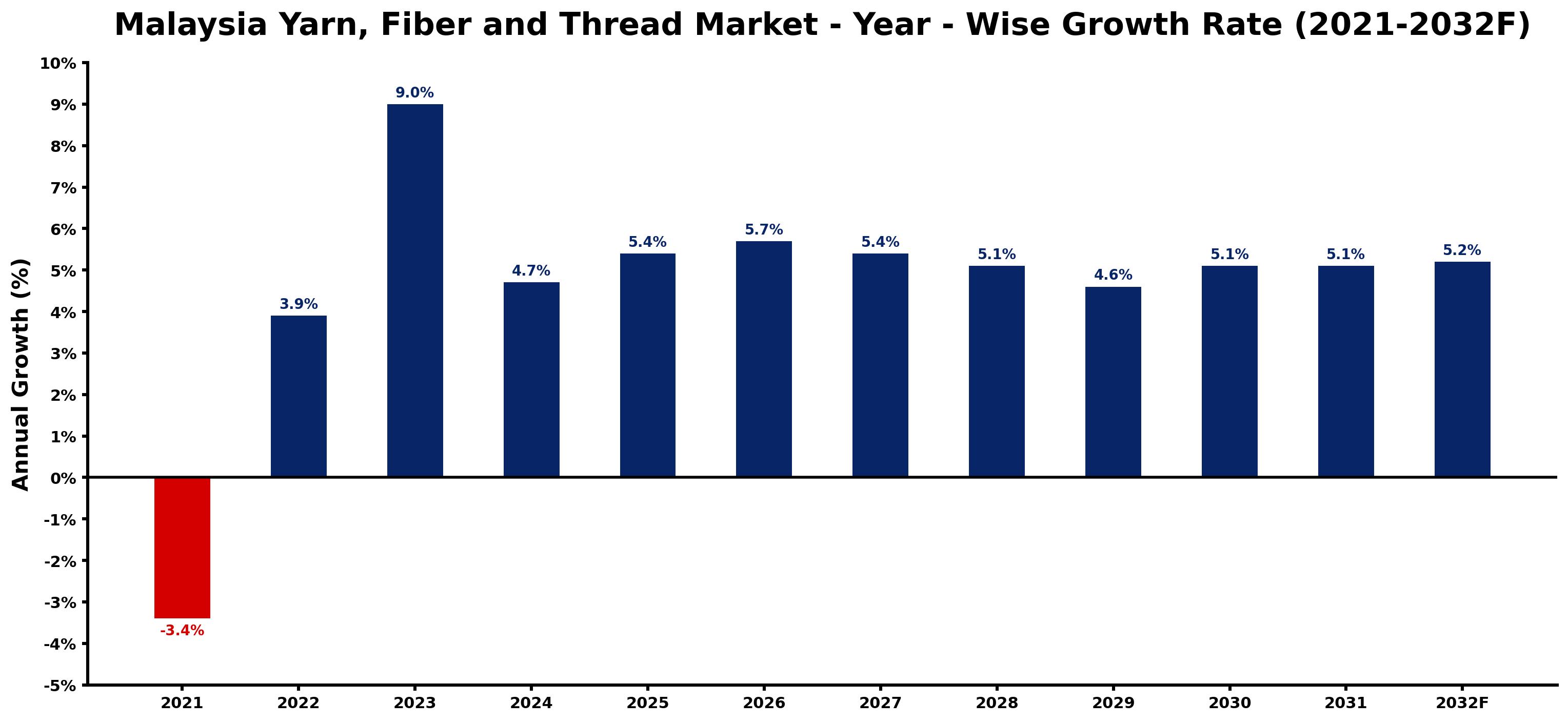
The table below presents the year wise growth rates along with the key drivers influencing the market
| Year | Growth Rate | Major Drivers |
| 2021 | -3.4% | Logistical disruptions due to pandemic constraints hampered supply chains, leading to inventory shortages and decreased sales. |
| 2022 | 3.9% | Local manufacturers invested in innovative techniques, enhancing product quality and variety. |
| 2023 | 9.0% | Increased fashion collaborations emphasized unique color palettes, influencing thread demand significantly. |
| 2024 | 4.7% | Post-lockdown retail projects prompted a resurgence in crafting and DIY activities nationwide. |
| 2025 | 5.4% | E-commerce platforms gained traction, providing wider access to specialty fibers and threads. |
| 2026 | 5.7% | Emerging fashion trends embraced artisanal products, driving interest in handcrafted yarns. |
| 2027 | 5.4% | High-performance textiles entered markets, leveraging advanced synthetic fibers for athletic wear. |
| 2028 | 5.1% | Revival of traditional weaving skills became popular, merging heritage with modern styles. |
| 2029 | 4.6% | Sourcing initiatives focused on local raw materials, reducing transportation costs and emissions. |
| 2030 | 5.1% | Investment in smart manufacturing technology improved production efficiency and waste management. |
| 2031 | 5.1% | Collaboration with local artisans enhanced brand storytelling, resonating with conscious consumers. |
| 2032 | 5.2% | Global shifts in supply chain dynamics encouraged Malaysia as a textile manufacturing hub. |
Note - Market size estimations and growth projections presented in this report are based on 6Wresearch's advanced forecasting approach, validated with industry datasets as of June 2026.
Malaysia Yarn, Fiber and Thread Market Synopsis
The Malaysia Yarn, Fiber and Thread Market is projected to reach 5.7% and witness significant growth during the forecast period (2026-2032). This market is primarily driven by the rising demand for apparel among Malaysian consumers, contingent upon increasing disposable income levels and the rapid expansion of the e-commerce sector. Moreover, strategic government initiatives aimed at bolstering the textile industry are anticipated to further stimulate market growth. However, challenges such as stringent environmental regulations regarding dyeing processes may hinder certain aspects of market expansion in the coming years.
Malaysia Yarn, Fiber and Thread Market Growth Drivers
Several key factors are propelling the Malaysia Yarn, Fiber and Thread Market. These drivers include:
- The surge in consumer demand for apparel is one of the foremost catalysts, with growing fashion consciousness among Malaysians leading to increased yarn consumption.
- Rising disposable income levels contribute positively, enabling consumers to opt for higher quality and diverse textile products.
- The burgeoning e-commerce industry has broadened the market reach for textile products, facilitating an easier purchase journey for consumers.
- Government initiatives focused on supporting the domestic textile sector through subsidies and infrastructure development are enhancing production capabilities.
- Increasing investments in research and development within the industry lead to the creation of innovative and value-added products, catering to evolving consumer preferences.
Malaysia Yarn, Fiber and Thread Market Challenges and Restraints
Despite the positive growth trajectory, the Malaysia Yarn, Fiber and Thread Market faces certain challenges that could impede its expansion:
- Stringent environmental regulations surrounding dyeing processes create operational hurdles for manufacturers, potentially increasing compliance costs.
- The volatility in raw material prices can adversely affect production costs, which in turn may impact profitability margins for manufacturers.
- The increasing competition from specialized manufacturers in neighboring countries could pose a threat to market share for local producers.
- Shifts in consumer behavior toward sustainability and eco-friendly products could necessitate rapid adaptations in manufacturing processes.
- Supply chain disruptions, particularly arising from global uncertainties, may affect the timely procurement of raw materials.
Malaysia Yarn, Fiber and Thread Market Government Investment and Initiatives
The government of Malaysia has recognized the importance of the textile industry, including the yarn and fiber sector, as a vital contributor to economic development. Various initiatives have been implemented to foster growth:
- Investment incentives are being provided to attract both domestic and foreign investments in textile production, boosting overall manufacturing capabilities.
- Programs aimed at upgrading technology and machinery in textile manufacturing facilities are being actively promoted to enhance efficiency.
- The government has initiated skill development programs aimed at equipping the workforce with the necessary expertise to meet industry requirements.
- Public-private partnerships are being encouraged to drive innovation in textiles, with a focus on sustainability and eco-friendly practices.
- Discussions on establishing export facilitation programs are underway, aiming to expand the market reach of Malaysian textile products internationally.
Malaysia Yarn, Fiber and Thread Market Latest Developments (May 2025 - June 2026)
The Malaysia Yarn, Fiber and Thread Market has seen notable developments in the period from May 2025 to June 2026. The industry is witnessing a steady upward trajectory, attributed to several dynamics:
- Increased production capacities have been reported as manufacturers gear up to meet growing domestic and international demand for textiles.
- Innovations in sustainable textile production have become a focal point, with companies exploring eco-friendly materials and technologies.
- A rise in collaborations between textile manufacturers and technology firms is observed, aimed at integrating advanced technologies into production processes.
- E-commerce platforms for textile sales are expanding, allowing for greater market penetration and accessibility for consumers.
- Market participants are increasingly participating in international trade fairs to showcase their products, thereby enhancing visibility and exploring collaboration opportunities.
Malaysia Yarn, Fiber and Thread Market - Key Attractiveness of the Report
- 10 Years of Market Numbers
- Historical Data Starting from 2022 to 2025
- Base Year: 2025
- Forecast Data until 2032
- Key Performance Indicators Impacting the Market
- Major Upcoming Developments and Projects
Key Highlights of the Report:
- Malaysia Yarn, Fiber and Thread Market Outlook
- Market Size of Malaysia Yarn, Fiber and Thread Market, 2025
- Forecast of Malaysia Yarn, Fiber and Thread Market, 2032F
- Historical Data and Forecast of Malaysia Yarn, Fiber and Thread Revenues & Volume for the Period 2022-2032F
- Malaysia Yarn, Fiber and Thread Market Trend Evolution
- Malaysia Yarn, Fiber and Thread Market Drivers and Challenges
- Malaysia Yarn, Fiber and Thread Price Trends
- Malaysia Yarn, Fiber and Thread Porter's Five Forces
- Malaysia Yarn, Fiber and Thread Industry Life Cycle
- Historical Data and Forecast of Malaysia Yarn, Fiber and Thread Market Revenues & Volume By Type for the Period 2022-2032F
- Historical Data and Forecast of Malaysia Yarn, Fiber and Thread Market Revenues & Volume By Regular Products for the Period 2022-2032F
- Historical Data and Forecast of Malaysia Yarn, Fiber and Thread Market Revenues & Volume By Special Products for the Period 2022-2032F
- Historical Data and Forecast of Malaysia Yarn, Fiber and Thread Market Revenues & Volume By Applications for the Period 2022-2032F
- Historical Data and Forecast of Malaysia Yarn, Fiber and Thread Market Revenues & Volume By Household for the Period 2022-2032F
- Historical Data and Forecast of Malaysia Yarn, Fiber and Thread Market Revenues & Volume By Commercial for the Period 2022-2032F
- Malaysia Yarn, Fiber and Thread Import Export Trade Statistics
- Market Opportunity Assessment By Type
- Market Opportunity Assessment By Applications
- Malaysia Yarn, Fiber and Thread Top Companies Market Share
- Malaysia Yarn, Fiber and Thread Competitive Benchmarking By Technical and Operational Parameters
- Malaysia Yarn, Fiber and Thread Company Profiles
- Malaysia Yarn, Fiber and Thread Key Strategic Recommendations






































