Maldives Candles Market Growth Rate Analysis (2021 - 2031)
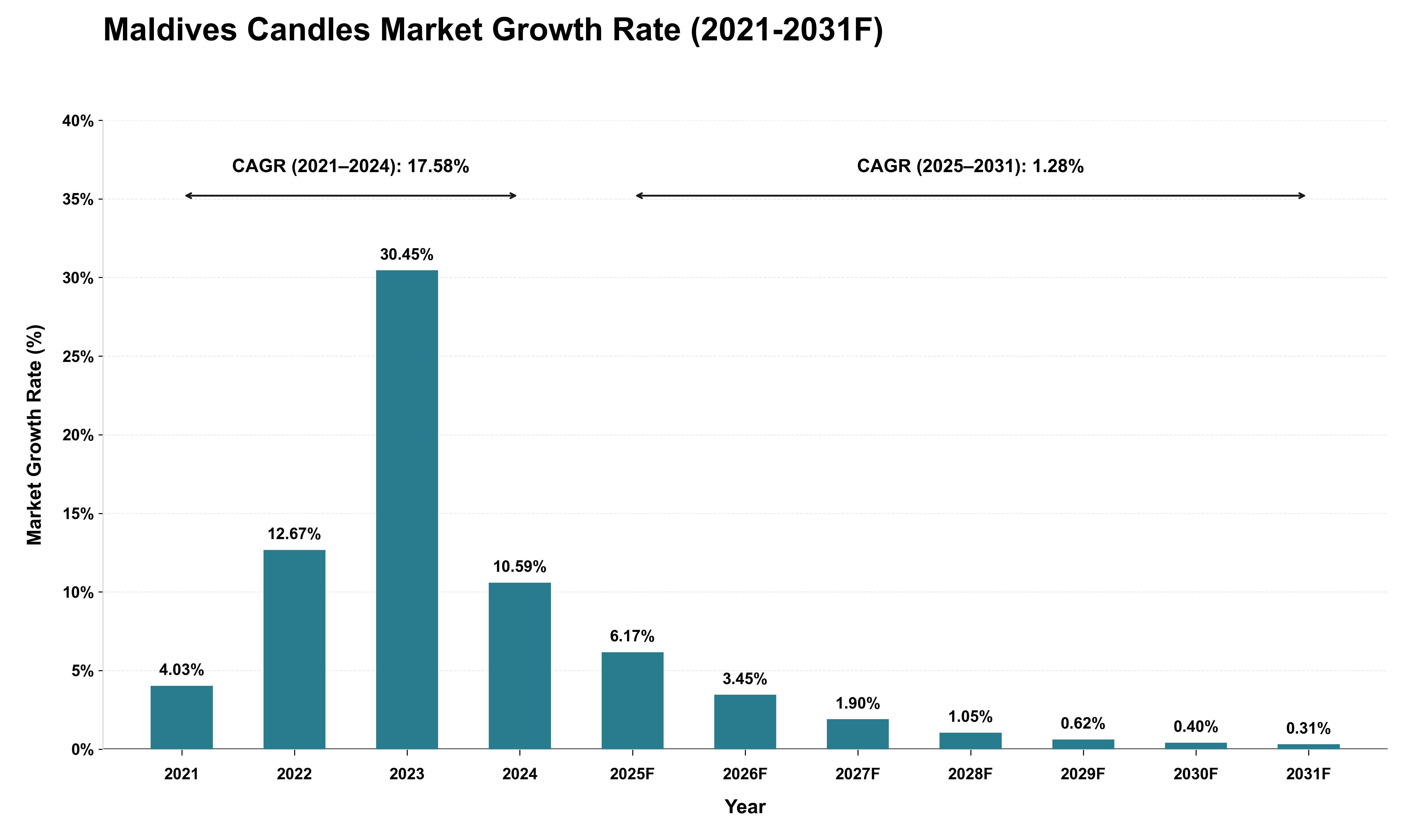
The Maldives candles market experienced a robust historical CAGR of 17.58% from 2021 to 2024, driven by a surge in tourism and heightened consumer interest in home ambiance products during the post-pandemic recovery phase. The significant annual growth of 30.45% in 2023 can be attributed to increased disposable incomes and a rebound in hospitality sectors, which typically favor luxury goods like candles. However, as the market transitions into the forecast period (2025-2031), growth is projected to decelerate sharply to a CAGR of just 1.28%. This slowdown reflects broader global trade dynamics, including potential supply chain disruptions and rising import costs that could affect consumer spending on non-essential items. Additionally, as the market matures, reliance on imports may intensify due to limited local production capabilities, further constraining growth prospects amidst changing consumer preferences and economic cycles.
Key Highlights of the Report:
- Maldives Candles Market Outlook
- Market Size of Maldives Candles Market, 2025
- Forecast of Maldives Candles Market, 2032
- Historical Data and Forecast of Maldives Candles Revenues & Volume for the Period 2022 - 2032F
- Maldives Candles Market Trend Evolution
- Maldives Candles Market Drivers and Challenges
- Maldives Candles Price Trends
- Maldives Candles Porter's Five Forces
- Maldives Candles Industry Life Cycle
- Historical Data and Forecast of Maldives Candles Market Revenues & Volume By Product Type for the Period 2022 - 2032F
- Historical Data and Forecast of Maldives Candles Market Revenues & Volume By Scented Candles for the Period 2022 - 2032F
- Historical Data and Forecast of Maldives Candles Market Revenues & Volume By Unscented Candles for the Period 2022 - 2032F
- Historical Data and Forecast of Maldives Candles Market Revenues & Volume By Application for the Period 2022 - 2032F
- Historical Data and Forecast of Maldives Candles Market Revenues & Volume By Aromatherapy for the Period 2022 - 2032F
- Historical Data and Forecast of Maldives Candles Market Revenues & Volume By Lighting for the Period 2022 - 2032F
- Historical Data and Forecast of Maldives Candles Market Revenues & Volume By Material for the Period 2022 - 2032F
- Historical Data and Forecast of Maldives Candles Market Revenues & Volume By Paraffin Wax for the Period 2022 - 2032F
- Historical Data and Forecast of Maldives Candles Market Revenues & Volume By Soy Wax for the Period 2022 - 2032F
- Historical Data and Forecast of Maldives Candles Market Revenues & Volume By Scent Type for the Period 2022 - 2032F
- Historical Data and Forecast of Maldives Candles Market Revenues & Volume By Lavender, Rose for the Period 2022 - 2032F
- Historical Data and Forecast of Maldives Candles Market Revenues & Volume By Unscented for the Period 2022 - 2032F
- Maldives Candles Import Export Trade Statistics
- Market Opportunity Assessment By Product Type
- Market Opportunity Assessment By Application
- Market Opportunity Assessment By Material
- Market Opportunity Assessment By Scent Type
- Maldives Candles Top Companies Market Share
- Maldives Candles Competitive Benchmarking By Technical and Operational Parameters
- Maldives Candles Company Profiles
- Maldives Candles Key Strategic Recommendations






































