Maldives Non Alcoholic Wine Market Growth Rate Analysis (2025 - 2031)
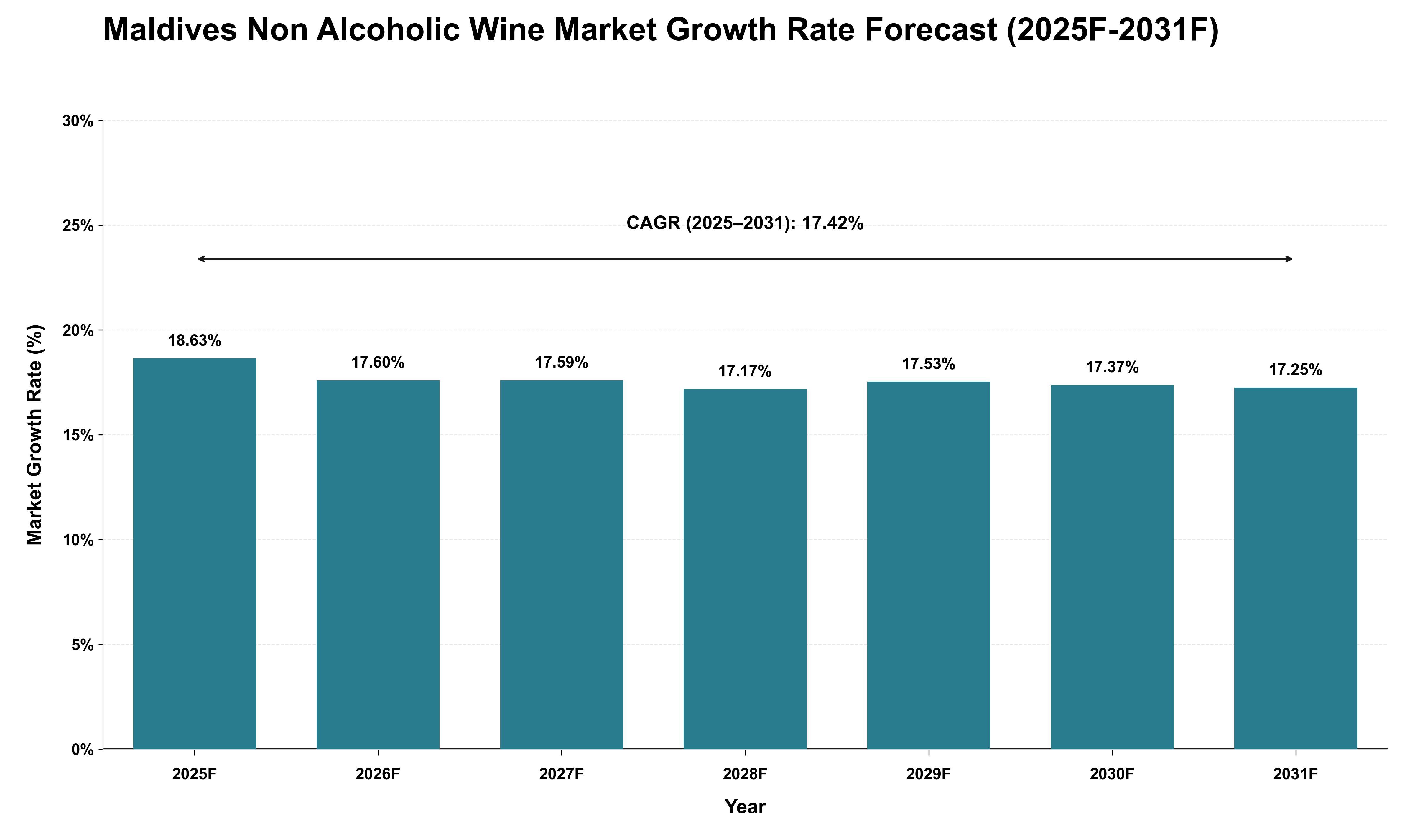
The forecasted growth trajectory for the Maldives non-alcoholic wine market will exhibit a notable deceleration from an initial 18.63% in 2025 to 17.25% by 2031, reflecting a gradual easing of demand dynamics. This trend will likely be influenced by evolving consumer preferences and the increasing availability of alternative beverage options, which may impact import dependencies and pricing structures. As the market expands, supply chain efficiencies will become critical; fluctuations in input costs—such as raw materials and transportation—will play a significant role in shaping profitability and pricing strategies. The anticipated CAGR of 17.42% underscores robust demand, yet the slight decline in annual growth rates suggests that producers must navigate potential challenges related to sourcing and distribution logistics while adapting to changing consumer tastes within this niche segment.
Key Highlights of the Report:
- Maldives Non-Alcoholic Wine Market Outlook
- Market Size of Maldives Non-Alcoholic Wine Market, 2024
- Forecast of Maldives Non-Alcoholic Wine Market, 2031
- Historical Data and Forecast of Maldives Non-Alcoholic Wine Revenues & Volume for the Period 2021- 2031
- Maldives Non-Alcoholic Wine Market Trend Evolution
- Maldives Non-Alcoholic Wine Market Drivers and Challenges
- Maldives Non-Alcoholic Wine Price Trends
- Maldives Non-Alcoholic Wine Porter's Five Forces
- Maldives Non-Alcoholic Wine Industry Life Cycle
- Historical Data and Forecast of Maldives Non-Alcoholic Wine Market Revenues & Volume By Product Type for the Period 2021- 2031
- Historical Data and Forecast of Maldives Non-Alcoholic Wine Market Revenues & Volume By Alcohol-Free for the Period 2021- 2031
- Historical Data and Forecast of Maldives Non-Alcoholic Wine Market Revenues & Volume By 0.5% Alcohol by Volume for the Period 2021- 2031
- Historical Data and Forecast of Maldives Non-Alcoholic Wine Market Revenues & Volume By Category for the Period 2021- 2031
- Historical Data and Forecast of Maldives Non-Alcoholic Wine Market Revenues & Volume By Plain for the Period 2021- 2031
- Historical Data and Forecast of Maldives Non-Alcoholic Wine Market Revenues & Volume By Flavored for the Period 2021- 2031
- Historical Data and Forecast of Maldives Non-Alcoholic Wine Market Revenues & Volume By Distribution Channel for the Period 2021- 2031
- Historical Data and Forecast of Maldives Non-Alcoholic Wine Market Revenues & Volume By Store-Based for the Period 2021- 2031
- Historical Data and Forecast of Maldives Non-Alcoholic Wine Market Revenues & Volume By Non-Store-Based for the Period 2021- 2031
- Maldives Non-Alcoholic Wine Import Export Trade Statistics
- Market Opportunity Assessment By Product Type
- Market Opportunity Assessment By Category
- Market Opportunity Assessment By Distribution Channel
- Maldives Non-Alcoholic Wine Top Companies Market Share
- Maldives Non-Alcoholic Wine Competitive Benchmarking By Technical and Operational Parameters
- Maldives Non-Alcoholic Wine Company Profiles
- Maldives Non-Alcoholic Wine Key Strategic Recommendations






































