Malta Umbrella Market Size (2020-2030)
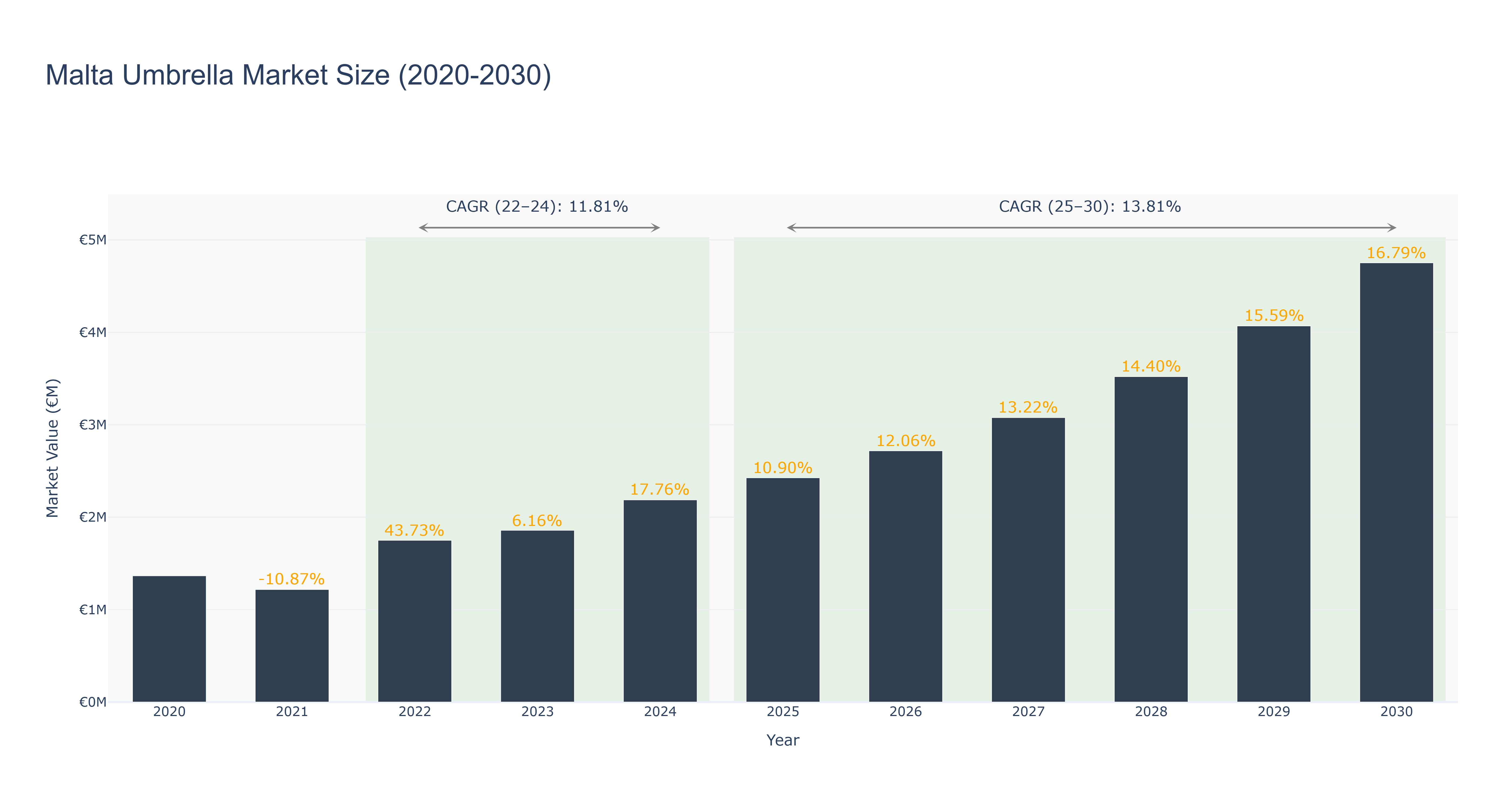
Malta Umbrella Market has shown a steady growth trajectory over the years. The peak market size of €4.75 million is forecasted for 2030, with a notable increase from €1.37 million in 2020. The market experienced a significant growth phase from 2022 to 2024, with a CAGR of 11.81%, attributed to increased consumer demand and innovative product offerings. Subsequently, from 2025 to 2030, the market is expected to maintain a robust growth rate with a CAGR of 13.81%, driven by favorable economic conditions and expanding market reach. Recent developments in sustainable materials and advanced technology integration are set to further propel market growth in the coming years, enhancing product quality and customer satisfaction. Malta Umbrella Market's promising outlook reflects its resilience and potential for sustained prosperity in the competitive landscape.
Malta Umbrella Market: Production & Trade Performance (2019-2025)
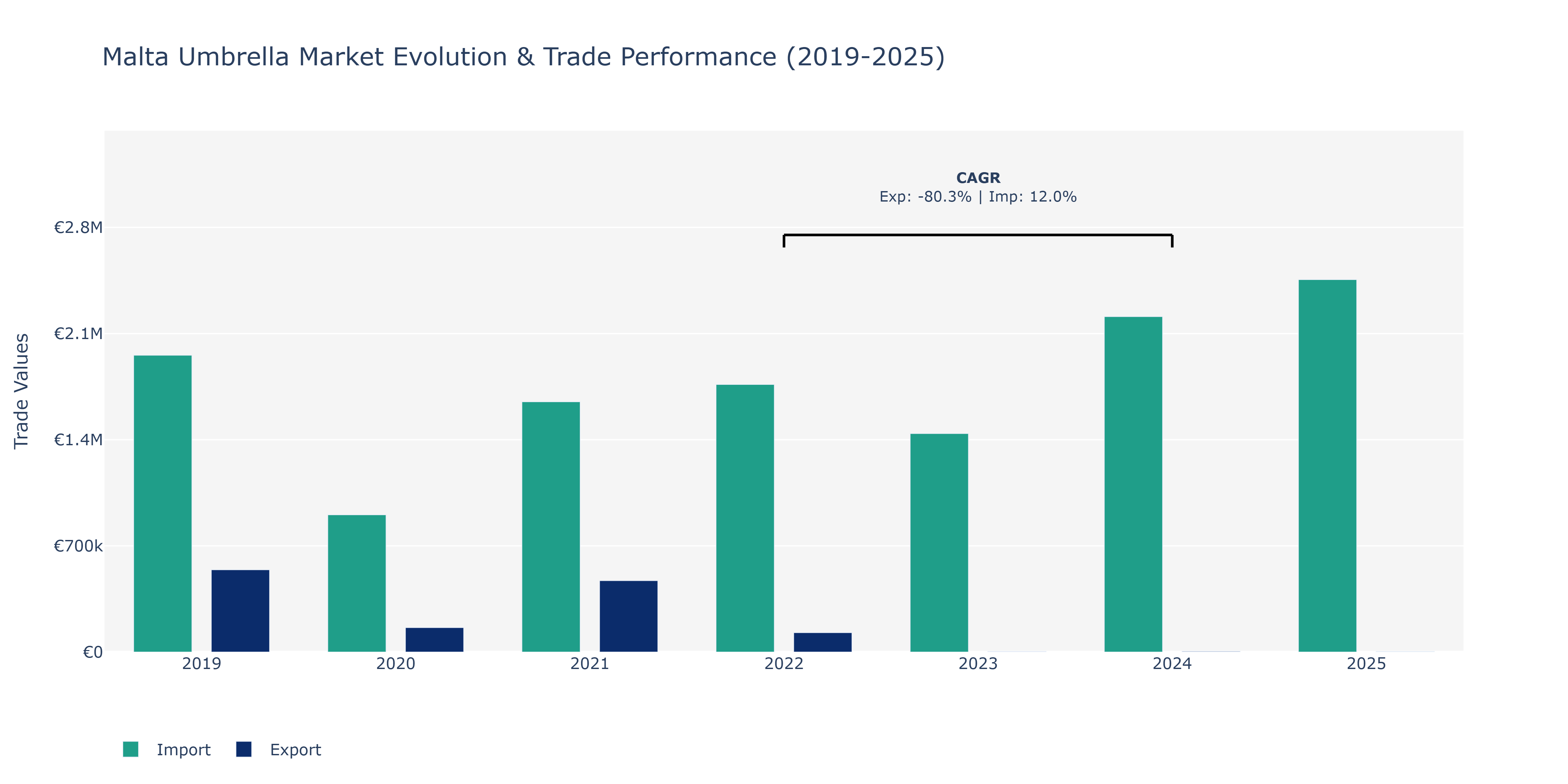
Between 2019 and 2025, the Malta Umbrella Market witnessed varying trends in exports and imports. In 2019, exports stood at €542.46 thousand and imports at €1.96 million, showcasing a substantial trade deficit. However, by 2020, both exports and imports experienced significant declines, with exports dropping to €160.81 thousand and imports to €904.9 thousand. The following years saw fluctuations in trade activities, with notable decreases in 2022 for exports (€127.49 thousand) and 2023 for imports (€1.44 million). A recovery was observed in 2024, with exports rising slightly to €4.94 thousand and imports peaking at €2.21 million. In 2025, exports amounted to around €3.71 thousand, while imports reached approximately €2.46 million. These fluctuations can be attributed to global economic conditions, shifting consumer demands, and possibly regulatory changes impacting the Umbrella Market in Malta. The positive CAGR of 11.97% for imports from 2022 to 2024 indicates a growing demand for imported umbrella products, possibly due to changes in consumer preferences or local manufacturing capacity limitations.
Key Highlights of the Report:
- Malta Umbrella Market Outlook
- Market Size of Malta Umbrella Market, 2025
- Forecast of Malta Umbrella Market, 2032
- Historical Data and Forecast of Malta Umbrella Revenues & Volume for the Period 2022 - 2032F
- Malta Umbrella Market Trend Evolution
- Malta Umbrella Market Drivers and Challenges
- Malta Umbrella Price Trends
- Malta Umbrella Porter`s Five Forces
- Malta Umbrella Industry Life Cycle
- Historical Data and Forecast of Malta Umbrella Market Revenues & Volume By Product for the Period 2022 - 2032F
- Historical Data and Forecast of Malta Umbrella Market Revenues & Volume By Reverse Umbrella for the Period 2022 - 2032F
- Historical Data and Forecast of Malta Umbrella Market Revenues & Volume By Straight Umbrella for the Period 2022 - 2032F
- Historical Data and Forecast of Malta Umbrella Market Revenues & Volume By Folding Umbrella for the Period 2022 - 2032F
- Historical Data and Forecast of Malta Umbrella Market Revenues & Volume By Automatic Umbrella for the Period 2022 - 2032F
- Historical Data and Forecast of Malta Umbrella Market Revenues & Volume By Other for the Period 2022 - 2032F
- Historical Data and Forecast of Malta Umbrella Market Revenues & Volume By Application for the Period 2022 - 2032F
- Historical Data and Forecast of Malta Umbrella Market Revenues & Volume By Commercial Use for the Period 2022 - 2032F
- Historical Data and Forecast of Malta Umbrella Market Revenues & Volume By Entertainment Use for the Period 2022 - 2032F
- Malta Umbrella Import Export Trade Statistics
- Market Opportunity Assessment By Product
- Market Opportunity Assessment By Application
- Malta Umbrella Top Companies Market Share
- Malta Umbrella Competitive Benchmarking By Technical and Operational Parameters
- Malta Umbrella Company Profiles
- Malta Umbrella Key Strategic Recommendations






































