Nepal Umbrella Market Size, Share & Growth Rate
The Nepal Umbrella Market was estimated at USD 435 Million in 2025 and is projected to reach USD 609 Million by 2032, growing at a CAGR of 4.9% from 2026 to 2032. This upward trajectory is primarily driven by an increase in disposable incomes among the local population and a burgeoning tourism sector, leading to heightened demand for both functional and decorative umbrellas. Additionally, the rising awareness around sustainable products is reshaping consumer preferences, steering them towards eco-friendly options.
Nepal Umbrella Market Year-wise Growth Rate and Key Drivers
This graph highlights how the Nepal Umbrella Market has steadily grown over the years, supported by major growth factors.
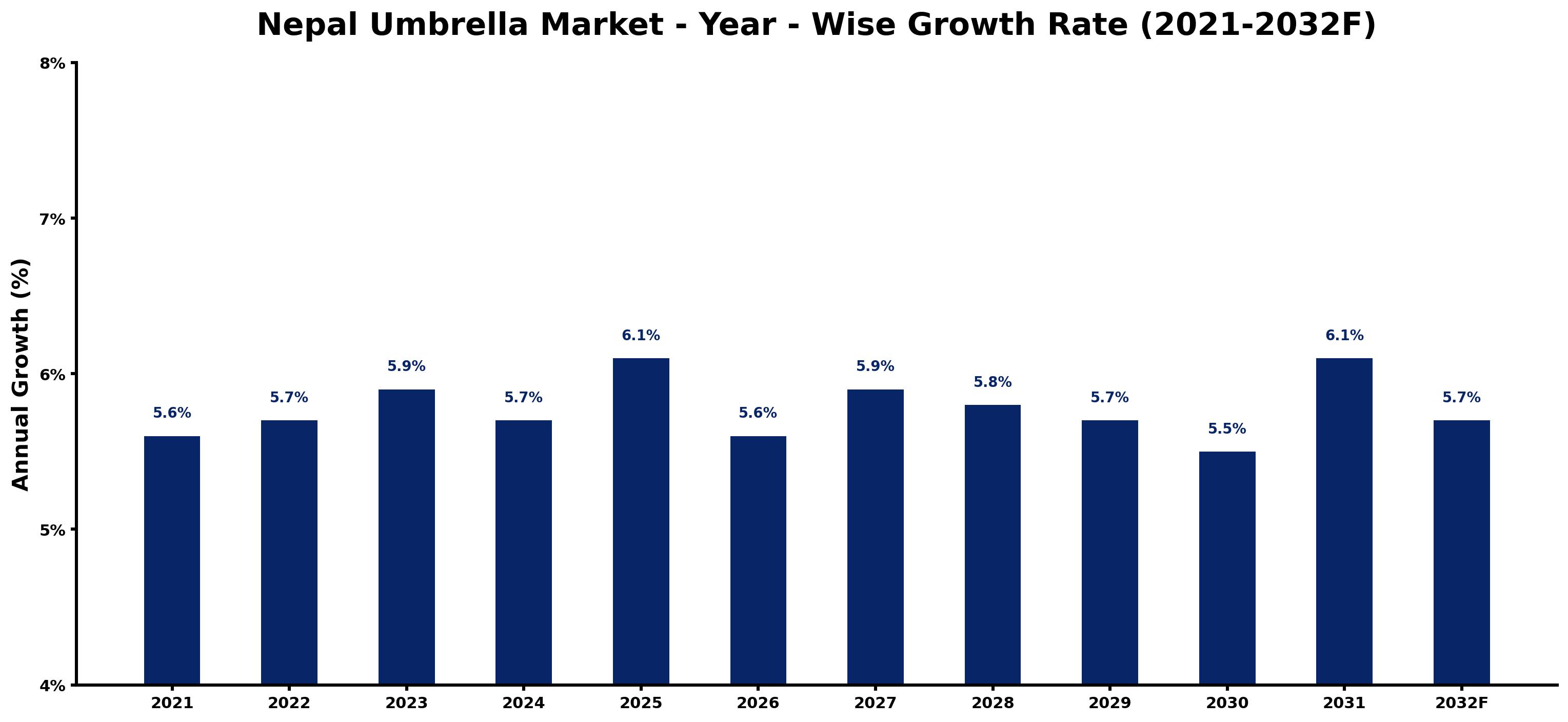
The table below presents the year‑wise growth rates along with the key drivers influencing the market
| Year | Growth Rate | Major Drivers |
| 2021 | 5.6% | Expansion of manufacturing activities |
| 2022 | 5.7% | Increasing smart city development projects |
| 2023 | 5.9% | Rising electricity demand across industries |
| 2024 | 5.7% | Growing renewable energy integration projects |
| 2025 | 6.1% | Expansion of commercial construction activities |
| 2026 | 5.6% | Expansion of manufacturing activities |
| 2027 | 5.9% | Expansion of commercial construction activities |
| 2028 | 5.8% | Expansion of commercial construction activities |
| 2029 | 5.7% | Expansion of transportation and logistics networks |
| 2030 | 5.5% | Increasing industrial automation investments |
| 2031 | 6.1% | Growing renewable energy integration projects |
| 2032 | 5.7% | Increasing industrial infrastructure investments |
Note - Market size estimations and growth projections presented in this report are based on 6Wresearch's advanced forecasting approach, validated with industry datasets as of June 2026.
Nepal Umbrella Market Synopsis
The Nepal umbrella market is characterized by a rich tapestry of traditional craftsmanship alongside modern production techniques. Local artisans produce unique, handcrafted umbrellas that not only serve practical purposes but also embody cultural significance, captivating both residents and tourists.
Meanwhile, the influx of international brands has introduced innovative materials and designs, increasing competition. This dynamic market landscape is a reflection of the evolving consumer preferences, where quality, design, and sustainability play pivotal roles in purchasing decisions.
Nepal Umbrella Market Key Takeaways
- The market is projected to experience steady growth driven by increasing demand for both traditional and innovative umbrellas.
- Eco-friendly products are becoming increasingly popular among consumers, aligning with global sustainability trends.
- Unique designs and vibrant colors are essential for brands looking to differentiate themselves in a crowded marketplace.
- Local artisans continue to play a vital role in maintaining cultural heritage through their craftsmanship.
- Investment in innovative distribution channels could enhance market penetration and expand reach both domestically and internationally.
Evaluation of Restraints in Nepal Umbrella Market
Intense competition remains one of the most significant hurdles in the Nepal Umbrella Market. With numerous players vying for market share, price wars have become commonplace, squeezing profit margins for local manufacturers. Furthermore, seasonality poses a substantial challenge; the distinct monsoon and dry seasons lead to unpredictable fluctuations in demand, complicating inventory management. Infrastructure bottlenecks and logistical hurdles also hinder efficient distribution, impacting the overall market dynamics.
Nepal Umbrella Market Trends
The Nepal Umbrella Market is currently witnessing a pronounced shift towards eco-friendly umbrellas, utilizing biodegradable materials such as bamboo and recycled plastics. Consumers are increasingly driven by environmental consciousness, opting for products that reflect their values. Additionally, there's a growing preference for compact and lightweight umbrellas, catering to the needs of a mobile population seeking convenience without compromising on style.
Nepal Umbrella Market Opportunities
Investment opportunities abound, particularly in the realms of eco-friendly manufacturing and innovative design. The intersection of traditional craftsmanship and modern aesthetics presents a lucrative niche for investors. Collaborating with local artisans to produce unique, high-quality products can tap into the rising demand for authentic and culturally rich items. Furthermore, exploring export avenues could significantly enhance the visibility and reach of Nepali umbrellas on the global stage.
Government Initiatives in the Nepal Umbrella Market
Government policies play a crucial role in shaping the Nepal Umbrella Market. Regulatory frameworks are in place to ensure quality standards and facilitate fair trade practices, thereby safeguarding consumer interests. Efforts to promote local craftsmanship and environmentally friendly practices are evident, with various programs aimed at supporting artisans in upgrading their skills and adopting sustainable methods. Additionally, labor laws are designed to protect workers' rights within the umbrella manufacturing sector, contributing to the overall market health.
Future Insights of the Nepal Umbrella Market
Looking ahead to 2026-2032, the Nepal Umbrella Market is set for robust growth. This positive outlook is fueled by an expanding middle class with increasing disposable incomes, along with a shift towards stylish and durable products. The tourism sector's growth will continue to drive demand, particularly for unique and locally crafted umbrellas. As eco-consciousness becomes more mainstream, companies that prioritize sustainable practices and innovation will likely lead the market forward, adapting to changing consumer preferences effectively.
Nepal Umbrella Market Latest Developments (May 2025 - June 2026)
Recent developments in the Nepal Umbrella Market indicate a growing emphasis on integrating technology into traditional manufacturing processes. Efforts are underway to improve the logistics and distribution channels to enhance product availability across remote regions. Additionally, collaborations between local artisans and design professionals are emerging, creating a new wave of innovative and aesthetically appealing products that resonate with both local and international consumers.
Nepal Umbrella Market - Key Attractiveness of the Report
- 10 Years of Market Numbers
- Historical Data Starting from 2022 to 2025
- Base Year: 2025
- Forecast Data until 2032
- Key Performance Indicators Impacting the Market
- Major Upcoming Developments and Projects
Key Highlights of the Report:
- Nepal Umbrella Market Outlook
- Market Size of Nepal Umbrella Market, 2025
- Forecast of Nepal Umbrella Market, 2032
- Historical Data and Forecast of Nepal Umbrella Revenues & Volume for the Period 2022-2032F
- Nepal Umbrella Market Trend Evolution
- Nepal Umbrella Market Drivers and Challenges
- Nepal Umbrella Price Trends
- Nepal Umbrella Porter's Five Forces
- Nepal Umbrella Industry Life Cycle
- Historical Data and Forecast of Nepal Umbrella Market Revenues & Volume By Product for the Period 2022-2032F
- Historical Data and Forecast of Nepal Umbrella Market Revenues & Volume By Reverse Umbrella for the Period 2022-2032F
- Historical Data and Forecast of Nepal Umbrella Market Revenues & Volume By Straight Umbrella for the Period 2022-2032F
- Historical Data and Forecast of Nepal Umbrella Market Revenues & Volume By Folding Umbrella for the Period 2022-2032F
- Historical Data and Forecast of Nepal Umbrella Market Revenues & Volume By Automatic Umbrella for the Period 2022-2032F
- Historical Data and Forecast of Nepal Umbrella Market Revenues & Volume By Other for the Period 2022-2032F
- Historical Data and Forecast of Nepal Umbrella Market Revenues & Volume By Application for the Period 2022-2032F
- Historical Data and Forecast of Nepal Umbrella Market Revenues & Volume By Commercial Use for the Period 2022-2032F
- Historical Data and Forecast of Nepal Umbrella Market Revenues & Volume By Entertainment Use for the Period 2022-2032F
- Nepal Umbrella Import Export Trade Statistics
- Market Opportunity Assessment By Product
- Market Opportunity Assessment By Application
- Nepal Umbrella Top Companies Market Share
- Nepal Umbrella Competitive Benchmarking By Technical and Operational Parameters
- Nepal Umbrella Company Profiles
- Nepal Umbrella Key Strategic Recommendations






































