Mexico 3D Glasses Market Summary
The mexico 3d glasses market was estimated at USD 220 Million in 2025 and is projected to reach USD 254 Million by 2032, growing at a CAGR of 0.7% from 2026 to 2032.
Mexico 3D Glasses Market Year-wise Growth Rate and Key Drivers
This graph highlights how the Mexico 3D Glasses Market has steadily grown over the past five years, supported by major growth factors.
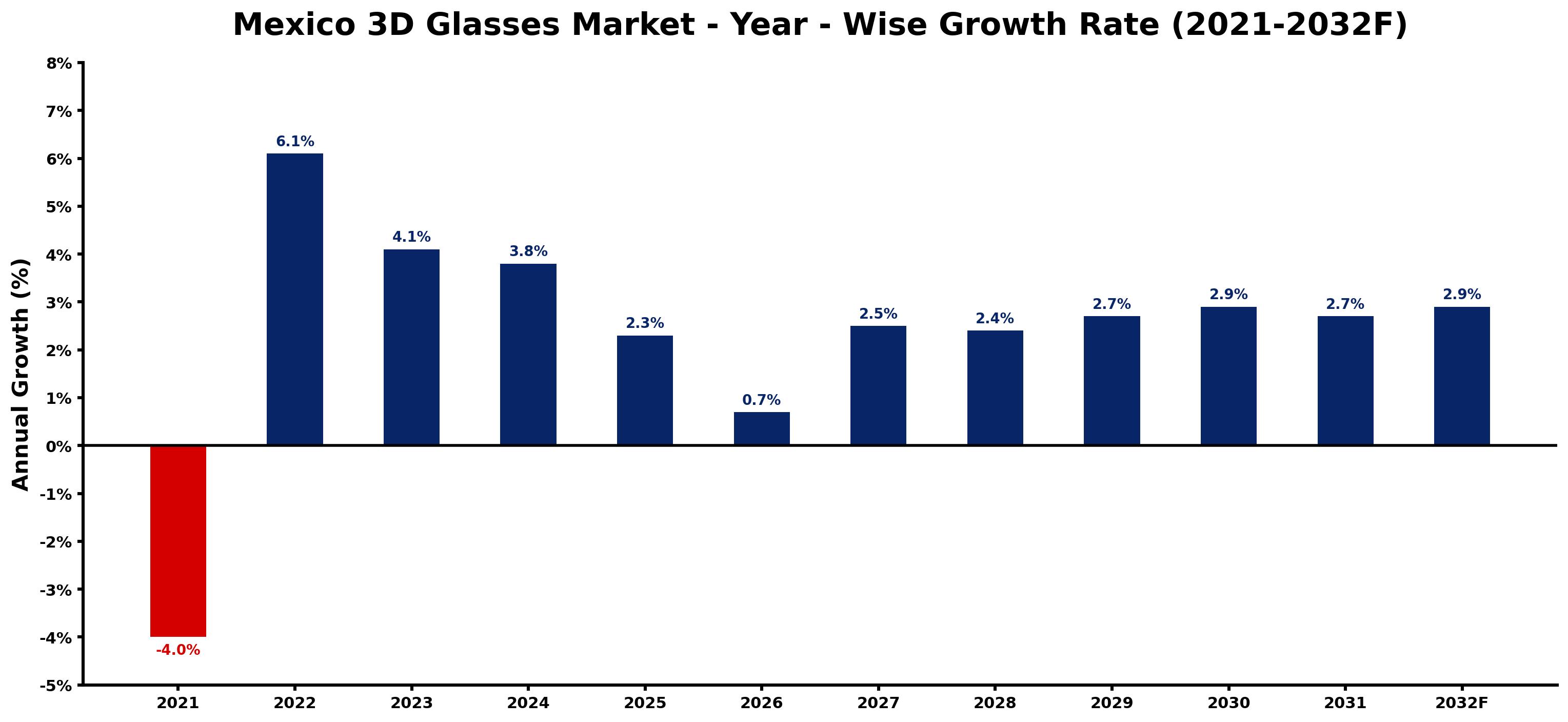
The table below presents the year wise growth rates along with the key drivers influencing the market
| Year | Growth Rate | Major Drivers |
| 2021 | -4.0% | Decreased demand for immersive entertainment experiences led to lower sales of 3D glasses in Mexico. |
| 2022 | 6.1% | Local manufacturers increasingly introduced competitively priced 3D glasses to the market. |
| 2023 | 4.1% | E-commerce platforms expanded their offerings, enhancing accessibility for diverse consumers. |
| 2024 | 3.8% | Investment in gaming and entertainment sectors prompted higher demand for quality visuals. |
| 2025 | 2.3% | Education institutions integrated 3D technologies into curricula, boosting market visibility. |
| 2026 | 0.7% | Partnerships between tech companies and film studios created innovative 3D content releases. |
| 2027 | 2.5% | Advancements in smartphone technology facilitated 3D content consumption and sharing. |
| 2028 | 2.4% | Virtual reality experiences gained popularity, further spurring interest in 3D glasses. |
| 2029 | 2.7% | Augmented reality applications emerged, creating a new segment for 3D technologies. |
| 2030 | 2.9% | Collaborations with healthcare providers began utilizing 3D glasses for medical training. |
| 2031 | 2.7% | Increased focus on sustainability prompted eco-friendly 3D glasses material development. |
| 2032 | 2.9% | Consumer electronics firms expanded portfolios, integrating 3D functionalities into mainstream devices. |
Note - Market size estimations and growth projections presented in this report are based on 6Wresearch's advanced forecasting approach, validated with industry datasets as of June 2026.
Mexico 3D Glasses Market Synopsis
The Mexico 3D Glasses Market is projected to reach 0.7% and witness significant growth during the forecast period (2026-2032). As the nation increasingly integrates advanced visual technologies into various sectors, the demand for quality 3D glasses is evolving. This rise can be attributed to expanding applications across entertainment, education, and healthcare, with consumers seeking more immersive experiences in all facets of life.
Mexico 3D Glasses Market Growth Drivers
The Mexico 3D Glasses Market is experiencing robust growth due to several critical drivers:
- The entertainment industry in Mexico is witnessing a notable increase in the production and distribution of 3D content, which directly boosts the demand for compatible 3D glasses. Cinemas and home entertainment systems are pivotal arenas where this technology thrives.
- Adoption of 3D technology in educational settings enhances teaching methods, allowing for immersive learning experiences that are increasingly sought after by both institutions and students.
- In healthcare, the application of 3D technology for diagnostics and surgical planning supports the market. Medical professionals leverage 3D imaging to enhance patient outcomes, contributing to increased demand for specialized eyewear.
- As consumer preferences shift towards high-quality visual experiences, manufacturers are innovating their product lines, producing advanced 3D glasses that cater to diverse market segments.
- The growth of gaming platforms that utilize 3D technology is also significant, particularly among younger demographics, driving sales and awareness of 3D glasses.
Mexico 3D Glasses Market Challenges and Restraints
Despite the promising outlook, the Mexico 3D Glasses Market faces several challenges that could impede growth:
- Limited adoption of 3D technology across some entertainment sectors restricts the potential market size. The growth of this market is heavily reliant on the availability of compelling 3D content.
- Concerns regarding health issues related to prolonged usage of 3D glasses pose risks for manufacturers. Addressing user discomfort and potential eye strain is crucial for maintaining consumer trust.
- The market faces competition from alternative technologies such as virtual reality (VR) and augmented reality (AR), which may dilute the focus on traditional 3D glasses.
- Economic fluctuations can affect discretionary spending on entertainment technologies, thereby impacting sales of 3D glasses.
- Gaps in consumer education about the advantages of 3D technology hinder potential growth. Informative marketing strategies are essential to raise awareness and promote the benefits of high-quality 3D glasses.
Mexico 3D Glasses Market Government Investment and Initiatives
The Mexican government has recognized the significance of advanced visual technologies, including 3D glasses, in enhancing various sectors. The following initiatives have been introduced to support this market:
- Policies promoting investment in technology development are pivotal. The government aims to create a favorable environment for innovation in visual technologies, including 3D applications.
- Public spending in education and healthcare sectors increasingly incorporates 3D technology, driving demand for quality 3D glasses to support immersive experiences.
- Research and development funding is being directed towards developing new technologies and improving existing 3D glasses, ensuring that the market remains competitive on a global scale.
- There are also incentives for educational institutions to adopt 3D technologies, which indirectly bolsters the demand for 3D eyewear among students and educators.
- The government actively seeks partnerships with tech firms to advance the capabilities of 3D technologies, further solidifying the importance of 3D glasses in the Mexican market landscape.
Mexico 3D Glasses Market Latest Developments (May 2025 - June 2026)
In the period from May 2025 to June 2026, the Mexico 3D Glasses Market has seen notable advancements that reflect the growing trend towards immersive technologies:
- There has been an uptick in partnerships between educational institutions and technology providers, facilitating the integration of 3D learning tools that enhance student engagement.
- Innovative product launches have occurred, focusing on ergonomic designs and improved visual clarity, addressing previous concerns regarding comfort during prolonged usage.
- Consumer awareness campaigns have been implemented, emphasizing the benefits of 3D experiences in gaming, education, and entertainment, thus expanding the potential customer base.
- In response to health concerns, manufacturers are investing in research to develop glasses that minimize discomfort and reduce eye strain.
- The expansion of 3D content in streaming services has further solidified the demand for 3D glasses, encouraging consumers to invest in better viewing experiences.
Mexico 3D Glasses Market - Key Attractiveness of the Report
- 10 Years of Market Numbers
- Historical Data Starting from 2022 to 2025
- Base Year: 2025
- Forecast Data until 2032
- Key Performance Indicators Impacting the Market
- Major Upcoming Developments and Projects
Key Highlights of the Report:
- Mexico 3D Glasses Market Outlook
- Market Size of Mexico 3D Glasses Market, 2025
- Forecast of Mexico 3D Glasses Market, 2032
- Historical Data and Forecast of Mexico 3D Glasses Revenues & Volume for the Period 2022-2032F
- Mexico 3D Glasses Market Trend Evolution
- Mexico 3D Glasses Market Drivers and Challenges
- Mexico 3D Glasses Price Trends
- Mexico 3D Glasses Porter's Five Forces
- Mexico 3D Glasses Industry Life Cycle
- Historical Data and Forecast of Mexico 3D Glasses Market Revenues & Volume By Product Type for the Period 2022-2032F
- Historical Data and Forecast of Mexico 3D Glasses Market Revenues & Volume By Active shutter for the Period 2022-2032F
- Historical Data and Forecast of Mexico 3D Glasses Market Revenues & Volume By Polarized for the Period 2022-2032F
- Historical Data and Forecast of Mexico 3D Glasses Market Revenues & Volume By Anaglyph for the Period 2022-2032F
- Historical Data and Forecast of Mexico 3D Glasses Market Revenues & Volume By Applications for the Period 2022-2032F
- Historical Data and Forecast of Mexico 3D Glasses Market Revenues & Volume By Media for the Period 2022-2032F
- Historical Data and Forecast of Mexico 3D Glasses Market Revenues & Volume By Cinemas for the Period 2022-2032F
- Mexico 3D Glasses Import Export Trade Statistics
- Market Opportunity Assessment By Product Type
- Market Opportunity Assessment By Applications
- Mexico 3D Glasses Top Companies Market Share
- Mexico 3D Glasses Competitive Benchmarking By Technical and Operational Parameters
- Mexico 3D Glasses Company Profiles
- Mexico 3D Glasses Key Strategic Recommendations






































