Mexico Automobile Components Market Summary
The mexico automobile components market was estimated at USD 92 Million in 2025 and is projected to reach USD 107 Million by 2032, growing at a CAGR of 1.1% from 2026 to 2032.
Mexico Automobile Components Market Year-wise Growth Rate and Key Drivers
This graph highlights how the Mexico Automobile Components Market has steadily grown over the past five years, supported by major growth factors.
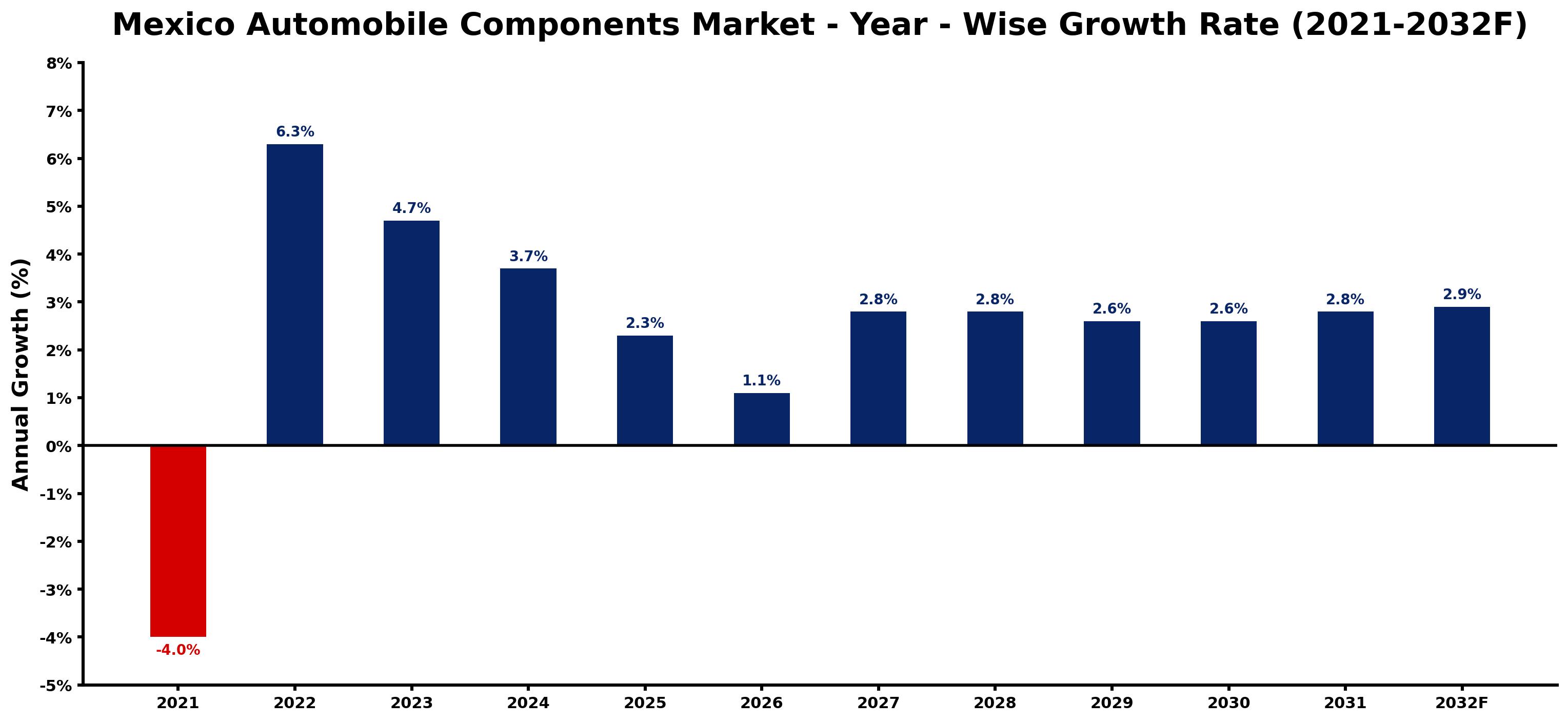
The table below presents the year wise growth rates along with the key drivers influencing the market
| Year | Growth Rate | Major Drivers |
| 2021 | -4.0% | Supply chain disruptions caused by the pandemic severely limited component availability, hindering automotive production. |
| 2022 | 6.3% | Local automotive production increases as global supply chains stabilize and adapt. |
| 2023 | 4.7% | Emerging electric vehicle trends shift component demand toward innovative technologies and materials. |
| 2024 | 3.7% | Investment in renewable energy infrastructure enhances demand for eco-friendly automobile components. |
| 2025 | 2.3% | Increased consumer preference for fuel efficiency drives innovation in lightweight materials. |
| 2026 | 1.1% | Collaboration between Mexico and US automakers boosts regional component manufacturing capabilities. |
| 2027 | 2.8% | Technological advancements in autonomous vehicles create opportunities for specialized component production. |
| 2028 | 2.8% | Rising export opportunities in Latin America encourage local manufacturers to scale operations. |
| 2029 | 2.6% | Urbanization in Mexico enhances demand for advanced urban mobility solutions and components. |
| 2030 | 2.6% | Sustainability initiatives compel manufacturers to comply with evolving environmental standards. |
| 2031 | 2.8% | Integration of smart technologies in vehicles reshapes market dynamics and component specifications. |
| 2032 | 2.9% | Global automotive electrification trends drive robust growth in battery and connector components. |
Note - Market size estimations and growth projections presented in this report are based on 6Wresearch's advanced forecasting approach, validated with industry datasets as of June 2026.
Mexico Automobile Components Market Synopsis
The Mexico Automobile Components Market is projected to reach 1.1% and witness significant growth during the forecast period (2026-2032). This market has experienced a steady upward trajectory, driven by the robust automotive industry in Mexico, which plays a pivotal role in the North American automotive manufacturing landscape. The market encompasses a diverse array of automobile components, including engines, transmissions, and numerous other essential parts required for vehicle assembly and maintenance.
Mexico Automobile Components Market Growth Drivers
Several factors contribute to the growth of the Mexico Automobile Components Market. Firstly, the increasing demand for automobiles, both domestically and in export markets, has amplified the need for high-quality components. Furthermore, Mexico's advantageous geographical location facilitates efficient access to major markets in North America, thereby enhancing its attractiveness for automobile component production.
- The expanding automotive manufacturing sector in Mexico is a significant driver, supported by domestic consumption and export demands.
- Investment in advanced manufacturing technologies improves production efficiency and product quality, catering to the evolving needs of the automotive industry.
- Integration of electric and hybrid vehicle technologies necessitates innovative components, prompting manufacturers to adapt to new industry standards.
- Trade agreements under the USMCA promote seamless trade flows among North American countries, creating a favorable environment for component manufacturers.
- Growing consumer preference for fuel-efficient and environmentally friendly vehicles is driving demand for specialized components that meet these criteria.
Mexico Automobile Components Market Trends and Opportunities
The Mexico Automobile Components Market is witnessing several trends that present both opportunities and challenges. The shift towards electric vehicles (EVs) is one of the most significant trends, as automakers increasingly focus on sustainable technologies. This transition requires a range of new components, from advanced batteries to electronic control systems, creating opportunities for manufacturers willing to innovate.
- The rise of smart manufacturing through Industry 4.0 technologies enhances operational efficiencies and reduces production costs for component manufacturers.
- Research and development investment is growing as companies seek to develop cutting-edge components that align with global automotive trends.
- Collaborations between manufacturers and technology firms are accelerating the development of innovative solutions tailored for modern vehicles.
- Increasing urbanization and rising incomes in Mexico are expected to boost domestic vehicle sales, further driving the need for automobile components.
- Focus on improving supply chain resilience in response to global disruptions presents opportunities for local sourcing of materials and components.
Mexico Automobile Components Market Challenges and Restraints
Despite promising growth prospects, the Mexico Automobile Components Market faces several challenges. Global supply chain disruptions, particularly in the wake of recent geopolitical tensions and pandemics, have strained component availability and logistics.
- Manufacturers are often challenged by fluctuating raw material prices, making cost management a critical issue in maintaining profitability.
- Adapting to evolving regulatory standards surrounding safety and environmental concerns necessitates ongoing investments in compliance and innovation.
- The market is also subject to intensifying global competition, requiring Mexican manufacturers to enhance their competitiveness through quality and pricing strategies.
- Workforce skill gaps in advanced manufacturing technologies present a potential hurdle for companies aiming to implement new production methodologies.
- Maintaining sustainable practices is increasingly important, as consumers and regulators push for greater environmental responsibility in manufacturing processes.
Mexico Automobile Components Market Government Investment and Initiatives
The Mexican government has recognized the strategic importance of the automobile components market and has initiated various policies to foster investment and growth in the sector. This includes providing incentives for both domestic and international manufacturers, aimed at establishing production facilities and enhancing local capabilities. Through financial incentives and subsidies, the government encourages research and development in innovative automobile component manufacturing.
Furthermore, initiatives focused on improving infrastructure and logistics are crucial to supporting the automotive supply chain. Policies that promote educational programs in technical fields are also being prioritized, as the government aims to equip the workforce with skills relevant to modern automobile manufacturing technologies.
Mexico Automobile Components Market Latest Developments (May 2025 - June 2026)
In recent months, the Mexico Automobile Components Market has seen a series of notable developments. Industry stakeholders have increasingly focused on adopting sustainable practices in manufacturing processes, aligning with global trends towards environmental responsibility. The introduction of various automotive regulations has prompted manufacturers to innovate and adapt their product lines to maintain compliance and competitiveness.
Additionally, collaborations between automotive manufacturers and technology firms have intensified, facilitating the integration of advanced technologies such as artificial intelligence and machine learning in production lines. The emphasis on electric vehicles has also prompted manufacturers to pivot towards components that support electric drivetrains, showcasing the dynamic nature of the market in response to consumer preferences.
Mexico Automobile Components Market - Key Attractiveness of the Report
- 10 Years of Market Numbers
- Historical Data Starting from 2022 to 2025
- Base Year: 2025
- Forecast Data until 2032
- Key Performance Indicators Impacting the Market
- Major Upcoming Developments and Projects
Key Highlights of the Report:
- Mexico Automobile Components Market Outlook
- Market Size of Mexico Automobile Components Market, 2025
- Forecast of Mexico Automobile Components Market, 2032
- Historical Data and Forecast of Mexico Automobile Components Revenues & Volume for the Period 2022-2032F
- Mexico Automobile Components Market Trend Evolution
- Mexico Automobile Components Market Drivers and Challenges
- Mexico Automobile Components Price Trends
- Mexico Automobile Components Porter's Five Forces
- Mexico Automobile Components Industry Life Cycle
- Historical Data and Forecast of Mexico Automobile Components Market Revenues & Volume By Product Type for the Period 2022-2032F
- Historical Data and Forecast of Mexico Automobile Components Market Revenues & Volume By Flywheel for the Period 2022-2032F
- Historical Data and Forecast of Mexico Automobile Components Market Revenues & Volume By Pressure Plate for the Period 2022-2032F
- Historical Data and Forecast of Mexico Automobile Components Market Revenues & Volume By Clutch for the Period 2022-2032F
- Historical Data and Forecast of Mexico Automobile Components Market Revenues & Volume By Other for the Period 2022-2032F
- Historical Data and Forecast of Mexico Automobile Components Market Revenues & Volume By Applications for the Period 2022-2032F
- Historical Data and Forecast of Mexico Automobile Components Market Revenues & Volume By Passenger Cars (PC) for the Period 2022-2032F
- Historical Data and Forecast of Mexico Automobile Components Market Revenues & Volume By Light Commercial Vehicles (LCV) for the Period 2022-2032F
- Historical Data and Forecast of Mexico Automobile Components Market Revenues & Volume By Heavy Commercial Vehicles (HCV) for the Period 2022-2032F
- Mexico Automobile Components Import Export Trade Statistics
- Market Opportunity Assessment By Product Type
- Market Opportunity Assessment By Applications
- Mexico Automobile Components Top Companies Market Share
- Mexico Automobile Components Competitive Benchmarking By Technical and Operational Parameters
- Mexico Automobile Components Company Profiles
- Mexico Automobile Components Key Strategic Recommendations






































