Mexico Bricks and Blocks Market Summary
The mexico bricks and blocks market was estimated at USD 197 Million in 2025 and is projected to reach USD 228 Million by 2032, growing at a CAGR of 0.9% from 2026 to 2032.
Mexico Bricks and Blocks Market Year-wise Growth Rate and Key Drivers
This graph highlights how the Mexico Bricks and Blocks Market has steadily grown over the past five years, supported by major growth factors.
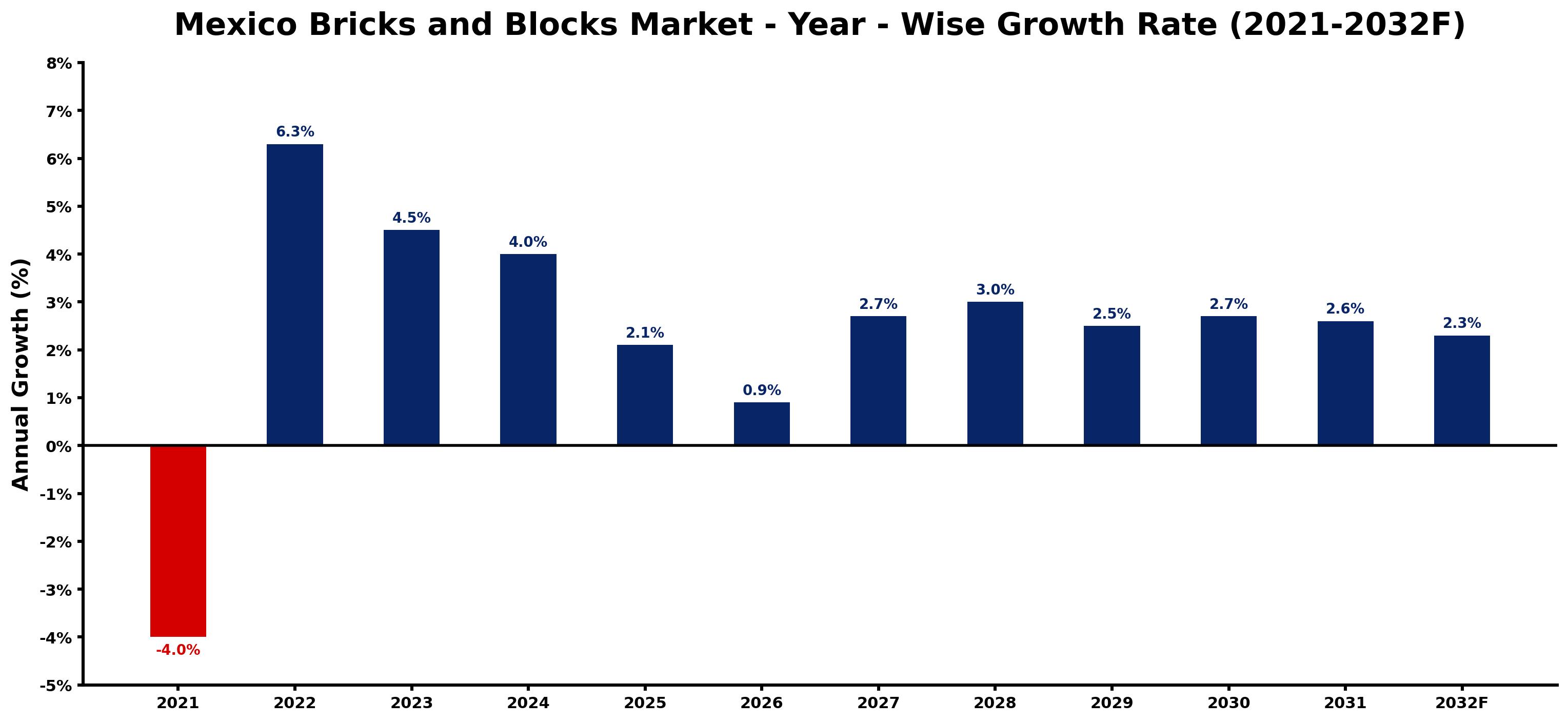
The table below presents the year wise growth rates along with the key drivers influencing the market
| Year | Growth Rate | Major Drivers |
| 2021 | -4.0% | Increased competition from alternative construction materials diminished demand for traditional bricks and blocks. |
| 2022 | 6.3% | Local manufacturers expanded output capacity, responding to heightened demand from regional builders. |
| 2023 | 4.5% | Investment in sustainable building practices positioned eco-friendly materials as attractive alternatives. |
| 2024 | 4.0% | Emerging urbanization trends highlighted the need for affordable housing solutions nationwide. |
| 2025 | 2.1% | Technological enhancements in production processes improved efficiency and lowered material costs. |
| 2026 | 0.9% | Private sector investments targeted renewable energy projects, boosting demand for resilient building materials. |
| 2027 | 2.7% | Regional trade agreements encouraged cross-border partnerships, expanding market access for manufacturers. |
| 2028 | 3.0% | Increased urban population density necessitated new developments, driving demand for bricks and blocks. |
| 2029 | 2.5% | Rising interest rates impacted financing, influencing construction project timelines and budgets. |
| 2030 | 2.7% | Economic recovery led to revitalized construction pipelines in both residential and commercial sectors. |
| 2031 | 2.6% | Focus on disaster-resistant designs increased demand for durable and lightweight construction materials. |
| 2032 | 2.3% | Sustainability trends in construction highlighted innovative materials, shaping future purchasing preferences. |
Note - Market size estimations and growth projections presented in this report are based on 6Wresearch's advanced forecasting approach, validated with industry datasets as of June 2026.
Mexico Bricks and Blocks Market Synopsis
The Mexico Bricks and Blocks Market is projected to reach 0.9% and witness significant growth during the forecast period (2026-2032). The evolution of this market is intrinsically linked to the broader construction sector, reflecting the increasing demand for robust and sustainable building materials. As urbanization and industrialization continue to reshape Mexico's infrastructure landscape, the bricks and blocks market is poised to adapt and innovate in response to both consumer needs and regulatory frameworks.
Mexico Bricks and Blocks Market Growth Drivers
The dynamics of the Mexico Bricks and Blocks Market are shaped by several pivotal growth drivers:
- The ongoing expansion of the construction sector, driven by residential, commercial, and industrial developments, is a primary catalyst for the bricks and blocks market. As new projects commence, the demand for durable and efficient building materials escalates.
- The trend towards urbanization continues to grow, prompting a shift in population demographics that necessitates more housing and infrastructure developments, directly influencing the demand for bricks and blocks.
- Increased focus on sustainable construction practices has led to a rising preference for environmentally friendly building materials, prompting manufacturers to innovate and adapt their product offerings.
- Government investments in infrastructure projects, including transportation and public facilities, create a steady demand for high-quality bricks and blocks, which are essential for various construction applications.
- Technological advancements in manufacturing processes enhance the performance and energy efficiency of bricks and blocks, making them more appealing to builders and developers.
Mexico Bricks and Blocks Market Challenges and Restraints
Despite its promising outlook, the Mexico Bricks and Blocks Market faces several challenges that could hinder growth:
- Navigating complex environmental regulations surrounding resource extraction and waste management poses a significant challenge for manufacturers in maintaining compliance while controlling costs.
- The need to develop cost-effective, sustainable products demands substantial investment in research and development, which may strain the resources of smaller manufacturers.
- Economic fluctuations and market volatility can impact construction investments, creating uncertainties in demand for bricks and blocks, and affecting manufacturers' profitability.
- Competition from alternative materials, such as steel and engineered wood products, poses a threat to the traditional bricks and blocks market, necessitating innovations to retain market share.
- Challenges in logistics and supply chain management can delay production and delivery, impacting project timelines and customer satisfaction.
Mexico Bricks and Blocks Market Government Investment and Initiatives
The Mexican government plays a crucial role in shaping the bricks and blocks market through various policies and initiatives aimed at fostering sustainable construction practices:
- Government regulations focus on establishing stringent building codes that dictate acceptable construction materials and methods, ensuring safety and durability in infrastructure projects.
- Environmental policies encourage manufacturers to adopt greener practices, including waste reduction, energy efficiency, and sustainable sourcing of raw materials.
- Public investment in infrastructure projects is supported by fiscal measures that incentivize the use of sustainable materials, fostering innovation and attracting investment into the bricks and blocks sector.
- Collaboration between government and industry stakeholders is promoted to address challenges related to construction standards and environmental impact, ensuring a cohesive approach to market development.
- Training and support programs are established to help manufacturers enhance their production capabilities, focusing on efficiency and adherence to new regulations.
Mexico Bricks and Blocks Market Latest Developments (May 2025 - June 2026)
Recent developments in the Mexico Bricks and Blocks Market indicate a shift towards more innovative and sustainable practices. Increasing collaboration between governmental bodies and industry players has resulted in enhanced product standards and sustainable material use. Additionally, manufacturers are actively exploring new technologies to improve efficiency and reduce costs, thus responding to the growing demand for eco-friendly building solutions. The focus on energy efficiency and sustainable construction is likely to shape the competitive landscape moving forward.
Mexico Bricks and Blocks Market - Key Attractiveness of the Report
- 10 Years of Market Numbers
- Historical Data Starting from 2022 to 2025
- Base Year: 2025
- Forecast Data until 2032
- Key Performance Indicators Impacting the Market
- Major Upcoming Developments and Projects
Key Highlights of the Report:
- Mexico Bricks and Blocks Market Outlook
- Market Size of Mexico Bricks and Blocks Market, 2025
- Forecast of Mexico Bricks and Blocks Market, 2032
- Historical Data and Forecast of Mexico Bricks and Blocks Revenues & Volume for the Period 2022-2032F
- Mexico Bricks and Blocks Market Trend Evolution
- Mexico Bricks and Blocks Market Drivers and Challenges
- Mexico Bricks and Blocks Price Trends
- Mexico Bricks and Blocks Porter's Five Forces
- Mexico Bricks and Blocks Industry Life Cycle
- Historical Data and Forecast of Mexico Bricks and Blocks Market Revenues & Volume By Type for the Period 2022-2032F
- Historical Data and Forecast of Mexico Bricks and Blocks Market Revenues & Volume By Clay Bricks for the Period 2022-2032F
- Historical Data and Forecast of Mexico Bricks and Blocks Market Revenues & Volume By Concrete Bricks and Blocks for the Period 2022-2032F
- Historical Data and Forecast of Mexico Bricks and Blocks Market Revenues & Volume By Calcium Silicate Bricks for the Period 2022-2032F
- Historical Data and Forecast of Mexico Bricks and Blocks Market Revenues & Volume By Autoclaved Aerated Concrete for the Period 2022-2032F
- Historical Data and Forecast of Mexico Bricks and Blocks Market Revenues & Volume By Others for the Period 2022-2032F
- Historical Data and Forecast of Mexico Bricks and Blocks Market Revenues & Volume By Applications for the Period 2022-2032F
- Historical Data and Forecast of Mexico Bricks and Blocks Market Revenues & Volume By Building for the Period 2022-2032F
- Historical Data and Forecast of Mexico Bricks and Blocks Market Revenues & Volume By Path for the Period 2022-2032F
- Historical Data and Forecast of Mexico Bricks and Blocks Market Revenues & Volume By Parterre for the Period 2022-2032F
- Historical Data and Forecast of Mexico Bricks and Blocks Market Revenues & Volume By Other for the Period 2022-2032F
- Mexico Bricks and Blocks Import Export Trade Statistics
- Market Opportunity Assessment By Type
- Market Opportunity Assessment By Applications
- Mexico Bricks and Blocks Top Companies Market Share
- Mexico Bricks and Blocks Competitive Benchmarking By Technical and Operational Parameters
- Mexico Bricks and Blocks Company Profiles
- Mexico Bricks and Blocks Key Strategic Recommendations






































