Mexico Data Center Networking Market Size & Growth Rate (2026-2032)
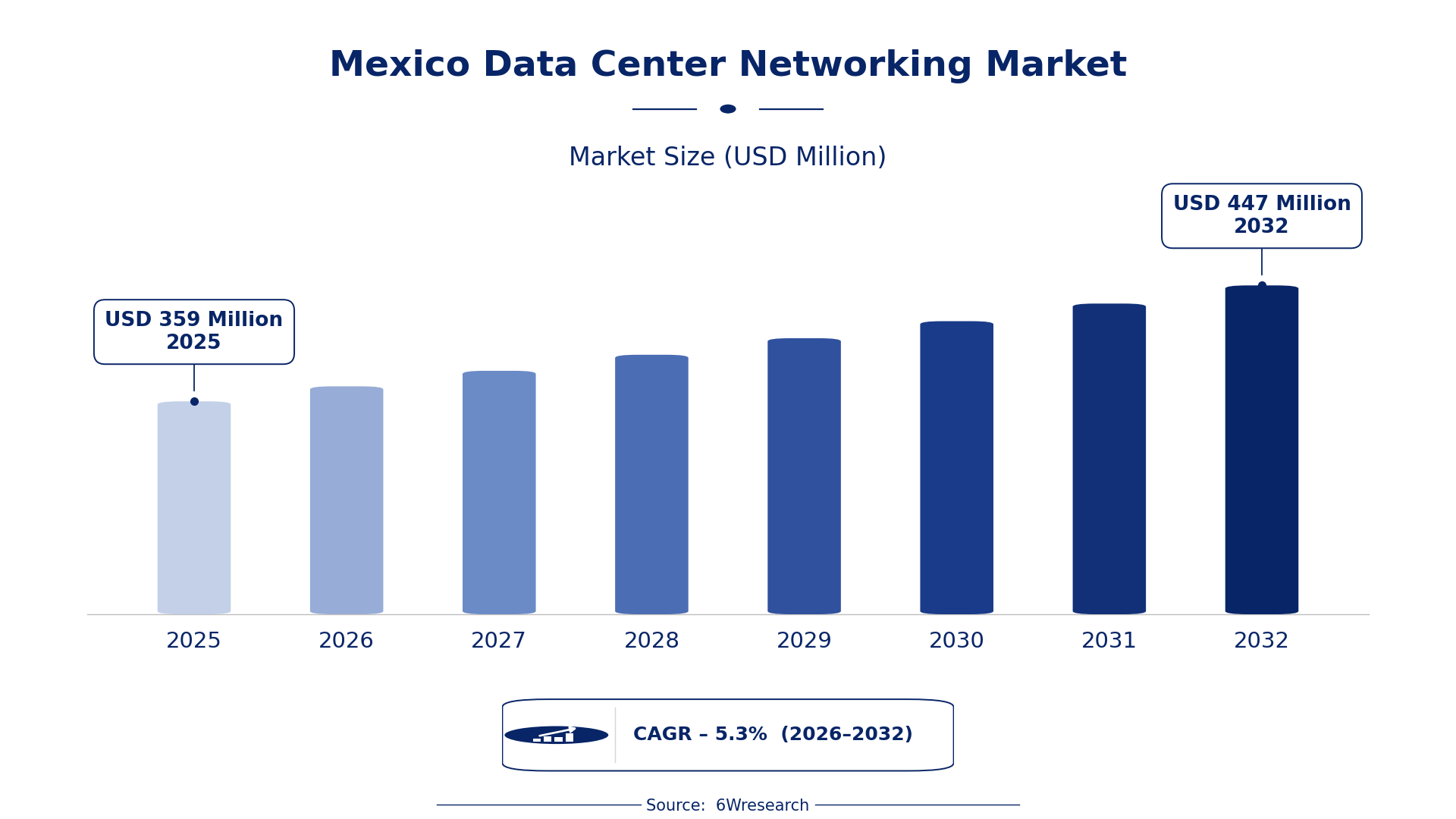
The Mexico Data Center Networking Market was estimated at USD 359 Million in 2025 and is projected to reach USD 447 Million by 2032, growing at a CAGR of 5.3% from 2026 to 2032.
Mexico Data Center Networking Market Synopsis
The Mexico Data Center Networking Market is seeing a surge in demand for high-performance networking solutions, driven by the escalating need for cloud computing and virtualization technologies. As enterprises strive for digital transformation, the integration of Ethernet switches, routers, and network fabrics becomes crucial for enabling efficient data transmission and enhancing connectivity.
The shift towards software-defined networking (SDN) is particularly noteworthy in Mexico, where organizations are seeking agility and scalability in their infrastructure. This demand compels data center operators to invest in advanced networking technologies that support not only increased bandwidth but also low-latency communication, catering to a growing array of applications and workloads.
Mexico Data Center Networking Market Year-wise Growth Rate and Key Drivers
This graph illustrates the annual growth rates of the Mexico Data Center Networking Market from 2021 to 2032, highlighting a steady upward trajectory and projected expansion over the forecast period.
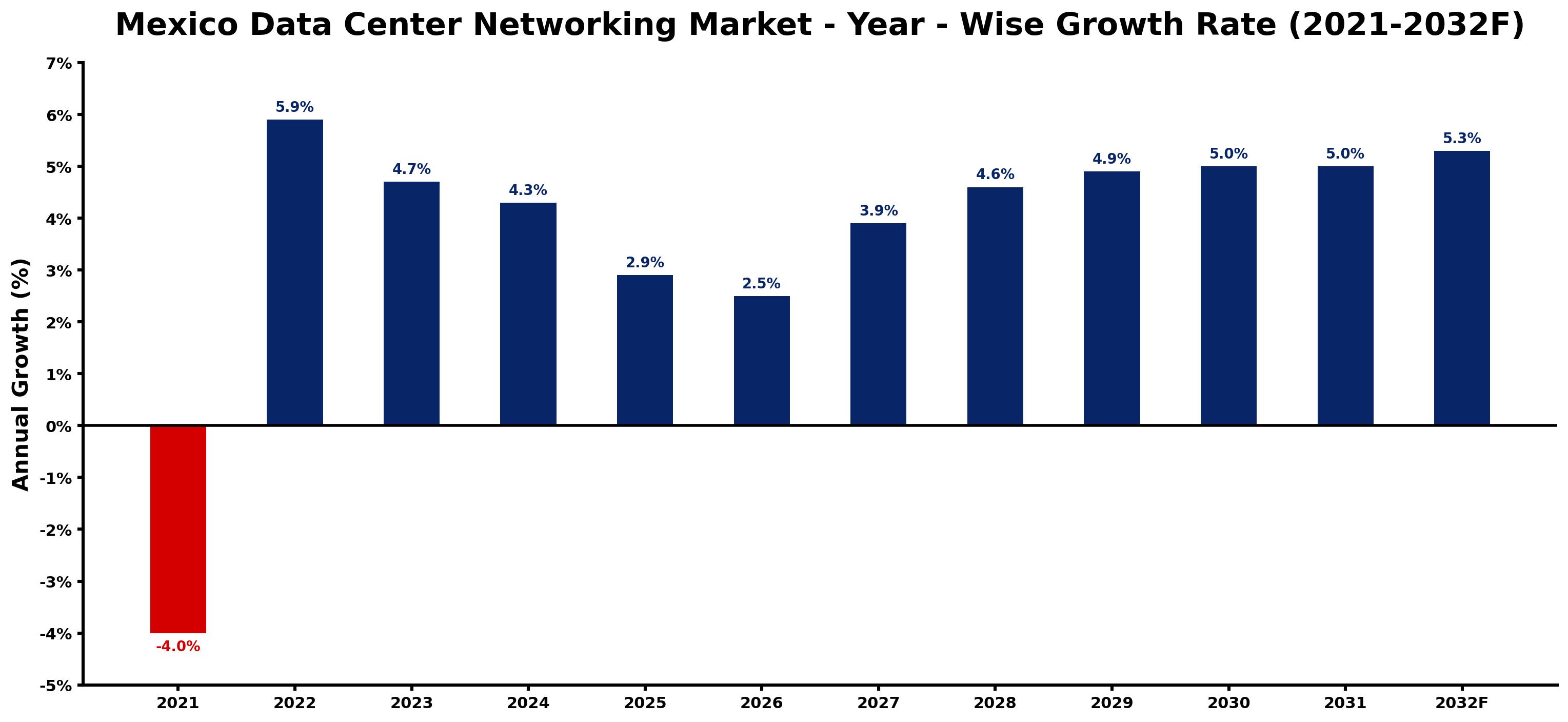
The table below presents the year‑wise growth rates along with the key drivers influencing the market
| Year | Growth Rate | Major Drivers |
| 2021 | -4.0% | Semiconductor shortages affected data center equipment imports. |
| 2022 | 5.9% | Mexico's National Digital Strategy encourages data center expansion. |
| 2023 | 4.7% | Increased cloud adoption among Mexican enterprises drives growth. |
| 2024 | 4.3% | Emerging tech startups boost demand for networking solutions. |
| 2025 | 2.9% | Telecom reforms lead to improved network infrastructure reliability. |
| 2026 | 2.5% | Increased foreign investment in tech drives data demands. |
| 2027 | 3.9% | Government incentives support renewable energy for data centers. |
| 2028 | 4.6% | Growing e-commerce sector boosts data processing needs. |
| 2029 | 4.9% | Rising digital content consumption accelerates networking upgrades. |
| 2030 | 5.0% | Cybersecurity mandates increase demand for advanced networking. |
| 2031 | 5.0% | 5G deployment enhances connectivity for data center networking. |
| 2032 | 5.3% | Local data residency regulations enforce increased data storage. |
Note: Market size estimations and growth projections presented in this report are based on 6Wresearch's proprietary forecasting methodology, utilizing the latest available industry data, government publications, and primary research inputs.
Mexico Data Center Networking Market Key Takeaways
Below are some of the specific key takeaways from the market, including:
- The market is characterized by a robust growth trajectory, driven by the expanding cloud services sector.
- Advanced networking technologies are essential for addressing the demands of modern data center environments.
- Organizations face increasing pressure to overcome challenges related to network congestion and security.
- Government initiatives are playing a critical role in promoting digital connectivity and infrastructure investment.
- Future opportunities lie in emerging technologies such as IoT and edge computing.
Evaluation of Restraints in Mexico Data Center Networking Market
Despite the promising outlook, the Mexico Data Center Networking Market grapples with several constraints. Organizations often struggle with designing scalable and high-performance networking architectures that meet the complex demands of contemporary applications. This challenge is magnified by the increasing adoption of cloud computing and IoT, which can lead to network congestion and latency issues.
Additionally, ensuring interoperability with existing systems remains a significant hurdle, requiring not just technology investments but also specialized expertise. As companies pursue network virtualization and automation, the need for advanced solutions becomes imperative to maintain operational efficiency and competitiveness.
Mexico Data Center Networking Market Trends
Current trends indicate a strong pivot towards software-defined networking (SDN) and network function virtualization (NFV), as businesses seek to enhance flexibility and reduce costs. The integration of AI and machine learning into network management systems is gaining traction, enabling predictive maintenance and optimized performance. on top of that, the rise of edge computing is prompting data centers to adopt more decentralized networking approaches, catering to localized data processing needs.
As security concerns rise, organizations are increasingly prioritizing network security measures, integrating advanced firewalls and threat detection systems into their infrastructure. This trend underscores the importance of creating resilient networks capable of withstanding evolving cyber threats, making security a top consideration in networking strategies.
Mexico Data Center Networking Market Opportunities
Significant opportunities are emerging in the Mexico Data Center Networking Market, particularly in the areas of cloud services and edge computing. As businesses continue to migrate to cloud platforms, the demand for high-performance networking solutions will increase, providing a ripe environment for investment. Additionally, the ongoing shift towards IoT creates the necessity for networks that can handle large volumes of data traffic efficiently.
Companies that can provide innovative solutions tailored to meet the dynamic needs of businesses are well-positioned to capitalize on this growth. on top of that, as the government pushes for enhanced digital infrastructure, partnerships between public and private sectors could further drive advancements in networking technology.
Government Initiatives in the Mexico Data Center Networking Market
The Mexican government is actively fostering an environment conducive to digital growth, with policies aimed at enhancing connectivity and promoting cloud adoption. By prioritizing investments in high-speed networking and infrastructure, these initiatives are crucial for the development of the Mexico Data Center Networking Market. Regulatory frameworks are also being put in place to support technology advancements and ensure that businesses can adapt to the evolving digital landscape.
- A national digital infrastructure upgrade program launched in 2023 focuses on expanding high-speed internet access across urban and rural areas.
- Current initiatives are underway to establish public-private partnerships aimed at developing cloud service infrastructures, expected to improve service availability by 2025.
- A regulatory framework introduced in late 2024 mandates the integration of advanced cybersecurity measures in data centers.
- Planned initiatives include a digital skills training program expected to roll out by 2026, aimed at enhancing workforce capabilities in IT and networking.
Future Insights of the Mexico Data Center Networking Market
Looking ahead to 2026-2032, the Mexico Data Center Networking Market is set to experience transformative growth. The rising demand for cloud computing solutions will necessitate the continued evolution of networking technologies, particularly those that enhance speed and reliability. As organizations further adopt IoT and edge computing, the focus will shift towards creating adaptable networks that can efficiently process data closer to the source.
The next few years will likely witness an increased emphasis on network security, driven by the proliferation of cyber threats. Companies that prioritize security in their networking solutions will gain a competitive edge, positioning themselves for success in a rapidly changing market. on top of that, continued government support for digital initiatives will bolster infrastructure development, paving the way for innovation and growth in this sector.
Mexico Data Center Networking Market Latest Developments
In recent months, activity within the Mexico Data Center Networking Market has accelerated, reflecting a strong commitment to enhancing infrastructure and technology solutions. The demand for high-speed connectivity and scalable network architectures has driven organizations to adopt innovative approaches to meet their operational needs. This trend is expected to continue as businesses pivot towards advanced networking technologies.
- A major technology vendor announced the launch of a new line of high-capacity Ethernet switches in Q1 2025, aimed at improving data center performance.
- An ongoing partnership between a leading regional operator and a cloud service provider is focused on expanding data center capabilities, expected to enhance service delivery by mid-2025.
- A recently completed infrastructure project upgraded a significant data center facility in Mexico City, enhancing its capacity for cloud service hosting.
- Upcoming plans include the rollout of a national fiber optic network expected to begin in early 2026, aimed at improving connectivity across various regions.
Mexico Data Center Networking Market - Key Attractiveness of the Report
- 10 Years of Market Numbers
- Historical Data Starting from 2022 to 2025
- Base Year: 2025
- Forecast Data until 2032
- Key Performance Indicators Impacting the Market
- Major Upcoming Developments and Projects
Key Highlights of the Report:
- Mexico Data Center Networking Market Outlook
- Market Size of Mexico Data Center Networking Market, 2025
- Forecast of Mexico Data Center Networking Market, 2032
- Historical Data and Forecast of Mexico Data Center Networking Revenues & Volume for the Period 2022-2032F
- Mexico Data Center Networking Market Trend Evolution
- Mexico Data Center Networking Market Drivers and Challenges
- Mexico Data Center Networking Price Trends
- Mexico Data Center Networking Porter's Five Forces
- Mexico Data Center Networking Industry Life Cycle
- Historical Data and Forecast of Mexico Data Center Networking Market Revenues & Volume By Component for the Period 2022-2032F
- Historical Data and Forecast of Mexico Data Center Networking Market Revenues & Volume By Solution for the Period 2022-2032F
- Historical Data and Forecast of Mexico Data Center Networking Market Revenues & Volume By Services for the Period 2022-2032F
- Historical Data and Forecast of Mexico Data Center Networking Market Revenues & Volume By End User for the Period 2022-2032F
- Historical Data and Forecast of Mexico Data Center Networking Market Revenues & Volume By IT and telecom for the Period 2022-2032F
- Historical Data and Forecast of Mexico Data Center Networking Market Revenues & Volume By Retail for the Period 2022-2032F
- Historical Data and Forecast of Mexico Data Center Networking Market Revenues & Volume By BFSI for the Period 2022-2032F
- Historical Data and Forecast of Mexico Data Center Networking Market Revenues & Volume By Public sector and utilities for the Period 2022-2032F
- Historical Data and Forecast of Mexico Data Center Networking Market Revenues & Volume By Energy for the Period 2022-2032F
- Historical Data and Forecast of Mexico Data Center Networking Market Revenues & Volume By Manufacturing for the Period 2022-2032F
- Historical Data and Forecast of Mexico Data Center Networking Market Revenues & Volume By Healthcare for the Period 2022-2032F
- Historical Data and Forecast of Mexico Data Center Networking Market Revenues & Volume By Others for the Period 2022-2032F
- Mexico Data Center Networking Import Export Trade Statistics
- Market Opportunity Assessment By Component
- Market Opportunity Assessment By End User
- Mexico Data Center Networking Top Companies Market Share
- Mexico Data Center Networking Competitive Benchmarking By Technical and Operational Parameters
- Mexico Data Center Networking Company Profiles
- Mexico Data Center Networking Key Strategic Recommendations






































