Mexico Digital Education Market Size & Growth Rate (2026-2032)
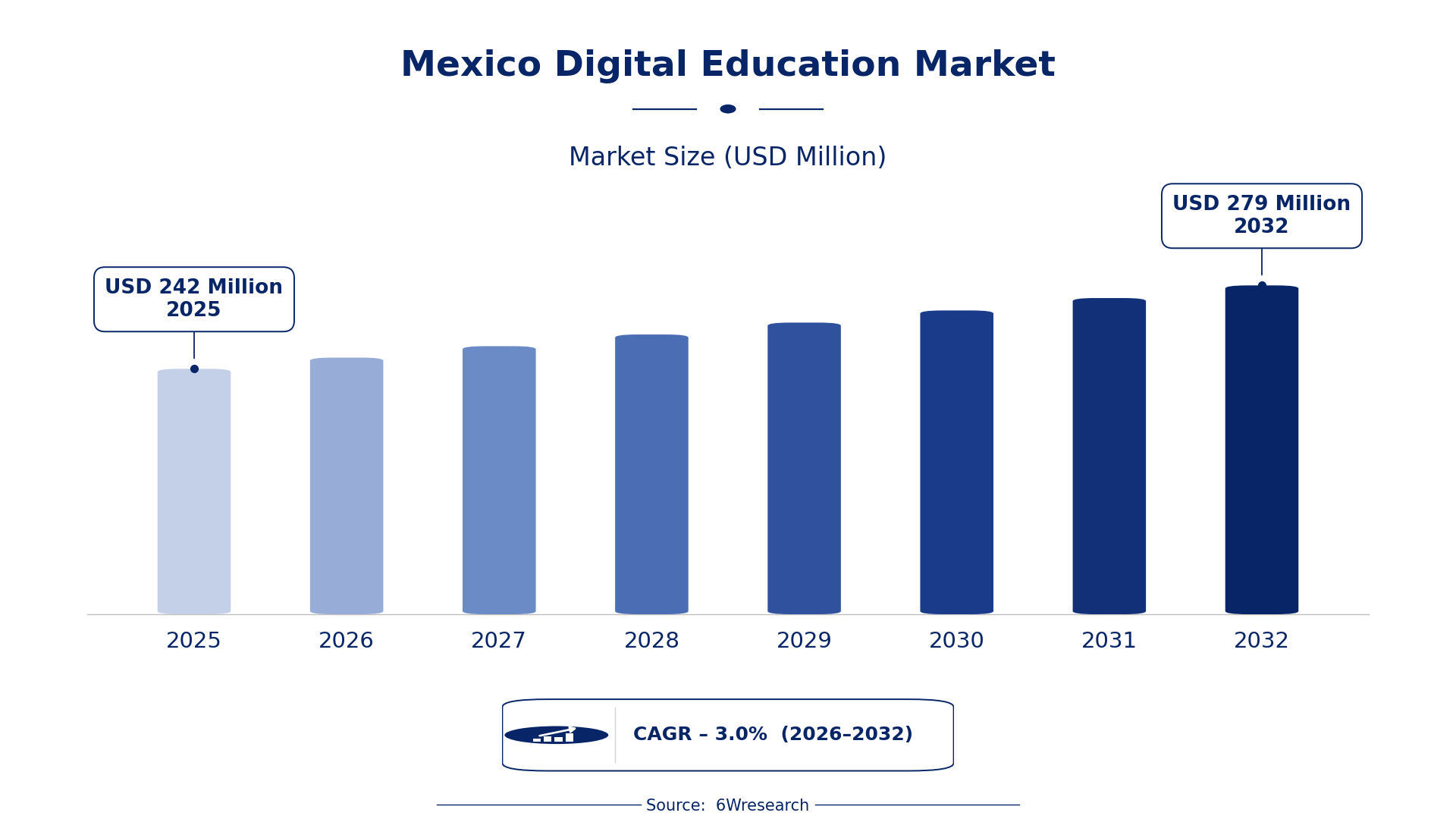
The Mexico Digital Education Market was estimated at USD 242 Million in 2025 and is projected to reach USD 279 Million by 2032, growing at a CAGR of 3.0% from 2026 to 2032.
Mexico Digital Education Market Synopsis
The demand for digital education in Mexico is rising sharply as educational institutions increasingly adopt technology to enrich the learning experience. The penetration of smartphones and reliable internet access has made digital platforms more accessible, allowing students from various backgrounds to engage in online learning.
This growth is particularly noticeable in urban areas, where educational institutions are leveraging digital tools to transition from traditional classroom settings. However, challenges such as inconsistent internet connectivity and the digital divide among students still pose hurdles that need to be addressed for the market to reach its full potential.
Mexico Digital Education Market Year-wise Growth Rate and Key Drivers
This graph illustrates the annual growth rates of the Mexico Digital Education Market from 2021 to 2032, highlighting a steady upward trajectory and projected expansion over the forecast period.
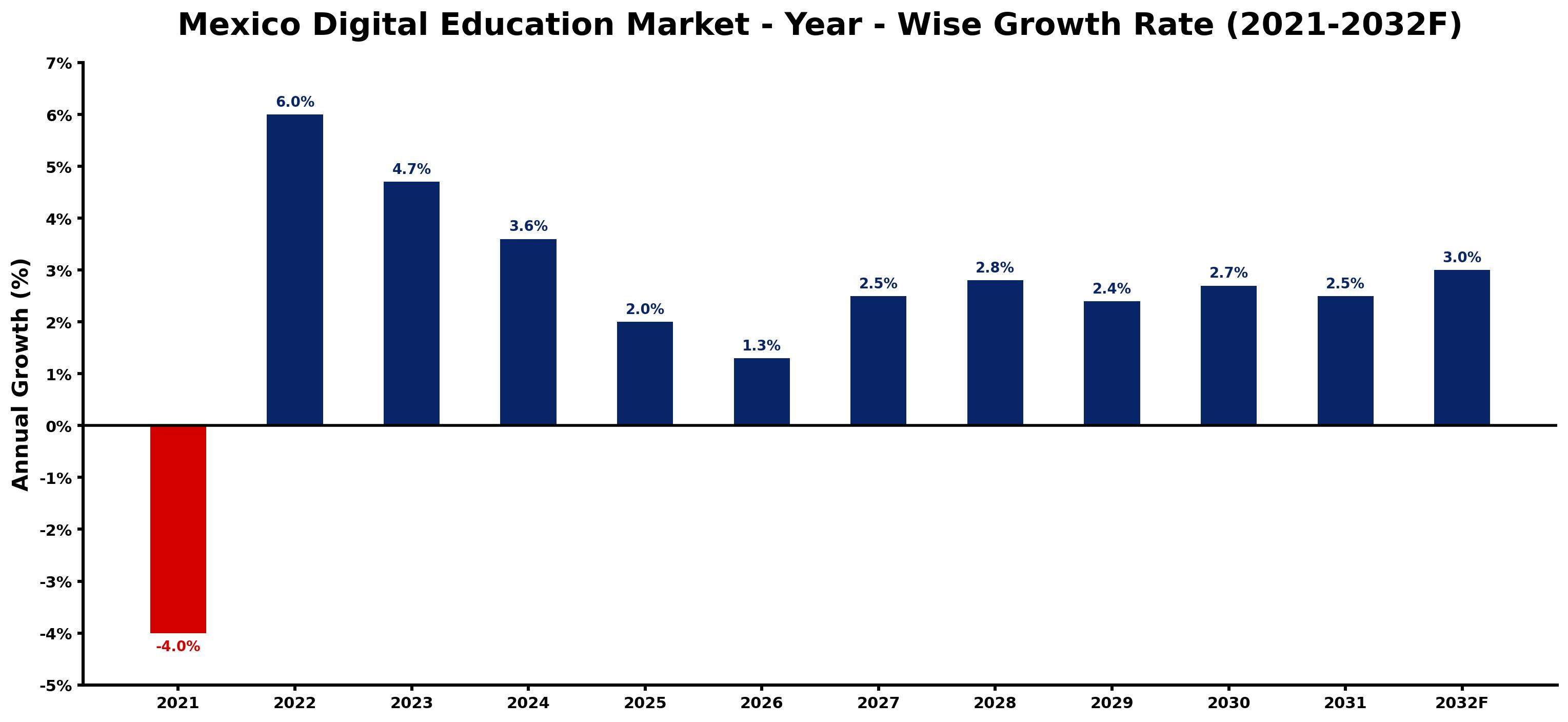
The table below presents the year‑wise growth rates along with the key drivers influencing the market
| Year | Growth Rate | Major Drivers |
| 2021 | -4.0% | COVID-19 school closures hindered digital adoption efforts. |
| 2022 | 6.0% | Increased online schooling initiatives by Mexican education authorities. |
| 2023 | 4.7% | Government subsidies for digital devices in rural schools. |
| 2024 | 3.6% | Growth in bilingual education programs boosting digital content needs. |
| 2025 | 2.0% | New regulations promoting digital literacy in primary education. |
| 2026 | 1.3% | Rise in partnerships with edtech startups for local solutions. |
| 2027 | 2.5% | Enhanced internet infrastructure facilitating remote learning accessibility. |
| 2028 | 2.8% | Increased demand for vocational training through digital platforms. |
| 2029 | 2.4% | Focus on social-emotional learning resources available online. |
| 2030 | 2.7% | Emphasis on personalized learning experiences via digital tools. |
| 2031 | 2.5% | Adoption of AI-driven tutoring systems in Mexican schools. |
| 2032 | 3.0% | Government initiatives backing STEM education via digital channels. |
Note: Market size estimations and growth projections presented in this report are based on 6Wresearch's proprietary forecasting methodology, utilizing the latest available industry data, government publications, and primary research inputs.
Mexico Digital Education Market Key Takeaways
Below are some of the specific key takeaways from the market, including:
- Increased smartphone penetration is driving access to digital education platforms.
- Government initiatives are providing essential support for infrastructure development.
- There is a strong demand for personalized and flexible learning solutions.
- Resistance to technology adoption in some institutions continues to be a barrier.
- The digital divide remains a critical challenge affecting equitable access to education.
Evaluation of Restraints in Mexico Digital Education Market
Several restraints are limiting the growth of the digital education market in Mexico. One of the most pressing issues is the digital divide, which leaves many students without access to reliable internet or the necessary technology to participate in online learning. Additionally, resistance to adopting new technologies among some educational institutions stifles innovation and limits the effectiveness of digital education solutions. Customizing digital content to cater to diverse learning styles also remains a challenge, as educators grapple with the need to address varied student needs within a standardized framework.
Mexico Digital Education Market Trends
Current trends indicate a shift towards blended learning models that combine traditional and digital educational practices. This hybrid approach caters to different learning preferences and promotes engagement. Additionally, the rise of artificial intelligence is starting to influence personalized learning experiences, allowing platforms to tailor content based on individual student performance. The increasing focus on digital literacy in the education system is also shaping curriculum development and teacher training programs.
Mexico Digital Education Market Opportunities
Opportunities for growth in the Mexico digital education market are abundant. As the demand for remote education solutions continues to expand, there is a clear opening for innovative digital platforms that offer personalized learning experiences. Investment in digital infrastructure, particularly in rural areas, can bridge the existing gaps in access. Additionally, partnerships between educational institutions and technology providers can lead to the development of tailored educational content that meets diverse learning needs.
Government Initiatives in the Mexico Digital Education Market
The Mexican government is actively shaping the digital education market through various initiatives aimed at improving digital literacy and integrating technology into educational frameworks. These policies reflect a commitment to enhancing educational outcomes and ensuring that students are equipped with the necessary skills for a digital future.
- A national digital infrastructure upgrade program launched in early 2025 aims to improve internet connectivity in underserved areas.
- Current initiatives are underway to provide training programs for educators on digital tools and teaching methodologies.
- A planned public-private partnership expected to expand access to educational technology by 2028 is in development.
- Recent funding allocations have been directed towards enhancing digital resources in schools across urban regions.
- Ongoing efforts include the integration of digital literacy into the national curriculum to prepare students for future job markets.
Future Insights of the Mexico Digital Education Market
Looking ahead to 2026-2032, the Mexico digital education market is likely to experience steady growth driven by technological advancements and increased governmental support. As institutions continue to adapt to blended learning models, the demand for innovative educational technologies will rise. on top of that, the emphasis on digital literacy will become increasingly critical as the economy evolves, necessitating a workforce skilled in digital competencies.
Mexico Digital Education Market Latest Developments
In the past year, the Mexico digital education market has seen considerable activity, with various initiatives aimed at enhancing digital learning experiences. Institutions are increasingly recognizing the importance of technology in education, leading to a surge in collaborative projects between tech companies and educational bodies.
- A major technology vendor launched a new online learning platform in Q3 2025, focusing on interactive content tailored for secondary education.
- In early 2025, a regional educational institution completed the rollout of a digital classroom initiative that integrates augmented reality into the curriculum.
- An initiative that began in mid-2025 and remains underway focuses on providing scholarships for students from low-income families to access digital learning resources.
- A pilot program expected to begin in late 2026 aims to implement AI-driven personalized learning tools in primary schools.
Mexico Digital Education Market - Key Attractiveness of the Report
- 10 Years of Market Numbers
- Historical Data Starting from 2022 to 2025
- Base Year: 2025
- Forecast Data until 2032
- Key Performance Indicators Impacting the Market
- Major Upcoming Developments and Projects
Key Highlights of the Report:
- Mexico Digital Education Market Outlook
- Market Size of Mexico Digital Education Market, 2025
- Forecast of Mexico Digital Education Market, 2032
- Historical Data and Forecast of Mexico Digital Education Revenues & Volume for the Period 2022-2032F
- Mexico Digital Education Market Trend Evolution
- Mexico Digital Education Market Drivers and Challenges
- Mexico Digital Education Price Trends
- Mexico Digital Education Porter's Five Forces
- Mexico Digital Education Industry Life Cycle
- Historical Data and Forecast of Mexico Digital Education Market Revenues & Volume By End User for the Period 2022-2032F
- Historical Data and Forecast of Mexico Digital Education Market Revenues & Volume By Academic Institutions for the Period 2022-2032F
- Historical Data and Forecast of Mexico Digital Education Market Revenues & Volume By Enterprises and Public Sector for the Period 2022-2032F
- Historical Data and Forecast of Mexico Digital Education Market Revenues & Volume By Learning Type for the Period 2022-2032F
- Historical Data and Forecast of Mexico Digital Education Market Revenues & Volume By Self-paced Online Education for the Period 2022-2032F
- Historical Data and Forecast of Mexico Digital Education Market Revenues & Volume By Instructor-led Online Education for the Period 2022-2032F
- Historical Data and Forecast of Mexico Digital Education Market Revenues & Volume By Course Type for the Period 2022-2032F
- Historical Data and Forecast of Mexico Digital Education Market Revenues & Volume By Science and Technology Courses for the Period 2022-2032F
- Historical Data and Forecast of Mexico Digital Education Market Revenues & Volume By Entrepreneurship and Business Management Courses for the Period 2022-2032F
- Historical Data and Forecast of Mexico Digital Education Market Revenues & Volume By Other Courses for the Period 2022-2032F
- Mexico Digital Education Import Export Trade Statistics
- Market Opportunity Assessment By End User
- Market Opportunity Assessment By Learning Type
- Market Opportunity Assessment By Course Type
- Mexico Digital Education Top Companies Market Share
- Mexico Digital Education Competitive Benchmarking By Technical and Operational Parameters
- Mexico Digital Education Company Profiles
- Mexico Digital Education Key Strategic Recommendations






































