Mexico Digital Signature Market Size & Growth Rate (2026-2032)
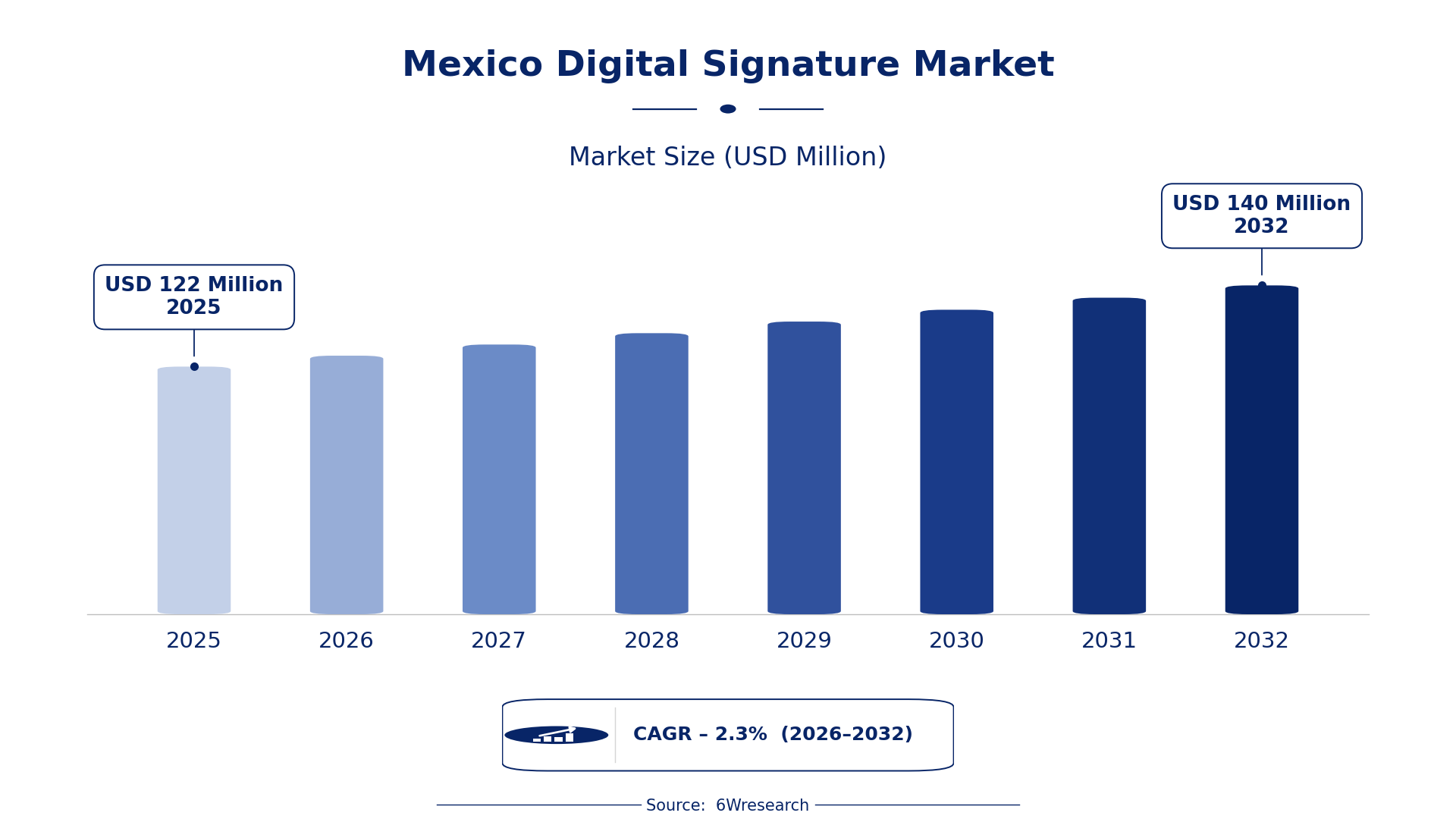
The Mexico Digital Signature Market was estimated at USD 122 Million in 2025 and is projected to reach USD 140 Million by 2032, growing at a CAGR of 2.3% from 2026 to 2032.
Mexico Digital Signature Market Synopsis
The Mexico Digital Signature Market is experiencing a surge in demand, fueled by the urgent need for secure electronic transactions across various sectors. As companies increasingly prioritize digital transformation, digital signatures have become a vital tool for ensuring the integrity of documents and compliance with legal requirements.
Emerging technologies like blockchain and advanced cryptography are playing an instrumental role in this shift, driving innovation and trust in digital transactions. Organizations across finance, healthcare, and government are adopting these solutions to enhance efficiency and mitigate risks associated with traditional methods of document verification.
Mexico Digital Signature Market Year-wise Growth Rate and Key Drivers
This graph illustrates the annual growth rates of the Mexico Digital Signature Market from 2021 to 2032, highlighting a steady upward trajectory and projected expansion over the forecast period.
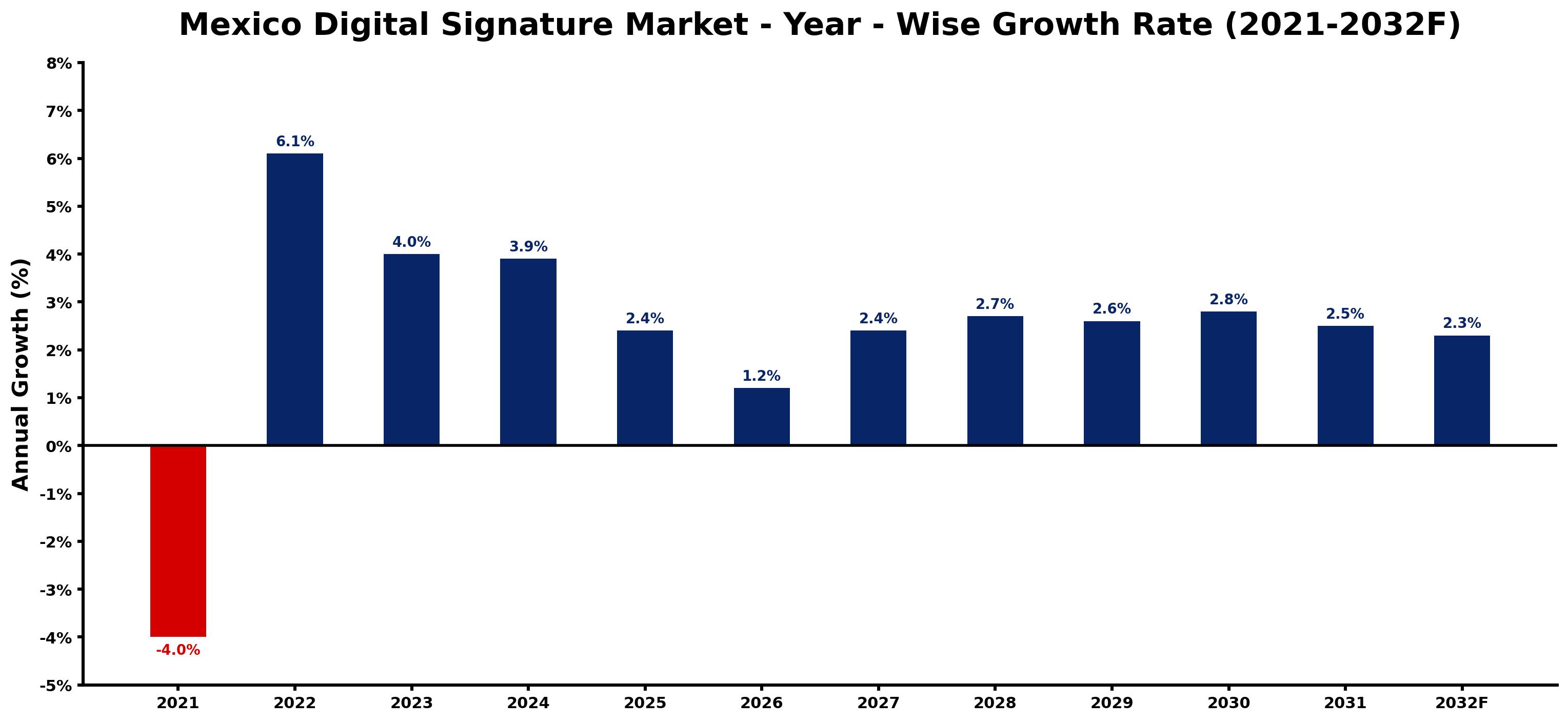
The table below presents the year‑wise growth rates along with the key drivers influencing the market
| Year | Growth Rate | Major Drivers |
| 2021 | -4.0% | AMIPCI report highlighted low adoption rates in SMEs |
| 2022 | 6.1% | Favorable regulations from SAT on e-signatures acceptance. |
| 2023 | 4.0% | Increased remote work boosting digital transaction needs. |
| 2024 | 3.9% | Government promotion of electronic invoicing usage nationwide. |
| 2025 | 2.4% | Rise in telehealth services requiring secure authentication. |
| 2026 | 1.2% | Increased focus on cybersecurity enhancing digital signature adoption. |
| 2027 | 2.4% | Legal framework supporting remote notarization gaining traction. |
| 2028 | 2.7% | Growing awareness of legal validity of e-signatures. |
| 2029 | 2.6% | Banking sector mandates for electronic customer onboarding processes. |
| 2030 | 2.8% | Emergence of e-commerce platforms requiring robust verification. |
| 2031 | 2.5% | Demand for compliance with newly enforced data protection laws. |
| 2032 | 2.3% | SMEs adopting digital solutions for streamlined operations. |
Note: Market size estimations and growth projections presented in this report are based on 6Wresearch's proprietary forecasting methodology, utilizing the latest available industry data, government publications, and primary research inputs.
Mexico Digital Signature Market Key Takeaways
Below are some of the specific key takeaways from the market, including:
- Growing digital transformation initiatives are driving increased adoption of digital signatures across various sectors.
- Technological advancements are enhancing the security and reliability of digital signature solutions.
- Challenges such as legal complexities and varying state regulations continue to hinder market growth.
- Government initiatives are playing a crucial role in promoting the legal recognition of digital signatures.
- Healthcare and finance sectors show the highest demand for robust digital signature solutions.
Evaluation of Restraints in Mexico Digital Signature Market
Despite the growing interest in digital signatures, the market faces several challenges that limit its potential. Chief among these are the intricate legal and regulatory frameworks that differ across states in Mexico. This fragmentation creates confusion and uncertainty for businesses contemplating the shift to digital signatures. Security concerns also loom large; the effectiveness of digital signatures hinges on public trust in their authenticity. Until these hurdles are addressed, widespread adoption will remain stunted, hindering the full realization of the market's potential.
Mexico Digital Signature Market Trends
A key trend influencing the Mexico Digital Signature Market is the integration of biometric authentication methods. Businesses are recognizing that enhancing security through biometric options, such as fingerprints and facial recognition, can substantially increase confidence in digital signatures. Additionally, increased awareness and acceptance of digital signatures among consumers are steadily rising, with more entities striving to meet the growing demand for efficiency and speed in transactions. The push for e-government initiatives is also compelling various public sector organizations to adopt digital signature technologies.
Mexico Digital Signature Market Opportunities
The market is ripe for growth, particularly in sectors that are traditionally slower to adopt technology, such as healthcare and small to medium-sized enterprises (SMEs). These entities are now realizing the efficiency benefits of digital signatures, creating a wave of opportunity for technology providers. Furthermore, collaborations between the public and private sectors can lead to broader initiatives aimed at establishing a more uniform legal framework, simplifying adoption for businesses across various regions.
Government Initiatives in the Mexico Digital Signature Market
Government policies are essential in shaping the future of the Mexico Digital Signature Market. As the administration pushes for digital transformation, several initiatives have been launched to support the growth of digital signatures. These policies not only foster trust among users but also streamline regulatory processes, making it easier for businesses and citizens to adopt these technologies.
- A recently completed national campaign aimed to educate small businesses on the benefits of digital signatures, enhancing understanding and usage.
- A current initiative is underway to align state regulations with federal standards, creating a more cohesive framework for digital signature use.
- Plans are in motion for a public sector digital infrastructure upgrade expected to enhance security measures surrounding digital transactions.
- Legislation recognizing the legal validity of digital signatures was implemented in recent years to bolster consumer confidence and compliance.
- An ongoing program focuses on partnering with tech firms to develop secure digital signature solutions for healthcare providers.
Future Insights of the Mexico Digital Signature Market
Looking ahead to 2026-2032, the Mexico Digital Signature Market is expected to expand as legal barriers are reduced and public awareness increases. The anticipated government backing and ongoing technological advancements will create an encouraging environment for investment. Digital signatures will likely see wider acceptance across various industries, particularly as regulatory frameworks become more standardized. Ultimately, businesses will find that integrating these solutions not only enhances security but also improves operational efficiency, driving long-term growth.
Mexico Digital Signature Market Latest Developments
Recent activity in the Mexico Digital Signature Market indicates a focus on enhancing security and user trust. Over the past year, various companies have launched initiatives aimed at improving digital transaction protocols and expanding service offerings. These developments demonstrate a commitment to meeting the evolving demands of consumers and businesses alike.
- A major technology vendor launched a new suite of digital signature solutions in early 2025, designed specifically for the financial sector, improving transaction security.
- In mid-2025, an initiative focused on enhancing encryption standards for digital signatures was announced, aimed at bolstering data protection.
- An upcoming partnership between a leading digital solutions firm and government bodies is expected to roll out by late 2026, targeting increased adoption in public services.
- A recent expansion of an existing digital signature platform has been completed, enhancing its capabilities to include mobile transaction options.
- Current testing is underway for a new blockchain-based solution to ensure the authenticity of digital signatures, with a rollout expected by mid-2026.
Mexico Digital Signature Market - Key Attractiveness of the Report
- 10 Years of Market Numbers
- Historical Data Starting from 2022 to 2025
- Base Year: 2025
- Forecast Data until 2032
- Key Performance Indicators Impacting the Market
- Major Upcoming Developments and Projects
Key Highlights of the Report:
- Mexico Digital Signature Market Outlook
- Market Size of Mexico Digital Signature Market, 2025
- Forecast of Mexico Digital Signature Market, 2032
- Historical Data and Forecast of Mexico Digital Signature Revenues & Volume for the Period 2022-2032F
- Mexico Digital Signature Market Trend Evolution
- Mexico Digital Signature Market Drivers and Challenges
- Mexico Digital Signature Price Trends
- Mexico Digital Signature Porter's Five Forces
- Mexico Digital Signature Industry Life Cycle
- Historical Data and Forecast of Mexico Digital Signature Market Revenues & Volume By Component for the Period 2022-2032F
- Historical Data and Forecast of Mexico Digital Signature Market Revenues & Volume By Solutions for the Period 2022-2032F
- Historical Data and Forecast of Mexico Digital Signature Market Revenues & Volume By Services for the Period 2022-2032F
- Historical Data and Forecast of Mexico Digital Signature Market Revenues & Volume By Solution for the Period 2022-2032F
- Historical Data and Forecast of Mexico Digital Signature Market Revenues & Volume By Software for the Period 2022-2032F
- Historical Data and Forecast of Mexico Digital Signature Market Revenues & Volume By Hardware for the Period 2022-2032F
- Historical Data and Forecast of Mexico Digital Signature Market Revenues & Volume By Vertical for the Period 2022-2032F
- Historical Data and Forecast of Mexico Digital Signature Market Revenues & Volume By BFSI for the Period 2022-2032F
- Historical Data and Forecast of Mexico Digital Signature Market Revenues & Volume By Government for the Period 2022-2032F
- Historical Data and Forecast of Mexico Digital Signature Market Revenues & Volume By Defense for the Period 2022-2032F
- Historical Data and Forecast of Mexico Digital Signature Market Revenues & Volume By Legal for the Period 2022-2032F
- Historical Data and Forecast of Mexico Digital Signature Market Revenues & Volume By Real Estate for the Period 2022-2032F
- Historical Data and Forecast of Mexico Digital Signature Market Revenues & Volume By Organization Size for the Period 2022-2032F
- Historical Data and Forecast of Mexico Digital Signature Market Revenues & Volume By Large Enterprises for the Period 2022-2032F
- Historical Data and Forecast of Mexico Digital Signature Market Revenues & Volume By Small and Medium-Sized Enterprises (SMEs) for the Period 2022-2032F
- Historical Data and Forecast of Mexico Digital Signature Market Revenues & Volume By Deployment Mode for the Period 2022-2032F
- Historical Data and Forecast of Mexico Digital Signature Market Revenues & Volume By Cloud for the Period 2022-2032F
- Historical Data and Forecast of Mexico Digital Signature Market Revenues & Volume By On-Premises for the Period 2022-2032F
- Mexico Digital Signature Import Export Trade Statistics
- Market Opportunity Assessment By Component
- Market Opportunity Assessment By Solution
- Market Opportunity Assessment By Vertical
- Market Opportunity Assessment By Organization Size
- Market Opportunity Assessment By Deployment Mode
- Mexico Digital Signature Top Companies Market Share
- Mexico Digital Signature Competitive Benchmarking By Technical and Operational Parameters
- Mexico Digital Signature Company Profiles
- Mexico Digital Signature Key Strategic Recommendations






































