Mexico Digital Twin Market Size, Share & Growth Rate
The Mexico Digital Twin Market was estimated at USD 209 Million in 2025 and is projected to reach USD 241 Million by 2032, growing at a CAGR of 2.1% from 2026 to 2032. This growth trajectory is primarily driven by the increasing adoption of Industry 4.0 principles among Mexican enterprises, especially within the manufacturing and healthcare sectors. Companies are recognizing the value of real-time data and predictive analytics facilitated by digital twin technologies, leading to enhanced operational efficiencies.
Mexico Digital Twin Market Year-wise Growth Rate and Key Drivers
This graph highlights how the Mexico Digital Twin Market has steadily grown over the years, supported by major growth factors.
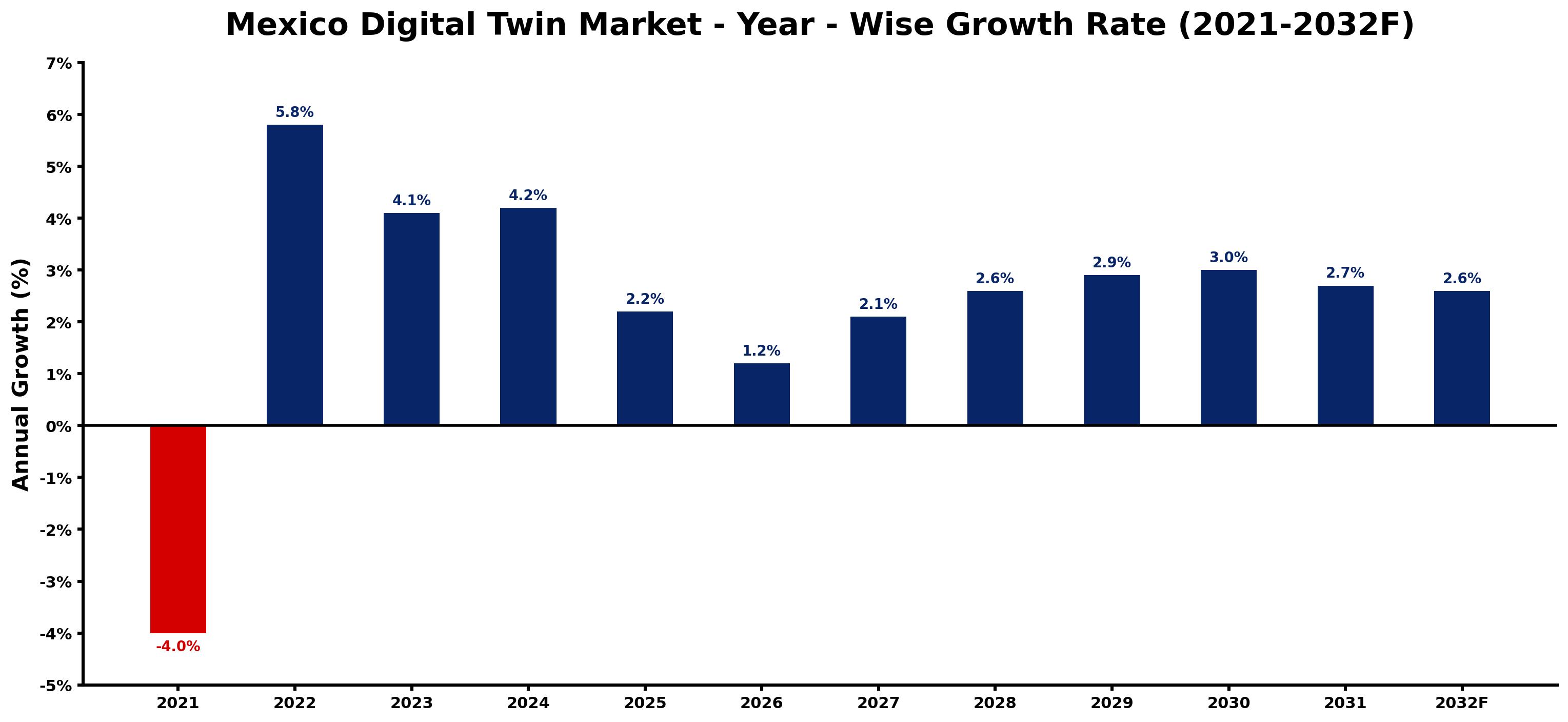
The table below presents the year‑wise growth rates along with the key drivers influencing the market
| Year | Growth Rate | Major Drivers |
| 2021 | -4.0% | Increasing industrial automation investments |
| 2022 | 5.8% | Expansion of commercial construction activities |
| 2023 | 4.1% | Government infrastructure modernization initiatives |
| 2024 | 4.2% | Increasing adoption of advanced technologies |
| 2025 | 2.2% | Rapid growth in telecom and data center sectors |
| 2026 | 1.2% | Increasing industrial automation investments |
| 2027 | 2.1% | Expansion of transportation and logistics networks |
| 2028 | 2.6% | Growing renewable energy integration projects |
| 2029 | 2.9% | Increasing smart city development projects |
| 2030 | 3.0% | Increasing smart city development projects |
| 2031 | 2.7% | Growing renewable energy integration projects |
| 2032 | 2.6% | Expansion of transportation and logistics networks |
Note - Market size estimations and growth projections presented in this report are based on 6Wresearch’s advanced forecasting approach, validated with industry datasets as of June 2026.
Mexico Digital Twin Market Synopsis
The digital twin phenomenon is taking center stage in Mexico, with businesses across various sectors eager to leverage this cutting-edge technology. By creating virtual representations of physical assets, companies can optimize processes, enhance decision-making, and predict maintenance needs more accurately.
As industries increasingly prioritize efficiency and smart operations, the digital twin technology not only streamlines workflows but also supports sustainability initiatives. The Mexican government's push toward digital transformation is further accelerating this trend, making the market ripe for innovation and investment.
Mexico Digital Twin Market Key Takeaways
- Growing interest in digital twin applications across manufacturing, healthcare, and infrastructure sectors.
- The technology is enabling real-time monitoring and predictive analysis, driving operational efficiency.
- Government initiatives promoting digital transformation are enhancing the market's growth potential.
- Integration challenges between traditional systems and digital twin platforms remain a significant concern.
- Cybersecurity measures are critical for ensuring data privacy and fostering stakeholder trust.
Evaluation of Restraints in Mexico Digital Twin Market
Despite the favorable growth prospects for the Mexico Digital Twin Market, several constraints are impeding faster adoption. One of the primary barriers is the integration of digital twin technology with existing legacy systems, as many industries still rely on traditional operations. The lack of standardized protocols for data exchange complicates this integration process. Furthermore, concerns surrounding data privacy and security are significant, necessitating the implementation of robust cybersecurity measures. These factors contribute to a cautious approach among potential adopters.
Mexico Digital Twin Market Trends
Several trends are currently shaping the Mexico Digital Twin Market. First, the alignment with Industry 4.0 practices is leading to increased investments in smart manufacturing technologies. Organizations are also focusing on enhanced data analytics capabilities to leverage insights generated by digital twins. Sustainability is another rising theme, with businesses adopting digital twins to reduce waste and improve resource management. Lastly, the integration of artificial intelligence with digital twin technologies is gaining traction, creating more intelligent, responsive systems.
Mexico Digital Twin Market Opportunities
Opportunities for growth in the Mexico Digital Twin Market are abundant. The rising demand for predictive maintenance in manufacturing can drive further investment in this technology. Additionally, the healthcare sector is ripe for digital twin applications, particularly in personalized medicine and patient monitoring systems. As infrastructure development accelerates, digital twins can enhance urban planning and facility management. Moreover, collaborative ventures between technology providers and industrial stakeholders may uncover novel applications, maximizing the benefits of digital twin implementations.
Government Initiatives in the Mexico Digital Twin Market
The Mexican government is actively fostering the growth of the digital twin market through initiatives focused on advancing Industry 4.0 and promoting digital transformation. Programs aimed at modernizing manufacturing processes and increasing technological adoption in public infrastructure underscore a commitment to enhancing operational efficiencies. Additionally, public investments in research and development are intended to spur innovation in digital technologies, positioning Mexico as a key player in the global smart manufacturing landscape.
Future Insights of the Mexico Digital Twin Market
Looking ahead to 2026-2032, the Mexico Digital Twin Market is poised for robust growth. As industries increasingly embrace automation and data-driven decision-making, the demand for digital twin technologies will likely escalate. Continuous improvements in technology infrastructure and increasing digital literacy among the workforce will further facilitate adoption. Furthermore, as regulatory frameworks evolve to embrace digital technologies, a greater number of sectors will explore the potential of digital twins, ultimately expanding the market.
Mexico Digital Twin Market Latest Developments (May 2025 - June 2026)
In recent months, the Mexico Digital Twin Market has witnessed significant momentum, characterized by heightened interest from various industries eager to explore digital transformation. Public forums have emerged, highlighting successful case studies in manufacturing and infrastructure. Additionally, educational initiatives are being implemented to enhance understanding of digital twins among professionals, facilitating better integration into existing operations. Furthermore, advancements in supporting technologies, including cloud computing and IoT, are expected to bolster digital twin applications.
Mexico Digital Twin Market - Key Attractiveness of the Report
- 10 Years of Market Numbers
- Historical Data Starting from 2022 to 2025
- Base Year: 2025
- Forecast Data until 2032
- Key Performance Indicators Impacting the Market
- Major Upcoming Developments and Projects
Key Highlights of the Report:
- Mexico Digital Twin Market Outlook
- Market Size of Mexico Digital Twin Market, 2025
- Forecast of Mexico Digital Twin Market, 2032
- Historical Data and Forecast of Mexico Digital Twin Revenues & Volume for the Period 2022-2032F
- Mexico Digital Twin Market Trend Evolution
- Mexico Digital Twin Market Drivers and Challenges
- Mexico Digital Twin Price Trends
- Mexico Digital Twin Porter's Five Forces
- Mexico Digital Twin Industry Life Cycle
- Historical Data and Forecast of Mexico Digital Twin Market Revenues & Volume By End-users for the Period 2022-2032F
- Historical Data and Forecast of Mexico Digital Twin Market Revenues & Volume By Automotive & Defense for the Period 2022-2032F
- Historical Data and Forecast of Mexico Digital Twin Market Revenues & Volume By Home & Commercial for the Period 2022-2032F
- Historical Data and Forecast of Mexico Digital Twin Market Revenues & Volume By Healthcare for the Period 2022-2032F
- Historical Data and Forecast of Mexico Digital Twin Market Revenues & Volume By Energy & Utilities for the Period 2022-2032F
- Historical Data and Forecast of Mexico Digital Twin Market Revenues & Volume By Electronics & Electrical Manufacturing for the Period 2022-2032F
- Historical Data and Forecast of Mexico Digital Twin Market Revenues & Volume By Others for the Period 2022-2032F
- Historical Data and Forecast of Mexico Digital Twin Market Revenues & Volume By Applications for the Period 2022-2032F
- Historical Data and Forecast of Mexico Digital Twin Market Revenues & Volume By Product Design and Development for the Period 2022-2032F
- Historical Data and Forecast of Mexico Digital Twin Market Revenues & Volume By Machine and Equipment Health Monitoring for the Period 2022-2032F
- Historical Data and Forecast of Mexico Digital Twin Market Revenues & Volume By Predictive Maintenance for the Period 2022-2032F
- Historical Data and Forecast of Mexico Digital Twin Market Revenues & Volume By Dynamic Optimization for the Period 2022-2032F
- Mexico Digital Twin Import Export Trade Statistics
- Market Opportunity Assessment By End-users
- Market Opportunity Assessment By Applications
- Mexico Digital Twin Top Companies Market Share
- Mexico Digital Twin Competitive Benchmarking By Technical and Operational Parameters
- Mexico Digital Twin Company Profiles
- Mexico Digital Twin Key Strategic Recommendations






































