Mexico Enterprise AI Market Size & Growth Rate (2026-2032)
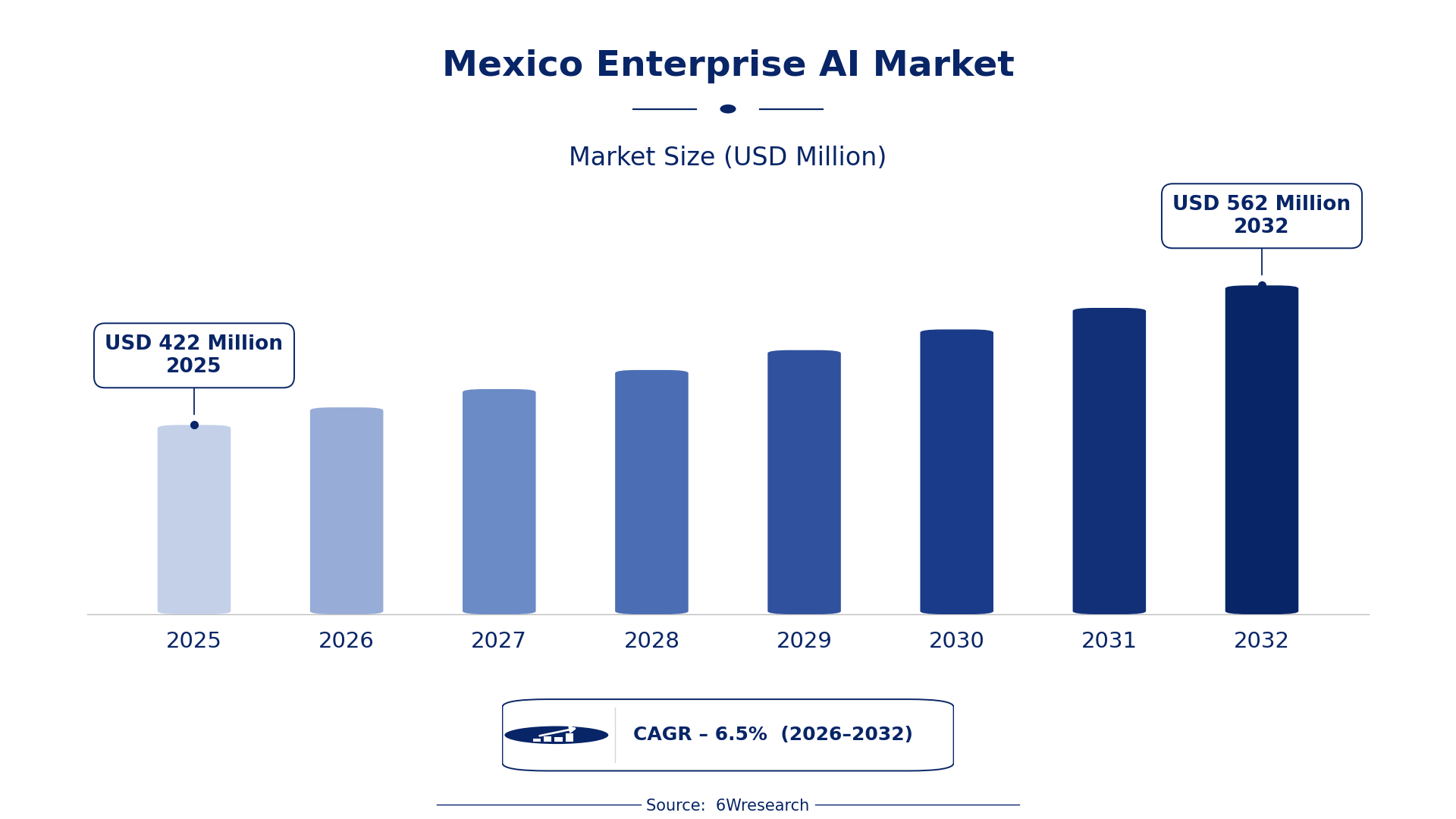
The Mexico Enterprise AI Market was estimated at USD 422 Million in 2025 and is projected to reach USD 562 Million by 2032, growing at a CAGR of 6.5% from 2026 to 2032.
Mexico Enterprise AI Market Synopsis
The demand for advanced AI solutions in Mexico is surging, particularly within the finance and healthcare sectors. Organizations are increasingly recognizing that integrating AI technologies can streamline operations and enhance customer interactions, leading to better overall business outcomes.
Simultaneously, the market is also characterized by a growing array of innovative AI products, from machine learning algorithms to natural language processing tools. This diversification is crucial as businesses seek tailored solutions that address their specific challenges and opportunities.
Mexico Enterprise AI Market Year-wise Growth Rate and Key Drivers
This graph illustrates the annual growth rates of the Mexico Enterprise AI Market from 2021 to 2032, highlighting a steady upward trajectory and projected expansion over the forecast period.
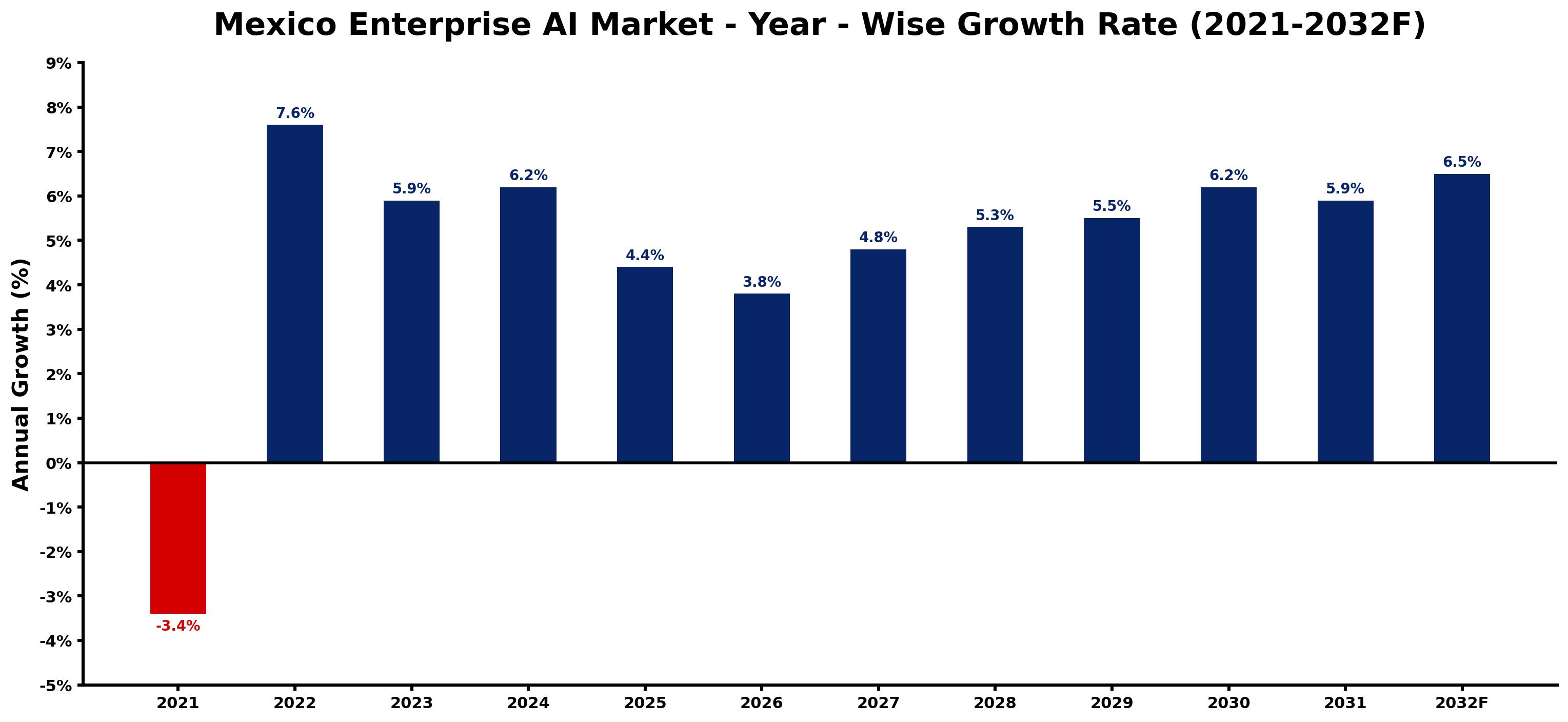
The table below presents the year‑wise growth rates along with the key drivers influencing the market
| Year | Growth Rate | Major Drivers |
| 2021 | -3.4% | Increased scrutiny from COFEMER on AI applications. |
| 2022 | 7.6% | Increased investment in AI technology by Mexican startups. |
| 2023 | 5.9% | Collaboration between CONACYT and tech firms on AI projects. |
| 2024 | 6.2% | Rising adoption of AI in manufacturing for efficiency. |
| 2025 | 4.4% | Corporate initiatives targeting AI-enhanced cybersecurity measures. |
| 2026 | 3.8% | Local demand for AI in logistics and supply chain. |
| 2027 | 4.8% | Public sector exploring AI for healthcare solutions. |
| 2028 | 5.3% | Enhanced AI training programs boosting workforce capabilities. |
| 2029 | 5.5% | Navigating regulatory frameworks favoring AI innovations. |
| 2030 | 6.2% | Adoption of AI-driven analytics among financial institutions. |
| 2031 | 5.9% | Investment from international tech firms in AI research. |
| 2032 | 6.5% | Growing integration of AI in retail payment systems. |
Note: Market size estimations and growth projections presented in this report are based on 6Wresearch's proprietary forecasting methodology, utilizing the latest available industry data, government publications, and primary research inputs.
Mexico Enterprise AI Market Key Takeaways
Below are some of the specific key takeaways from the market, including:
- The market is expanding rapidly across multiple sectors, notably finance, healthcare, and retail.
- Investments in AI technologies are primarily focused on enhancing operational efficiency and customer experience.
- Ethical AI practices and data privacy compliance are becoming central concerns for companies implementing these technologies.
- Strategic partnerships between local firms and AI technology providers are increasing.
- Government initiatives are actively fostering innovation and investment in the AI sector.
Evaluation of Restraints in Mexico Enterprise AI Market
Several challenges are hindering the growth of the Mexico Enterprise AI Market. A lack of awareness about AI technologies remains a significant barrier, with many organizations uncertain about how to effectively integrate these solutions into their operations. Additionally, concerns surrounding data privacy and the need for compliance with regulations such as the General Data Protection Law are top priorities. The shortage of skilled professionals in AI further complicates matters, as companies struggle to find the talent necessary to implement and maintain these advanced technologies. Addressing these constraints requires a concerted effort from both the public and private sectors to invest in education and training.
Mexico Enterprise AI Market Trends
Currently, the Mexico Enterprise AI Market is witnessing several key trends. The demand for AI-powered solutions is not just about efficiency; it’s increasingly about enhancing customer experiences. Companies are focusing on adopting machine learning and natural language processing technologies to personalize services and improve engagement. on top of that, there is a heightened focus on ethical AI practices, ensuring that AI deployment is responsible and compliant with regulations.
Mexico Enterprise AI Market Opportunities
The potential for investment in the Mexico Enterprise AI Market is substantial, particularly in sectors like healthcare and finance. Opportunities abound for companies that specialize in AI software development and automation solutions tailored to local enterprises. Investors should also consider startups that are addressing unique market challenges, as these firms can offer innovative approaches and solutions. As businesses increasingly adopt AI technologies to drive growth, the demand for robust AI services will likely continue to expand.
Government Initiatives in the Mexico Enterprise AI Market
The Mexican government is actively shaping the Enterprise AI Market through a series of initiatives aimed at promoting technological advancement. With policies designed to encourage investment in AI and the establishment of regulatory frameworks, the government is laying the groundwork for a thriving AI ecosystem. These efforts highlight the importance of public policy in fostering innovation and ensuring that AI technologies are developed and implemented responsibly.
- A recently completed National AI Strategy aims to promote AI technology across various sectors.
- A current initiative focuses on providing tax incentives for businesses investing in AI solutions.
- There are ongoing efforts to create regulatory frameworks that ensure ethical AI practices.
- A planned public-private partnership is expected to enhance digital infrastructure to support AI development by 2027.
- The government is initiating education programs to improve AI literacy and skills among the workforce.
Future Insights of the Mexico Enterprise AI Market
Looking ahead, the Mexico Enterprise AI Market is set for a promising trajectory between 2026 and 2032. With businesses increasingly recognizing the competitive advantages that AI technologies offer, demand will likely grow across various sectors. Advancements in AI algorithms and tools will further enhance operational efficiency and customer engagement strategies. As the ecosystem for AI development matures, both local and international vendors will find ample opportunities to thrive in Mexico’s expanding market.
Mexico Enterprise AI Market Latest Developments
In the past year, the Mexico Enterprise AI Market has seen notable activity, with companies ramping up their AI initiatives in response to emerging demands. This growing focus on AI is indicative of a broader shift towards digital transformation across industries, driven by the need for enhanced efficiency and customer satisfaction.
- A major technology vendor launched a new AI-driven analytics platform in early 2025, aimed at optimizing supply chain management for local enterprises.
- An ongoing project is currently underway, where a leading regional operator is integrating AI solutions into customer service operations to enhance user experience.
- A recent partnership between a local AI firm and a multinational corporation was established to develop tailored AI applications for the retail sector, expected to roll out by mid-2026.
- There is an upcoming initiative set to begin in late 2025, focusing on AI training programs for professionals in Mexico to bridge the talent gap in the industry.
- A consortium of companies is working on a collaborative AI research project aimed at developing innovative healthcare solutions, which is currently in the planning stages.
Mexico Enterprise AI Market - Key Attractiveness of the Report
- 10 Years of Market Numbers
- Historical Data Starting from 2022 to 2025
- Base Year: 2025
- Forecast Data until 2032
- Key Performance Indicators Impacting the Market
- Major Upcoming Developments and Projects
Key Highlights of the Report:
- Mexico Enterprise AI Market Outlook
- Market Size of Mexico Enterprise AI Market, 2025
- Forecast of Mexico Enterprise AI Market, 2032
- Historical Data and Forecast of Mexico Enterprise AI Revenues & Volume for the Period 2022-2032F
- Mexico Enterprise AI Market Trend Evolution
- Mexico Enterprise AI Market Drivers and Challenges
- Mexico Enterprise AI Price Trends
- Mexico Enterprise AI Porter's Five Forces
- Mexico Enterprise AI Industry Life Cycle
- Historical Data and Forecast of Mexico Enterprise AI Market Revenues & Volume By Component for the Period 2022-2032F
- Historical Data and Forecast of Mexico Enterprise AI Market Revenues & Volume By Solution for the Period 2022-2032F
- Historical Data and Forecast of Mexico Enterprise AI Market Revenues & Volume By Services for the Period 2022-2032F
- Historical Data and Forecast of Mexico Enterprise AI Market Revenues & Volume By Technology for the Period 2022-2032F
- Historical Data and Forecast of Mexico Enterprise AI Market Revenues & Volume By Machine learning and deep learning for the Period 2022-2032F
- Historical Data and Forecast of Mexico Enterprise AI Market Revenues & Volume By Natural Language Processing (NLP) for the Period 2022-2032F
- Historical Data and Forecast of Mexico Enterprise AI Market Revenues & Volume By Application Area for the Period 2022-2032F
- Historical Data and Forecast of Mexico Enterprise AI Market Revenues & Volume By Security and risk management for the Period 2022-2032F
- Historical Data and Forecast of Mexico Enterprise AI Market Revenues & Volume By Marketing management for the Period 2022-2032F
- Historical Data and Forecast of Mexico Enterprise AI Market Revenues & Volume By Customer support and experience for the Period 2022-2032F
- Historical Data and Forecast of Mexico Enterprise AI Market Revenues & Volume By Human resource and recruitment management for the Period 2022-2032F
- Historical Data and Forecast of Mexico Enterprise AI Market Revenues & Volume By Analytics application for the Period 2022-2032F
- Historical Data and Forecast of Mexico Enterprise AI Market Revenues & Volume By Process automation for the Period 2022-2032F
- Historical Data and Forecast of Mexico Enterprise AI Market Revenues & Volume By Deployment Type for the Period 2022-2032F
- Historical Data and Forecast of Mexico Enterprise AI Market Revenues & Volume By Cloud for the Period 2022-2032F
- Historical Data and Forecast of Mexico Enterprise AI Market Revenues & Volume By On-premises for the Period 2022-2032F
- Historical Data and Forecast of Mexico Enterprise AI Market Revenues & Volume By Organization Size for the Period 2022-2032F
- Historical Data and Forecast of Mexico Enterprise AI Market Revenues & Volume By Small and Medium-sized Businesses (SMBs) for the Period 2022-2032F
- Historical Data and Forecast of Mexico Enterprise AI Market Revenues & Volume By Large enterprises for the Period 2022-2032F
- Mexico Enterprise AI Import Export Trade Statistics
- Market Opportunity Assessment By Component
- Market Opportunity Assessment By Technology
- Market Opportunity Assessment By Application Area
- Market Opportunity Assessment By Deployment Type
- Market Opportunity Assessment By Organization Size
- Mexico Enterprise AI Top Companies Market Share
- Mexico Enterprise AI Competitive Benchmarking By Technical and Operational Parameters
- Mexico Enterprise AI Company Profiles
- Mexico Enterprise AI Key Strategic Recommendations






































