Brazil Enterprise AI Market Size & Growth Rate (2026-2032)
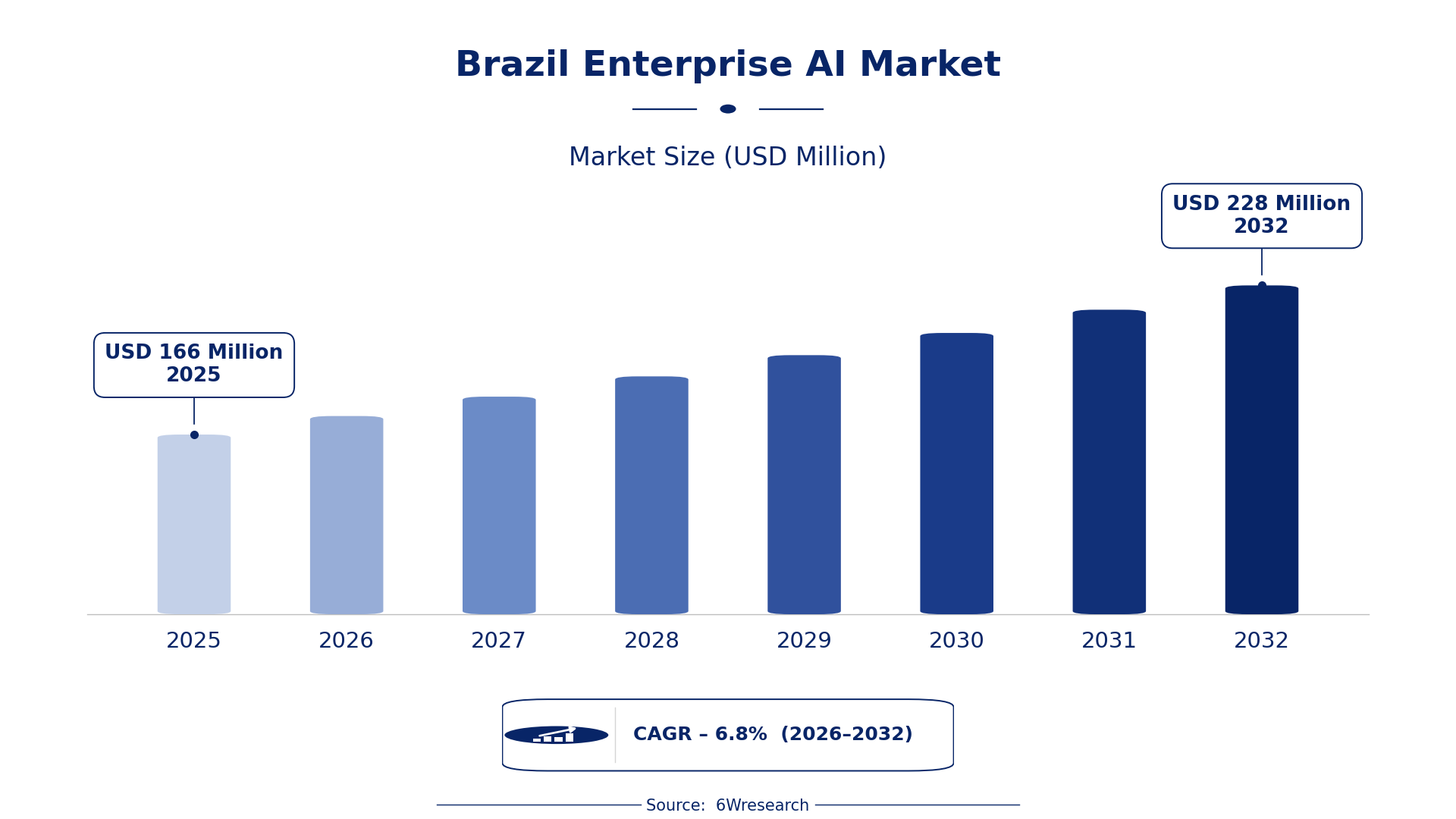
The Brazil Enterprise AI Market was estimated at USD 166 Million in 2025 and is projected to reach USD 228 Million by 2032, growing at a CAGR of 6.8% from 2026 to 2032.
Brazil Enterprise AI Market Synopsis
The Brazil Enterprise AI market is currently experiencing a surge as organizations across various sectors realize the potential of artificial intelligence to enhance operational efficiency and decision-making. As businesses continue to integrate AI solutions, they are uncovering opportunities for automation and data-driven insights that were previously unattainable.
Looking ahead, the trajectory of the market indicates a steady climb fueled by technological advancements and an increasing emphasis on competitive differentiation. However, challenges such as the high costs of deployment and the critical need for skilled talent present hurdles that must be navigated for sustainable growth.
Brazil Enterprise AI Market Year-wise Growth Rate and Key Drivers
This graph illustrates the annual growth rates of the Brazil Enterprise AI Market from 2021 to 2032, highlighting a steady upward trajectory and projected expansion over the forecast period.
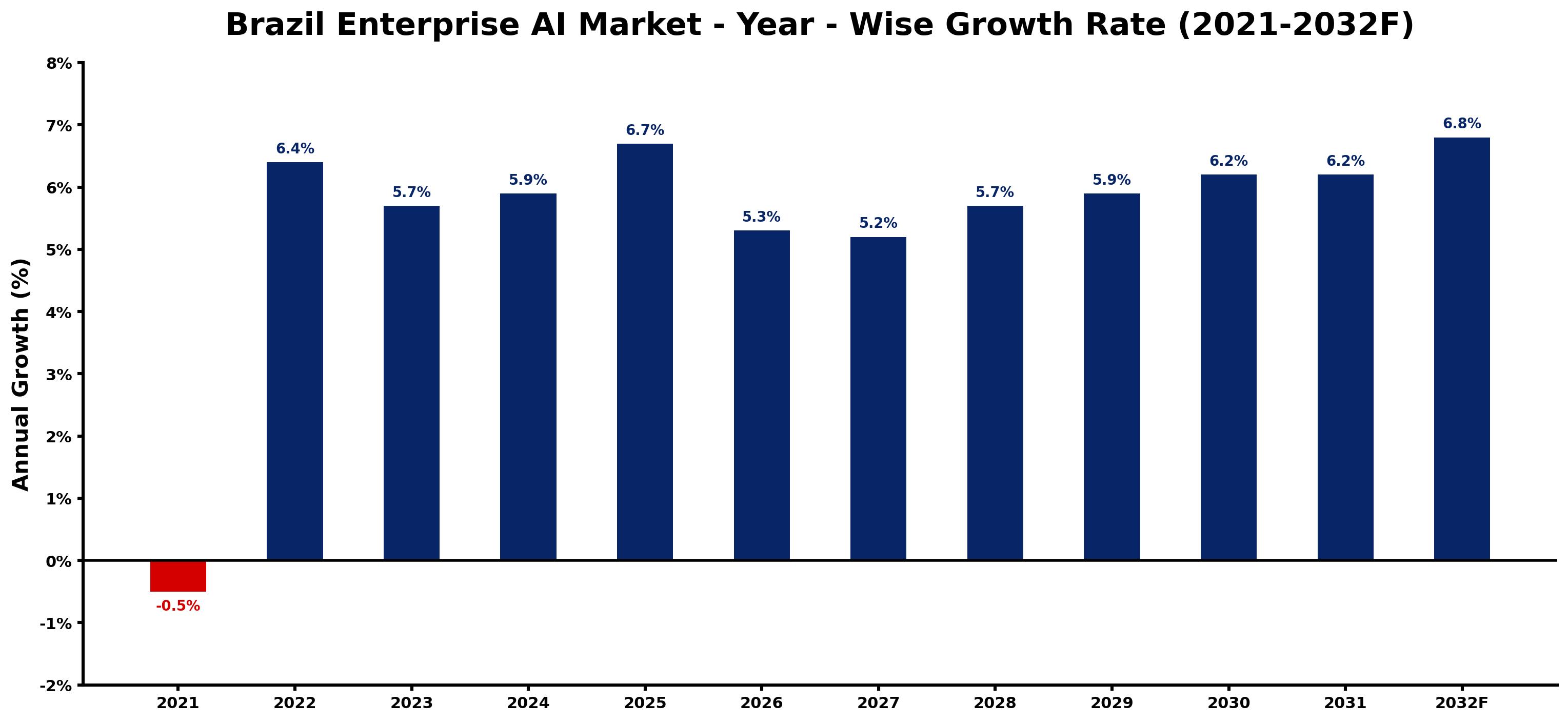
The table below presents the year‑wise growth rates along with the key drivers influencing the market
| Year | Growth Rate | Major Drivers |
| 2021 | -0.5% | Disruption from Labor Ministry's AI employment regulations. |
| 2022 | 6.4% | Growth in cloud computing adoption by Brazilian enterprises. |
| 2023 | 5.7% | Increased government investment in AI research initiatives. |
| 2024 | 5.9% | Emergence of local AI startups driving innovative solutions. |
| 2025 | 6.7% | Demand for data analytics in financial services sector. |
| 2026 | 5.3% | Enhanced regulatory support for AI ethics frameworks. |
| 2027 | 5.2% | Adoption of AI in Brazil's logistics and supply chains. |
| 2028 | 5.7% | Integration of machine learning in healthcare systems. |
| 2029 | 5.9% | Corporate partnerships boosting AI talent development programs. |
| 2030 | 6.2% | Rising focus on AI-driven customer service technologies. |
| 2031 | 6.2% | Supportive policies from BNDES for tech innovation. |
| 2032 | 6.8% | Growing investment in cybersecurity solutions leveraging AI. |
Note: Market size estimations and growth projections presented in this report are based on 6Wresearch's proprietary forecasting methodology, utilizing the latest available industry data, government publications, and primary research inputs.
Brazil Enterprise AI Market Key Takeaways
Below are some of the specific key takeaways from the market, including:
- Organizations are increasingly investing in AI to streamline processes and enhance decision-making.
- The demand for skilled professionals in AI remains a critical barrier to widespread adoption.
- Government policies are evolving to create an environment conducive to AI innovation.
- Ethical considerations are becoming more prominent as AI applications expand across industries.
- Cost-effective solutions will be key to unlocking the market's full potential.
Evaluation of Restraints in Brazil Enterprise AI Market
Despite the enthusiasm surrounding the Brazil Enterprise AI market, several restraints are holding back its full potential. The initial costs associated with AI implementation can be prohibitive, particularly for smaller organizations that may struggle to justify the investment. on top of that, the integration complexities of these systems require not just financial resources but also substantial expertise. As companies seek to adopt AI solutions, the shortage of skilled professionals with the necessary AI expertise adds another layer of complexity. Addressing these restraints is essential for businesses aiming to harness AI's capabilities effectively.
Brazil Enterprise AI Market Trends
Several trends are shaping the Brazil Enterprise AI market. First, there's a clear push toward automation across industries, as organizations look to minimize manual processes and enhance operational efficiency. Predictive analytics is gaining traction, enabling businesses to anticipate market trends and customer behaviors more accurately. Additionally, the focus on personalized customer experiences is prompting companies to deploy AI-driven solutions that tailor interactions to individual needs. Finally, the emergence of collaborative AI tools signifies a shift toward solutions that enhance human capabilities rather than replace them.
Brazil Enterprise AI Market Opportunities
The Brazil Enterprise AI market presents numerous growth and investment opportunities. Organizations that prioritize developing cost-effective AI solutions will find a receptive environment, especially in sectors like finance, healthcare, and retail. on top of that, investing in workforce training programs can help address the talent gap, facilitating smoother AI adoption. Companies that embrace ethical AI practices will not only differentiate themselves but also build trust with consumers. Lastly, partnerships with technology providers can accelerate innovation and enhance capabilities.
Government Initiatives in the Brazil Enterprise AI Market
Government policies in Brazil are crucial in shaping the Enterprise AI market. The current regulatory framework emphasizes research and development, aiming to stimulate innovation and competitiveness. With growing recognition of the ethical implications of AI, policies are being introduced to guide responsible AI use. The government's support through grants and tax incentives is vital for fostering a conducive environment for businesses looking to invest in AI technologies.
- A recently completed initiative focused on providing grants to startups developing AI technologies, aimed at promoting innovation.
- A currently ongoing program that enhances data governance standards to ensure ethical AI practices in businesses.
- A planned public-private partnership expected to launch in 2026, aimed at expanding AI education and workforce development.
- A new regulatory framework introduced in 2025 emphasizing transparency and accountability in AI algorithms.
- An initiative underway to create AI research hubs in collaboration with universities to foster innovation.
Future Insights of the Brazil Enterprise AI Market
As we look toward 2026-2032, the Brazil Enterprise AI market is set to evolve significantly. The integration of AI technologies will become deeper, with businesses not only using AI for operational efficiency but also for strategic decision-making. There will be an increasing emphasis on ethical considerations, influencing consumer trust and adoption rates. on top of that, advancements in AI capabilities will lead to innovative applications, particularly in sectors such as healthcare and finance, where predictive analytics can have transformative impacts.
Brazil Enterprise AI Market Latest Developments
In the past year, the Brazil Enterprise AI market has witnessed notable developments that reflect its dynamic nature. Organizations are increasingly rolling out AI-driven solutions, while partnerships and collaborations are forming to enhance capabilities and foster innovation. The government's initiatives are also aligning with industry needs, paving the way for a more integrated approach to AI adoption.
- A major technology vendor launched a new AI platform in early 2025 designed specifically for the Brazilian market, addressing local business needs.
- An ongoing partnership between a leading regional university and industry players aims to create a training program for AI specialists, initiated in mid-2025 and expected to continue for several years.
- A public-private initiative that began in late 2025 focuses on developing ethical AI standards, with stakeholders from various sectors involved.
- Upcoming in early 2026 is a nationwide campaign promoting awareness of AI technologies and their benefits for small to medium-sized enterprises.
- A recent collaboration between tech startups and established firms to develop AI solutions tailored for the healthcare sector, now in the implementation phase.
Brazil Enterprise AI Market - Key Attractiveness of the Report
- 10 Years of Market Numbers
- Historical Data Starting from 2022 to 2025
- Base Year: 2025
- Forecast Data until 2032
- Key Performance Indicators Impacting the Market
- Major Upcoming Developments and Projects
Key Highlights of the Report:
- Brazil Enterprise AI Market Outlook
- Market Size of Brazil Enterprise AI Market, 2025
- Forecast of Brazil Enterprise AI Market, 2032
- Historical Data and Forecast of Brazil Enterprise AI Revenues & Volume for the Period 2022-2032F
- Brazil Enterprise AI Market Trend Evolution
- Brazil Enterprise AI Market Drivers and Challenges
- Brazil Enterprise AI Price Trends
- Brazil Enterprise AI Porter's Five Forces
- Brazil Enterprise AI Industry Life Cycle
- Historical Data and Forecast of Brazil Enterprise AI Market Revenues & Volume By Component for the Period 2022-2032F
- Historical Data and Forecast of Brazil Enterprise AI Market Revenues & Volume By Solution for the Period 2022-2032F
- Historical Data and Forecast of Brazil Enterprise AI Market Revenues & Volume By Services for the Period 2022-2032F
- Historical Data and Forecast of Brazil Enterprise AI Market Revenues & Volume By Technology for the Period 2022-2032F
- Historical Data and Forecast of Brazil Enterprise AI Market Revenues & Volume By Machine learning and deep learning for the Period 2022-2032F
- Historical Data and Forecast of Brazil Enterprise AI Market Revenues & Volume By Natural Language Processing (NLP) for the Period 2022-2032F
- Historical Data and Forecast of Brazil Enterprise AI Market Revenues & Volume By Application Area for the Period 2022-2032F
- Historical Data and Forecast of Brazil Enterprise AI Market Revenues & Volume By Security and risk management for the Period 2022-2032F
- Historical Data and Forecast of Brazil Enterprise AI Market Revenues & Volume By Marketing management for the Period 2022-2032F
- Historical Data and Forecast of Brazil Enterprise AI Market Revenues & Volume By Customer support and experience for the Period 2022-2032F
- Historical Data and Forecast of Brazil Enterprise AI Market Revenues & Volume By Human resource and recruitment management for the Period 2022-2032F
- Historical Data and Forecast of Brazil Enterprise AI Market Revenues & Volume By Analytics application for the Period 2022-2032F
- Historical Data and Forecast of Brazil Enterprise AI Market Revenues & Volume By Process automation for the Period 2022-2032F
- Historical Data and Forecast of Brazil Enterprise AI Market Revenues & Volume By Deployment Type for the Period 2022-2032F
- Historical Data and Forecast of Brazil Enterprise AI Market Revenues & Volume By Cloud for the Period 2022-2032F
- Historical Data and Forecast of Brazil Enterprise AI Market Revenues & Volume By On-premises for the Period 2022-2032F
- Historical Data and Forecast of Brazil Enterprise AI Market Revenues & Volume By Organization Size for the Period 2022-2032F
- Historical Data and Forecast of Brazil Enterprise AI Market Revenues & Volume By Small and Medium-sized Businesses (SMBs) for the Period 2022-2032F
- Historical Data and Forecast of Brazil Enterprise AI Market Revenues & Volume By Large enterprises for the Period 2022-2032F
- Brazil Enterprise AI Import Export Trade Statistics
- Market Opportunity Assessment By Component
- Market Opportunity Assessment By Technology
- Market Opportunity Assessment By Application Area
- Market Opportunity Assessment By Deployment Type
- Market Opportunity Assessment By Organization Size
- Brazil Enterprise AI Top Companies Market Share
- Brazil Enterprise AI Competitive Benchmarking By Technical and Operational Parameters
- Brazil Enterprise AI Company Profiles
- Brazil Enterprise AI Key Strategic Recommendations






































