Mexico Ingots Market Summary
The mexico ingots market was estimated at USD 202 Million in 2025 and is projected to reach USD 233 Million by 2032, growing at a CAGR of 0.7% from 2026 to 2032.
Mexico Ingots Market Year-wise Growth Rate and Key Drivers
This graph highlights how the Mexico Ingots Market has steadily grown over the past five years, supported by major growth factors.
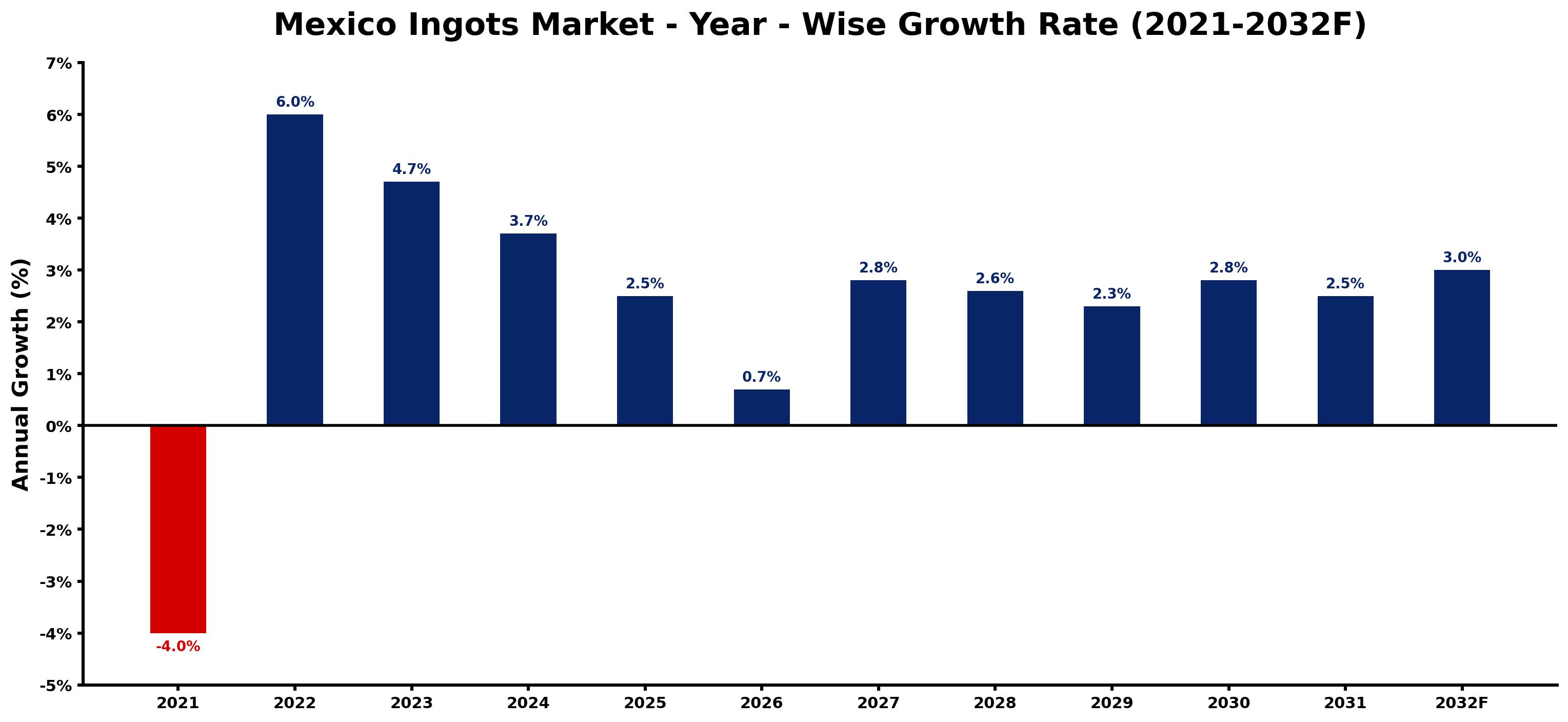
The table below presents the year wise growth rates along with the key drivers influencing the market
| Year | Growth Rate | Major Drivers |
| 2021 | -4.0% | Increased competition from alternative metals led to declining demand for traditional ingots among manufacturers. |
| 2022 | 6.0% | Increased focus on renewable energy sources drives demand for high-quality ingots. |
| 2023 | 4.7% | Infrastructure projects in urban areas enhance the ingot market's potential significantly. |
| 2024 | 3.7% | Local manufacturers expand capacities to meet emerging domestic and export needs. |
| 2025 | 2.5% | Technological innovations in metallurgy improve production efficiency and reduce costs. |
| 2026 | 0.7% | Shifts in global supply chains favor Mexican ingots for strategic resources. |
| 2027 | 2.8% | Collaborative ventures between local firms and international players boost market presence. |
| 2028 | 2.6% | Sustainability trends compel industries to source eco-friendly and recycled ingots. |
| 2029 | 2.3% | Rising automotive production in Mexico requires more aluminum and metal ingots. |
| 2030 | 2.8% | Investments in green construction elevate the demand for durable ingot materials. |
| 2031 | 2.5% | Emerging local startups innovate ingot applications in electronics and power sectors. |
| 2032 | 3.0% | Robust economic growth enhances infrastructure spending, driving up ingot consumption. |
Note - Market size estimations and growth projections presented in this report are based on 6Wresearch's advanced forecasting approach, validated with industry datasets as of June 2026.
Mexico Ingots Market Synopsis
The Mexico Ingots Market is projected to reach 0.7% and witness significant growth during the forecast period (2026-2032). Positioned as a vital segment in the country's metal manufacturing landscape, this market serves multiple industries, including construction and automotive, which are crucial for Mexico's economic progress. The ongoing modernization efforts in manufacturing processes are anticipated to further enhance the demand for high-quality ingots, creating various opportunities for market stakeholders.
Mexico Ingots Market Growth Drivers
The growth trajectory of the Mexico Ingots Market is primarily influenced by several key drivers that shape its dynamics.
- The demand for metal ingots such as aluminum, copper, and zinc is significantly fueled by the construction sector, which benefits from ongoing infrastructural initiatives throughout the country.
- The automotive industry relies heavily on metal ingots for manufacturing components, and as vehicle production ramps up in Mexico, the need for ingots is expected to rise correspondingly.
- Technological advancements in manufacturing processes contribute to increased production efficiency and quality in ingot production, enabling manufacturers to meet the evolving demands of various industries.
- Increasing exports of finished products, driven by competitive advantages in manufacturing costs and trade agreements, bolster the ingots market as industries seek to enhance value chains.
- Economic recovery and growth in global markets generate enhanced demand for metals, catalyzing growth in the production of ingots within Mexico's robust manufacturing framework.
Mexico Ingots Market Challenges and Restraints
Despite the promising outlook, the Mexico Ingots Market encounters several challenges that could hinder its growth.
- Fluctuations in global metal prices can significantly impact production costs and profit margins, leading to uncertainty in investment and production planning.
- The market faces stringent regulatory compliance requirements regarding quality and safety standards, which necessitate continuous adaptation and investment in compliance systems.
- Environmental concerns associated with ingot production, including emissions and waste management, pose challenges that stakeholders must address through sustainable practices.
- Competition from international markets, particularly those with lower production costs, may limit the growth potential for domestic manufacturers.
- Supply chain disruptions, as observed during recent global events, highlight vulnerabilities in sourcing raw materials, which can adversely affect ingot production schedules.
Mexico Ingots Market Government Investment and Initiatives
The Mexican government actively invests in policies and initiatives aimed at bolstering the ingots market, promoting sustainable practices and technological innovation.
- The government's regulatory frameworks prioritize quality control and safety standards, ensuring that domestic production aligns with international best practices.
- Public spending initiatives aimed at enhancing infrastructure and industrial capabilities directly impact the demand for metal ingots, particularly in construction projects.
- Incentives for research and development in metallurgy and production technologies encourage companies to invest in more efficient and environmentally friendly ingot manufacturing methods.
- Trade agreements foster international partnerships and export opportunities, enhancing the competitiveness of Mexico's ingots in the global market.
- The promotion of sustainable industrial practices is a key initiative, as the government aims to balance economic growth with environmental stewardship within the ingots market.
Mexico Ingots Market Latest Developments (May 2025 - June 2026)
In the period from May 2025 to June 2026, the Mexico Ingots Market has witnessed several notable developments that reflect the industry's evolving landscape.
- New regulatory measures focused on environmental sustainability have been introduced, prompting manufacturers to enhance their compliance and production processes.
- The ongoing investments in infrastructure development have accelerated demand for metal ingots across various sectors, particularly in construction.
- Technological innovations in ingot production methods have been adopted, leading to improved efficiency and reduced environmental impact.
- Collaborations between industry stakeholders and academic institutions have increased, fostering research and development in advanced metallurgy.
- Increasing export opportunities, especially in the North American market, have led to a more competitive landscape for Mexican ingot producers.
Mexico Ingots Market - Key Attractiveness of the Report
- 10 Years of Market Numbers
- Historical Data Starting from 2022 to 2025
- Base Year: 2025
- Forecast Data until 2032
- Key Performance Indicators Impacting the Market
- Major Upcoming Developments and Projects
Key Highlights of the Report:
- Mexico Ingots Market Outlook
- Market Size of Mexico Ingots Market, 2025
- Forecast of Mexico Ingots Market, 2032
- Historical Data and Forecast of Mexico Ingots Revenues & Volume for the Period 2022-2032F
- Mexico Ingots Market Trend Evolution
- Mexico Ingots Market Drivers and Challenges
- Mexico Ingots Price Trends
- Mexico Ingots Porter's Five Forces
- Mexico Ingots Industry Life Cycle
- Historical Data and Forecast of Mexico Ingots Market Revenues & Volume By Product Types for the Period 2022-2032F
- Historical Data and Forecast of Mexico Ingots Market Revenues & Volume By Single Crystals for the Period 2022-2032F
- Historical Data and Forecast of Mexico Ingots Market Revenues & Volume By Copper Alloys for the Period 2022-2032F
- Historical Data and Forecast of Mexico Ingots Market Revenues & Volume By Material Types for the Period 2022-2032F
- Historical Data and Forecast of Mexico Ingots Market Revenues & Volume By Aluminium for the Period 2022-2032F
- Historical Data and Forecast of Mexico Ingots Market Revenues & Volume By Steel for the Period 2022-2032F
- Historical Data and Forecast of Mexico Ingots Market Revenues & Volume By Gold for the Period 2022-2032F
- Historical Data and Forecast of Mexico Ingots Market Revenues & Volume By Tin for the Period 2022-2032F
- Historical Data and Forecast of Mexico Ingots Market Revenues & Volume By Others for the Period 2022-2032F
- Historical Data and Forecast of Mexico Ingots Market Revenues & Volume By Applications for the Period 2022-2032F
- Historical Data and Forecast of Mexico Ingots Market Revenues & Volume By Petroleum for the Period 2022-2032F
- Historical Data and Forecast of Mexico Ingots Market Revenues & Volume By Oil & Gas for the Period 2022-2032F
- Historical Data and Forecast of Mexico Ingots Market Revenues & Volume By Chemical for the Period 2022-2032F
- Historical Data and Forecast of Mexico Ingots Market Revenues & Volume By Marine for the Period 2022-2032F
- Historical Data and Forecast of Mexico Ingots Market Revenues & Volume By Others for the Period 2022-2032F
- Mexico Ingots Import Export Trade Statistics
- Market Opportunity Assessment By Product Types
- Market Opportunity Assessment By Material Types
- Market Opportunity Assessment By Applications
- Mexico Ingots Top Companies Market Share
- Mexico Ingots Competitive Benchmarking By Technical and Operational Parameters
- Mexico Ingots Company Profiles
- Mexico Ingots Key Strategic Recommendations






































