Mexico Lighting equipment Market Summary
The mexico lighting equipment market was estimated at USD 182 Million in 2025 and is projected to reach USD 210 Million by 2032, growing at a CAGR of 1.1% from 2026 to 2032.
Mexico Lighting equipment Market Year-wise Growth Rate and Key Drivers
This graph highlights how the Mexico Lighting equipment Market has steadily grown over the past five years, supported by major growth factors.
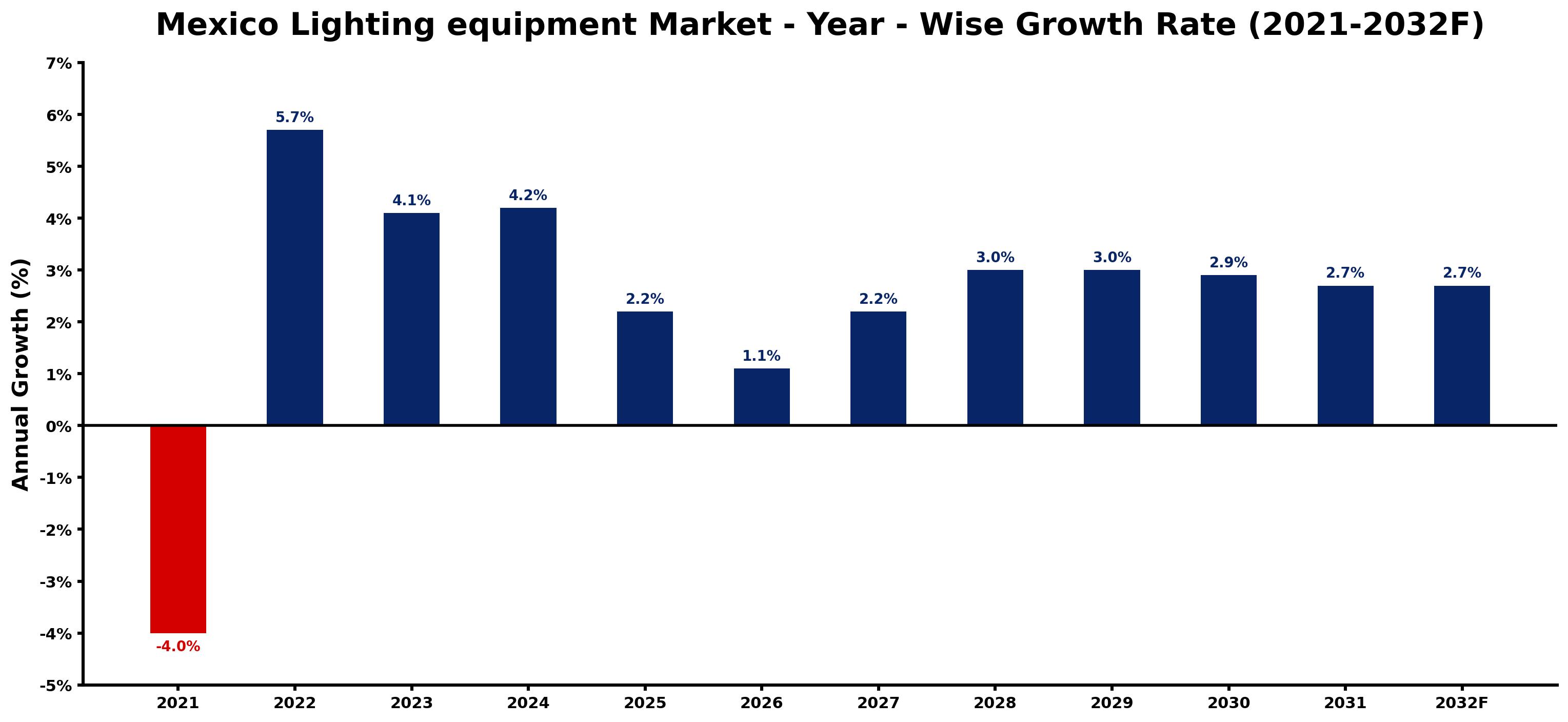
The table below presents the year wise growth rates along with the key drivers influencing the market
| Year | Growth Rate | Major Drivers |
| 2021 | -4.0% | Supply chain disruptions, exacerbated by the pandemic, hindered product availability and limited retail options for consumers. |
| 2022 | 5.7% | Retail and hospitality sectors invested heavily in upgrading lighting for enhanced customer experiences. |
| 2023 | 4.1% | Construction projects in urban areas began integrating smart lighting technologies for sustainability. |
| 2024 | 4.2% | Emerging middle-class consumers are increasingly demanding stylish and functional home lighting options. |
| 2025 | 2.2% | Local manufacturers are leveraging advanced technologies to improve production efficiency and reduce costs. |
| 2026 | 1.1% | Increased awareness of sustainable practices has led to a boom in LED lighting adoption. |
| 2027 | 2.2% | Smart home integrations are driving consumer interest in innovative lighting automation products. |
| 2028 | 3.0% | Urbanization trends are pushing demand for versatile lighting solutions in densely populated areas. |
| 2029 | 3.0% | Local governments are promoting eco-friendly lighting initiatives to enhance urban aesthetics and safety. |
| 2030 | 2.9% | Collaborations between tech firms and lighting manufacturers are yielding cutting-edge smart lighting solutions. |
| 2031 | 2.7% | Energy efficiency mandates are further encouraging investments in modern lighting technologies across sectors. |
| 2032 | 2.7% | The market sees a transformation as circular economy principles influence lighting product design. |
Note - Market size estimations and growth projections presented in this report are based on 6Wresearch's advanced forecasting approach, validated with industry datasets as of June 2026.
Mexico Lighting equipment Market Synopsis
The Mexico Lighting equipment Market is projected to reach 1.1% and witness significant growth during the forecast period (2026-2032). As advancements in energy-efficient technologies continue to reshape the landscape, the market is increasingly characterized by a shift towards sustainable lighting solutions. The ongoing urban development and extensive infrastructure projects across the country are further propelling the demand for innovative and eco-friendly lighting systems, tailored to enhance the aesthetics of both residential and commercial spaces.
Mexico Lighting equipment Market Growth Drivers
The growth of the Mexico Lighting equipment Market is influenced by several key drivers:
- Urban development initiatives are leading to an expansion in the construction of residential and commercial buildings, thereby driving demand for advanced lighting solutions that meet modern design standards.
- The rapid adoption of LED lighting technology is transforming traditional lighting practices, delivering significant improvements in energy efficiency and longevity while reducing overall operational costs.
- Regulatory measures aimed at promoting energy conservation are compelling manufacturers to innovate and introduce energy-efficient lighting products into the market.
- Consumer preferences are shifting towards aesthetically pleasing and functional lighting that not only enhances the ambiance but also adheres to sustainability principles.
- The emergence of smart lighting technologies is positioning the market for significant growth, with features that enable automation, remote control, and integration with home and building management systems.
Mexico Lighting equipment Market Challenges and Restraints
While the Mexico Lighting equipment Market exhibits promising growth prospects, various challenges need to be navigated:
- The rapid transition to LED technology entails considerable investment in upgrading manufacturing processes, which may pose a financial burden on smaller players in the market.
- Energy efficiency regulations are becoming increasingly stringent, necessitating continuous innovation to comply with evolving standards.
- Consumer education on the benefits of new technologies is critical, as market acceptance of advanced lighting solutions may lag.
- Supply chain disruptions can impact the availability and pricing of essential components, creating challenges for manufacturers aiming to meet market demands.
- Economic fluctuations and trade complexities may affect operational costs and pricing strategies, necessitating careful market analysis and agility in response.
Mexico Lighting equipment Market Government Investment and Initiatives
Government policies significantly influence the Mexico Lighting equipment Market by focusing on sustainability and energy efficiency. Strategic public spending is directed towards urban infrastructure projects, which include the installation of energy-efficient lighting systems. Initiatives aimed at promoting the adoption of LED technologies are bolstered by incentives that encourage both consumers and businesses to transition from traditional lighting solutions. Regulatory frameworks also emphasize product labeling and compliance with energy consumption standards, facilitating informed decision-making among consumers. As the government prioritizes reducing the carbon footprint, the phasing out of inefficient lighting products is anticipated to further stimulate market growth.
Mexico Lighting equipment Market Latest Developments (May 2025 - June 2026)
Recent months have witnessed notable advancements in the Mexico Lighting equipment Market. A continued push towards smart lighting solutions has seen an increase in partnerships between technology providers and manufacturers, aiming to create integrated systems that enhance user experience and efficiency. Regulatory updates have also been introduced, aimed at tightening energy consumption standards for new products entering the market. Furthermore, there is a growing emphasis on public awareness campaigns to educate consumers about the benefits of energy-efficient lighting, significantly impacting purchasing decisions. Companies are increasingly focusing on R&D to innovate their product offerings, catering to evolving consumer expectations while ensuring compliance with national standards.
Mexico Lighting equipment Market - Key Attractiveness of the Report
- 10 Years of Market Numbers
- Historical Data Starting from 2022 to 2025
- Base Year: 2025
- Forecast Data until 2032
- Key Performance Indicators Impacting the Market
- Major Upcoming Developments and Projects
Key Highlights of the Report:
- Mexico Lighting equipment Market Outlook
- Market Size of Mexico Lighting equipment Market, 2025
- Forecast of Mexico Lighting equipment Market, 2032
- Historical Data and Forecast of Mexico Lighting equipment Revenues & Volume for the Period 2022-2032F
- Mexico Lighting equipment Market Trend Evolution
- Mexico Lighting equipment Market Drivers and Challenges
- Mexico Lighting equipment Price Trends
- Mexico Lighting equipment Porter's Five Forces
- Mexico Lighting equipment Industry Life Cycle
- Historical Data and Forecast of Mexico Lighting equipment Market Revenues & Volume By ?Application for the Period 2022-2032F
- Historical Data and Forecast of Mexico Lighting equipment Market Revenues & Volume By General Purpose Lighting for the Period 2022-2032F
- Historical Data and Forecast of Mexico Lighting equipment Market Revenues & Volume By Vehicle/Automobile Lighting for the Period 2022-2032F
- Historical Data and Forecast of Mexico Lighting equipment Market Revenues & Volume By Backlighting for the Period 2022-2032F
- Historical Data and Forecast of Mexico Lighting equipment Market Revenues & Volume By Others? for the Period 2022-2032F
- Historical Data and Forecast of Mexico Lighting equipment Market Revenues & Volume By Technology for the Period 2022-2032F
- Historical Data and Forecast of Mexico Lighting equipment Market Revenues & Volume By Conventional Lighting/Non-Environment Friendly Lighting for the Period 2022-2032F
- Historical Data and Forecast of Mexico Lighting equipment Market Revenues & Volume By Environment Friendly Lighting for the Period 2022-2032F
- Historical Data and Forecast of Mexico Lighting equipment Market Revenues & Volume By SSL (Solid State Lighting) for the Period 2022-2032F
- Historical Data and Forecast of Mexico Lighting equipment Market Revenues & Volume By LED (Light Emitting Diodes) for the Period 2022-2032F
- Historical Data and Forecast of Mexico Lighting equipment Market Revenues & Volume By OLED (Organic Light Emitting Diodes) for the Period 2022-2032F
- Historical Data and Forecast of Mexico Lighting equipment Market Revenues & Volume By PLED (Polymer Light Emitting Diodes)? for the Period 2022-2032F
- Historical Data and Forecast of Mexico Lighting equipment Market Revenues & Volume By ?End Users for the Period 2022-2032F
- Historical Data and Forecast of Mexico Lighting equipment Market Revenues & Volume By Industrial for the Period 2022-2032F
- Historical Data and Forecast of Mexico Lighting equipment Market Revenues & Volume By Commercial for the Period 2022-2032F
- Historical Data and Forecast of Mexico Lighting equipment Market Revenues & Volume By Others? for the Period 2022-2032F
- Mexico Lighting equipment Import Export Trade Statistics
- Market Opportunity Assessment By ?Application
- Market Opportunity Assessment By Technology
- Market Opportunity Assessment By ?End Users
- Mexico Lighting equipment Top Companies Market Share
- Mexico Lighting equipment Competitive Benchmarking By Technical and Operational Parameters
- Mexico Lighting equipment Company Profiles
- Mexico Lighting equipment Key Strategic Recommendations






































