Mexico Natural Fragrance Market Size, Share & Growth Rate
The Mexico Natural Fragrance Market was estimated at USD 100 Million in 2025 and is projected to reach USD 116 Million by 2032, growing at a CAGR of 2.1% from 2026 to 2032. This growth trajectory is primarily driven by an increasing consumer demand for products that feature natural and organic ingredients, aligning with a broader global trend towards sustainability and wellness. As awareness of the health and environmental benefits associated with natural ingredients continues to rise, this market is poised for expansion.
Mexico Natural Fragrance Market Year-wise Growth Rate and Key Drivers
This graph highlights how the Mexico Natural Fragrance Market has steadily grown over the years, supported by major growth factors.
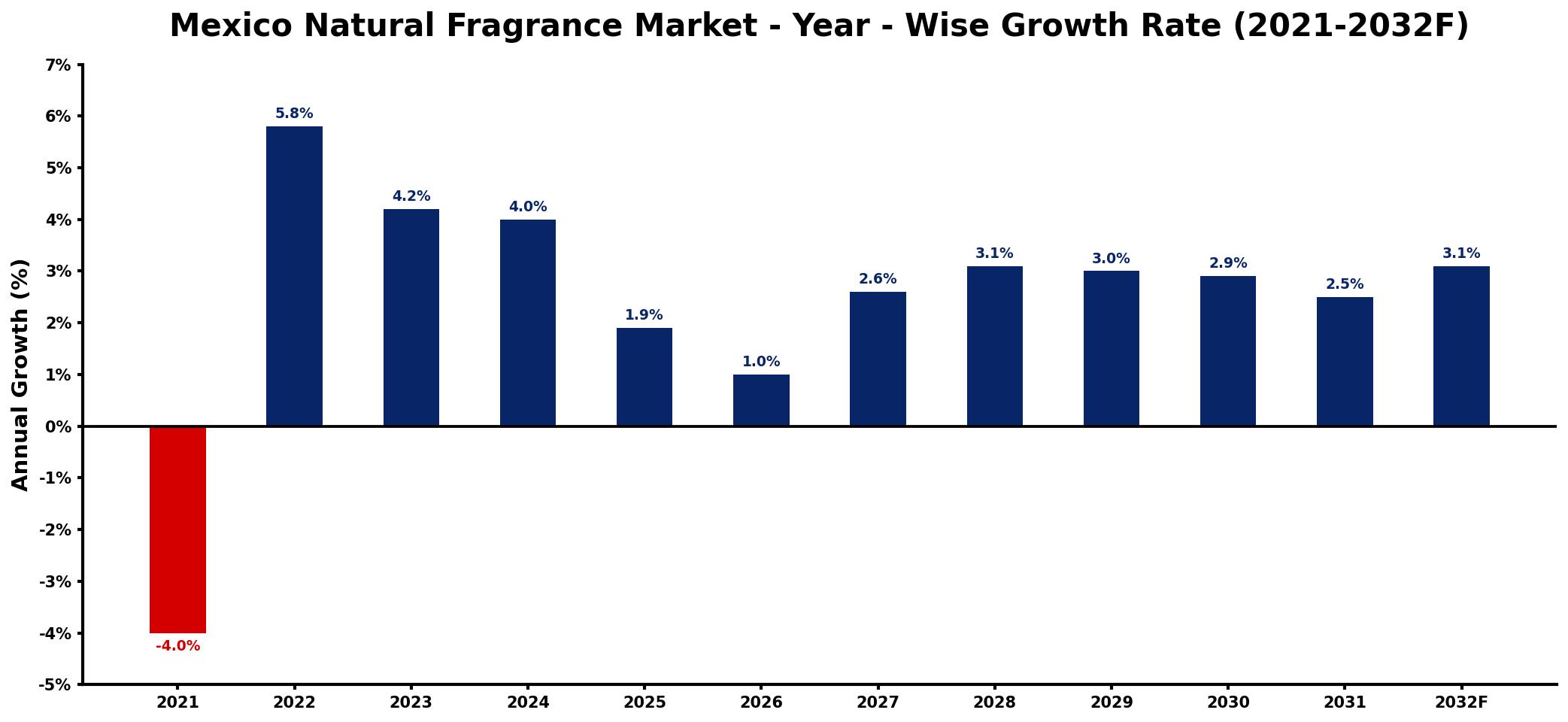
The table below presents the year‑wise growth rates along with the key drivers influencing the market
| Year | Growth Rate | Major Drivers |
| 2021 | -4.0% | decrease in consumer spending habits |
| 2022 | 5.8% | growing interest in eco-friendly options |
| 2023 | 4.2% | rising popularity of sustainable products |
| 2024 | 4.0% | increased investment in green technologies |
| 2025 | 1.9% | expansion of distribution channels online |
| 2026 | 1.0% | growing awareness of ethical sourcing |
| 2027 | 2.6% | enhanced marketing strategies for sustainability |
| 2028 | 3.1% | development of innovative product lines |
| 2029 | 3.0% | increased demand for organic ingredients |
| 2030 | 2.9% | stronger distribution network expansion |
| 2031 | 2.5% | rising consumer preference for authenticity |
| 2032 | 3.1% | expanding manufacturing base activity |
Note: Market size estimations and growth projections presented in this report are based on 6Wresearch's proprietary forecasting methodology, utilizing the latest available industry data, government publications, and primary research inputs.
Mexico Natural Fragrance Market Synopsis
Consumer preference for eco-friendly products is the strongest force shaping the Mexico Natural Fragrance Market today. The shift towards natural fragrances reflects a growing consciousness regarding personal health and the ecological footprint of products, driving demand across personal care, household, and fragrance segments.
In Mexico, natural fragrances are increasingly recognized for their therapeutic benefits, as essential oils and botanical extracts gain traction among health-conscious consumers. This rising inclination towards holistic and organic lifestyles supports a robust market environment, reflecting an essential shift in consumer values.
Mexico Natural Fragrance Market Key Takeaways
- The demand for natural fragrances is significantly influenced by increasing consumer awareness regarding health and environmental benefits.
- Growth in the personal care sector is a primary driver for the expansion of the natural fragrance market in Mexico.
- Sourcing and ensuring sustainability in supply chains are crucial for maintaining consumer trust in natural fragrances.
- Government regulations play a vital role in ensuring product safety and transparency in fragrance formulations.
- There is a notable trend towards incorporating plant-based ingredients in fragrance formulations, enhancing market appeal.
Evaluation of Restraints in Mexico Natural Fragrance Market
Despite its promising outlook, the Mexico Natural Fragrance Market faces significant restraints. One of the most pressing issues is the sourcing of high-quality natural ingredients, as supply chain complexities often lead to concerns about sustainability and traceability. Additionally, consumer expectations regarding ingredient transparency and regulatory compliance can pose challenges for manufacturers striving to meet market demands while adhering to safety standards. The pressure to continuously innovate and respond to evolving preferences also creates an environment where the slightest misstep can impact brand reputation and market share.
Mexico Natural Fragrance Market Trends
Several trends are currently shaping the Mexico Natural Fragrance Market. Notably, there is a growing inclination towards products that incorporate botanicals known for their aromatic and therapeutic properties, aligning with holistic health trends. Additionally, the rise of clean beauty movements is pushing brands to invest in transparent sourcing and eco-friendly packaging, appealing to conscientious consumers. Technological advancements in extraction methods are also enabling companies to develop more diverse and unique fragrance profiles, further fueling market interest.
Mexico Natural Fragrance Market Opportunities
Opportunities for growth in the Mexico Natural Fragrance Market lie in the expanding personal care and home fragrance segments. Brands that focus on the development of innovative products featuring unique botanical blends are likely to capture the interest of discerning consumers. Moreover, as e-commerce continues to rise, leveraging online platforms for marketing and sales can broaden reach and enhance consumer engagement. Collaborative ventures with local farmers and suppliers can also promote sustainability while fostering community ties.
Government Initiatives in the Mexico Natural Fragrance Market
The Mexican government has implemented several policies aimed at enhancing consumer safety and promoting sustainable practices within the natural fragrance market. Regulations focusing on product labeling and marketing claims are designed to ensure transparency and accuracy, which in turn fosters consumer trust. Furthermore, various programs encourage research and development in natural ingredients, incentivizing companies to pursue innovative and eco-friendly formulations that align with national health and safety standards.
Future Insights of the Mexico Natural Fragrance Market
Looking forward to the period of 2026-2032, the Mexico Natural Fragrance Market is expected to continue its upward trajectory, driven by a sustained interest in wellness-oriented and environmentally friendly products. As more consumers prioritize natural and organic options, brands that successfully align their product offerings with these values will likely prosper. The enhancement of supply chain practices focusing on sustainability and traceability will further support this growth, ensuring that the market not only expands but does so ethically.
Mexico Natural Fragrance Market Latest Developments (2025 - 2026)
Recent developments in the Mexico Natural Fragrance Market reflect a dynamic shift towards innovation and sustainability. Brands are increasingly investing in research to enhance the efficacy of natural extracts, with a focus on improving scent longevity and appeal. Additionally, collaborations with local artisans and farmers are becoming more common, fostering community engagement and enhancing the authenticity of product offerings. As regulatory frameworks evolve, companies are adapting to meet new safety standards, which are essential for maintaining consumer trust.
Mexico Natural Fragrance Market - Key Attractiveness of the Report
- 10 Years of Market Numbers
- Historical Data Starting from 2022 to 2025
- Base Year: 2025
- Forecast Data until 2032
- Key Performance Indicators Impacting the Market
- Major Upcoming Developments and Projects
Key Highlights of the Report:
- Mexico Natural Fragrance Market Outlook
- Market Size of Mexico Natural Fragrance Market, 2025
- Forecast of Mexico Natural Fragrance Market, 2032
- Historical Data and Forecast of Mexico Natural Fragrance Revenues & Volume for the Period 2022-2032F
- Mexico Natural Fragrance Market Trend Evolution
- Mexico Natural Fragrance Market Drivers and Challenges
- Mexico Natural Fragrance Price Trends
- Mexico Natural Fragrance Porter's Five Forces
- Mexico Natural Fragrance Industry Life Cycle
- Historical Data and Forecast of Mexico Natural Fragrance Market Revenues & Volume By Ingredient for the Period 2022-2032F
- Historical Data and Forecast of Mexico Natural Fragrance Market Revenues & Volume By Essential Oils for the Period 2022-2032F
- Historical Data and Forecast of Mexico Natural Fragrance Market Revenues & Volume By Natural Extracts for the Period 2022-2032F
- Historical Data and Forecast of Mexico Natural Fragrance Market Revenues & Volume By Type for the Period 2022-2032F
- Historical Data and Forecast of Mexico Natural Fragrance Market Revenues & Volume By Top note for the Period 2022-2032F
- Historical Data and Forecast of Mexico Natural Fragrance Market Revenues & Volume By Middle Note for the Period 2022-2032F
- Historical Data and Forecast of Mexico Natural Fragrance Market Revenues & Volume By Base Note for the Period 2022-2032F
- Historical Data and Forecast of Mexico Natural Fragrance Market Revenues & Volume By Application for the Period 2022-2032F
- Historical Data and Forecast of Mexico Natural Fragrance Market Revenues & Volume By Fine Fragrances for the Period 2022-2032F
- Historical Data and Forecast of Mexico Natural Fragrance Market Revenues & Volume By Personal Care & Cosmetics for the Period 2022-2032F
- Historical Data and Forecast of Mexico Natural Fragrance Market Revenues & Volume By Household Care for the Period 2022-2032F
- Mexico Natural Fragrance Import Export Trade Statistics
- Market Opportunity Assessment By Ingredient
- Market Opportunity Assessment By Type
- Market Opportunity Assessment By Application
- Mexico Natural Fragrance Top Companies Market Share
- Mexico Natural Fragrance Competitive Benchmarking By Technical and Operational Parameters
- Mexico Natural Fragrance Company Profiles
- Mexico Natural Fragrance Key Strategic Recommendations






































