Mexico Optical Mirror Market Size, Share & Growth Rate
The Mexico Optical Mirror Market was estimated at USD 222 Million in 2025 and is projected to reach USD 257 Million by 2032, growing at a CAGR of 2.1% from 2026 to 2032. This steady growth trajectory is fueled by technological advancements in mirror coatings and materials, particularly in sectors like automotive and aerospace. As these industries demand higher-quality optical components, the market is adapting to meet these evolving requirements, thereby enhancing its overall potential.
Mexico Optical Mirror Market Year-wise Growth Rate and Key Drivers
This graph highlights how the Mexico Optical Mirror Market has steadily grown over the years, supported by major growth factors.
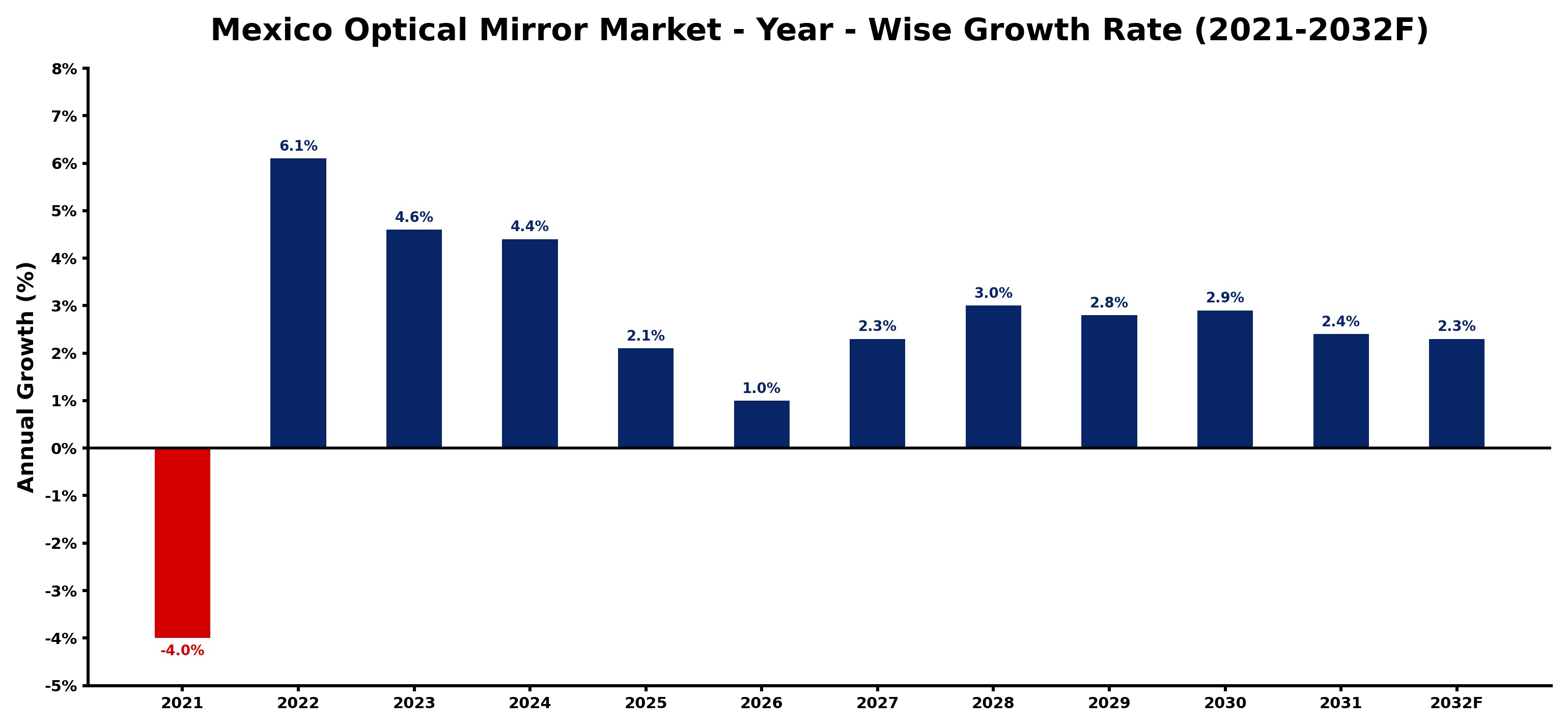
The table below presents the year‑wise growth rates along with the key drivers influencing the market
| Year | Growth Rate | Major Drivers |
| 2021 | -4.0% | Increasing industrial infrastructure investments |
| 2022 | 6.1% | Expansion of manufacturing activities |
| 2023 | 4.6% | Rapid growth in telecom and data center sectors |
| 2024 | 4.4% | Increasing industrial infrastructure investments |
| 2025 | 2.1% | Expansion of transportation and logistics networks |
| 2026 | 1.0% | Increasing industrial automation investments |
| 2027 | 2.3% | Expansion of manufacturing activities |
| 2028 | 3.0% | Rising electricity demand across industries |
| 2029 | 2.8% | Increasing adoption of advanced technologies |
| 2030 | 2.9% | Increasing smart city development projects |
| 2031 | 2.4% | Expansion of manufacturing activities |
| 2032 | 2.3% | Increasing industrial automation investments |
Note - Market size estimations and growth projections presented in this report are based on 6Wresearch's advanced forecasting approach, validated with industry datasets as of June 2026.
Mexico Optical Mirror Market Synopsis
The most significant force shaping the Mexico Optical Mirror Market right now is the booming demand for high-performance optical mirrors driven by the healthcare and aerospace sectors. These industries increasingly rely on precision optics, leading to innovations that enhance both the functionality and efficiency of optical mirrors.
Alongside growing industrial applications, the evolution of mirror coating technologies continues to redefine quality standards in the market. This is resulting in better performance across various platforms, from telescopes to advanced imaging systems in consumer electronics, further propelling the market's expansion.
Mexico Optical Mirror Market Key Takeaways
- The market is expected to grow steadily, reflecting advancements in optical technology.
- Healthcare and aerospace industries are the primary growth drivers for optical mirrors.
- Innovations in mirror coatings are enhancing product performance and market competitiveness.
- Government policies support research and development in optical mirror manufacturing.
- Challenges persist in maintaining quality and precision amid rising demand.
Evaluation of Restraints in Mexico Optical Mirror Market
The Mexico Optical Mirror Market faces notable restraints primarily stemming from the challenge of maintaining high precision and quality while responding to the demands for rapid innovation. Sourcing materials that meet stringent specifications can be problematic, often leading to increased costs. As industries such as automotive and aerospace raise their standards for reflectivity and durability, manufacturers must navigate a landscape where cost management and technical performance are increasingly at odds. This dichotomy represents a complex challenge as companies strive to remain competitive without sacrificing quality.
Mexico Optical Mirror Market Trends
A prominent trend in the Mexico Optical Mirror Market is the ongoing advancement in coating technologies that significantly improve mirror performance. As the demand for lightweight and durable mirrors rises, companies are investing heavily in novel materials and processing methods. This trend not only enhances the optical quality but also reduces production costs, making high-performance mirrors more accessible across various applications.
Moreover, the integration of smart technologies into optical mirrors is gaining traction, especially in consumer electronics and automotive applications. Mirrors equipped with sensors and digital interfaces are transforming user interactions and expanding the functionality of traditional optical systems.
Mexico Optical Mirror Market Opportunities
Significant growth and investment opportunities in the Mexico Optical Mirror Market can be found in sectors such as healthcare and automotive technology. The increasing need for precision imaging and diagnostic tools in healthcare sets the stage for optical mirrors that cater to high-end applications. Furthermore, the automotive sector's shift towards smart vehicles opens avenues for innovative optical solutions, aligning well with evolving consumer preferences for advanced technology. Additionally, supporting collaborations between academic institutions and industry players promise to further amplify research and development efforts, creating a fertile ground for new entrants and existing players alike.
Government Initiatives in the Mexico Optical Mirror Market
The Mexican government is actively promoting the growth of the optics and photonics industry through various initiatives aimed at fostering innovation in the optical mirror market. Investment in research and development is a key focus, encouraging collaboration between academia and industry to advance manufacturing technologies. Furthermore, efforts to formulate policies that ensure quality and precision standards for optical mirrors aim to enhance their competitiveness in both domestic and international markets, reflecting a strong commitment to advancing this vital industry sector.
Future Insights of the Mexico Optical Mirror Market
Looking ahead to 2026-2032, the Mexico Optical Mirror Market is poised for gradual but steady growth driven by increasing applications in emerging technologies. The demand for high-quality optical mirrors is likely to rise, supported by ongoing innovations in materials and coatings. Industries such as aerospace and healthcare will continue to evolve, pushing the boundaries of what optical mirrors can achieve. As manufacturers adapt to these trends, the landscape will transform, paving the way for enhanced performance standards and broader applications.
Mexico Optical Mirror Market Latest Developments (May 2025 - June 2026)
In recent months, the optical mirror sector has witnessed significant shifts towards sustainability and efficiency in manufacturing processes. Companies are exploring eco-friendly materials and production methods, reflecting a broader industry trend towards reducing environmental impact. Additionally, strategic collaborations aimed at enhancing research capabilities are being established between universities and industry stakeholders. This cooperation promises to accelerate innovation, particularly in advanced coatings and optical designs, setting the stage for a more competitive and responsive market.
Mexico Optical Mirror Market - Key Attractiveness of the Report
- 10 Years of Market Numbers
- Historical Data Starting from 2022 to 2025
- Base Year: 2025
- Forecast Data until 2032
- Key Performance Indicators Impacting the Market
- Major Upcoming Developments and Projects
Key Highlights of the Report:
- Mexico Optical Mirror Market Outlook
- Market Size of Mexico Optical Mirror Market, 2025
- Forecast of Mexico Optical Mirror Market, 2032
- Historical Data and Forecast of Mexico Optical Mirror Revenues & Volume for the Period 2022-2032F
- Mexico Optical Mirror Market Trend Evolution
- Mexico Optical Mirror Market Drivers and Challenges
- Mexico Optical Mirror Price Trends
- Mexico Optical Mirror Porter's Five Forces
- Mexico Optical Mirror Industry Life Cycle
- Historical Data and Forecast of Mexico Optical Mirror Market Revenues & Volume By Product Type for the Period 2022-2032F
- Historical Data and Forecast of Mexico Optical Mirror Market Revenues & Volume By Aspheric Type for the Period 2022-2032F
- Historical Data and Forecast of Mexico Optical Mirror Market Revenues & Volume By Spherical Type for the Period 2022-2032F
- Historical Data and Forecast of Mexico Optical Mirror Market Revenues & Volume By Flat Type for the Period 2022-2032F
- Historical Data and Forecast of Mexico Optical Mirror Market Revenues & Volume By Application for the Period 2022-2032F
- Historical Data and Forecast of Mexico Optical Mirror Market Revenues & Volume By Solar for the Period 2022-2032F
- Historical Data and Forecast of Mexico Optical Mirror Market Revenues & Volume By Semiconductor for the Period 2022-2032F
- Historical Data and Forecast of Mexico Optical Mirror Market Revenues & Volume By Astronomy for the Period 2022-2032F
- Historical Data and Forecast of Mexico Optical Mirror Market Revenues & Volume By Others for the Period 2022-2032F
- Mexico Optical Mirror Import Export Trade Statistics
- Market Opportunity Assessment By Product Type
- Market Opportunity Assessment By Application
- Mexico Optical Mirror Top Companies Market Share
- Mexico Optical Mirror Competitive Benchmarking By Technical and Operational Parameters
- Mexico Optical Mirror Company Profiles
- Mexico Optical Mirror Key Strategic Recommendations






































