Mexico Petroleum Refining Products Market Summary
The mexico petroleum refining products market was estimated at USD 242 Million in 2025 and is projected to reach USD 281 Million by 2032, growing at a CAGR of 1.3% from 2026 to 2032.
Mexico Petroleum Refining Products Market Year-wise Growth Rate and Key Drivers
This graph highlights how the Mexico Petroleum Refining Products Market has steadily grown over the past five years, supported by major growth factors.
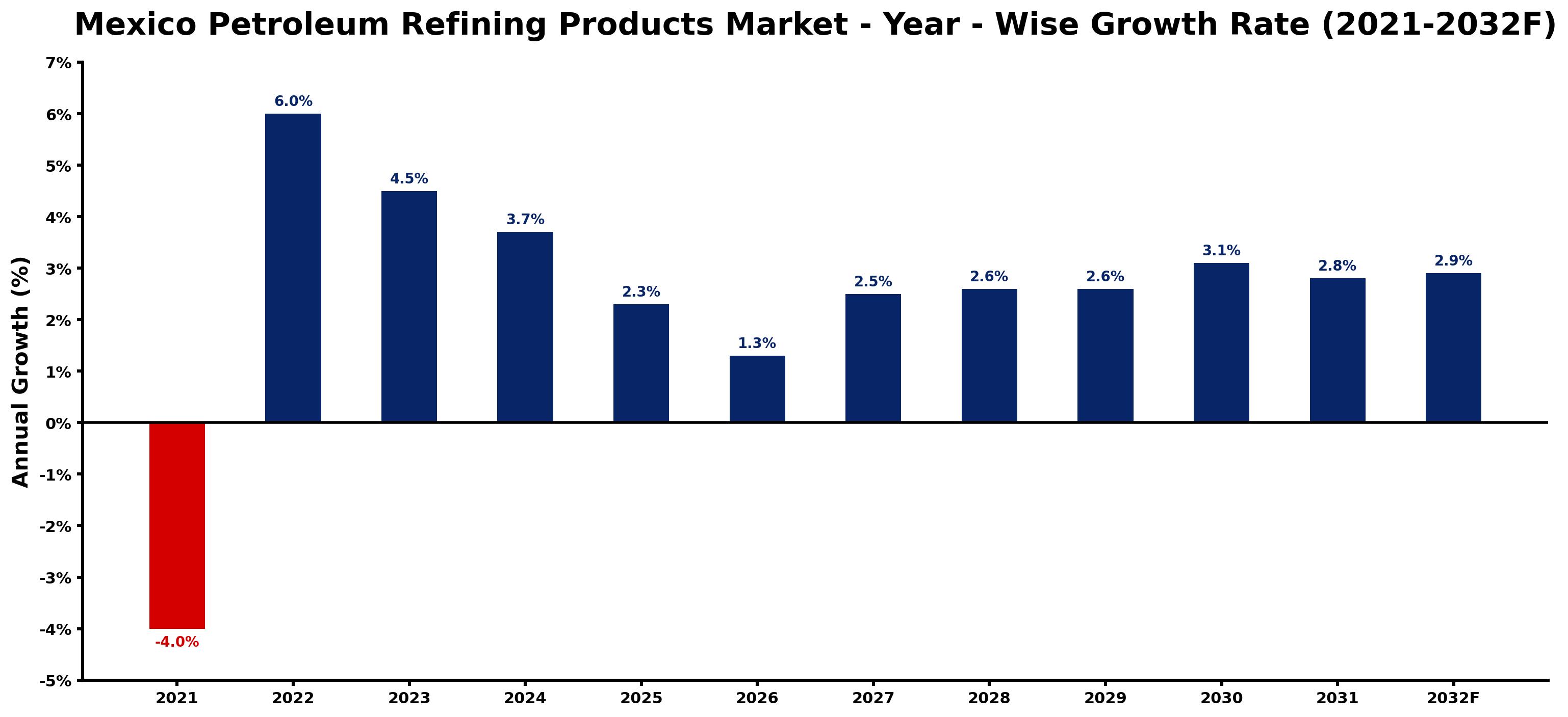
The table below presents the year wise growth rates along with the key drivers influencing the market
| Year | Growth Rate | Major Drivers |
| 2021 | -4.0% | Decreased demand for petroleum products due to a shift towards electric vehicles hampered market growth. |
| 2022 | 6.0% | Local demand for gasoline surged, influenced by a rebound in automotive sales. |
| 2023 | 4.5% | Infrastructure projects expanded, creating a higher need for refined petroleum products. |
| 2024 | 3.7% | Investment in renewable energy sources inspired traditional refineries to innovate. |
| 2025 | 2.3% | Corporate mergers in the industry streamlined operations and enhanced production efficiencies. |
| 2026 | 1.3% | Increased global oil prices led to higher margins for local refiners. |
| 2027 | 2.5% | Technological advancements in refining processes improved output quality significantly. |
| 2028 | 2.6% | Emerging markets within Mexico showed an uptrend in consumer energy consumption. |
| 2029 | 2.6% | Shift towards cleaner fuels compelled refineries to adapt their product lines. |
| 2030 | 3.1% | Partnerships with international firms introduced advanced refining technologies locally. |
| 2031 | 2.8% | Environmental awareness spurred investments in sustainable refining practices and infrastructure. |
| 2032 | 2.9% | A stable political climate fostered enhanced foreign direct investments in refinery sectors. |
Note - Market size estimations and growth projections presented in this report are based on 6Wresearch's advanced forecasting approach, validated with industry datasets as of June 2026.
Mexico Petroleum Refining Products Market Synopsis
The Mexico Petroleum Refining Products Market is projected to reach 1.3% and witness significant growth during the forecast period (2026-2032). This market serves as a vital segment of the country's energy landscape, catering to both domestic consumption and international export demands. The ongoing evolution within the sector is driven by various factors including legislative agendas aimed at environmental compliance, technological advancements, and the fluctuating dynamics of global oil pricing.
Mexico Petroleum Refining Products Market Growth Drivers
Several key factors are propelling the Mexico petroleum refining products market forward. These drivers are crucial in ensuring the sector remains aligned with both national and global energy trends.
- The increasing domestic energy demands, as the population and industrial activities expand, necessitate an efficient and robust refining infrastructure.
- Environmental regulations are pushing for cleaner refining technologies, prompting investments into advanced methodologies that enhance energy efficiency.
- The volatility of global oil prices necessitates that the Mexican refining industry remain competitive and adaptive to shifts in raw material costs.
- Technological advancements not only contribute to efficiency but also reduce operational costs, making Mexican petroleum products more attractive on the global market.
- Government incentives aimed at modernizing refineries and promoting cleaner technologies have catalyzed growth, encouraging investment in the sector.
Mexico Petroleum Refining Products Market Challenges and Restraints
While the market offers various growth opportunities, several challenges complicate its landscape. Addressing these issues is critical for the sustainability of Mexico's petroleum refining sector.
- The transition from traditional hydrocarbon-based products to renewable energy sources poses a significant challenge, as the industry grapples with balancing its current outputs with evolving energy paradigms.
- Environmental concerns are escalating, necessitating swift compliance with stricter regulations that can require substantial investment and operational adjustments.
- Infrastructure limitations can hinder the efficiency of refining operations, impacting the overall competitiveness of Mexico's refined products.
- Global trends towards decarbonization could potentially redirect investment away from fossil fuel refining, making it imperative for the sector to innovate and adapt.
- Adapting to changing consumer preferences for sustainable energy options requires a fundamentally transformed approach to refining and product development.
Mexico Petroleum Refining Products Market Government Investment and Initiatives
The Mexican government plays a pivotal role in shaping the petroleum refining products market through various investment initiatives and policies. These efforts reflect the commitment to modernizing the energy industry and promoting sustainability.
- Substantial public spending is being directed towards upgrading existing refinery infrastructure, enhancing operational efficiency, and reducing environmental impact.
- Government policies encourage the adoption of cleaner technologies, which align with national goals to mitigate greenhouse gas emissions and promote renewable energy.
- Incentives are provided for research and development in sustainable refining technologies, aimed at fostering innovation in biofuels and other cleaner alternatives.
- Collaborative efforts with international partners to share best practices and technology in refining processes are being actively pursued to modernize the sector.
- Regulatory frameworks are being adapted to support the diversification of the energy sector, with a focus on reducing dependence on fossil fuels and enhancing energy security.
Mexico Petroleum Refining Products Market Latest Developments (May 2025 - June 2026)
Recent developments in the Mexico petroleum refining products market from May 2025 to June 2026 indicate a pronounced shift towards sustainability and modernization. The focus has been on integrating advanced refining technologies that align with environmental policies and economic viability.
- Progress has been made in adopting cleaner refining processes, with several refineries implementing new technologies to reduce emissions and improve efficiency.
- Discussions surrounding regulatory reforms are underway, aiming to enhance the operational capabilities of refineries while maintaining compliance with environmental standards.
- Investment in alternative energy sources such as biofuels is gaining momentum, reflecting a national strategy to diversify the energy mix and reduce carbon footprints.
- Government collaborations with private sectors have resulted in initiatives that prioritize sustainability and innovation in refining practices.
- The financial landscape for investors in the refining sector is gradually improving as governmental support and international interest enhance the market's attractiveness.
Mexico Petroleum Refining Products Market - Key Attractiveness of the Report
- 10 Years of Market Numbers
- Historical Data Starting from 2022 to 2025
- Base Year: 2025
- Forecast Data until 2032
- Key Performance Indicators Impacting the Market
- Major Upcoming Developments and Projects
Key Highlights of the Report:
- Mexico Petroleum Refining Products Market Outlook
- Market Size of Mexico Petroleum Refining Products Market, 2025
- Forecast of Mexico Petroleum Refining Products Market, 2032
- Historical Data and Forecast of Mexico Petroleum Refining Products Revenues & Volume for the Period 2022-2032F
- Mexico Petroleum Refining Products Market Trend Evolution
- Mexico Petroleum Refining Products Market Drivers and Challenges
- Mexico Petroleum Refining Products Price Trends
- Mexico Petroleum Refining Products Porter's Five Forces
- Mexico Petroleum Refining Products Industry Life Cycle
- Historical Data and Forecast of Mexico Petroleum Refining Products Market Revenues & Volume By Type for the Period 2022-2032F
- Historical Data and Forecast of Mexico Petroleum Refining Products Market Revenues & Volume By Ethane & LPG for the Period 2022-2032F
- Historical Data and Forecast of Mexico Petroleum Refining Products Market Revenues & Volume By Gasoline for the Period 2022-2032F
- Historical Data and Forecast of Mexico Petroleum Refining Products Market Revenues & Volume By Diesel/Gasoil for the Period 2022-2032F
- Historical Data and Forecast of Mexico Petroleum Refining Products Market Revenues & Volume By Jet/Kerosene for the Period 2022-2032F
- Historical Data and Forecast of Mexico Petroleum Refining Products Market Revenues & Volume By Naphtha for the Period 2022-2032F
- Historical Data and Forecast of Mexico Petroleum Refining Products Market Revenues & Volume By Fuel Oil for the Period 2022-2032F
- Historical Data and Forecast of Mexico Petroleum Refining Products Market Revenues & Volume By Others for the Period 2022-2032F
- Historical Data and Forecast of Mexico Petroleum Refining Products Market Revenues & Volume By End-users for the Period 2022-2032F
- Historical Data and Forecast of Mexico Petroleum Refining Products Market Revenues & Volume By Transportation for the Period 2022-2032F
- Historical Data and Forecast of Mexico Petroleum Refining Products Market Revenues & Volume By Others for the Period 2022-2032F
- Mexico Petroleum Refining Products Import Export Trade Statistics
- Market Opportunity Assessment By Type
- Market Opportunity Assessment By End-users
- Mexico Petroleum Refining Products Top Companies Market Share
- Mexico Petroleum Refining Products Competitive Benchmarking By Technical and Operational Parameters
- Mexico Petroleum Refining Products Company Profiles
- Mexico Petroleum Refining Products Key Strategic Recommendations






































