Mexico Rocking Chairs Market Size, Share & Growth Rate
The Mexico Rocking Chairs Market was estimated at USD 154 Million in 2025 and is projected to reach USD 206 Million by 2032, growing at a CAGR of 4.2% from 2026 to 2032. This growth is primarily driven by the increasing consumer demand for comfortable yet stylish furniture options, which reflects broader trends in home décor preferences. Additionally, the revival of interest in traditional craftsmanship, particularly among younger consumers, is enhancing the market's dynamism as they seek unique, artisanal pieces that resonate with their personal aesthetics.
Mexico Rocking Chairs Market Year-wise Growth Rate and Key Drivers
This graph highlights how the Mexico Rocking Chairs Market has steadily grown over the years, supported by major growth factors.
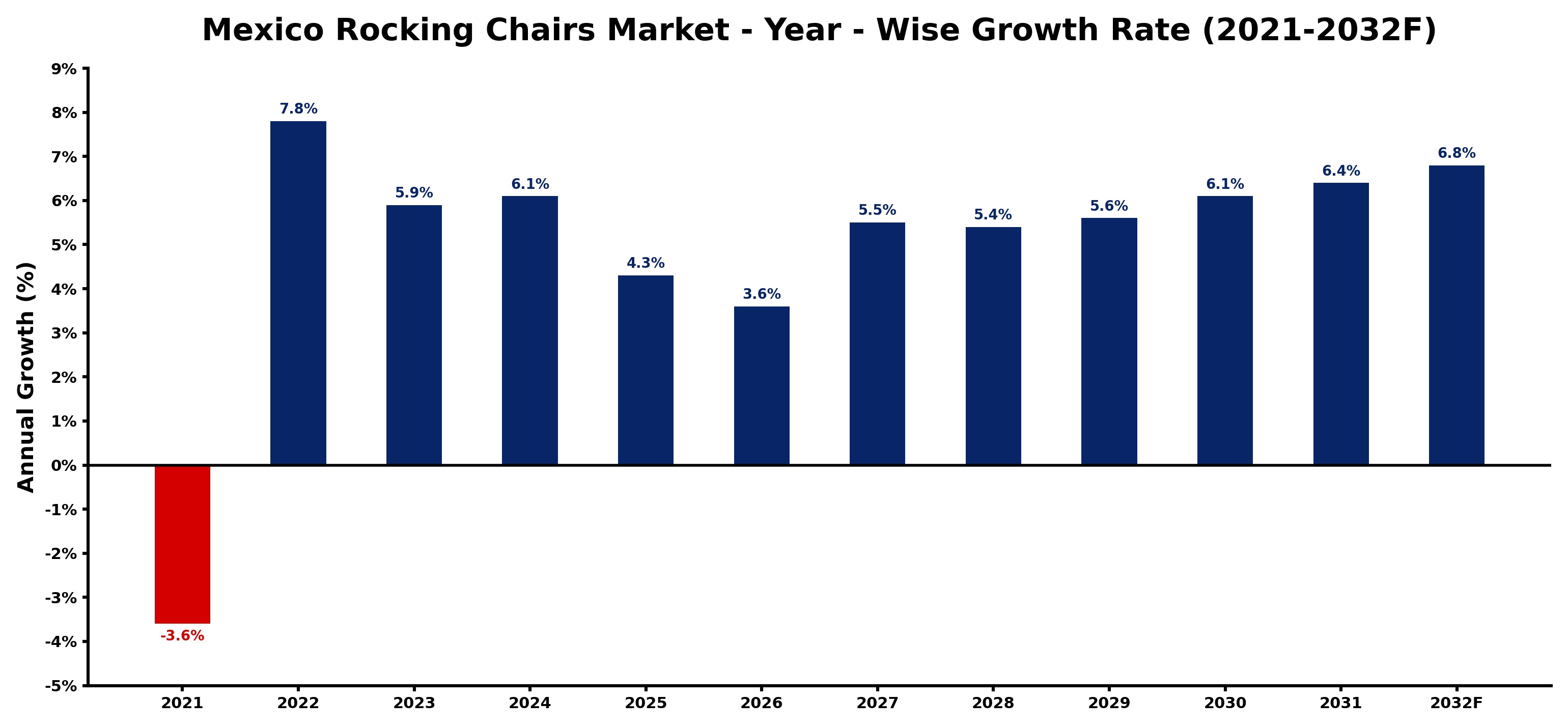
The table below presents the year‑wise growth rates along with the key drivers influencing the market
| Year | Growth Rate | Major Drivers |
| 2021 | -3.6% | Weak domestic demand hindered investments in rocking chair manufacturing |
| 2022 | 7.8% | Strengthened CNC machining adoption enhanced rocking chair production efficiency |
| 2023 | 5.9% | New OEM contracts boost production rates in rocking chair manufacturing |
| 2024 | 6.1% | Machinery upgrades boost efficiency in rocking chair production lines |
| 2025 | 4.3% | OEM investments in ergonomic design boost rocking chair production capacity |
| 2026 | 3.6% | OEM partnerships drive export oriented rocking chair production efficiencies |
| 2027 | 5.5% | OEM investment in precision machining boosted rocking chair production efficiency |
| 2028 | 5.4% | OEM investments in furniture manufacturing upgraded wood processing capabilities |
| 2029 | 5.6% | OEM facility upgrades optimized rocking chair production capacity utilization |
| 2030 | 6.1% | Increased demand for exports drives wood component manufacturing growth |
| 2031 | 6.4% | Technology integration in woodworking enhanced efficiency in rocking chair production |
| 2032 | 6.8% | Automotive assembly resurgence drives demand for quality wood materials |
Note - Market size estimations and growth projections presented in this report are based on 6Wresearch's advanced forecasting approach, validated with industry datasets as of June 2026.
Mexico Rocking Chairs Market Synopsis
In Mexico, rocking chairs are increasingly regarded as more than mere furniture; they symbolize relaxation, nostalgia, and familial connections. This cultural significance has led to a rise in the demand for rocking chairs that combine functionality with artistic design, positioning them as essential elements in modern living spaces.
Local artisans have capitalized on this trend by offering a wide array of styles, merging traditional techniques with contemporary design elements. This has resulted in a diverse market that caters to various consumer preferences, ensuring that there is something for everyone.
Mexico Rocking Chairs Market Key Takeaways
- Growing consumer interest in ergonomic and stylish furniture is driving market expansion.
- Artisanal craftsmanship combined with modern aesthetics is a hallmark of the current product offerings.
- Increasing demand for sustainable materials is influencing manufacturing practices.
- Cultural significance of rocking chairs enhances their desirability in Mexican households.
- Competitive pricing and innovative design strategies are essential for success in the market.
Evaluation of Restraints in Mexico Rocking Chairs Market
Despite the burgeoning interest in rocking chairs, the market faces significant challenges. Chief among them is the stiff competition from alternative seating options, which are often perceived as more versatile or modern. Additionally, fluctuations in raw material costs pose a risk to manufacturers, potentially leading to increased prices that could deter consumers. The market also has to navigate regulatory frameworks governing safety standards, which can add complexity to the production process. These constraints necessitate strategic thinking and innovation from stakeholders aiming to thrive in this evolving landscape.
Mexico Rocking Chairs Market Trends
Current trends indicate a marked preference for sustainable and locally sourced materials among consumers, reflecting a broader global shift toward eco-consciousness. Designs that integrate ergonomic features are becoming increasingly popular, as consumers prioritize both comfort and health. Moreover, there is a notable rise in the customization of rocking chairs, allowing consumers to tailor products to their specific tastes and needs, thus enhancing the personal connection to these pieces.
Mexico Rocking Chairs Market Opportunities
The growth trajectory of the Mexico Rocking Chairs Market presents numerous opportunities for stakeholders. Innovations in design and materials offer avenues for product differentiation. Additionally, expanding distribution channels, including online marketplaces, provide access to a broader audience. There's potential for collaboration with interior designers and home furnishing stores to create exclusive collections that appeal to discerning consumers looking for unique pieces. Lastly, targeting the healthcare sector to promote ergonomic rocking chairs as therapeutic furniture could open new revenue streams.
Government Initiatives in the Mexico Rocking Chairs Market
Government policies are increasingly focused on ensuring the quality and safety of consumer products, including rocking chairs. This involves establishing standards for materials and construction practices to enhance consumer protection. Initiatives that promote local craftsmanship and sustainable manufacturing practices are also being prioritized, reflecting a commitment to boost the local economy while supporting eco-friendly efforts. The government may also explore funding programs to encourage innovation in design and production, thereby fostering a more robust market environment.
Future Insights of the Mexico Rocking Chairs Market
Looking ahead to 2026-2032, the Mexico Rocking Chairs Market is poised for sustained growth driven by evolving consumer preferences. As the market embraces modernity while respecting traditional craftsmanship, expect to see an influx of innovative designs that prioritize both aesthetics and function. The growing popularity of remote work is likely to increase the demand for home office setups, where comfortable seating options like rocking chairs can play a vital role in creating a serene work environment. Overall, as consumers continue to invest in their living spaces, the rocking chair will solidify its place as a beloved staple in Mexican homes.
Mexico Rocking Chairs Market Latest Developments (May 2025 - June 2026)
Recent developments in the Mexico Rocking Chairs Market indicate a surge in collaborations between artisans and designers to create limited-edition collections that blend traditional styles with modern functionality. This trend is being met with positive consumer response, highlighting a demand for unique and handcrafted pieces. Additionally, there has been an increase in online sales platforms, making rocking chairs more accessible to a broader audience, including younger consumers who prioritize style and comfort. Furthermore, innovations in sustainable materials are becoming a focal point, as manufacturers seek to align with environmentally conscious consumer preferences.
Mexico Rocking Chairs Market - Key Attractiveness of the Report
- 10 Years of Market Numbers
- Historical Data Starting from 2022 to 2025
- Base Year: 2025
- Forecast Data until 2032
- Key Performance Indicators Impacting the Market
- Major Upcoming Developments and Projects
Key Highlights of the Report:
- Mexico Rocking Chairs Market Outlook
- Market Size of Mexico Rocking Chairs Market, 2025
- Forecast of Mexico Rocking Chairs Market, 2032
- Historical Data and Forecast of Mexico Rocking Chairs Revenues & Volume for the Period 2022-2032F
- Mexico Rocking Chairs Market Trend Evolution
- Mexico Rocking Chairs Market Drivers and Challenges
- Mexico Rocking Chairs Price Trends
- Mexico Rocking Chairs Porter's Five Forces
- Mexico Rocking Chairs Industry Life Cycle
- Historical Data and Forecast of Mexico Rocking Chairs Market Revenues & Volume By Types for the Period 2022-2032F
- Historical Data and Forecast of Mexico Rocking Chairs Market Revenues & Volume By Metal for the Period 2022-2032F
- Historical Data and Forecast of Mexico Rocking Chairs Market Revenues & Volume By Fabric for the Period 2022-2032F
- Historical Data and Forecast of Mexico Rocking Chairs Market Revenues & Volume By Leather for the Period 2022-2032F
- Historical Data and Forecast of Mexico Rocking Chairs Market Revenues & Volume By Plastic for the Period 2022-2032F
- Historical Data and Forecast of Mexico Rocking Chairs Market Revenues & Volume By Others for the Period 2022-2032F
- Historical Data and Forecast of Mexico Rocking Chairs Market Revenues & Volume By Application for the Period 2022-2032F
- Historical Data and Forecast of Mexico Rocking Chairs Market Revenues & Volume By Department Stores for the Period 2022-2032F
- Historical Data and Forecast of Mexico Rocking Chairs Market Revenues & Volume By Grocery Stores and Supermarkets for the Period 2022-2032F
- Historical Data and Forecast of Mexico Rocking Chairs Market Revenues & Volume By Warehouse Retailers for the Period 2022-2032F
- Historical Data and Forecast of Mexico Rocking Chairs Market Revenues & Volume By Convenience Retailer for the Period 2022-2032F
- Historical Data and Forecast of Mexico Rocking Chairs Market Revenues & Volume By Discount Retailer for the Period 2022-2032F
- Historical Data and Forecast of Mexico Rocking Chairs Market Revenues & Volume By Others for the Period 2022-2032F
- Mexico Rocking Chairs Import Export Trade Statistics
- Market Opportunity Assessment By Types
- Market Opportunity Assessment By Application
- Mexico Rocking Chairs Top Companies Market Share
- Mexico Rocking Chairs Competitive Benchmarking By Technical and Operational Parameters
- Mexico Rocking Chairs Company Profiles
- Mexico Rocking Chairs Key Strategic Recommendations






































