Morocco Aircraft Cabin Interior Market Size, Share & Growth Rate
The Morocco Aircraft Cabin Interior Market was estimated at USD 1395 Million in 2025 and is projected to reach USD 2623 Million by 2032, growing at a CAGR of 9.4% from 2026 to 2032. This trajectory is primarily driven by the burgeoning demand for new aircraft deliveries to accommodate Morocco's thriving tourism sector, alongside the retrofitting of older aircraft to enhance passenger comfort and aesthetics. Additionally, airlines are increasingly adopting advanced technologies that focus on lightweight materials and sustainability, contributing significantly to the market's expansion.
Morocco Aircraft Cabin Interior Market Year-wise Growth Rate and Key Drivers
This graph highlights how the Morocco Aircraft Cabin Interior Market has steadily grown over the years, supported by major growth factors.
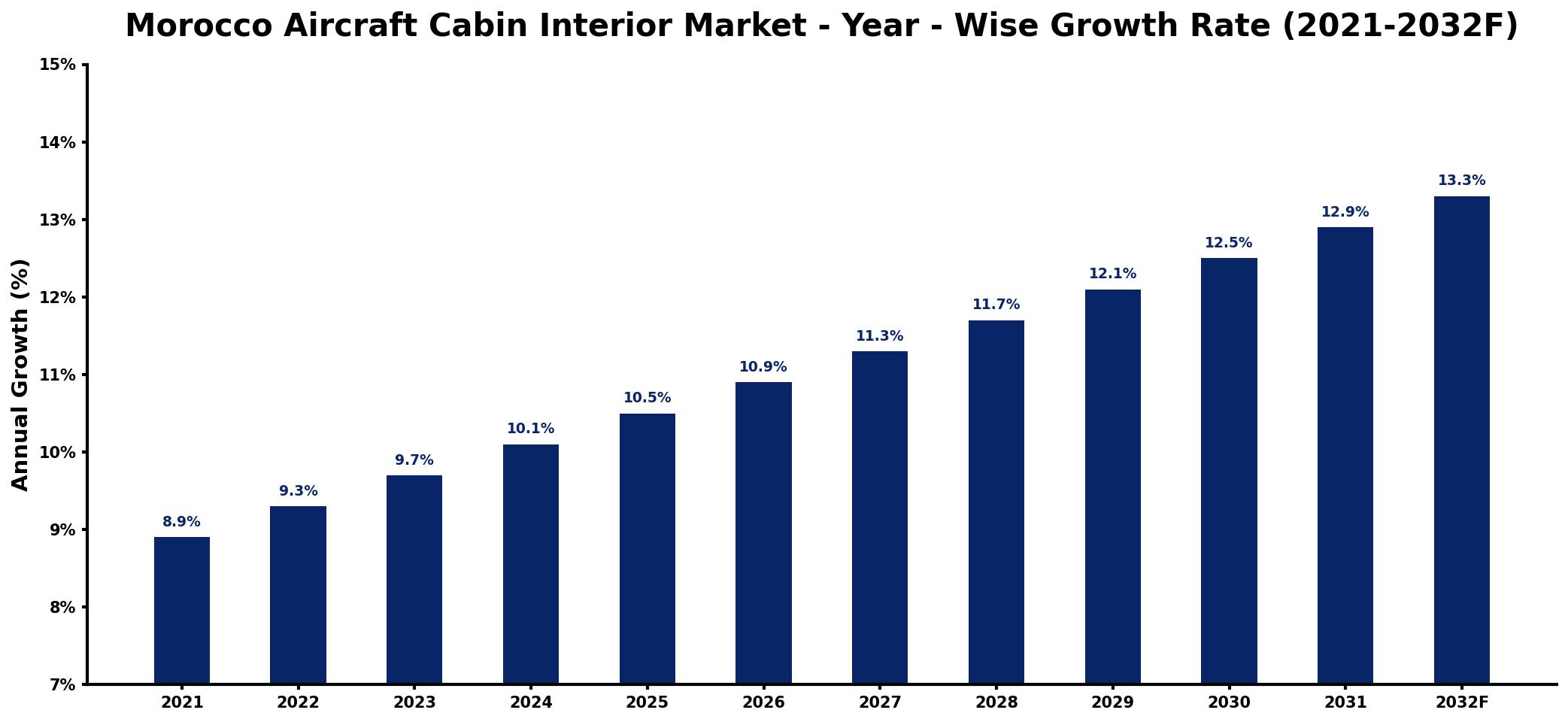
The table below presents the year‑wise growth rates along with the key drivers influencing the market
| Year | Growth Rate | Major Drivers |
| 2021 | 8.9% | Rising tourism boosting travel demand |
| 2022 | 9.3% | Increased investments in aviation sector |
| 2023 | 9.7% | Growing passenger traffic expectations |
| 2024 | 10.1% | Expansion of regional airline networks |
| 2025 | 10.5% | Upgrades in fleet modernization initiatives |
| 2026 | 10.9% | Enhanced passenger experience requirements |
| 2027 | 11.3% | Growing focus on sustainability efforts |
| 2028 | 11.7% | Emerging technologies driving innovations |
| 2029 | 12.1% | Increased regulatory support for aviation |
| 2030 | 12.5% | Rising disposable income among travelers |
| 2031 | 12.9% | Collaborations enhancing industry partnerships |
| 2032 | 13.3% | Expanding global trade and logistics |
Note: Market size estimations and growth projections presented in this report are based on 6Wresearch's proprietary forecasting methodology, utilizing the latest available industry data, government publications, and primary research inputs.
Morocco Aircraft Cabin Interior Market Synopsis
The most compelling force shaping the Morocco Aircraft Cabin Interior Market today is the rising emphasis on passenger comfort. Airlines are not merely upgrading their fleets but are also investing in innovative cabin designs that promise a seamless and enjoyable travel experience for passengers.
In tandem with the growing tourism industry, there is a notable push towards sustainability. This has prompted manufacturers and airlines alike to explore eco-friendly materials and processes that minimize environmental impact while delivering high-quality cabin interiors.
Morocco Aircraft Cabin Interior Market Key Takeaways
- Strong growth driven by increasing demand for aircraft and cabin retrofitting.
- Focus on passenger comfort leads to innovative design and technology adoption.
- Sustainability initiatives are reshaping material choices and manufacturing processes.
- Investment opportunities abound due to expanding airline fleets and tourism.
- Government policies are fostering a favorable environment for market growth.
Evaluation of Restraints in Morocco Aircraft Cabin Interior Market
The Morocco Aircraft Cabin Interior Market faces notable constraints that could impede its full potential. A significant barrier is the limited domestic manufacturing capacity, which necessitates reliance on imports for advanced cabin components. This dependence makes the market vulnerable to fluctuations in raw material prices and currency exchange rates, impacting the cost-effectiveness of local manufacturers. Moreover, the cyclical nature of the aviation sector creates unpredictability in demand, further complicating the landscape for stakeholders aiming to establish a foothold in this evolving market.
Morocco Aircraft Cabin Interior Market Trends
Current trends in the Morocco Aircraft Cabin Interior Market reveal a clear shift towards lightweight and fuel-efficient materials. This transition is largely motivated by the necessity to enhance aircraft performance and reduce operational costs. Furthermore, there is a burgeoning demand for advanced cabin features, such as modern in-flight entertainment systems and mood lighting, that prioritize passenger comfort and safety. Customization is also becoming more prominent, with airlines eager to create unique experiences that differentiate their brands in a competitive market.
Morocco Aircraft Cabin Interior Market Opportunities
Opportunities for growth and investment in the Morocco Aircraft Cabin Interior Market are extensive. As domestic airlines expand their fleets and modernize their aircraft, there is a clear need for high-quality cabin interior solutions, including seating, overhead bins, and in-flight entertainment systems. Additionally, Morocco's strategic geographic location as a bridge between Europe and Africa enhances its appeal for investors looking to penetrate this market. Collaborating with local manufacturers and suppliers can yield tailored solutions that meet the evolving demands of airlines and passengers alike.
Government Initiatives in the Morocco Aircraft Cabin Interior Market
The Moroccan government has enacted a series of initiatives aimed at bolstering the growth of the Aircraft Cabin Interior Market. Financial incentives, including tax breaks and subsidies, are available to attract foreign investments in the aerospace sector. Additionally, vocational training programs have been established to cultivate a skilled workforce capable of meeting the industrys specific labor demands. Strategic partnerships with international aerospace companies further enhance Morocco's capacity for technological advancement, positioning the country as a competitive player in the global landscape.
Future Insights of the Morocco Aircraft Cabin Interior Market
Looking ahead, the Morocco Aircraft Cabin Interior Market is set for promising growth from 2026 to 2032. The increasing demand for air travel, spurred by rising disposable incomes and improved air connectivity, is driving the need for modern cabin interiors. Innovations in lightweight materials and advanced cabin designs will continue to transform this market. As airlines strive to enhance the passenger experience while adhering to sustainability standards, opportunities for growth and innovation will abound.
Morocco Aircraft Cabin Interior Market Latest Developments (2025 - 2026)
The Morocco Aircraft Cabin Interior Market has witnessed several significant developments recently. Innovations in cabin design are increasingly prioritizing passenger experience through improved aesthetics and comfort. Additionally, manufacturers are focusing on the integration of technology, such as enhanced in-flight entertainment options and smart cabin systems. There has also been a notable increase in collaborations between domestic firms and international suppliers, aimed at boosting local production capabilities and enhancing competitiveness.
Morocco Aircraft Cabin Interior Market - Key Attractiveness of the Report
- 10 Years of Market Numbers
- Historical Data Starting from 2022 to 2025
- Base Year: 2025
- Forecast Data until 2032
- Key Performance Indicators Impacting the Market
- Major Upcoming Developments and Projects
Key Highlights of the Report:
- Morocco Aircraft Cabin Interior Market Outlook
- Market Size of Morocco Aircraft Cabin Interior Market, 2025
- Forecast of Morocco Aircraft Cabin Interior Market, 2032
- Historical Data and Forecast of Morocco Aircraft Cabin Interior Revenues & Volume for the Period 2022-2032F
- Morocco Aircraft Cabin Interior Market Trend Evolution
- Morocco Aircraft Cabin Interior Market Drivers and Challenges
- Morocco Aircraft Cabin Interior Price Trends
- Morocco Aircraft Cabin Interior Porter's Five Forces
- Morocco Aircraft Cabin Interior Industry Life Cycle
- Historical Data and Forecast of Morocco Aircraft Cabin Interior Market Revenues & Volume By Type for the Period 2022-2032F
- Historical Data and Forecast of Morocco Aircraft Cabin Interior Market Revenues & Volume By Seats for the Period 2022-2032F
- Historical Data and Forecast of Morocco Aircraft Cabin Interior Market Revenues & Volume By Cabin Lightening for the Period 2022-2032F
- Historical Data and Forecast of Morocco Aircraft Cabin Interior Market Revenues & Volume By Windows and Windshields for the Period 2022-2032F
- Historical Data and Forecast of Morocco Aircraft Cabin Interior Market Revenues & Volume By Galley and Lavatory for the Period 2022-2032F
- Historical Data and Forecast of Morocco Aircraft Cabin Interior Market Revenues & Volume By In-Flight Entertainment & Connectivity for the Period 2022-2032F
- Historical Data and Forecast of Morocco Aircraft Cabin Interior Market Revenues & Volume By Others for the Period 2022-2032F
- Historical Data and Forecast of Morocco Aircraft Cabin Interior Market Revenues & Volume By Class for the Period 2022-2032F
- Historical Data and Forecast of Morocco Aircraft Cabin Interior Market Revenues & Volume By First Class for the Period 2022-2032F
- Historical Data and Forecast of Morocco Aircraft Cabin Interior Market Revenues & Volume By Business Class for the Period 2022-2032F
- Historical Data and Forecast of Morocco Aircraft Cabin Interior Market Revenues & Volume By Premium Economy Class for the Period 2022-2032F
- Historical Data and Forecast of Morocco Aircraft Cabin Interior Market Revenues & Volume By Economy Class for the Period 2022-2032F
- Historical Data and Forecast of Morocco Aircraft Cabin Interior Market Revenues & Volume By Aircraft Type for the Period 2022-2032F
- Historical Data and Forecast of Morocco Aircraft Cabin Interior Market Revenues & Volume By Narrow Body Aircraft for the Period 2022-2032F
- Historical Data and Forecast of Morocco Aircraft Cabin Interior Market Revenues & Volume By Wide-Body Aircraft for the Period 2022-2032F
- Historical Data and Forecast of Morocco Aircraft Cabin Interior Market Revenues & Volume By Business Jets for the Period 2022-2032F
- Historical Data and Forecast of Morocco Aircraft Cabin Interior Market Revenues & Volume By Regional Transport Aircraft for the Period 2022-2032F
- Historical Data and Forecast of Morocco Aircraft Cabin Interior Market Revenues & Volume By End User for the Period 2022-2032F
- Historical Data and Forecast of Morocco Aircraft Cabin Interior Market Revenues & Volume By OEM for the Period 2022-2032F
- Historical Data and Forecast of Morocco Aircraft Cabin Interior Market Revenues & Volume By Aftermarket for the Period 2022-2032F
- Morocco Aircraft Cabin Interior Import Export Trade Statistics
- Market Opportunity Assessment By Type
- Market Opportunity Assessment By Class
- Market Opportunity Assessment By Aircraft Type
- Market Opportunity Assessment By End User
- Morocco Aircraft Cabin Interior Top Companies Market Share
- Morocco Aircraft Cabin Interior Competitive Benchmarking By Technical and Operational Parameters
- Morocco Aircraft Cabin Interior Company Profiles
- Morocco Aircraft Cabin Interior Key Strategic Recommendations






































